(198X) Factbook serialization, part 1
Added 2025-09-12 03:14:52 +0000 UTCI figure a good way of kicking myself in the ass on the factbook is "serializing" it here. Not quite the whole thing, since this is only lore entries and illustrations (the main part, but not the whole, of the book). There will be CIA World Factbook-style raw nerd data on factions and subfactions (population, industry, arms, development, so on), map cutouts and other sundries to accompany these.
You may have seen a couple of these entries before as excerpts. This is the book's entries from the "top down", starting with the Intermarine Federation (specifically, the Federal state of Vansa--among six others). To tempt you into parting with your hard-earned three dollars this will be a free post.
I think I'll stick to chunks of about nine or ten illustrations per post because they go by fairly fast and because that's about as much as fits on one sketchbook page. Therefore future (paid) serial posts will be roughly comparable in size to this one. The speed of their posting will depend on how fast I draw, since the majority of lore-writing (more than 48k words as of posting) is already done.
Lastly, you might see a [CLASSIFIED] here or there. When I'm hung up on an important name, I don't let it stop me writing. These won't be there in the final book. There will likely be some editing differences there too, and some entries I throw in at the last minute (factional sections having a habit of growing on their own!). But I've kept you waiting long enough.
--------------------------------------
THE INTERMARINE FEDERATION.

VANSA - CYDOLAND - SUMPKASSEL - RIESLING - DJEKKER - VYKELAND & DEIRE - EDDELAW
A BRIEF HISTORY OF THE INTERMARIUM
1st Firing (1 F) — The Great Gun is discovered and excavated by the tribes of the Lowlands. It is charged with black powder and fired for the first time, marking the passage of the year.
48 F — The practice of firing the Great Gun on the last day of the year is formalized.
640 F — Rygos annexes the Lowland tribes.
656 F— The “Little Firing”: urban laborer Piet Erp defies plague and war to charge and fire the Great Gun, solely with his own mug of black powder. The sound carries as far as Langport, inspiring the besieged city’s starving defenders.
988 F — Opening of traffic by portal to Proserpina; establishment of human presence on the moon.
1691-1700 F— Secession of the Intermarine Confederacy from Rygos.
1792 F — Fall of Rygos; collapse of portal traffic to Proserpina.
1863 F— Formal Confederate participation in the Ebon Restoration, on behalf of the nascent Regency.
1922-1958 F— The Thirty-Six Years’ War.
1930-1934 F— The Confederate Civil War; colloquially, “The Big Shootout”. National reorganization into the Intermarine Federation.
1934-1942 — The Eight Years’ Armistice.
1958 F — Deployment of the Strategic Defense Initiative.
1965 F — First physical contact re-established with Proserpinan colonials.
1971 F — Inauguration of regular blackwater freight service to Proserpina.
MEMBER STATES OF THE INTERMARIUM
VANSA
OVERVIEW
Vansa—the heart of the Intermarium; economic, political, military, spiritual, anything and everything. First among equals, and the first of the Founding Four states. The Key to the Sea; the Seedcorn of Liberty. Vansans never get tired of self-praise. They’ll say: Even the land here is our work. We pulled it out of the sea, drained it, built everything on it. Sweat of our brows. Great Gun, we’re proud of it. And we’d die before we lost it.
Rayleigh Irving, Federal Intelligence
LANGPORT, CAPITAL OF THE FEDERATION

Vansans think of the rest of us as underdeveloped peasants. Langporters think of the rest of Vansa as a bunch of cavemen. Hard to find a bigger city. Right smack in the middle of Oid; gathering all the goods on the Sea of Lights and shitting its own down river, canal, and railroad to the Sea of Masts. Everything, everyone, and every idea passes through it. You could make a case for it as a vertical slice for the world. You want it? It’s yours. Just gotta find it—and in a mound of centuries like Langport, that’s rarely easy.
If the dikes were ever blasted open, and the sea came in to reclaim its lost bed, all its millions would drown. They laugh about it. Hey, man, it’s not gonna happen. This is the nerve center of Oid, didn’t you know? If someone takes us out, the rest of the world drops dead.
Like it wasn’t tried already.
Rayleigh Irving, Federal Intelligence
THE ASSEMBLY OF THE STATES-GENERAL

...while every Federal state is governed differently, according to their own customs and laws, all are required to provide a delegation of seven Federal Stateholders to serve four-year terms. These men, gathered in the opulent Tulip Houses in Langport, constitute the Assembly of the States-General—the ruling legislature of the Intermarine Federation, itself based on the traditional Vansan model.
Every Federal Stateholder serves a four-year term. Elected by and from their number, two years into every term, is the Stateholder-General: commander-in-chief, first among equals, and formal head of state. A voteless Steward of the Tulip Houses presides over the Assembly and maintains order...
“The Federal Government”, student’s textbook
The Intermarium was never more than the illusion of one nation; not when it defied our Master Brain for the first time, and not now. It began as a treaty for mutual defense and trade by its constituent states; and that is what they still think of it as. No change in name nor standing army can shake that.
Seven states; seven men from each. Forty-nine men: the Federal Stateholders. Forty-nine cigars, pipes and comfortable seats. Forty-nine wheezing executives and rustic idiots. One beleaguered Steward to hold them together—they have started to argue again: is arugula an herb? Damn you, Steward—I call that a matter of policy! And somewhere in the midst—the Stateholder-General is fast asleep!
Giorgio Moceri, University of Baba Gadou
“...that is the problem with the Intermarine system—any fool can become the arbiter of millions of lives. Then, just as he has started to learn left from right, he is out of office. The Lowlanders cannot understand that the head of state must be a professional. Worse, that head cannot hope to work with any patience. Why start a ten-year effort when you know you will not see it through?”
[CLASSIFIED], Regent of the Kingdom of the Ebon Forest
You can visit the Stateholder-General whenever he’s not sitting in at the Tulip Houses. Go right up to his desk—if he’s not seeing one of the throng of petitioners already—and talk shop about your problems. No appointments, no passes. Just wait your turn in line and come back later if he waves the lot of you off.
I first heard about it in school, when I was eight. I was convinced it was bullshit. My old man said you couldn’t get within a kilometer of the Regent in the old country. Just seeing him was something special. That was with a disarmed people, too—one already distrusted for their natural weapons. Here there’s a gun on every hip.
If you think about it, it makes sense. Nobody would shoot the Stateholder-General. The rest of the people sleeping on 11 Arsenal Street’s floor to bother him would tear the assassin into little pieces.
Well. Nobody would do it again, because they did.
Marcel Laurent, Federal Marshal
THE GREAT GUN

Gunbed: too far to hear the waves on the shore; too far from Vansa’s trade arteries. Hot in the summer, and not too windy either. Too dry. Not a very auspicious place for a city, but its population still triples in the week before New Years’ Eve.
There are no skyscrapers around the Great Gun. It’s not because it shatters windows (they’re all reinforced for a reason): it’s to keep the view unobstructed. The whole place is in a valley. You crest the surrounding hills on Interstate 16 and you see it. First the great tube, then the sprawling base. The ages beating down on the burnished steel. A real long-runner. Before our distant ancestors filled the Lowlands, it was there. Waiting for us.
Rayleigh Irving, Federal Intelligence
¹BEFORE the land was the sea. ²The sea was without land; and darkness was over the deep. ³Above the sea was a firmament that held back the stars. ⁴The GUN rose from the waters; and water issued from the mouth of the GUN. ⁵The GUN fired. ⁶Light issued over the sea; and the firmament was pierced. ⁷Then the firmament collapsed and the stars rushed in. ⁸The shot of the GUN was set among the stars, and became the North Star. ⁹The pieces of the solid firmament became the land; and the stars fell on the wet land. ¹⁰The waters brought forth creatures having life...
The Gunbook
On my fourteenth birthday, like any Federal boy, I was given my first sidearm. No more a wooden “jimmy”, a dummy pistol—but the real thing. Proof I could be trusted, and trust myself. Usually, it’s a heirloom gun, one with a few generations on it. You wear it for special occasions; get yourself something more modern for daily carry. My family had no heritage; I was the first of us with any roots in the Intermarium. So I got a new one, an Emerald hammerless in seven-six-five. Cheap, but we didn’t have a lot of money.
My old man’s pockets were squeezed pretty hard that week. As soon as my party was over we packed our bags and took the railshaker to Gunbed. He wanted to raise me right, in the ways of the new country, and that meant a pilgrimage when I was young.
Looking up the staircase to the muzzle, flanked by streams of humanity rolling up and down, my head swam. The smell of long-burnt sulfur and dry iron; the tramp of a thousand feet on the reinforced staircase. Not for the faint of heart. Old people spend the whole year climbing their stairs, slowly, once a day, to get ready for it. A steel mountain, complete with water-hawkers at its foot.
You get your mug. Fill it with black powder, cannon-coarse. Hold it level as you climb. Reach the muzzle—don’t look down; don’t look inside. Men have fallen in, even with the guardrail. The huge circle eats up the light. The smell of burnt powder makes you start breathing through your mouth. Pour your mug in there (don’t throw it in, asshole; the fragments fall downrange). Go on down before the crowd pushes you.
We came pretty late. The Firing, and its celebrations, were at midnight on the same day—the last day of the year. People come a week early; the deeper your mugful sits, the luckier you’ll be that year. First pours to bigwigs and dignitaries. All of the rest of Gunbed exists to fuck tourists and pilgrims out of their money for that one week. The rest of the time the city sits torpid, like the Gun. Waiting for Zero Hour.
The Firing: a yellow column of flame and smoke. You hear it inside you first. A one-second sunrise and a monstrous cloud. There are a pair of enormous hydraulic cylinders on top of the Great Gun. It’s not enough to cycle them.
Marcel Laurent, Federal Marshal
The Shot of the Great Gun’s comin’. I know it. You know it. Never stopped. Nothin’ t’ stop it. One big loop. Broke th’ firmament and it’s comin’ back to Oid n’ it’ll crack it right open. An’ I know the date and the hour. I’ve seen it movin’ in the stars. Done the numbers. You’ll see... You’ll just see...
“Old Man Westerbeek”, Loader’s Row Asylum
The Great Gun is that most priceless thing to the Intermarine spirit--a mechanism suffused with time, with history. That can neither be rushed, bought, or replaced. It is alone in its class. Were it to be lost, the world would be deprived of it forever. In many respects, the Federals attribute life to machines; but here lies the root. “If it could speak...” But it can, and it will, in your dreams.
The Federals are as fiercely protective of their Great Gun as my city's pilgrims are of our Master Brain's shell. It is the one subject that they will brook no humor on.
When Recce Salvatore, Prince of Riksu, found himself on the back foot against the blued-steel fist, he raved. He threatened to send agents to Gunbed, to plant charges on the Gun at a weak point and send it crashing to the ground.
When our princes do business with the Intermarium, they still think of what the blue soldiers did to Salvatore.
Giorgio Moceri, University of Baba Gadou
UNIVERSAL ARMAMENT

A Lowlander custom. Positively ancient, although not explicitly practiced by many of the satellite states anymore—that's what they get for being a little closer to Rygos.
A boy can be trusted with a real pistol when he's 14. By then he should have learned his basics on a wooden jimmy; been slapped a few times for pointing it at someone. Now it's a record of your family history and a mark of your social status. Keeps things polite, too. (Anything goes, mind—I know a few sawn-off guys—but comfort is king and it'll always be pistols for going-out dress.)
Petty Staters just don't get it. I was gabbing with one of our station bosses in an eastern city and he brought up this recent case—totally forgettable shit, a fistfight that ended up clearing leather. Asked me why we tolerate such violence, such social ill.
I say to him: “Tolerate? The dumb son of a bitch chose to draw. You make that leap from your knuckles, you better not come up short, like he did.”
Rayleigh Irving, Federal Intelligence
THE BAYOU

Vansa is a wet country. Now sure, it stretches inland a good long run; and, where it borders Sumpkassel, there’s a fair bit of dry land. But the majority of it is damp, fed by four great rivers flowing from the peaks of the Visgebergte to the Sea of Lights. Much like highways, you see; and, formerly, used as such. Get off on an exit branch and things slow down. When the river starts sidewinding, you’ve hit the bayou.
That was where I grew up. Slow creek; slow days. Winding on just fast enough to keep the place from becoming a bog, but not fast enough to sweep you away. The summers were hot, but under the tree cover it was cool enough. A little refuge.
It’s still the same back there. But a few kilometers over, they’ve drained the marsh and built new houses. People are moving in from the coastal cities.
Staunton Ross, CEO, Johnson Bar Brewery
My old man used to talk about life back in the Ebon Forest. Gaze hierarchies. Layers of meaning in words. You could insult a man enough to make him try and kill you by just looking at him the right way. He called it a corpse in silk. Ugly, rotten core, all wound up in freshening courtesies. Here it's different. People pull their punches when it's polite. But ask them squarely and you'll get it squarely. Blunt as a hammer—they just have to. No other way. And no matter what, they act like they know you.
It was my dad's first month in Vansa. He made some friends at work and one of them figured he'd host the dogface for an evening. Icebreaker stuff. They lounged around on the backyard porch, shot aimlessly into a big dirt berm. Ate junk food and yawned.
My dad knocks back some drinks (and you know how we hold our alcohol). He says: your door's unlocked. You have a car in the driveway, and a full fridge, and your wallet. You hardly know me. What if I robbed or hurt you?
And the guy laughs, and says: hey, my gut tells me you won't. But if you tried, I'd kill you.
Marcel Laurent, Federal Marshal
“...The show concludes; the costumed actors take up a line abreast and bow in turn. The crowd claps and cheers. It has been a good performance, and the fervor of the audience only grows louder. I am lifting my glass to my mouth when the first gun goes off.
I roll out of my chair and crouch, covering my head. My pistol—my pistol! I have not yet drawn it before firing is general in the house. But I am not dead. I realize with dull surprise that the men and women around me are shooting into the ceiling.
Gradually they empty their magazines and remain standing. From the merry faces around me I can tell there is raucous laughter. There is a deafening ringing in my ears. Alone through the tuning-fork whine I can distinctly hear a baby laughing. Someone claps me on the shoulders.
The performers are bowing as if to fall forward into the crowd. My eyes rise off their arched backs and follow the rays of smoke caught in the house lights to the roof. I realize for the first time that the mottled texture of the ceiling is a backstop.”
Giasone Tavani, from “The Budget Assassin”
POLDERS

Once you hit the coast, Vansa becomes one long row of high-rises and urban developments: city lights like a field of fallen stars, twinkling in the dark. Langport might be chief among them, but that doesn’t mean the rest isn’t receiving traffic. Vansans are industrious types. They’ve got a real eye for growth. You run out of space: build up. Your skyscrapers hit their limit: build higher, better, stronger. Your land prices run wild: make more land.
Dikes are a fixture of the Vansan coast. At first they were a defensive measure, combined with the natural sand dunes: keep back the storm surges of half a planet’s open water striking a continental shore. Without them the inland state would become a shallow inland sea. Then they became an offensive weapon. Encircle the sea, then pump your new floodplain out. That’s a polder. Soon it’ll be a new town; then, a city.
Bit by bit the coast has grown over the years. The Fingerbone Islands, stretching over the north and shielding Langport from the worst of the sea, have always been the poldermakers’ dream. One day they’ll pump the whole damned gulf out. Then they’ll build a good town on the new coast, and all the ships will go there instead of Langport, and they’ll be the richest men in the Intermarium.
Not for long. Someone else’ll pump out the sea all the way to the North Pole, and then they’ll be screwed.
Rayleigh Irving, Federal Intelligence
VANSA AND THE SEA

Last time I was in Langport, I took an afternoon off to loaf around on Aanzee Beach. Yeah, yeah, I know—the go-to tourist destination. But the funny thing about it is that it’s not all crowded. There’s beautiful sand, beachside bars, the works; but nobody’s on the rocks. I figured I’d go there. There’s something to be said for discovering new places hiding right underneath familiar ones.
The Sea of Lights swallows up the horizon. Hard to describe; it’s not like any other body of water. Somehow you can sense the depth-of-field: the fact that you’re looking at a hemisphere of open water, save for a few odd little landmasses. Blueside surveys aren’t sure they’ve found the deepest part yet. Not for lack of trying; fifteen kilometers is a lot of cable to carry.
I hung around for a while. In the distance, a ship climbed over the horizon; emerging from the water funnel-first, then then pilothouse, like a mammoth submarine tanker surfacing after a long south-polar transit. The ship was a heavy-duty containerman of the Witkop Line, en route to its berthing in Loader’s Row. One of countless such ships—the Federal merchant-marine is the biggest in the world. No wonder; you look long enough over these shores and the sea calls to you. There’s not a sea on Oid that hasn’t beckoned ships flying the Polestar Rag.
Sometimes I regret my line of work.
Rayleigh Irving, Federal Intelligence
SHIP SQUIDS

They're smart enough to understand working for food and squishy enough to get into the tiniest crevices. No blue-water ship's company is complete without one for each watch.
It used to be that they'd come up over the sides and steal things: pots, pans, anything metal, anything that needed fire to make. You couldn't keep them out and they wouldn't stick around. The secret turned out to be the bottle. They can't get enough of the stuff.
Rayleigh Irving, Federal Intelligence
THE STATES-NAVY

The Senior Service. If you’re unsure on whether Army or Navy’s your style, stick an iron rod up your ass. If you feel like keeping it in, go Navy.
The States-Navy is a completely different world. They remember what wooden ships were like and act like they’re still on them from the instant you sign. There are two times in a man’s life where the state has the power to disarm him: when he goes to prison, and when he reports to a naval recruit camp. They won’t trust landsmen with the slightest thing; not until they’ve been born again on a rolling deck. You show them an Army training company, where everyone still has their personal sidearms, and their heads fall off. (Swings and roundabouts. When you sign a Navy contract, you’re in for it. None of this gone-next-day business when the going gets too tough.)
Army-Navy cooperation is always hilarious to watch, even if they do deliver results. Last case I saw with my own eyes was a couple staff officers meandering down the post road—a sub-colonel and a captain, second rank. Along comes an Army ranker with a dirty chevron on his sleeve and a can of Sweet Riesling Blueberry dangling from his fingers. He slops his open palm to his hat and goes “howdy, boss”.
The Navy guy blows up—stop, damn you, click your heels when I’m talking to you, who’s your sergeant-major—sub-colonel, why are you laughing? How can you rely on a slapdash man like this? Hasn’t he any respect for your service?
His Army friend nods and says “I’ll have it taken care of, captain”. And he fixes the frozen ranker with the signature States-Army look: stern and commanding from the sides; from the front, “get a fucking load of this guy!”
Rayleigh Irving, Federal Intelligence
Let the Army slop through their job; leave their own manuals unread; their horizon-blue tunics soft and well-worn and thrown on whether on parade or into combat. It works for them. Their job is on dry land; nothing can rob a landsman of the surety of the earth beneath him, though he might have nothing else to hold onto. And if they tire of an unmanageable man they can simply drum him out and sign on another.
A ship at sea is the world; a tenuous world, at that, one kept firm and real and its inhabitants alive only by their continued effort. One merely needs to look down on their first cruise, past the rising white cliff of the hull to the deep ocean water below, to know their first and most bitter enemy. A warship lives or dies, together with its ship’s company, only by the excellence and good order of its men.
The junior services may laugh all they’d like. The Federation will continue on flexing its naval muscles whenever it needs to project power. Oid’s waves are blue and white because the States-Navy rules them.
Jop Stobbelaar, Rear Admiral, Outer Fleet Staff
The Navy is a different world from the landsman's, but it's not one thing, either. The big division is this: Inner or Outer Fleet?
Inner Fleet men ride flattops, gun and missile cruisers, little hotshot destroyers. They're called the “coastal club” by the Outer Fleet, because the waters aren't so bad. The weather could be better though—aircraft buzzing around at all hours, with a high chance of shorebound missiles in the afternoon. You stand solid odds of getting rescued, at least.
The Outer Fleet is where the big boys play. There, the first enemy is the water. Vertical dark-green walls, hammer blows on bent decks. Carrier ops are right out. Satellites can warn you about the storms, but you’re just ducking one right into another. This is the realm of the big-gun ships, the famous BBNs, prowling like lions in the thrashing waves. Looking for something to plug with their guided sabots. It's slim pickings out there. Just you go face twenty-inch guns like theirs! Even still, they remain the most prestigious force in the Navy.
Ask the submarine arm and they’ll tell you that the distinction isn't important. Everyone riding a “bathtub” on the surface is just a target. It takes balls for the half of them driving old tin-can diesel boats to say that. But who else do we task with the fun jobs?
Rayleigh Irving, Federal Intelligence
Comments
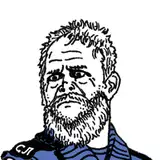
Thanks, man. That'll be a fun section to illustrate. Every faction gets its own style (lupes doing an ink-dipped clawtip for their traditional writing, i.e. I'll be working with a dip pen; Ray Irving's doodles based on some Soviet border guard mag drawings).
Rifle Infantry
2025-09-14 17:53:03 +0000 UTCThe mix of man on the ground troop level perspective from various characters mixed with pseudo-historical vignettes you write for these and often the unit splash text genuinely floors me sometimes, dude Nothing grounds the world better than stuff like this and i really do feel you've nailed it: I'm looking forward to the dogface book to see just how much absinthe it takes to kill the pain of a state-issued concrete kennel
Sweatwater
2025-09-13 16:55:08 +0000 UTCSome of the best three dollars I have ever spent
Lo
2025-09-13 13:20:22 +0000 UTC