It's been a damnably long couple of weeks since last I posted- to say they've been rather difficult is an understatement. I apologize for the radio silence; this week I'll be catching up with a very, very long post.
The Order of Saint Roisin, or the "Black Fangs", are one of my personal favorite designs in Firelock. If you follow me on Twitter you've doubtlessly seen them before:
 A lot of people who enjoy my work seem to agree in the above assessment. I mean, it's a design that goes hard: a fucked-up, hairless werewolf wrapped in blackened and gilded plate, with flensing steel claws. But they didn't spring up ex nihilo, and a lot of the design took a while to finalize since they came together sometime in 2020. In this post we'll be tracing the evolution (or, perhaps, mutation) of the design- and, in part, the setting as a whole.
This will naturally be a little incomplete- I'm reconstructing this from the records (a slop-folder full of raw sketchbook scans) over five years. Even while writing this article I've come across a few pieces I didn't at first remember making. Kindly bear with me.
1. 2020 - EARLY CONCEPTS & FALSE STARTS

The Black Fangs hail from Santagria- a human nation patterned after medieval and early modern Iberia in culture and aesthetic spirit. At the time, I was just starting to work on the Santagrines. I wasn't really sure what they would be like or what they'd get up to; but I knew it'd be something in the vein of Alatriste, Don Quixote, and Bernal Diaz's conquistador accounts.
Naturally, that meant that they would be a rough, sunburnt, and hot-blooded people; concerned with blood and the sword, and ready to risk lives far overseas for spiritual or material riches alike (preferably both). At first, I wanted to invent some equivalent to the Aztecs- jungle elves, or jaguar-men, perhaps- but instead I turned toward the idea of a desert power of equal strength as their adversary. It felt more appropriate for the medieval influences I wanted to convey for their foes to be less Montezuma and more Saladin.
But what would those armies look like? I had only vague imagery in my head. My usual remedy to that is to get to drawing and see what comes out. The above piece was the result.
Somewhere while drawing it, I had doubtlessly thought of the idea of imperial auxiliaries on both sides: men, or beasts calling themselves men, from the hinterlands of civilization. The Santagrines received a lupar; and to "Santagrinize" him, I wrapped him in full plate and gave him a big sword.
You'll also notice a hawk-man on the right. Firelock used to be full of different beast-races; these would be Egyptoidal cliff-dwellers fond of glide-archery. Over time I developed a sense for what factions and races I found promising, and worth further exploration, and which ones I didn't. The hawks didn't make the cut, alongside centaurs, trolls, dwarves, orcs, and so on.
You may see elements of them recycled into the modern Firelock factions. There's a reason, for instance, that Confederates (and later, Federals) are all bearded and mustachioed, blunt and trustworthy, and possessed of great wealth and machines of industry. If I like parts of a concept, but not the whole thing, I'll cut the good out of it and discard the bad.

Immediately I felt there was potential to the concept; but I wasn't satisfied with the design. All I had really done was crudely encrust a dogface with steel; the helmet looked like something out of Warhammer 40k, with steel teeth and imitation brows and all that. I started to study the way suits of plate actually went together. I didn't want them to just ride on rule-of-cool; I felt that even if the design brief was a bit ridiculous (Renaissance-esque full plate on a 17th century battlefield) I should try my best to make it work. Rule-of-cool is great, but I didn't want it to cover for a bad design.
The first iteration, above, was better as far as functionality went. It wasn't satisfying, though, and I couldn't then put my finger on what was wrong. In retrospect, I think it was the morphology. Compare and contrast with the image at the top of this article: the lanky, reaching monstrousness just wasn't there. I had something that looked like a plate armor enthusiast's fursona: a wolf-head and legs stuck to a human body.
Nonetheless, some of the basic design elements stuck here. The steel claws appear for the first time, as well as the large feather plumes.

At this time, my thoughts turned back to how they'd actually be used in combat. Obviously they felt like an elite unit: how many musketeers could you field for the cost of a werewolf knight with steel skin? I explored the idea of them countering the elites of the yet-unnamed enemy (who would become the Devlet); so, that meant elephants or mammoths.* The steel claws, at this point, became as much utility as terror weapons; with them the Black Fang could climb the sides of the beast to attack the men stationed on top of it.
At this point they still hadn't become hairless, and I hadn't fully settled on their armor being black (their naming would come later).
*The line-of-sight thing would be to do this with pikes; after all, the Santagrine inspirations involve the perfect culture and timeframe for it. But by now I didn't want to abandon the concept.


Thanks to my buddy Kab for the colorization. I have no idea why these are dated to 2019 when I know for a fact I first posted this piece in 2020 (the day I made it).
My first instinct to make the lupar (for Black Fangs are dogfaces, and thus changing their basic anatomy meant changing that of the race) more monstrous was to make them bulkier, more imposing. That also wasn't satisfactory. Again, it was "sanitized": conveying power and danger, but not inhumanity.
I include the colorized piece because it set their subsequent palette. Beforehands, I had thought of them as black and silver, not gold. (Kab may have been thinking something Egyptian here; there's something Anubian to the design if you squint, after all.) Green, red, and white felt gut-correct; it's a rather Portuguese scheme, but then I like to include pan-Iberian elements to the Santagrines. Portugal has a history just as rich and inspiring as Spain, I feel, and their seafarer's exploits provide a similar basis for me.

At the end of the month I started to explore practical design work for them. I quickly established a few rules:
They had to be completely enclosed. I was immediately unsatisfied with the half-helm; already I was starting to feel that they should be "less than human" while under armor, and an exposed face detracted from that.
Any contact with armor, especially chainmail at the joints, had to include padding. Imagine your arm or leg hair snagging, then extend it to a wolf-pelt. Ouch.
The idea of what amounted to racehorse coifs still persists to this day in Firelock 198X: it's what all lupar troops wear under their helmet.
There was still great trial and error. On the right, I messed with the idea of a "white wolf", in polished rather than blackened armor. I guess it just didn't feel right. My favorite armor from this period is the devil-horned, earless, "eyeless" bascinet. It appeared again in another piece around that time:

At this point, I conceived of the Black Fangs as still essentially a "real" knightly order, instead of a bunch of psychologically-conditioned attack dogs under the impression of their knighthood. They would not tolerate battlefield cannibalism or berserking, as it would endanger their human masters.
Black Fangs in the bascinet would be locked into it: the helmet could only be removed with an exterior key. It'd essentially be an elaborate muzzle and sense-duller. Without earholes, and with burning incense or some other scentmaker hanging from their nose, they would be severely disadvantaged if they tried to attack their own. If they could not be reconditioned, they would be sent into battle with a chunk of bloody meat hanging from their nose instead, and simply "disposed of" into the enemy ranks.
Little of this concept has survived since then. The Fangs as a whole have become more rigorously controllable and psychologically conditioned; brutal, horrific butchery is also more of an intended function than a mask-slipping moment now. The bascinet informs a lot of helmet design for them now, though.

The captain mulled over his bookshelf and withdrew a tome he'd been meaning to read. His bed was not quite in order but he didn't intend to sleep. Lately he had trouble getting any before midnight. Better to use those sleepless hours for something beneficial, at least.
The black armor customarily glowered from its stand. It could not speak, hollow as it was, but the light caught its empty eye-sockets and gave it a sort of animation nonetheless. The captain felt compelled to respond to the unspoken accusation.
"It is but a passing fancy," he rumbled under his breath. "Trouble me no more. I will attend to you in the morning as I always do."
And so the black and gold stayed silent, waiting to be whole again.
----------
Around the same time I was experimenting with how they'd live at home, and how they'd think. The above lore entry dates to around the same time. I wasn't as good at writing back then as I am now.
This one-eyed character- you've seen him a few times now, as a go-to example Black Fang- could have a comfortable little cell. The layout is a little ridiculous, but then such are many exploratory pieces. The bed is square; I think that it's funny to imagine lupar wanting to curl up like dogs when sleeping instead of laying flat.
I liked the idea that the Black Fangs might be very different in and out of the armor: either a total nightmare, or a substantially more cultured and noble creature than the average forest dogface. That idea became increasingly important for the lupar as a whole over time- monkish self-discipline, culture, and stories to hold back their bestial impulses.

I would be remiss if I didn't mention this wonderful piece by my very close friend and confidante, hunger. It was part of an art trade at the end of the year, and would go on to inform a lot of the Black Fangs' later aesthetics. I'm deeply honored whenever someone else draws my designs; after all, my mission as an artist is to inspire, to fire your creativity.
2. 2021 - PUTTING THINGS TOGETHER
 Continued dissatisfaction with lupar anatomy led me to generally redesign them. Now they were wider-set, with broad chests and sunken waists like dogs; their arms and legs were longer; and most importantly their head was forward-set on a canine neck, slouching to shoulder-level. I felt that this silhouette was much more intimidating and monstrous than the previous more-or-less-upright one. With some tweaks* it's still how I draw them today.
The steel claws grew increasingly long and terrible. Instead of just being backup weapons to a sword or halberd, they now became primary weapons in and of themselves. The wearer would not be able to make a fist with them on.
Some slight improvements to the armor took place. The pauldrons were redesigned to take after later suits of armor. Because Firelock is, at base, a late 17th-century setting, I figured that plate armor had already reached its apex in terms of complexity and development. Maybe it was no longer greatly used, but the understanding of how to make it had advanced more or less to its final point.
You might notice how washed out the highlights on the armor are. That's because they're not negative space, like usual: I was using some kind of white-out over flat black for this one. That was an experiment that I didn't come back to; the starkness of unfilled paper felt better.
*This guy is still very bulky by the standards of how I now draw lupar. Wolves are big and strong, but they're also lean animals. While Black Fangs would likely be some of the best-fed and most physically fit of their kind, I still wanted to avoid giving them bodybuilder physiques: that felt too human, detracting from the slightly "starved-skinwalker" look.

It was in that year that I figured I'd do a little four-page comic. I wanted to explore the war between the Santagrines and Devleti, portray some action, and refine the Black Fangs' design through action. It wouldn't take more than a few weeks, I thought, and it was to be a simple-enough comic (without any dialogue!) that I needn't plan it in advance beyond the broad strokes.
I finished it on Christmas Day- twenty pages later. Well, the best-laid schemes of mice and men, and so on.
Attached to this article at the bottom is the full .pdf of How The Black Dog Lost His Eye. It's certainly not up to the standard of my work now; it's a bit rushed at the end; and many design elements are now rather outdated. But it holds a special place in my heart as the first real piece of longform Firelock work.
I'm not sure what the idea was with that weird borzoi-oid on the left, with the mismatched eyes. I think I was experimenting with more overt deformity for lupar; but it didn't sit right. There was a lot of back-and-forth on precisely how monstrous they should be before I settled on a roughly satisfactory spot.
One of the lasting things from the comic was their hairlessness. Lupar in Firelock are vulnerable to silver. Just touching it, in quantity, causes their wolf-parts (that is, most of their flesh and parts of the skeleton) to decay and slough off. A silver bullet will rot a lupar alive in minutes unless he digs it out. The symptoms are roughly comparable to acute radiation syndrome, but on a shorter timeframe. A small quantity of silver- a tiny powdering, carefully applied- will cause their pelts to permanently fall out, revealing the pale humanlike skin underneath.
This process is undergone by the Black Fangs for two reasons. Materially, it's useful for lupes who must fight in plate armor, often under a hot sun: without fur they won't cook as fast or snag on anything inside. Spiritually, it helps them become closer to the humans they wish to be.
3. 2022 AND BEYOND - INCREMENTAL TWEAKS
For a long time after How The Black Dog Lost His Eye, I didn't touch the Black Fangs. My attention generally leaned towards other parts of the setting.
In late 2022 I began thinking of another battlefield for the Santagrines- like any artist, I've got a small mountain of concepts and projects on the records. This one would be on a sunny Hellenic island; this time, the Santagrines and Devlet would battle as enemies and "allies" of local minotaurs ("bukoloi"), respectively. The premise was to be used as an excuse to make Osprey-esque plates of two or three figures apiece for all three armies. I got through a few of them, but then shipped off to boot and left the project hanging. I still haven't gotten back to it.

These are some rather sober, Swiss-like Santagrines; one's got a very outdated matchlock arquebus. I think it was a mistake to reduce their armament that much, although I still think of the Santagrines as heavier on pikes and cold weapons than firearms, and fond of slung carbines rather than long muskets.


The Devlet were now more of a cosmopolitan power: taking increasingly more after Turks and Indians than the generic Middle Easterners they had been before. They would field auxiliaries from client states and peoples: riflemen from Indian hills, cutthroats from the steppe, and anachronistic professional spearmen from the south.
While I never got to their plate, I did begin thinking about the Black Fangs again. In How The Black Dog Lost His Eye, I'd hit on the idea of them functioning as interceptors to enemy heavy-hitters, operating in small numbers in protection of the common Santagrine soldiers forming the bulk of the army. Their speed and toughness would fit them well here.

Here I hit on the concept- derived from hunger's piece above- of decorating their armor. I returned to the old rondel-based pauldrons because I felt they would make more sense on broad lupar shoulders; the range of motion wouldn't be so impaired. It also simply looked cooler.
They received raptor-claws on their feet around this time. Since the role of a Black Fang with steel claws would be as a sort of living blender- something that would protect twenty musketeers by dismembering the twenty charging men approaching them- every extremity would become a weapon. They could now emu-kick someone to spill his guts out, or gain better purchase when climbing.

Another thing I wanted to play with was the idea of covering the armor with cloth, like a tabard, as well as playing with different weapon loadouts. The steel claws would remain "standard", but greatswords, polearms, and other setups might also see use as need be. Black Fangs are big investments, so it stands that they shouldn't be totally devoted to a single tactical role. The gauntlets would retain a single raptor-claw as a backup.
The long Egyptian chin-extension, with the little tuft, is something of a call-back to the sentiments I discussed regarding Kab's color work.

The surf was warm on the lancepesade's bare calves. He listened to the foam as it scraped over the thousandfold tiny shells that lined the island shore. He thought of the small wriggling creatures that once occupied them, how they swarmed and multiplied and died. How many lay in this little ossuary? He did not feel them crunching underfoot for the ache of a long hill-march had consumed all sensation south of his ankles.
"I don't get it, sir." The lancepesade looked up. An arquebusier, one of the ten men under his command, leaned at the waterside with his firearm for a walking stick. "How can--" he lowered his voice-- "you not be frightened of the thing?"
With every lance in the hills there was assigned a knight of the Order of Saint Roisin; theirs stood watch on the hill as the lance rested beneath. It was a pale and hairless thing beaten into the shape of a wolf and encased in a steel carapace whose over-long limbs ended in bladed digits. The beast was the charge of the lancepesade and he carried a hooked man-catcher about the haft of which the surf churned. He looked up at the creature on the hill and cleared his throat.
The Roisinite slewed about gracefully and clicked down the hill, through the gravel. The gunner on the beach caught his breath. He looked to the lancepesade and back at the armored figure, took a step back. It closed the distance and short-stopped. Its armor was articulated well and the padded joints hissed as they slid over one another. It stared at the lancepesade, turned its head to the arquebusier. A falconet-shot settled in his throat.
"Becerrillo," said the lancepesade, "open your mouth." The beast obeyed.
The lancepesade stepped to its side. The Roisinite's head didn't follow him. The lancepesade stood on his toes and balled his fist. He stuck it between the monster's fangs without ceremony. The arquebusier gasped. Three seconds passed and the lancepesade withdrew his hand- a little faster. He breathed in and out and began to laugh- a heavy, throaty laugh that swept up the astonished gunner in it.
"I would trust him with a baby. He's as well-trained as they come, friend!"
The fangs snapped shut and the laughter stopped. The lancepesade's eyebrows twitched.
"Ah- thank you, Becerrillo. As you were."
The limbs and body of the Roisinite turned first; the head lingered for a second longer. The gunner locked eyes with it. They had the shape of wolves' eyes but the brows were those of a man. Where ink or scars did not conceal it, there were the wrinkles and crow's-feet of a spent old laborer's face. Then it was gone, and the steel silhouette went slinking up the hill.
----------
Another study into how the Black Fangs might be armed, deployed, and how they might behave. I mentioned right at the start that they're technically the Order of Saint Roisin- but I figure nobody calls them that in-setting save for very formal occasions. (Exactly who Roisin is, or why she's important to lupar, is a story I'll tell later; I'm a beginner at longform epic poetry.)
This Fang is armed with a pistol (with a mace-end, of course) and a claw-gauntlet with a shield worked into it. He would open a fight with a shot, turn the pistol about, and enter the fray with both a blunt weapon, a shield, and claws ready.
His helmet is horned and includes a sun-disk; these are bukoloi images. I imagine that the Santagrines would take visual elements from defeated peoples; as the Black Fangs are janissaries of sorts, it'd be appropriate to give them these powerful symbols conquered from the foe to enhance their own strength.
The helmet itself is anonymous, with no face. This is something I've included more and more of in newer pieces; I want to reinforce the idea that so long as they are under armor, there is nothing there- an extremely strong psychological conditioning.
All of that leads us back to the start. Here are some WIP shots of the first poster:

The bare anatomy: power, but also inhuman lankiness. The face shouldn't be canine, but a human head warped into the rough shape of a wolf. The nails are trimmed; the armor's claws are the true ones.

The plate. You'll notice that I've thickened his neck somewhat- introduced a bit of a warhorse look to it. As before, I'm reluctant to overly bulk lupar for fear of losing their overall silhouette; so, to portray a powerful specimen, I focus more on the neck and chest than the limbs. I try to retain the "wasp-waist" look, since it reminds me of dogs like bloodhounds and is generally disturbing in and of itself. Only after the picture was taken did I end up fixing the thumb on his hanging gauntlet- I think I was drawing sometime after midnight and it missed me for a while.
 Inked and scanned- contemplating which of his two faces is the real one.
Here's another attachment: a short story (2.5k words - silhouette.pdf) I wrote at around the same time. It's another exploratory piece; a grim little yarn aping Cormac McCarthy's style in Blood Meridian.
4. THE FUTURE - FIRELOCK 198X
The lineage of this misbegotten order runs long. Their first progenitors were taken from the forest, skinned with armor and given long steel claws, for use as terror-troops in the Overseas holdings. Formally, they were (and are) the Order of Saint Roisin; but I doubt even their masters, to whose wall-burnt shadows they now cry out to in the night, ever called them that.
They live in a fantasy, these monsters, hairless, pale brutes sprinkled with fine silver dust. That’s fine; a good, fiery delusion is the right of any Santagrine. But it must be his own choice to get lost in it.
The Black Fangs have been beaten in mind and body since the day they were whelped, and now they can’t help but believe it—that knighthood is obedience, and that virtue lies in killing savagely on command, stopping suddenly when bidden—losing themselves in their task. Perhaps they would like to forget about themselves. An animated suit scarcely needs introspection, after all.
- Brother Torres
----------
If it wasn't already obvious, that's their lore entry in the Santagrine army book for Firelock 198X. My next challenge with them is seeing how they've changed in the timespan between fantasy Firelock and 198X.
The basic idea is that they have become werewolf ronin of sorts; their masters and controllers are dead, and now they wander around, searching for any sign of them. In the Santagrine roster, they remain elite troops; now, though, they're more akin to Schwarzenegger in Commando than the knightmares that are their fantasy predecessors.
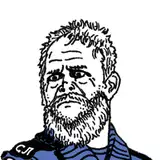
I've yet to draw them in any detail- all I have is the MS Paint placeholder token we use for Tabletop Simulator runs of 198X:

Armed to the teeth, with weapons stripped from a helicopter gunship, and dressed for the nuclear battlefield. I'm looking forward to giving them a proper treatment in ink.