Among the ruins of the Roman town of Herculaneum which was buried after the eruption of Mt. Vesuvius in 79CE are two well-preserved frescos depicting several aithiopian priests as central figures in a ceremony dedicated to the Egyptian goddess Isis.
Across the Mediterranean and up the Nile to the southernmost border of Rome was the city of Philae, where numerous inscriptions and relief scenes indicate the presence of Nubians as priests in Isiac ceremonies and temple administration.
The appearance of Nubians/Aithiopians as important religious figures in these two Roman settlements separated by vast distances, illustrates the dynamic nature of the diasporic communities of Africans across the ancient world that has been overlooked in the historiography of the continent.
The rapid spread of Isiac centres across the Roman empire resulted in what is arguably the earliest and most widely attested establishment of African religious practices across the ancient Mediterranean world, whose popularity enabled it to last more than three centuries after the rise of Christianity.
This Patreon article explores the history of Nubian priests of Isis in the Roman world, focusing on their activities in the towns of Philae and Herculaneum.

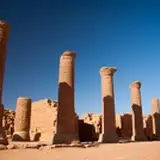
1st-century Painting from Herculaneum, Italy, depicting an Isis ceremony with aithiopian priests, and the Isis temple at Philae in Lower Nubia, Egypt.
Background on the history of Isis in the kingdom of Kush.
At the time of the Roman conquest of Egypt in 30 BC, the worship of the goddess Isis in the kingdom of Kush had been established for centuries.

Map of Roman-Egypt and Merotic Kush, showing the border town of Philae.
Isis was first attested in Lower Nubia (currently under Lake Aswan) and Upper Nubia (ie: Kush) during the occupation of the region in the New kingdom, when the worship of her as “Mistress of Nubia” highlighted her fixed tie with Kush. In a Theban magico-medical spell from the 19th Dynasty, the goddess Isis announced herself: “I am the Nhsy (Kushite/Aithiopian) descended from heaven” The Egyptian intent in terming Isis a Nhsy may have been symbolic, but it certainly inspired their Kushite coreligionists to identify Isis as one of their own.
(Isis in Kush pg 97, The Invention of Aithiopian Antecedence pg 168-169)

coffin fragment (Late Period, Dynasties 26-31 c. 664-332 B.C.E.) showing the goddess Isis in mourning. Brooklyn Museum
Such circumstances would have encouraged the elites of Kush to conceptualize in their own terms the deities named in Egyptian texts as part of a shared religious heritage, and thus legitimize their conquest of Egypt in the 8th century BC by the Napatan rulers of Kush.
The Napatan rulers spread the worship of Isis across Kush, and their royal inscriptions indicate the Kushite worship of the Osirian triad (Osiras the husband, Isis the wife and Horus the son). The Kushite rulers strengthened the connection of Isis, whom they referred to as “Mother of the God” and “Mistress of Nubia” with her son Horus, especially in divine legitimation of the king, through the association of her and her son Horus with the Queen Mother and the king. This is best attested in the numerous depictions of Isis suckling Horus and Napatan queens, [this imagery partially inspired Christian depictions of the Virgin Mary and infant Christ, albeit indirectly]
(Isis in Kush pg 98-100)

Amulet showing seated Isis suckling her son Horus. Napatan period, 25th Dynasty Findspot: Sudan, Meroe. Amulet of Isis nursing the infant Horus Nubian Meroitic Period Findspot: Sudan, Meroe. Boston Museum

Shrine-shaped pectoral depicting Osiris seated between Isis and Horus, Nubian Napatan Period, reign of Piankhy (Piye)743–712 B.C. Findspot: Nubia (Sudan), el-Kurru, Ku 51 (tomb of a queen of Pianky), Winged Isis pectoral, Nubian Napatan Period, reign of Amaninatakelebte538–519 B.C. Findspot: Sudan (Nubia), Nuri, Pyramid 10. Boston Museum.

Closeup of a Stele of King Aspelta depicting the king offering to Osiris attended by Isis and Anubis. Napatan Period, reign of Aspelta 593–568 B.C.Findspot: Sudan, Nubia, Nuri, Pyramid 8. Boston Museum.
The occurrence of royal women in the coronation and cult scenes was a very recurrent theme of the Napatan period. The mother, wife and sisters of the Nubian king held in this occasion a greater role than their Egyptian counterparts, and they were often entrusted with ritual duties that were only made by men in the Pharaonic kingdom. Depictions showed king’s female relatives accompanying the king, playing the sistrum (generally associated with Isis and Hathor) as preliminary activity to the ritual. They communicated directly with the gods and, in their identification as Isis, could mediate between people, king and deities.
(Isis in Kush pg 100-101)
The worship of Isis continued during the Meroitic period (270BC-360CE), and was greatly expanded through the construction of temples dedicated to the goddess, not just in the capital Meroe where there are also numerous offering tables dedicated to Isis and Osiris, but also as far north as Philae, which during this period was contested between Kush and Ptolemaic Egypt.
The Isis temple at Philae was initially constructed by the last native ruler of Egypt Nectanebo II (358–340 BC) and his successors, the Greek Ptolemaic dynasty. It was later expanded by the Meroitic Kings Arkamani (270-260BC) and Adikhalamani, before the region was retaken by the Ptolemies in 186 BC, and established as the border between Egypt and Kush continuing into the Roman period.
(Calling out to Isis pg 39-50, Between Two Worlds pg 386-400, 420-430)

Isis temple chambers, Meroe, University of Liverpool.

stela discovered at the Isis temple of Meroe, depicting King Teriteqas before the goddess Isis. University of liverpool. Stele of Prince Tedeken offering to an enthroned Osiris with Isis standing next to him, Meroitic Period200–100 B.C.Findspot: Sudan, Nubia, Meroe, Beg W, pyramid 19. Boston Museum.

The temples of Dakka and Dabod built by Kushite Kings; Arqamani and Adikhalamani during Meroe’s two-decade long control of the Triakontaschoinos (207-186 BC)

entryway to the temple of Isis at Philae, which was built by the pharaoh Ptolemy II beginning around 260 B.C. Reliefs on this pylon depict the pharaoh Ptolemy XII smiting his enemies and preparing to sacrifice them to the gods Isis, Horus, and Hathor.
The Isiac centre of Philae
The Isis temple at Philae was oriented south with respect to the Nubian origin of the annual Nile inundation, which is also alluded by ritual objects, such as a fine terracotta statuette representing a female Nubian priestess of Isis of Philae, depicted in a kneeling position while performing a Greek-type mortuary wine libation.

This statuette was likely made in Alexandria during the 2nd century BC. According to the Nubiologist Laszlo Torok, it perfectly combines three cultural aspects; Nubian, Egyptian and Greek:
"The Nubian ethnotype was united with the Hellenized cult of Isis, one of the most generally revered ancient Egyptian deities, and associated with Philae, a “national” sanctuary which was developed since the Twenty-Sixth Dynasty... The Nubian figure also alluded to the Nubian origin of the annual Nile inundation."
(Hellenizing art in ancient Nubia pg 58-59)
The Isis temple at Philae therefore acquired a central role in the geopolitical context of the Lower Nubian region, as the main theatre of diplomatic relations between the rulers of Egypt – Ptolemies before and Romans later – and the Meroitic kingdom to the south. Several graffiti on the temple, in Hieroglyphic, Demotic, Greek and cursive Meroitic writings, represent the most direct evidence of the great flow of pilgrims to Philae from Egypt and Nubia that included elites such as Kings, diplomats, priests, and commoners, such as ordinary worshippers.
The longest graffito at Philae (and indeed in Egypt) was left by Sasan, son of Paese in 253 CE, while on a diplomatic mission to Rome, and in it he recounts his different works for Isis.

A 26-line inscription (above left) on the Gate of Hadrian records the Nubian envoy Sasan’s participation in rites held on the island in A.D. 253. A figure (above right) near the inscription may be intended to represent Sasan. Image by Solange Ashby
Inter alia, he was ordered to convey money (10 talents) to the temple and the priests of Isis and did so effectively. Furthermore, the king of Kush ordered him to go to Philae together with the king's son and the qeren-priests of Isis so that they should perform the festivals and banquets in the temple of Isis. He himself together with his company made contributions for golden cultic vessels as well as to the expenses of the festival. Finally, he directly invokes Isis, prays for success in his diplomatic mission to Rome (which seems also to involve matters of direct concern for the cult of Isis) and a safe return to Meroe.
(Isis in Kush pg 102-103, The Demotic Proskynema of a Meroite envoy pg 67-103)
The presence of Meroitic envoys to Philae is best attested by the “Meroitic chamber” in the forecourt of the Isis temple, depicting an embassy dated around the mid-third century CE, likely under Nubian king Laẖidamani. Two processions of six Meroitic officials, flanked by inscriptions in Meroitic cursive script, are depicted along the walls of the room, paying homage to Isis, offer letters and gifts of the king to the goddess, and making sacrifices.
(Isis in Kush pg 103-105)

Two Aithiopians of the “Meroitic Delegation” depicted in the Temple of Isis at Philae
Meroitic royal emissaries to Philae served a dual role; as civil administrators in Meroitic Nubia who collected the revenues necessary to provide the “one-tenth” of the produce that was due to the temple; and as priests who performed the proper rites for Osiris and Isis. Some of the named figures, such as Tami and Sasan, bore the title of “ambassador”. Tami had the title of (πρεσβευτοῦ) ambassador and exercised prerogatives normally reserved for the high priest of Alexandria, while Sasan left a rough self-portrait and lengthy text in Demotic Egyptian in which he bore the title of Meroë’s “great envoy (apote) to Rome (arme).
(The Invention of Aithiopian Antecedence pg 168-169, Calling out to Isis pg 140, 144-160)

Detail of Meroitic offering table BM EA 892 (REM 0129) from Faras, near Abu Simbel. The words apote and Arome appear together in line 4. British Museum.
Others like Paêse from the 2nd century bear titles that explicitly unite priestly and political functions eg qorene and (derived from ruler) and “agent of Isis”. More important were Paêse's descendants; the Wayekiye family, who according to their 3rd century inscription were also qorene of Isis. For over 8 generations, members of this powerful family were appointed by the rulers of Kush to serve as governors of Lower Nubia and as his envoys to Rome, they were also temple officials and high priests who acted as “district-commissioner” and chief managers of several temples in lower Nubia.
(Between Two worlds pg 456-469, Calling Out to Isis pg 120-127)
As priests, Meroitic dignitaries were also in charge of leading daily rituals and feasts to Isis. Such feasts attracted a massive pilgrimage; the festivals more often mentioned in graffiti by Meroites are Khoiak and Isis' Feast of Entry. The Festival of Entry provided for a visit by Isis to the tomb of her husband Osiris in Abaton on Biga island near Philae, in order to offer him milk libations, while the month of Khoiak, lasting from 27th November to 26th December, marked the end of the Nile flood; and thus the resurrection of Osiris was celebrated in order to assure the continued richness of the soils.
During Khoiak, and in other boat processions, Nubian deities visited the Isis temple, strengthening the connection of the Meroitic society with Philae and its goddess. A Greek epigram inscribed around the beginning of the Christian epoch on the south pylon tower of the Isis temple reports so:
Having arrived at the island, the limits of Egypt, most beautiful, holy,
(place) of Isis, in the face of Aithiopia,
we saw in the river Nile fast-sailing ships
which carried the Aithiopians' shrines, worthy of the gods,
to our land, the wheat-bearing, worth a visit,
which all mortal men on earth revere"
(Isis in Kush pg 105)

Figural graffito from western exterior of Gate of Hadrian. Note libation flask to the left of boat transporting Isis as the divine cow. Image by Solange Ashby

Philae, Meroitic chamber, Images and inscriptions. Mid-third century AD (ater Griith 1912, pl. XVIII)
While the above examples and description of Isiac worship come from the later centuries when the region of lower Nubia came under Meroitic control, the presence of 'native' Nubians/Aithiopians at the Isis temple of Philae begun significantly earlier than this.
The Roman administration of Philae and its “Aithiopian” inhabitants, for example, included “district-commissioners” who refered to themselves as "agents of Isis", and were derived from the priesthood of the temple of Isis at Philae. All these commissioners had non-Egyptian (ie: Nubian or Meroitic) names like Menai, Selwa, and Reki, and their activities are contained in demotic inscriptions from the 1st century BC to the 1st century CE, atleast one of which mention the regnal years of a ruler of Meroe.
(Between Two worlds pg 435-439)
During this early phase, local Nubian populations also functioned as temple administrators who obtained their positions as 'strategos' from their Roman suzerains without the direct backing of the Kings in Meroe. Many of their inscriptions commemorated work undertaken on a temple or recorded commitments to perform cultic services for Isis. As "agents" of the goddess, they received offerings at the temple, acted as financial representatives of the goddess, and led religious services as 'priests'.
(Calling out to Isis pg 62-88)
Importantly, these lower-Nubian administrators and priests of Isis at Philae gained their positions because of the peace settlement between Meroe and Rome at Samos after 22BC, which resulted in the withdraw of Rome's direct control in the region, and the allowing of Meroitic worshippers to access the temple. Until Rome re-asserted its direct control of the region at the end of the 1st century CE, Roman military defence of Egypt’s southern border consisted of three cohorts of primarily Nubian soldiers, stationed at Syene (Aswan). Some of these Roman-Nubian soldiers were literate in Greek, such as a one Paccius Maximus, who also visited Philae and left a number of inscriptions.
(Calling out to Isis pg 89-91, Between Two worlds pg 444-446)
The evidence of contacts and travel between Roman Egypt and Kush via Nubia are therefore plentiful, as i explored in this previous article, and we can be certain that some of the Nubians and Kushites who traveled to Roman Egypt and beyond were likely to have been adherents of the goddess Isis, such as the aforementioned Sasan who left an inscription on his way to Rome.
The spread of Isiac worship across the Roman world and the role of Nubian priests.
The first mentions of the deities from the Isiac family outside Egypt are attested at the end of the fourth century BC in the Greek-speaking world, as well as in Carthage and as far as the Black sea region and Spain, mostly spread by Egyptian travelers. As early as 332BC, an Athenian decree suggests that Egyptians merchants dedicated a temple for Isis in the place of their operation.
By the late 1st century BC in Rome, Isiac shrines were so common in Rome that authorities initially tried to destroy them. The Isiac triad was later recognized as part of the Roman pantheon during the reign of Vespasian (69-79 CE) who was himself a worshipper of the goddess, and attained their peak popularity under the Severan emperors (193–235 CE) and the period of Tetrarchy (293-324 CE), before being displaced by Christianity after 390CE.
(Connecting the Isiac cults pg 19-53, The cult of Isis among women in the Greco-Roman world pg 10-36)

Isis temple in Pompeii, Italy.
Aithiopians/Nubians doubtlessly played a role in the spread of Isiac worship in the Roman world as is strongly suggested, if not proved, by the frequent literary references to Aithiopians in connection with the cult and discovery of the representations of Aithiopians in Isiac rites. While many in the ancient world worshipped the goddess under a variety of names, it was only the Ethiopians and the Egyptians who, according to the Roman writer Apuleius (d. 170 CE), called the deity by her true name, 'Queen Isis'.
(Ethiopians and Isiac worship pg 116, The Isis-book pg 75)
Unlike the situation in Lower Nubia where textural and epigraphic evidence can be used to identify different groups of Isiac worshippers as 'Nubian', 'Meroitic', 'Egyptian', etc, (eg the use of different scripts and names), the exact identities of Isiac worshippers in the Roman heartland are more difficult to distinguish as they wrote in Latin and took up local names, or were named after Latinized versions of Egyptian towns and deities (eg Memphius and Serapion).
Epigraphic evidence from the Greek period indicates that the earliest priests were typically 'native' Egyptians appointed in the office. For example, in 200BC, the civic authorities of the Greek city of Priene appointed an Egyptian priest, owing to his expert knowledge, to offer sacrifices to Serapis, Isis and Apis.
(The Cult of Isis Among women in the Greco-Roman world pg 63-64, 88, The Isis-book pg 91, Isis-Hellas pg 60)
Nevertheless, there is some documentary and artistic evidence that explicitly associates the worship of Isis with 'Aithiopians', who most likely came from Roman Egypt and Nubia.
The 1st century Roman historian Gaius Suetonius Tranquillus briefly mentions a rehearsal of a nocturnal performance in which scenes from the underworld are enacted by Egyptians and Ethiopians around the end of Caligua's reign (38-41 CE). The scene likely represented an episode such as the installation of Osiris as king in the underworld, or some related Isiac scene, for it was during Caligua's reign that Isis was given her first public temple in Rome. The 2nd century Roman writer Lucian mentions an aithiopian scribe from Memphis who was an adherent of Isis, while his contemporary, the Roman poet Juvenal mentions that Roman noblewomen would make a pilgrimage to Meroe to obtain holy Nile water for the temple of Isis in the Campus Martius (in Rome).
(Blacks in Antiquity pg 190-191)
Isiac worship at Herculaneum.
The remaining evidence for Isiac priests and worshippers in the Roman heartland is mostly contained in artistic representations of Isiac ceremonies. These artworks indicate that the core of the Isiac clergy in Rome came from Egypt and Nubia, as indicated by the prominent depictions of aithiopian figures who were distinguished from the rest of the worshipers.
They show that Greeks, Romans, and others who had been converted to the worship of Isis welcomed the expert ritualistic knowledge of the Egyptians and Aithiopians, such as in the sacred dances, songs, instruments that were central to her worship. Their presence would thus bestow an air of legitimacy and authenticity on the performance of Isiac rites.
(The Egyptian and Egyptianizing Monuments of Imperial Rome 17-18, Ethiopians and Isiac worship pg 116)
The best archaeological and artistic evidence for Isiac worship comes from the ruined towns of Herculaneum and Pompeii, where a volcanic explosion by Mt. Vesuvius in 79 CE preserved a rich treasure of wall paintings and other objets d'art that show how both were major centres of Isiac worship. These include a temple of Isis at Pompeii dated to the early 2nd century CE, monuments depicting male and female priests or devotees, as well as houses such as that of Acceptus and Euhodia that contain sections for Egyptian deities. An estimated ten percent of Pompeii's population of 20,000 were adherents of the goddess.
(The Cult of Isis and other mystery religions in Pompeii pg 8-12, The Cult of Isis Among women in the Greco-Roman world pg 83,The Isis-book pg 191)
Two fascinating representations showing ceremonies in honor of Isis were found in Herculaneum in the 18th century and are nowadays in the Museo Nazionale in Naples.

Panel painting from Herculaneum. Naples, Museo Archeologico Nazionale, inv. no. 8924
This first painting depicts three priests with shaven heads standing outside the door of the plain façade, two of them are fully clad, and one of them is a dark-skinned figure with bare shoulders. The priest at the centre holds a golden vase, likely containing water from the Nile, while the male and female priests flanking him are holding sistrums. In the centre below the stairs a fourth priest, also dark skinned and with bare shoulders, stretching his right arm towards a group of persons. In the foreground is a priest who is also dark-skinned with bare shoulders, preparing an offering on a horned altar “guarded” by two live ibis birds, to his right are two musicians playing sistrums, one of whom is dark skinned with bare shoulders, and on his left are is a fully clad dark skinned musician with a sistrum, and an attendant holding a staff.
(The Cult of Isis Among women in the Greco-Roman world pg 97, Ministers of Isiac cults pg 367-368, Blacks in Antiquity pg 189)

Panel painting from Herculaneum, Naples, Museo Archeologico Nazionale, inv. no. 8919
In this second painting, the focal figure is a dark skinned man in a costume dancing on top of a flight of five stairs in front of a shrine adorned with festoons and surrounded by trees. Behind him are pale-skinned persons playing instruments while beside him is a dark skinned man with a shaven head and bare shoulders playing a sistrum. In the lower section is a horned altar surrounded by live ibis birds next to which is a kneeling dark-skinned figure with bear shoulders, behind him are two musicians, one of whom is a dark skinned man rattling a sistrum with his right hand and holding a green twig in his left, to his left are two women with wigs, one of whom is standing and playing a sistrum while the other is kneeling. Behind all of these are worshippers, including children.
(Ministers of Isiac cults pg 368-369, Blacks in Antiquity pg 190)

Marble relief with scene of music and dance dedicated to Isis, 100 A.D. circa. From a tomb along the Appian Way. Detail: the deity Bes among baboons, the deity Apis and birds of the river Nile. Getty images
A similar depiction of Aithiopians in an Isiac ceremony in Rome is represented on a marble relief from a tomb along the Appian war near Ariccia, which depicts a scene with Egyptian and Nubian dancers and spectators. The central figures of which are dancing steatopygic women dressed in long transparent tunics and a male figure. They are looking up at the deity Thoth (or Bes?) flanked by baboons, below them are the deity Apis and birds of the river Nile.
(Ethiopians in Isiac worship pg 114-115)
A description of an Isiac ceremony by the aforementioned 2nd century Roman writer and Isis initiate Apuleius may aid in interpreting some of the aspects of these artworks. His account describes the activities of five "priests of ritual, who, clad in a white linen that was fitted tightly round the breast and reached to their feet, bore forward the distinguished emblems of the mightiest gods." These emblems included a golden lantern, an altar, a palm branch with leaves wrought of gold, a herald's staff, another carried a golden vessel for pouring milk libations, another carried a winnowing basket made of twigs, and another bore a two-handled pitcher.
Apuleius also mentions the prominence of women in this ceremony, who were "radiant in white garmets", with a "transparent veil" wrapped around their locks, producing a "shill tinkling noise with sistrums" made of silver and gold. The women were followed by a "choir of the most select youths, radiant in snow-white festal tunis." He also mentions the launching of the rite of dedicating a ship or boat to Isis, which is certainly rooted in Egyptian and Nubian religious traditions about the goddess's sacred journey along the Nile and the funerary boat journey of her husband Osiris.
(The Isis-Book pg 81-83, 31-47)

Apsidal room on the southern mole, possibly the Temple of Isis. Cenchreae, Greece.
Apuleius was writing around 170CE in Carthage, and this section is taken from book XI of his novel titled 'Metamorphoses'. He was mostly describing an Isis cult center in Cenchreae near Corinth in Greece, so his account doesn't mention the presence of aithiopians (nor Egyptians nor even his fellow 'Africans' of Roman-Numidia except the novel's protagonist). We must therefore turn back to the artistic evidence for the presence of aithiopians in Herculaneum.
According to the Egyptologist Jean Leclant,
"The use of black personnel in the Isiac temples in Italy during the Roman period probably sprang from this same concern for authenticity, but even more, it seems, from a heightened taste for the exotic. Blacks as priests, musicians, and dancers lent an African flavor to the ceremonies, just as the ancient statues and sculptures brought from Egypt to decorate the temples of Isis gave them an Egyptian cast, which was meant to plunge the initiated in a very special atmosphere, thus captivating both their senses and their minds […]. Dances by blacks could therefore be performed as part of Isiac feasts like that of the November Isia, in which the death and resurrection of Osiris were acted out […]. One may also admit the presence of blacks in the sacred Isiac dramas. According to Suetonius, for the night after Caligula was murdered a spectacle was being prepared in which “scenes from the underworld” were to be played by Egyptians and “Ethiopians.”
(Dancing for Hathor: Nubian Women in Egyptian Cultic Life pg 84-85)
The decline of Isiac worship across Rome.
In 391 A.D. the destruction of the Serapeum in Alexandria removed the last centralizing force of the religion in the Roman world, followed in the same year, by an edict prohibiting sacrifice to the pagan gods and the frequenting of their sanctuaries in Rome. The final mention of an Isis festival was held in Falerii (Italy) in 416 A.D. Though small groups of believers for a while no doubt remained outside of Rome, the religion eventually died, giving way to Christianity.
(The Cult of Isis among women in the Greco-Roman world pg 35-36)
After the collapse of Meroe in the mid 4th century, the only remaining centre of Isiac worship was at Philae, which was increasingly threatened by the region's christianization. Worship of the goddess was revived by the Blemmyan rulers of lower Nubia during the first half of the 5th century.
Isiac priests, such as the Nubian Esmet family, shared the island of Philae with Christians for over a century, a transitional period in which the traditional priests gradually lost their position of dominance on the island. However, the Isis temple was ultimately converted into a Church sometime after 435, and the Christian Noubadian king Silko ultimately conquered the Blemmyan polity in 453CE, formally bringing an end to the only remaining stronghold of the Isiac religion.
(Calling out to Isis pg 207-217, 267-270, The Death of Demotic redux, pg 499-506)

This Christian imagery was carved into the walls of Philae’s temple of Isis after the building was appropriated by Christians in the fourth century A.D. Image by Solange Ashby.
Conclusion:
Building on the pioneering research by the classicist Frank M. Snowden on the presence of Africans in the Greco-Roman world, this essay presents further evidence to highlight the role of Nubians/Aithiopians in the spread of the Isiac religion across the Roman empire.
While Snowden's magisterial work on the African diaspora in the classical world has unfortunately not been followed up by later scholars, the increased interest in Isiac practices in Nubia and Kush will hopefully expand our knowledge of this remarkable African religion, which rivaled some of the most popular belief systems of the ancient world.

19th-century engraving by Robert von Spalart, reproducing the painting from Herculaneum depicting an Isiac ceremony.
References:
Calling Out to Isis: The Enduring Nubian Presence at Philae by Solange Ashby
The Isis-Book (Metamorphoses, Book XI) By Apuleius of Madauros
The Cult of Isis Among Women in the Graeco-Roman World By Sharon Kelly Heyob
Connecting the Isiac Cults: Formal Modeling in the Hellenistic Mediterranean by Tomáš Glomb
Between Two Worlds: The Frontier Region Between Ancient Nubia and Egypt by László Török
Hellenizing Art in Ancient Nubia 300 B.C. - AD 250 and its Egyptian Models by László Török
Blacks in Antiquity: Ethiopians in the Greco-Roman Experience by Frank M. Snowden
The Egyptian and Egyptianizing Monuments of Imperial Rome by Anne Roullet
Isis in Kush , a Nubian soul for an Egyptian goddess by M Baldi
The Invention of Aithiopian Antecedence by Jeremy Pope
Ethiopians and Isiac worship by Frank M. Snowden
The Demotic Proskynema of a Meroite envoy by Jeremy Pope
Isis-Hellas by R.E Witt.
The Cult of Isis and other mystery religions in Pompeii and the Roman world by C Meyers
Ministers of Isiac Cults in Roman Wall Painting by Eric Moormann
Dancing for Hathor: Nubian Women in Egyptian Cultic Life by Solange Ashby
The Death of Demotic Redux: Pilgrimage, Nubia and the Preservation of Egyptian Culture by Eugene Cruz-Uribe