I am not the most qualified/experienced freelancer to be giving advice, but before I made the switch from hobbyist taking fan art commissions to taking on more official client work, I had almost no one to turn to and no resources to help me make that leap, so I thought I'd put together a little bit of advice and a general process walkthrough for any artist here who is also trying to bridge that gap! I'll be using my recent job creating a t-shirt design for the indie wrestler, Danjerhawk as my examples!

CLIENT BRIEF
It all starts here, with the brief for what the project and commission is going to be. This is when you're learning what the client/commissioner wants from you. Try to get as many specifics as possible - you don't want to hand in all your sketches and then learn that the client actually has an entire specific outfit for the character in mind that they failed to mention.
For example, when Danjerhawk described his brief to me, all he said was, "a comic book cover titled “The Scarlet Sparrow” [with] me in a wrestling ring kinda like spider man when he was a wrestler in the comics and first film". This was a fantastic starting point, because I immediately had an idea of where he wanted to go with his shirt design, but there was a bunch of things I needed to know, like what era of comic covers did Danjer want to emulate? (That would guide my approach to inking and coloring styles). He also revealed he was thinking of having comic bubbles saying some of his signature phrases, which was important for me to know! I could have gone on sketching without leaving space for text bubbles to go, and that probably would have become a headache down the line.
SKETCHES
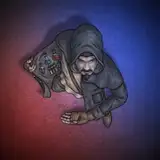
As artists, we're usually expected to provide one or more sketches to the client that you can then collaborate and move from. I generally offer three to four options for the client to look at and choose from. I try to get the sketches to a place where they are readable and communicate a concept and my intent, but I don't spend too much time polishing them, because there's no sense in spending 2 hours cleaning up a sketch the client doesn't pick, anyway. If you're curious, here are the sketches I gave Danjer to choose from!

These sketches had some preliminary colors, mostly for me to help conceptualize where I might take each sketch, should Danjer choose them, but I had to make it clear to him that he shouldn't focus so much on the color as much as the poses.
And here is the most important advice I can give you in regards to taking commissions: never, ever give your client an option that you flat-out don't want to work on. I know it's hard, because sometimes you gotta just poop out a fourth sketch because your contract said you'd do four, but they will ALWAYS pick that poop fourth sketch if you show it to them. Don't ask me why. The universe is cruel. Save yourself the trouble and don't even show it to them. I know I'm not the only artist who learned this the hard way!!
REVISIONS

I should have mentioned it earlier, but here is the second most important practice I can advise you on: establish the maximum amount of revisions you will do during the client brief and invoicing stage. Do not let your client keep giving you revision on revision and edit on edit, especially if you're really far along with the piece, or you're gonna watch your hourly pay rate go down the drain. If you do let them make continuous revisions, then have it in your contract that any revisions after X amount will cost $Y more!
When I first take on the job with the client/commissioner, I let them know that their main windows to request revisions are 1) after they select a sketch option, and 2) when I send one (sometimes two) in-progress shots. I won't do revisions after the artwork is finished.

Final Stages
This part was unique, since this project was a t-shirt design, not a painting commission. But I wanted to give Danjerhawk a number of text treatments and design elements to choose from for his final shirt design!

And this is a good opportunity for me to discuss Adobe. You all know me, you all know how hard I recommend Clip Studio Paint over Photoshop for drawing and painting. However, there are a lot of things the Adobe Creative suite still has that are immensely helpful. With my subscription to Adobe products, I also get access to Adobe fonts, most of which are free to me to download (price included with monthly subscription), and more importantly, are properly licensed for commercial use.
Free font sites like dafont.com may be free to download, but if you look at the fine print on each font page, it'll designate what type of uses you can use them for, and it's, surprise surprise, not commercial. The commercial use is especially important for this project, because I know Danjerhawk will be selling this shirt (thus commercially profiting off of it), and because I sold him the rights to the completed design.
...Also, I wouldn't have been able to do any of those text design work in CSP. Those were all done with Illustrator. Sometimes, you just can't escape Adobe. u_u
FINAL THOUGHTS
Again, I'm still an absolute newbie when it comes to taking on real client work, and one of the reasons I put it off for so long is because I felt woefully under-prepared to step into the industry without knowing how these things worked. So I hope some of this will be helpful to anyone looking to take on paid work, be it personal commissions or chasing those freelance clients!
From what I gather, working with small clients (such as individuals like Danjer) is a vastly different experience than working with larger companies. For example, I supplied Danjer with the contract. A studio that hires me will likely provide ME with the contract, instead. I also ask of my small clients like Danjer for at least partial payment up front. I've heard stories of freelancers having to repeatedly chase down past clients for final payments.
Lastly, I've said the word 'contract' multiple times throughout this. I am absolutely not qualified to give any advice on how to write contracts, but everything I do know, I learned from The Graphics Artists Guild Handbook for Pricing and Ethical Guidelines, which includes not only information regarding legal contracts for visual artists, but sample contracts for you to download!
Oh. And did you want to see the final design Danjer went with?

I'm most proud that I can say it's something I'm proud of. You know?
Kody Okamoto
2020-06-26 19:41:08 +0000 UTCLee
2020-06-25 19:28:28 +0000 UTC