[COLUMN] There is No God, Only Deadpool and Wolverine | by Darren Mooney
Added 2024-08-09 14:00:16 +0000 UTC
There is an interesting recurring joke in Deadpool and Wolverine, in which Wade Wilson (Ryan Reynolds) repeatedly identifies himself as “the Messiah.” Over the course of the film, he jokingly refers to himself as “Marvel Jesus”, “Marvel H. Christ” or “M.J., if you’re nasty.” At the climax of the movie, having returned from certain death, he proudly declares to the villainous Mister Paradox (Matthew Macfadyen), “He is Risen, baby girl!”
This is far from the only explicit invocation of Christian iconography in Deadpool and Wolverine. Johnny Storm (Chris Evans) describes the Void as “purgatory.” The evil Cassandra Nova (Emma Corrin) declares her plan at the climax is “to become God.” A significant portion of the third act of Deadpool and Wolverine is set to a remix of Madonna’s Like a Prayer, which is not only an ode to the pleasures of oral sex but also a song that was infamous for its incorporation of religious imagery.
Religion is arguably never too far from the surface of American popular culture. Certainly, the past couple of years of blockbusters have demonstrated something of a crisis of faith bubbling through the collective consciousness. Several of last year’s biggest movies were quite explicitly about the fear that “God is dead”, for lack of a better way of framing it. These were often stories about human beings trying to fill a spiritual or existential vacancy left by some divine power.
In Fast X, the villain Dante (Jason Momoa) has a near-death experience where he encounters no afterlife. He responds by trying to blow up the Vatican. In Guardians of the Galaxy, Vol. 3, the villainous High Evolutionary (Chukwudi Iwuji) screams, “There is no God! That’s why I stepped in!” The Creator finds soldier Joshua Taylor (John David Washington) tracking down the eponymous creator (Gemma Chan), who is hiding in a Buddhist temple, to disconnect her life support machine.
Mission: Impossible – Dead Reckoning, Part 1 arguably has a more complicated relationship with one very specific religion, but it is also engaged in this existential battle over a perceived spiritual absence. Ethan Hunt (Tom Cruise) faces down an omniscient artificial intelligence known as “the Entity”, fighting its “dark messiah” and “chosen messenger” Gabriel (Esai Morales) with the assistance of characters literally named Grace (Hayley Atwell) and Faust (Rebecca Ferguson).
Christopher Nolan’s Oppenheimer was adapted from American Prometheus, its opening text framing the story as a parable about mankind stealing fire from the gods and using it to create “a terrible revelation of divine power.” Divinity is conspicuous in its absence from Indiana Jones and the Dial of Destiny, the first entry in the 40-year-old film franchise that isn’t about an explicitly religious artifact. Barbie is, by director Greta Gerwig’s own admission, “the opposite of the creation myth in Genesis.”

Obviously, this pattern isn’t intentional or even conscious, but it does speak to some broader idea simmering away in the background. Barbie, Oppenheimer, Guardians of the Galaxy, Vol. 3 and Fast X represent four of the five highest-grossing films of last year. These ideas didn’t just take root in the films, they resonated with the audience. While it might be a stretch to try to fashion some cohesive statement from these movies, there is a clear “vibe” working its way through them.
What’s interesting is that some of this year’s films – specifically the superhero movies – seem to have offered a response to that perceived absence of divine power. After all, Madame Web is perhaps best understood as “a very Spider-Man nativity.” The climax of the movie finds Mary Parker (Emma Roberts) being rushed to the hospital so she can give birth to Peter Parker, the boy who would be Spider-Man. Conspicuously, Peter’s father Richard is entirely absent from the drama.
Mary is protected by three wise Spider-Women (Sydney Sweeney, Isabela Merced and Celeste O'Connor) as the evil Ezekiel Sims (Tahar Rahim) hunts them down. Sims is haunted by visions and prophecies of his own future death and the collapse of his criminal empire, like some superheroic King Herod. While the film has clearly been mangled in post-production, it feels very much like it was originally intended as Terminator take on the Spider-Man mythos, “a sci-fi nativity story.”
Deadpool and Wolverine is even more explicit. However, it’s important to be clear: as much as Deadpool might joke about being the Christ figure in the story, he really isn’t. Instead, Deadpool and Wolverine finds its Messiah in Wolverine (Hugh Jackman). At its most basic level, Deadpool and Wolverine is a story about how Wolverine died and was resurrected, and in doing so he redeemed a fallen world. It’s the most biblical of stories.
In the narrative logic of Deadpool and Wolverine, Wolverine is “an anchor being.” His death causes reality itself to unravel. Interestingly, Paradox suggests that the decay and collapse of a universe happens a couple of thousand years after the death of its “anchor being”, an interesting observation to make in the year 2024 A.D. The only way that Deadpool can save the universe is by finding a way to resurrect Wolverine, restoring him to life and preventing the erosion of his native reality.
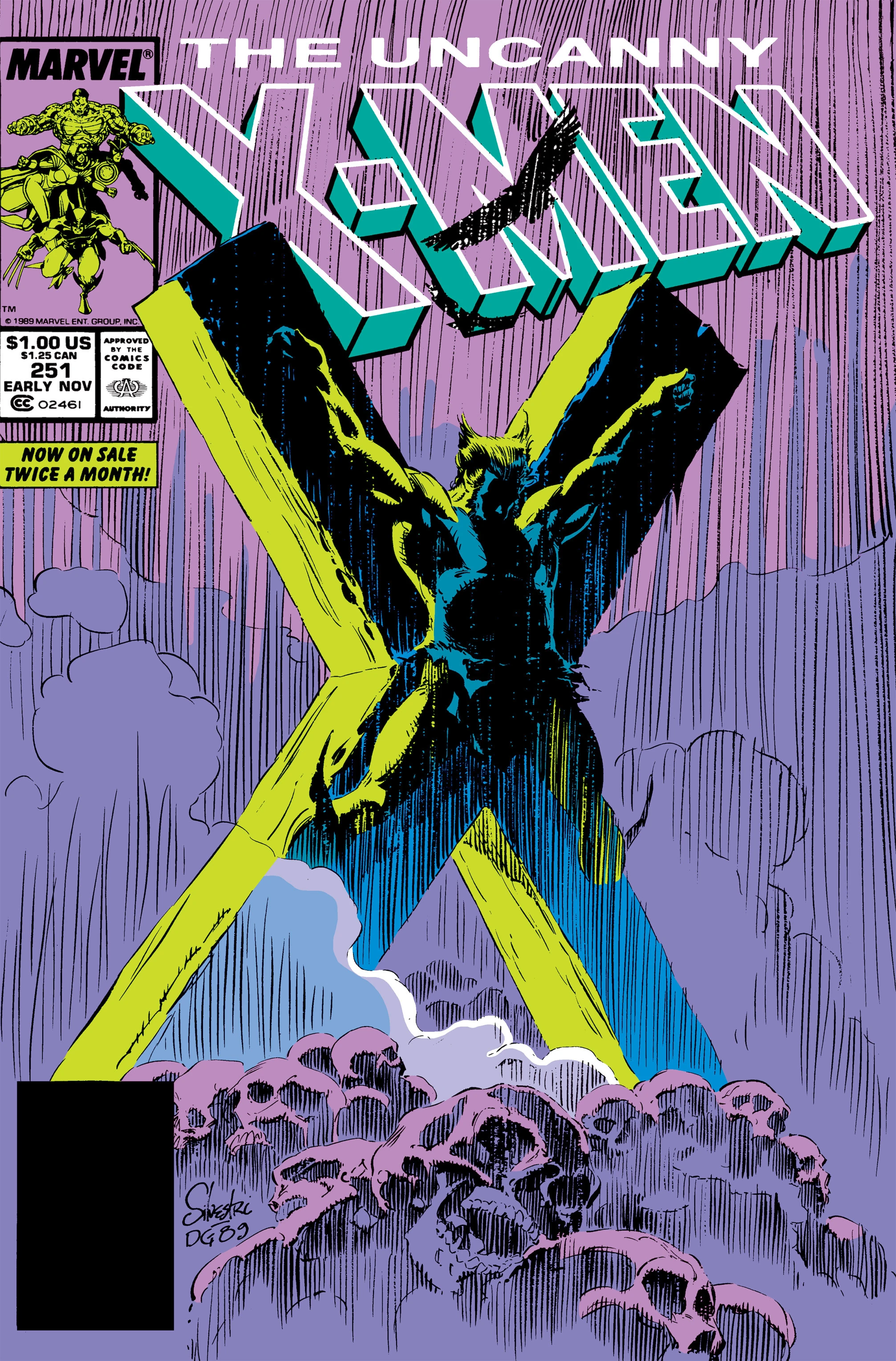
Deadpool and Wolverine is not a subtle film. Early in his efforts to find a viable replacement for his universe’s Wolverine, Deadpool stumbles across a version of the feral superhero crucified atop a mountain of skulls – a literal “place of the skull.” This is an obvious homage to the cover of Uncanny X-Men #251, but it’s still evocative. Wolverine doubts his worthiness, and finds himself cast into a vast wasteland where he wanders and finds himself. This does admittedly take fewer than 30 days.

Of course, some fans might argue that Wolverine was not literally resurrected. This is an alternate Wolverine compared to the one who died in Logan. It is not technically the same character. However, he is still played by Hugh Jackman. He becomes a surrogate father figure to Laura (Dafne Keen). When Cassandra Nova peers into his head, she sees clips from Logan. Even the universe itself seems to suggest he’s functionally interchangeable with the character from Logan.
This is far from the narrative’s only biblical allusion. Cassandra Nova is presented as a Miltonian figure, a fiend who believes it is “better to reign in Hell, then serve in Heav’n.” Cassandra has been cast out of paradise, but serves as something of a warden in the vast wasteland for the other exiles banished by the Time Variance Authority, the overseers who protect “the Sacred Timeline.” Cassandra even tempts Logan during his own stay in the Void, offering to take away his pain and suffering if he will choose to serve her.
If Logan is Christ and Cassandra is Satan, then there must be an absent God. Charles Xavier haunts Deadpool and Wolverine without ever appearing in it. Wolverine treats himself as the unworthy ambassador for Xavier’s values. Cassandra is Xavier’s biological sister, whose original sin was trying to strangle him in the womb. However, even to Cassandra – who warred against Charles – he is a father figure. She muses that in his absence he never “taught [her] temperance.” Cassandra is introduced riding Xavier’s wheelchair, as if to suggest that God’s Throne is empty.
The early phases of the Marvel Cinematic Universe were very careful to avoid even the implication of a comparison between these heroes and the divine. In Thor, the Asgardians were not literal gods, but instead “sufficiently advanced” aliens. When Black Widow (Scarlett Johansson) introduces Steve Rogers (Chris Evans) to Thor (Chris Hemsworth) and his fellow aliens as “basically gods”, Steve retorts, “There’s only one God, ma’am, and I’m pretty sure he doesn’t dress like that.”
However, more recent movies in the franchise have grown more comfortable with the invocation of divinity. Early in Doctor Strange in the Multiverse of Madness, the bearded magician (Benedict Cumberbatch) turns water into wine at a wedding. “A bit on the nose?” he asks. In Thor: Love and Thunder, Gorr the God Butcher (Christian Bale) murders his way through various pantheons, before being stopped by Thor and Jane Foster (Natalie Portman). Eternals is a movie about aborting God.
The absence of a father figure or creator is an interesting and essential recurring figure in these stories. Deadpool and Wolverine is a story about characters essentially orphaned during the merger of Fox and Disney, bereft when the company guiding their fictional universe ceased to exist. In a vaguely spiritual and existential sense, Deadpool and Wolverine is about the question of what happens when creations outlive their creators, their writers and their original owners.

This is an interesting recurring motif in these kinds of stories. In Barbie, for example, Barbie (Margot Robbie) is thrown into a crisis when her owner (America Ferrara) has an existential crisis. She journeys to the real world, where she discovers that the woman who created her, Ruth Handler (Rhea Perlman), is dead. This arc is mirrored in the more recent Harold and the Purple Crayon, when Harold (Zachary Levi) ventures to the real world to discover his author (Alfred Molina) is dead. Earlier this summer, Ryan Reynolds starred in IF, a movie about the idea that imaginary friends outlive their relationships to the children who create them.
If one wants to be optimistic about these stories, they are about the romantic notion – as Handler argues in Barbie – that “ideas live forever.” However, it’s hard to shake the sense that these stories of immortal ideas are not celebrating creativity itself, but intellectual property ownership. Deadpool and Wolverine opens with Deadpool monologuing about Disney’s purchase of Fox. Barbie fixates on Barbie’s relationship to her corporate owner and the film’s production company, Mattel.
This is “death of the author” taken to an extreme, insisting these characters have a life that extends beyond any of the flesh-and-blood human beings who help to make these stories so appealing. If nothing else, the takeaway at the end of Deadpool and Wolverine is that Deadpool and Wolverine both survived the collapse of one of the oldest Hollywood studios, an institution that contributed immeasurably to larger culture. They’re owned by Disney now, and Disney will take good care of them.
As such, there is something deeply cynical at play here, in these movies that seek to move intellectual property to fill the perceived void left by religious belief. Of course, this makes a certain amount of sense – the word “fan” is, after all, derived from “fanatic.” If sports are a “civic religion”, why not multimedia franchises? Many of these franchises are obsessed with “canon.” It makes sense for the large corporations that own these properties to assert their near-religious credentials.
It's interesting that this shift happens as many of these iconic franchises threaten to enter the public domain, ripe for exploitation by anybody. Elevating these characters and their stories to near-religious status serves as bulwark against any attempt to democratize them. Any interpretation that goes against the sanctioned teachings can be labelled heresy. This might explain why so many of these adaptations are just repetitions of familiar iconography; myth is built through repetition.
It's frequently argued that superheroes constitute “a modern mythology.” What this argument often omits is that mythology is a public resource, while these characters remain trapped within rigid confines by their corporate owners. That’s not mythology, that’s religion. It’s interesting to see the studios leaning into this, whether consciously or not. Watching the latest superhero blockbuster, it’s hard to shake the fear that there is no God, just Deadpool and Wolverine.
Comments
I suspect a huge portion went on Reynolds and Jackman. They apparently couldn't (wouldn't) pay Jones enough to reprise the role of Juggernaut.
Darren Mooney
2024-08-09 22:53:14 +0000 UTCSo if we apply that logic in a wider context. Is every comicbook adaption that existed before and/or outside the MCU but now belongs to it the old testament? And are all the cameos in Deadpool & Wolverine the apostle?^^ Also about all the cameos. I am wondering just how large that chunk of the budget was. Because I don´t know if it is just me, but parts of the movie looked somewhat cheap.
Skujat
2024-08-09 19:27:34 +0000 UTC"it is with great satisfaction that I remember the UK is no longer a country where a majority identify as “Christian”." We're getting there in America...slowly. Every year, the Pew Research Center does its "survey on religion and public life", and since about the turn of the millennium, the percentage of Americans identifying as Christian has dropped by about one percentage point per year, to the point where it's now in the low 60s (with "none" growing as people choose it as their new answer. Which, curiously, is a distinct answer to outright choosing "atheist".) If current trends continue, we'll cross the 50 percent barrier in about 2036 and certainly before 2040. And, of course, in civilised parts of America like urban areas in blue states, we're already well below 50 percent. Look on a dating app in Seattle and a lot of men and women alike have "Christian" as one of their dealbreakers. People on the fence might well discard their faith simply due to social pressure. Thank the gods.
May Contain Fox-Like Substance
2024-08-09 15:26:47 +0000 UTCI was eagerly awaiting your article on Deadpool and Wolverine and I have to say you didn’t disappoint. Immensely well written and reasoned, with an interesting point of view especially re: “mythology and religion”. It speaks to what a filthy casual I am that I was just happy to see Blade again rather than noticing the now incredibly blatant to see religious parallels! But I do think you’re on to something there. It may just be that subconsciously the western mind is so marinated in Christianity and the themes, stories and iconography that writers and studios just automatically emulate it, knowing or unconsciously feeling that it will be easily understood and instantly resonate. Or perhaps it is a more conscious commentary on the current perceived lack of faith and moral panic (it is with great satisfaction that I remember the UK is no longer a country where a majority identify as “Christian”). Something to ruminate on.
Tim Wilson
2024-08-09 15:16:26 +0000 UTC