[COLUMN] Kite Man: Hell Yeah! Suggests Not All Villains Need to be Super | by Darren Mooney
Added 2024-07-26 14:00:20 +0000 UTC
As far as supervillains go, Kite Man (Matt Oberg) has always been a bit of a loser.
The character has existed in DC continuity for decades as something of a punchline. Writer Tony Isabella, who describes Kite Man as his “favorite goofy Batman villain” and who revealed the character’s secret identity in the pages of Hawkman, argues “that he is Charlie Brown grown up.” Indeed, one of the early jokes in Kite Man: Hell Yeah! is that the character doesn’t even rate highly enough to inspire a server at a villain-themed restaurant that employs a Calendar Man stand-in.
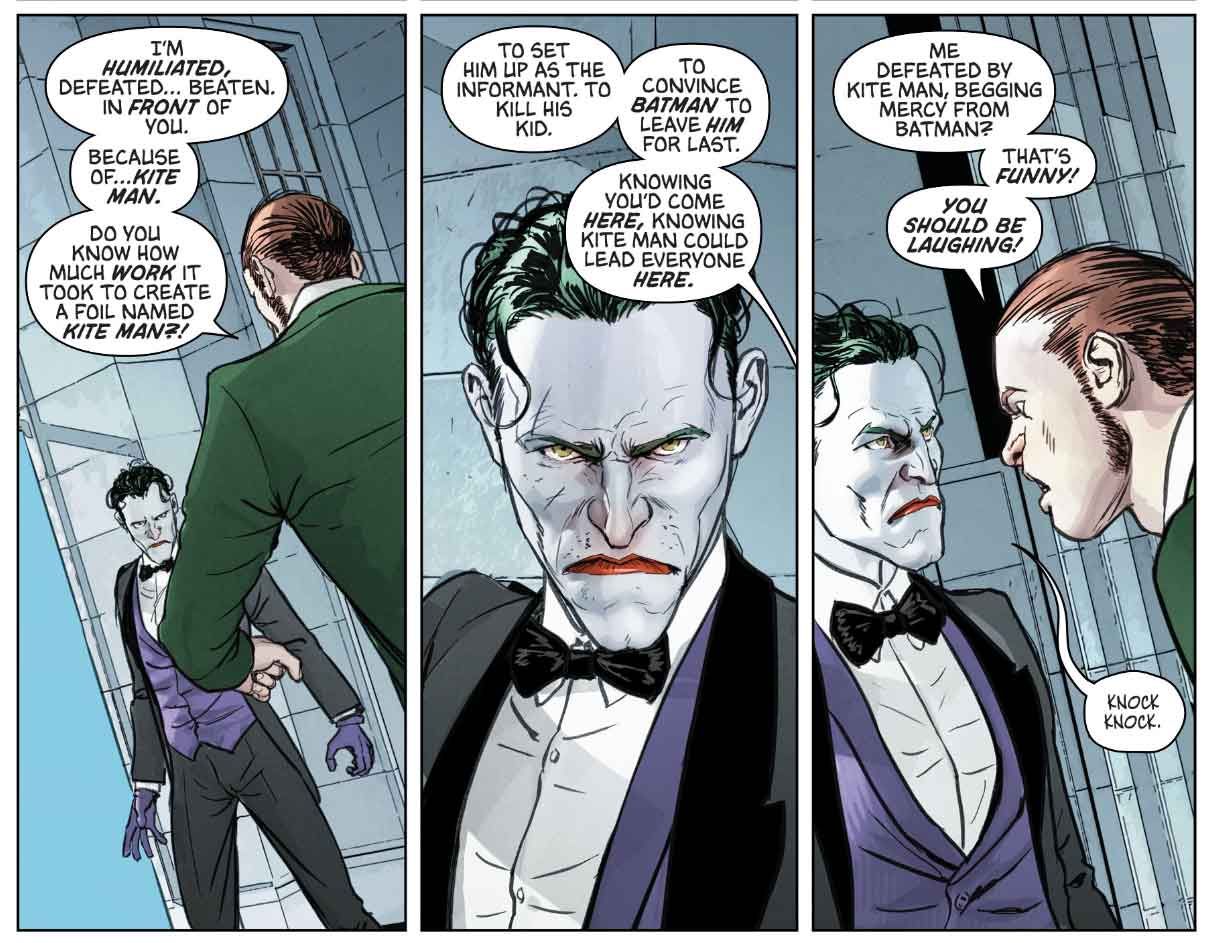
Still, the past couple of years have been kind to Kite Man. The character experienced something of a renaissance under the pen of writer Tom King, who made him a recurring character in his Batman run. It was King who provided Charles “Chuck” Brown with his now-signature catchphrase. Even then, King’s Batman was built around the idea of Kite Man as a joke. The Riddler creates an elaborated back story and action climax around Kite Man, in the hopes of making the Joker laugh.
However, there is also something undeniably sweet and wholesome about the character of Kite Man, a two-bit loser who isn’t particularly dangerous and who can never catch a break. “To me, he's Sisyphus, the guy who rolls the rock up the hill only to have it fall back down and crush him,” King explained of his reimagining of the character, and that makes it easy to root for him. He is a supervillain who isn’t especially super, but who still tries.
This explains how Kite Man became a breakout character on Harley Quinn. Once again, he was included as something of a joke, a romantic obstacle positioned between Harley Quinn (Kelly Cuoco) and Poison Ivy (Lake Bell). “Kite Man was originally just a plot device and a cipher for male supervillains that aren't that powerful — or, in Kite Man's case, don't have any power but sort of act like they're all-powerful,” explained Harley Quinn showrunner Patrick Schumacker. “And then it just evolved because Kite Man became kind of a favorite character to write in the writer's room.”
Kite Man caught on, in part due to the inherent appeal of the character’s concept and in part due to Oberg’s charming “aw, shucks!” performance. When Warner Bros. commissioned a spin-off from Harley Quinn, it made sense to build the series around a lead who could (charitably) be considered a C-list supervillain. It gives the show a unique angle in the larger context of major superhero franchises. Kite Man: Hell Yeah! is a series about the little guy.
Indeed, Kite Man wasn’t originally the hero of his own show. The series was initially announced as Noonan’s, centering on the dingy Gotham Bar of the same name created by Garth Ennis and John McCrea and which served as the central hub of their Hitman series. The show even carries over some of Ennis and McCrea’s characters: the proprietor Sean Noonan (Jonathan Banks), the two-headed mobster Joe Dubelz (Michael Imperioli), alcoholic superhero Sixpack (Eddie Pepitone), and more.
“Initially, the idea was ‘Cheers with villains’,” explains showrunner Dean Lorey of the series that would become Kite Man: Hell Yeah! It is not a bad hook for a superhero show, and offers something of a welcome reprieve from the high stakes that define so much superhero media. Kite Man is certainly an uneven show with a unique sensibility that won’t necessarily appeal to all viewers, but it’s also endearingly gentle for a series as profane and graphic as it occasionally is.

Kite Man is a show about second-rate villains. As Dubelz boasts of the dingy rundown bar that serves as the show’s central location, “This place is the dregs, the goons, the hunches, the rest of us.” The show’s first episode contrasts the crappy pub – complete with a phone marked “local calls only” – with the sleek Legion of Doom operated by Lex Luthor. Here, Luthor is voiced by the late and great Lance Reddick, essentially reprising his magnificent Toys R Me performance.
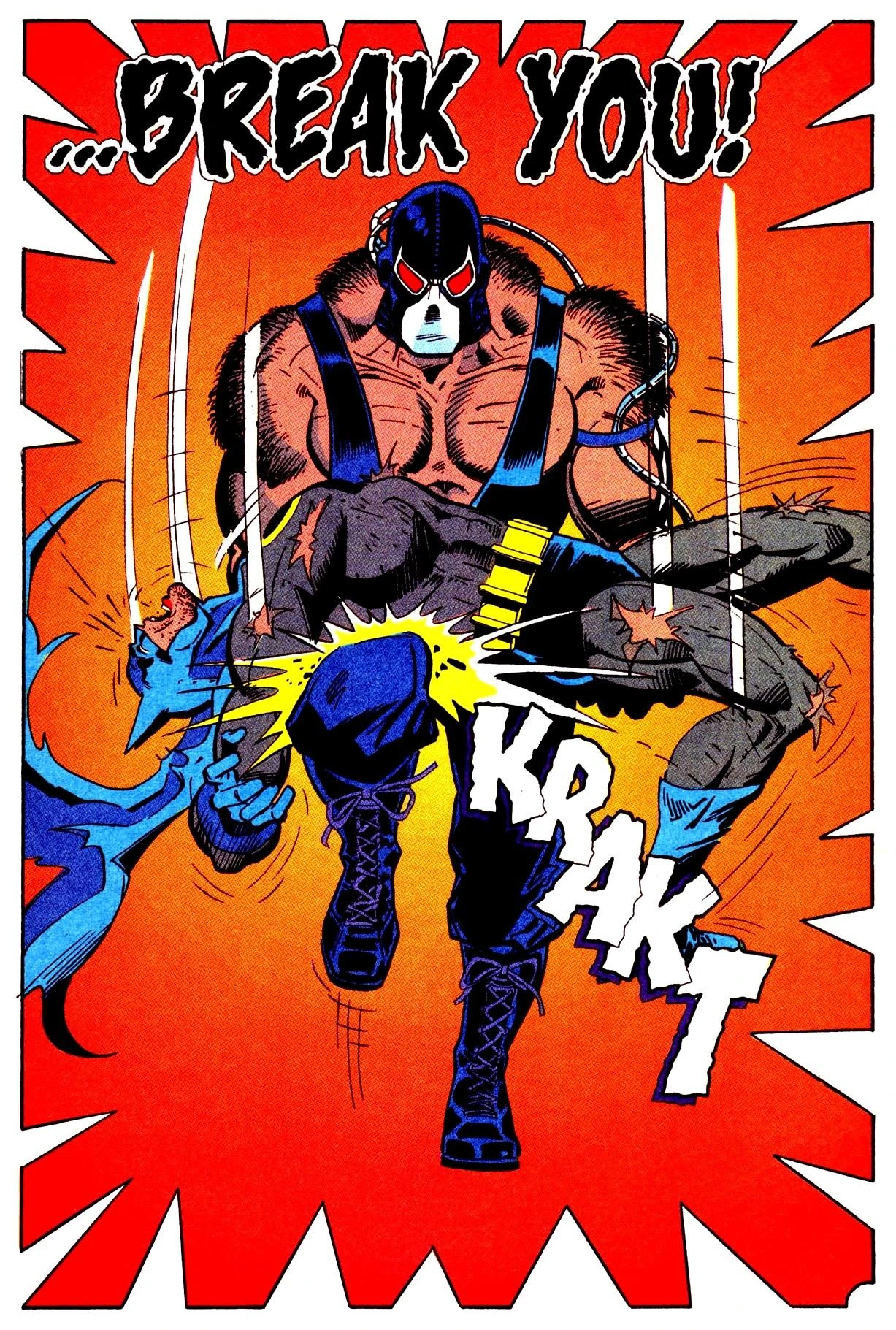
The most significant character to feature among the regular cast is Bane (James Adomian), another breakout interpretation of a comic book character from Harley Quinn. Bane is arguably a top-tier villain: he was introduced breaking Batman’s back in the comics and he was the villain of Christopher Nolan’s The Dark Knight Rises. Tom Hardy’s take on Bane is genuinely iconic, to the extent that Adomian is largely riffing on it, with a few charming verbal tics of his own, like dropping vowels.
However, Bane is a relatively young character compared to classic Batman villains like the Joker or Catwoman, and so his status as an A-lister is a bit more precarious. Comic book writer Gail Simone recalls that Bane was basically foisted on her team book Secret Six by editorial, because the character needed exposure. “For Bane, DC asked me to put him in,” she explained. “The film [The Dark Knight Rises] was going to be coming out eventually, and he needed to be used and built back up again.”
This weird tension between Bane’s status as a top-shelf supervillain and the sense that he wasn’t quite A-list informed his portrayal in Harley Quinn, with Adomian noting that “it was really well done on this show where they make him into a sitcom loser — the put-upon, unwanted member of the group. He's a low-status Bane, which is very funny to me.” As such, Bane is a very good fit among the Kite Man ensemble, existing in a liminal space between these losers and their betters.
Much of the tension of Kite Man is built around the low status of the central characters. In the first episode, Kite Man makes the mistake of mildly frustrating Luthor, prompting the villain to try to buy and demolish the bar out of spite, forcing Kite Man and his girlfriend Golden Glider (Stephanie Hsu) to race to assemble a rival bid. In the second episode, Luthor sabotages their grand reopening by hosting his own rival, swankier party. It’s classic “slobs vs. snobs” storytelling.
Lex Luthor is one of the show’s two primary antagonists, a successful supervillain who provides a clear contrast to Chuck Brown. The other is Helen Villigan (Judith Light), who operates the international conglomerate “Villigans.” In the show’s third episode, the company opens a rival location directly across the street from Noonan’s, hoping to drive Chuck out of business. It’s a fairly low-stakes story, but one that resonates in an era where even pubs are mass franchises.
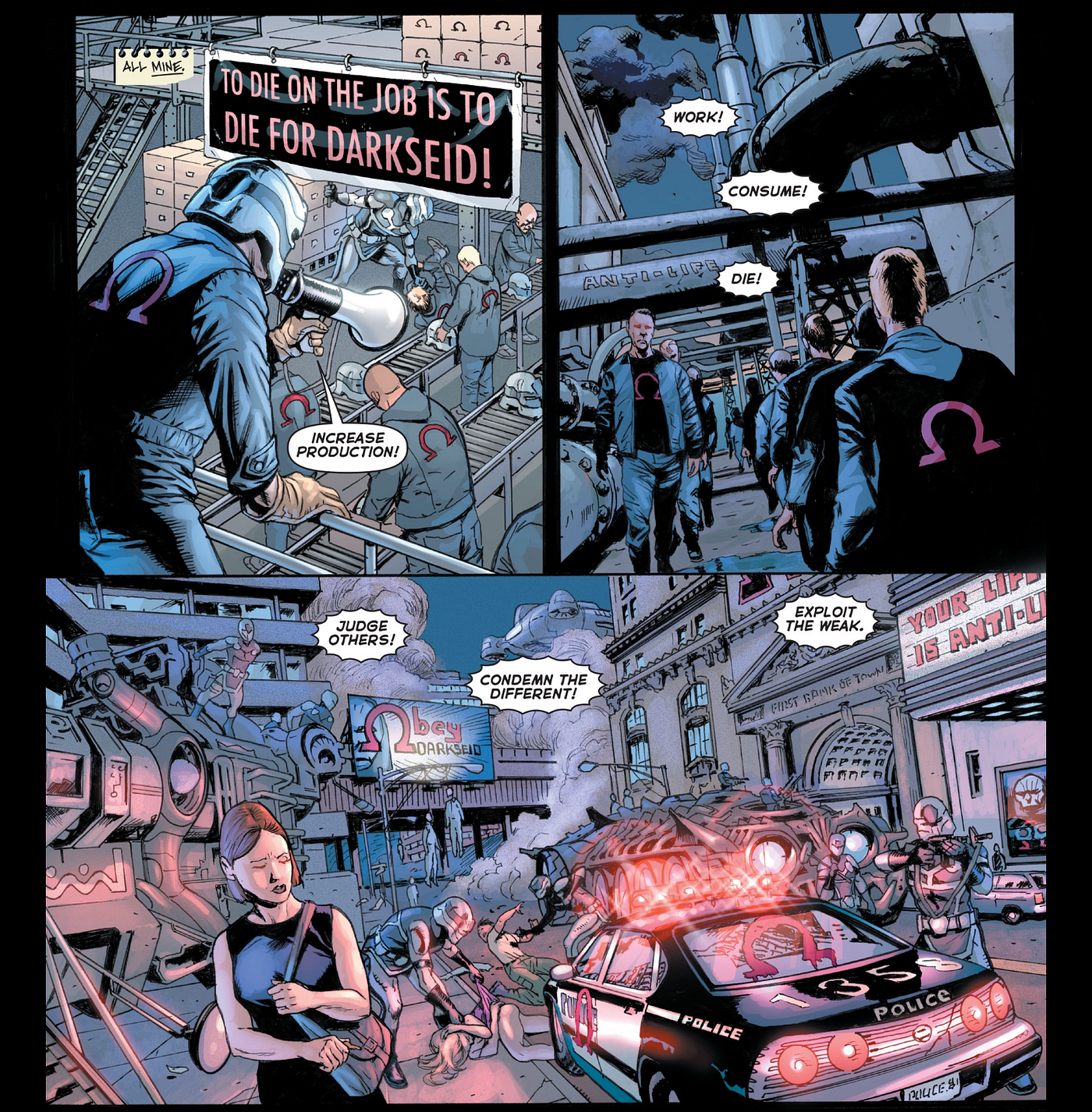
As the season progresses, it becomes clear that Villigans is more than just a rival chain. It is “the largest online retail business in the world, providing our customers with anything they need, shipped to them at anywhere anytime” with “free one-hour delivery.” As such, Kite Man joins The Boys as another superhero show where the villain is effectively Amazon. Indeed, the Anti-Life Equation is a major plot point for the season, which feels appropriate given that Grant Morrison treated it as the embodiment of oppressive late capitalism (“work! consume! die!”) in their epic Final Crisis.

Some of this energy carries over from Harley Quinn. That is another series that arguably works better as a vibe than as a plot delivery mechanism, an excuse to hang out with a cast of eccentric weirdos and freaks. However, Harley Quinn has a much stronger narrative engine to it. It is built around recognizable characters, one of whom is a woman seeking to escape her abusive relationship with one of the most famous villains in the history of comic books. There are emotional stakes there that are much higher than those in Kite Man.
In contrast, Kite Man is the story of a frankly terrible supervillain who reinvents himself as “the happiest small business owner in the world” by buying a bar with “four mortgages on it, as well as black mold inside every wall.” It’s a much more conventional sitcom format. Lorey mentioned Cheers, but it’s also not too far removed from Friends or It’s Always Sunny in Philadelphia. It’s fun to take that very recognizable set-up and employ it within the colorful world of comic book supervillains.
There is a long tradition in comic books of stories about low-tier villains just struggling to get by. Appropriately enough, given Bane’s involvement in Kite Man, Gail Simone’s Secret Six is a great example of the genre. More recently, Nick Spencer and Steve Lieber’s The Superior Foes of Spider-Man was built around a set of Z-tier villains trying to assemble their own Sinister Six. These books are fun and playful, and they aren’t really represented in mass superhero media.
The demands of modern blockbusters mean that every crowd-pleasing superhero film is expected to end with an epic action set piece, even ostensibly lower-key examples like Birds of Prey. Ant-Man (Paul Rudd) might publish a book called “Look Out for the Little Guy!”, but he’s still taking part in gigantic action sequences. Even Hawkeye, an adaptation of a relatively chill hangout comic by Matt Fraction and David Aja, still has to build to lore reveals and big showy climaxes. When Amazon revived The Tick, the show couldn’t return to its sitcom vibes, but instead had to adopt the language of modern superhero blockbusters.
Even among animated shows like My Adventures with Superman or Batman: The Caped Crusader, there is an expectation of scale and spectacle that can be quite numbing. As such, it’s refreshing to have a superhero series – even an animated show – that is largely about these sorts of characters just going about their days, engaging in wacky hijinks and mostly dealing with their own personal dysfunctions while trying to avoid getting crushed into the ground by more powerful forces.
Much like its protagonist, there’s an appealing mundaneness to Kite Man: Hell Yeah! At one point, Sean Noonan is shocked to discover that the inspector (Richard Kind) visiting the premises is unkillable. “So you’re immortal and you decided to be a health inspector?” Noonan asks, incredulous. “Of course, it’s a government job!” the inspector replies. “You have those for life!” It’s an exchange that captures the charming banality of Kite Man: Hell Yeah!
Kite Man: Hell Yeah! is not a masterpiece, by any measure. Indeed, the season’s final stretch inevitably finds itself drawn into the sort of big bombastic storytelling that the show’s stronger stretches avoid. Still, for most of the season, it’s nice to see this low-stakes aspect of superhero storytelling get some focus. However, befitting its title character, it’s a perfectly affable piece of work.
Comments
Thanks! Glad you appreciated it, and I hope you enjoy the show!
Darren Mooney
2024-07-27 11:20:47 +0000 UTCreally enjoyed this article! i’m reminded of the good times watching Harley Quinn and am glad Kite Man has a spin-off of full of good Cheer vibes
D.L. Kim
2024-07-27 05:25:35 +0000 UTC