Eye painting techniques for intermediate and advanced eye painters
Added 2023-01-18 16:10:50 +0000 UTC*Note; This post is very wordy and is likely to be a translation with poor grammar and wording. Please read it with that in mind.
You finally opened this page.... Welcome to the eye paint swamp...
There are some books on the street that give specific instructions on how to do eye painting, but surprisingly few of them explain how to move your hands and brushes, how to hold the parts without shaking your hands, etc. The resolution of the photos may be insufficient due to space limitation. Even if you understand the sequence of steps, it is not uncommon for you to stumble over other details.
Of course there is a book in Japanese, but unfortunately it will never be translated and released!
Although Anime figure's eye painting is an extremely important process, there are few specialized books that focus exclusively on it.
In most monthly magazines, the process is explained quickly as one part of a flow of overall painting, eye paint, matte finish, and completion.
Therefore, even though I picked up the book because I wanted to know more about eye painting, I often end up thinking, "I didn't understand it very well, but at least I know it's great.
So I am writing this article in the hope that I can provide my own explanation using not only photos but also videos, and in a medium that does not limit the number of pages or the space available.
┃What this post says (with photos and video)
─────────────────────────────
1. Posture around the arm during the eye paint.(how to hold the part to prevent the hand from shaking)
2. How far away to it (for naked eye cases only)
3. What you should keep around your desk when you are aipeeing to make your work more efficient*.
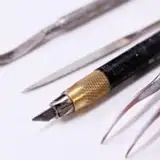
4. Brushes and tools you use when working
5. Tips for physically rolling back clear-coated parts and parts that have been painted skin tone to their pre-skin tone state*.
6. Pre-painting or post-painting of skin tone is better?
7. What I keep in mind to resemble the original painting and improve my skills.
8. What I need to do to improve my skills (information gathering and practice)
─────────────────────────────
In this article, I would like to systematically tell you about the tools and tips we use when doing face work and how to partially redo the work without removing the paint, which are often asked in the comments of our videos. I often get questions and comments in the videos, but it is difficult to answer them individually each time, so I will tell you everything I can in this article if I can.
*If you want to know individual cases such as when to insert the clear coat, etc., please read another past article. *
If you are curious about eye painting, or if you want to go one step further from beginner or intermediate level, this article is designed to give you a general idea of what was done in the parts of the video that are cut.
Of course, there is a lot of information that can be gathered from twitter and other sources, as well as things that can be learned by doing the work yourself, so there may not be new information for some people.
This is just my own way of doing things, so it may not be suitable for everyone. So, *as a basic stance, always look for methods and tools that suit you and keep yourself updated on the information*. Failure to do so may result in wasted time in your progress.
If you want to be sure to improve, I recommend attending a class conducted by a professional finisher in japan. The response to your questions will be reliable and accurate, so you can get your questions answered immediately and not waste time. Eye painting is the most important process in figurine painting, and it greatly affects the impression of the figure. Therefore, it takes a lot of time.
The only individual tutoring figure painting school is probably in Tokyo. And the seats are always filled....
┃Saving time is the most important issue in improving eye painting.
I have said many times that "time is...", but that is how much time and concentration is required for eye painting.
Wasting time = missing the opportunity to improve = wasting your life...
It may be an exaggeration, but working with that kind of attitude may be ideal. (If I could do that, I wouldn't have any trouble...)
Since I am completely self-taught in figure painting, it has taken me quite a while to find tips on how to improve and how to work efficiently and rationally.
I think anyone reading this article now will be able to absorb all the things I've learned the long way around, so the scope of time wasted will be smaller.
┃I don't need any talent at all for figure eye-painting work.
I have seen some people comment on my videos that they would like to try figure eye-painting but have not graduated from an art college (technical school) or that they are clumsy with their hands, but I have no such specialized education to begin with and just started as a hobby. So in the end, I think that what is necessary for progress is whether or not you can concentrate on what you want to do and devote your time to it.
And frankly speaking, I am not dexterous. As long as you are dexterous enough to not let parts fall out of your hands, there is nothing wrong with that.
Also, I want to say this, I am not talented. It's just that *I have spent an odd amount of time learning the craft*.
Instead of "I can't do it, so I give up," he said, "I'm mad at myself for not being able to do it, so I'm going to find a way to do it better and put it into practice."
This is just repeated over and over again. So, if you invest a huge amount of time (not only in eye painting, of course), about 1000 hours of trial and error to improve your figure painting skills, you can surely improve to the level of a professional painter. Anyone can do it if they follow the right steps.
(If you call it talent to be able to do that for a long period of time, then maybe...
)
Eye painting is only one process. If you are painting a number of figures, 1000 hours is not long. If you spend 100 hours to make one garage kit, you can expect to make 10 garage kits, and if you spend 50 hours, you can expect to make 20 garage kits, and you will have improved a lot.
Therefore, it is not a question of talent, but rather of theory, logic, and what good painters are doing. The goal is not to be a talent, but rather to train your hands to imagine how you can reproduce the same kind of painting and eye painting as the professional painters. If you do this, you will improve on your own.
Also, and this is the most important thing, *don't be satisfied with just reading this*. You will not improve at all just by reading this article.
The worst thing you can do is to become a so-called "knowledge collector. After reading the book, be sure to do some eye-painting and think, "Oh, this is what I read. If there is something that is not mentioned in the article, please do not be surprised if it is not mentioned in the article.
If it is not mentioned in the article, search for it by yourself or do trial-and-error. If you do this, it will be easier to fix in your long-term memory, and you will naturally learn how to deal with problems. *The secret of progress is to establish a routine of output after each input.
I hope you will take this into consideration as you read this.
----------
1. Posture around the arm during ipe and how to hold the part so that the hand does not shake
┃ The posture and the distance between the part and your own eyes
*The hardest part of the eye painting process is eye strain and stiff shoulders*. Therefore, the first thing you should pay attention to when doing eye painting is your posture. Since the process tends to cause poor posture, it is best to avoid slouching as much as possible and to be aware of such things as taking breaks and rotating your shoulders moderately.
As I will write about on another page, the closer the distance between the parts and the eyes during eye painting, the worse your posture becomes, and the more likely you are to tire your eyes and stiffen the muscles in your shoulders, so you should be careful.
┃ It is healthier and easier to improve the quality of the work if you allow a week or so for the eye painting work rather than working on it continuously
The more you work continuously, the more it will affect your physical condition (especially your eyes will get tired and your eyesight will temporarily deteriorate), so it is better to limit yourself to 2 to 3 hours at most.
*It is important* to relax your shoulders and rest your eyes in moderation. If possible, it may be a good idea to spend one to three days for preliminary drawing, three days for the main drawing, and one day in reserve, for a total of around one week.
Note that working at close range for long periods of time tends to cause myopia. If it is temporary myopia, the vision will return to normal over time, but if it is repeated many times, the myopia will become fixed (roughly speaking, it will become difficult to focus with the naked eye), and it will greatly affect future work, so you should always be aware of myopia prevention.
In addition, since they will be working in a chair for long periods of time, they tend to lack exercise. It is a good idea to make moderate exercise, such as walking or jogging, a part of your daily routine in order to improve your physical strength and relax your stiff muscles.
Although it may not seem to have much to do with eye painting, you will be able to concentrate more on your work if you take care of your health as well.
And importantly, you should have enough time and mental capacity. Otherwise, you may not be able to come up with a good idea or identify the cause of a mistake.
I had to redo the eye painting several times because I didn't have a lot of time to spare when I painted Thea. I could not identify the cause of the mistake. (I will tell you about this in my post on Thea)
┃ How to hold face parts to minimize hand tremors
So finally, the main question. How do you hold the parts so that your hands do not shake? This is a very common question. It is hard to understand if I just explain it in words, so I have prepared a video as well.
(The video cannot be embedded in the article, so please click on the link below to watch it)

**It is assumed that the right hand is the dominant hand. If you are left-handed, please try it in the opposite direction. *
Start with the hand that holds the part. Hold the part at four points with the thumb, index, middle, and ring fingers of the left hand. The little finger should be wrapped around the ring finger for stability.

Next is the right hand that holds the brush. The thumb, index, middle, and ring fingers are used to hold the brush, right? What to do with the leftover little finger? It is used to hold parts. When the right hand is freehand, it is extremely difficult to draw a line on the desired spot, but with just one pinky finger, it is surprisingly stable.

The basic posture of the arms during eye painting is a kinematic pose (hands together and elbows propped up). By holding the part with the elbows and hands, the tremor (blurring) of the fingertips can be eliminated. There are three different styles of this kinematic posture.
Posture during eye painting

*1. Elbowless posture with palm side resting on the desk*.
*2. Forearm resting on the corner of the desk*.
*3. Elbows touching the desk*.
1 is relatively relaxing and stable because the fulcrums of the parts and hands are close together, but it is difficult to work with a low desk because it makes you turn your head down.
2 is somewhere in between, with a good balance between the fulcrum of the desk and the arms, making it stable and easy to work with.
In position 3, the back is straight to some extent, but the fulcrum of the arms is far away, so it may be difficult for some people to stabilize themselves in this position. However, you can find a stable position by changing the width and height of the arms.
The above is also affected by the height of the chair and desk, so it is better to find a good position by yourself. As for me, when I was actually working, I seemed to be alternating between postures 1 and 2.
I know this is a long story, but if you pay attention to the following two points, you will be able to concentrate on eye painting with your hand trembling as little as possible.
・Place the pinky finger of the hand holding the brush on the part.
・Position your elbows and hands in a stable position with an awareness of kinematic support.
-------
2. At what distance do you do eye painting? (Only in the case of the naked eye)
Now that you know how to reduce hand tremors, the next thing to consider is *how far should I set the distance between the part and my eye to work? *.
Naturally, with the naked eye, the farther away the eye is, the less detail you can see. Therefore, we naturally tend to hunch over or move our face too close to the parts....
However, such a posture increases the possibility of physical deterioration and nearsightedness. In fact, I temporarily lost about 0.2 of my vision because I worked with my eyes too close to the parts.
I honestly wondered what would happen before it recovered, but after a few months I was really happy to have my vision back to normal.
So now I try to work at a distance that does not put too much strain on my eyes, allows me to see to some extent, and does not make my posture as bad as possible.
Actually, at what distance do you do eye painting?

Specifically, I think around 30cm is a reasonable distance. Of course, I look at parts of the work that require detailed and nerve-racking work at a closer distance (sometimes several times for a short period of about 10 minutes), but for the most part I try to keep the distance at around 30 cm for my work.
In any case, be conscious of keeping a distance that does not make you nearsighted. Your eyes are really important.
3. What you can keep around your desk to work more efficiently during eye paint.
Once you know your posture and distance, you can then make your desk setup as efficient as possible for you to work.
In my case, I have the following tools available to me when I am drawing.

------------------------------
3 main brushes.
paint brushes for separating paints*.
Red for underpainting
Gaianotes enamel paint, pure color (diluted with lighter fluid and replaced with an empty Mr. Color bottle)*
Finish Master (or Rubyhead H-31) .
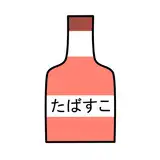
Tamiya Enamel Solvent (replaced in an empty bottle of S.B. La-Yu (Chili Oil) ) .
zippo lighter oil (for airbrush painting without particle feeling)*
------------------------------
For work efficiency, three paint dishes are prepared at the preliminary drawing stage, one for paint, one for Finish Master cleaning, and one for brush cleaning. If the paint dishes are placed on a flat surface, the solvent will quickly evaporate, so they are placed on an angle with some sort of adhesive tack or other material placed underneath. The following image shows the setting for a particularly time-consuming preliminary drawing.

The Tamiya enamel solvent is replaced with an empty bottle of La-Yu (Chili Oil) so that it can be quickly replenished when the solvent volatilizes.
bottle of S.B. La-Yu (Chili Oil)

Enamel solvents are not used in large quantities like lacquer solvents, so only a small amount is needed.
Therefore, the La-Yu bottle is really useful for narrowing down the amount of solvent to be used.
I mix Tamiya enamel red (X-7) and orange (X-6) in advance and stock one bottle of vermilion for underpainting in an empty bottle. It is troublesome to mix colors one by one....
Also, since Tamiya enamels do not have pure colors, I use the pure colors of Gaianotes.
Unfortunately, Gaianotes enamel paint bottles are not very convenient to use as they are, so I diluted them with zippo lighter oil in advance and replaced them with another container. The dilution should be neither too thick nor too thin.
┃Is a draft necessary for eye painting in the first place?
I'll start with the conclusion that it is not necessary. I just do it because it's easier to check if there is one.
Nowadays, more and more people are doing underpainting as a matter of course as an eye painting process seen on Twitter timelines, but originally, many people refer to Hoshina's work process in Replicant EX vol.7. I am one of them.
Note:She is one of the best commercial figure painters in Japan and has worked on many coloring samples for famous manufacturers such as Alter, AMAKUNI, Good Smile and Max Factory.
Of course, there is no problem if you do the main drawing without doing the preliminary drawing, but the advantage of doing the preliminary drawing is that you can learn a little more and *it becomes easier to do the reddish to brownish gradation on both ends of the eyelashes, which is popular in illustrations these days*.

No matter how much time and effort you put into your eye painting, it does not matter what others think of it. This is especially true on social networking sites, where the number of "likes" and "RTs" can be very noticeable.
Conversely, there is no need to be concerned about these numbers at all, as more likes does not necessarily mean better. They are only indicators.
*If you are not concerned about these numbers, and are thoroughly satisfied with yourself and can aim to become an expert, it is better to start with a rough sketch to increase the degree of perfection. This does not mean that you have to do the preliminary drawing in vermilion.
If you want to try it, you can do it, and if you don't think it is necessary, you don't have to do it.
┃Eye paint is less difficult with enamel paint
If you are going to do eye painting, I think there are different methods depending on whether you use lacquer or enamel. some people use lacquer, but basically it is easier to use enamel. This is because you can make corrections until you are satisfied with the results.
I was going to use lacquer for a while, but I ended up using enamel because it is easier to make corrections.
The advantages of using lacquer for eye painting are as follows
Good coloring.
Less chance of unevenness in the paint .
Strong coating
Faster work because you don't have to close each coat with clear after the first coat
However, if colors bleed through or overflow, it becomes difficult to correct and requires a great deal of practice.
Therefore, it is relatively easier to use enamel, which can be corrected, although it is troublesome to make lacquer clear saves in the middle of the process.
However, the greatest difficulty with enamel paint is that it tends to look grainy when sprayed with an airbrush. However, I found that this problem can be solved *by diluting with zippo lighter oil*.
┃The biggest problem with enamel paints, which is that they look grainy when airbrushed, is solved with zippo lighter fluid

Most people use Tamiya enamel paints when diluting enamel paints. This solvent is very useful for brush painting, but it dries slowly for airbrush painting, causing many failures.
The concept of Gaianotes' "Quick Drying Enamel Thinner" is to shorten the drying time so that work can be done at a speed comparable to that of lacquer. However, the problem was that while it dried quickly, it also tended to produce particles.
Moreover, Tamiya Enamel Solvent and Gaia Fast Drying Enamel Thinner are incompatible with each other, and enamel paints made by mixing them together tend to coagulate and become more particulate, which is a hellish situation that makes GK players cry.
Therefore, Tamiya enamel solvent and quick-drying enamel thinner are not practical for airbrush painting, and as a result of searching for a solvent that can both dry quickly and have fine particles, I arrived at zippo lighter oil.
I don't know the logic behind this, but by diluting it with zippo lighter oil, we were able to achieve a drying speed equivalent to that of lacquer, and the enamel pigments dissolved so well that they had no graininess.
As a result, I now use Tamiya Enamel Solvent exclusively for brush painting and zippo lighter oil for all airbrush painting.
Tamiya enamel solvent and zippo lighter oil do not coagulate when mixed together to dilute enamel paints, so there is no problem even if they are accidentally mixed.
- thinner, it is now sitting in the back of the shelf, out of the light of day, because accidents happen when I use it....
┃Gaia enamel pure color requires container replacement

Nowadays, enamel paints are also available in pure and fluorescent colors from Gaianotes, so the problem of difficulty in achieving saturation is already an old one.
However, I do not know why, but the paint bottles of Gaia Enamel are very difficult to use, and it is better to replace them with other containers. Also, the amount of solvent may be low, and the paint is sloppy compared to Tamiya Enamel.
Since pure colors are indispensable for color mixing, it is recommended to dilute them with zippo lighter oil and store them in an empty Mr. Color or Tamiya bottle for immediate use.
The reason why we dilute with zippo lighter oil is because we are basically assuming airbrush painting.
If you dilute it with Tamiya enamel, it is fine when using a brush, but when airbrushing, it will not dry at all...
I would be very grateful if you could keep it in this type of easy-to-use bottle from the beginning.......
---
┃digression1:I wish Ipaint could do macro shots and 4K video without breaking the bank....
It is possible to create a gradation by painting fine dots of enamel paint with a brush, but it is desirable to be able to create a gradation with less graininess and blurriness for macro lens photography and 4K video.
If you are just looking at the image with the naked eye, it is not a problem if you don't care about it, but since most of the time we publish our work on the web, it is something that we have to care about.
When I take a close-up photo myself with a macro lens, I don't feel good if the lines are saggy (in my case). Also, when I show my work to others or when I am asked to show them examples of my work, I hesitate to send them in that state....
For this reason, I use an airbrush from the beginning for areas where gradation is necessary. In particular, eyelash (eyeliner) gradation is almost always done by airbrush. I paint with a thin layer of a dark color such as enamel black on top of the vermilion underpainting.
It is interesting to experiment with different gradations of different colors by using a color other than vermillion for the underpainting.
┃digression2: If you can make decal data, that might be okay?
However, if you start to be particular about this, no amount of time is enough, so if you want to specialize in precision and ease (shortening time), you can make your own decals using Illustrator or other drawing software.
I have the impression that the use of decals instead of hand-drawing has been increasing in recent paint samples (after 2021), and I believe that this is a way to improve work efficiency.
Since the number of characters that are difficult to paint has increased and man-hours have increased, it is essential to streamline the process somewhere. For those who want to become finishers in the future, choosing which skills to train may be more important than you imagine.
It is not impossible that people who can make decal data will be more useful than those who can do eye painting.
4. Brush tool used when working - Eye paint lines are made by scraping, not drawing.
Many people also seem to be concerned about the brushes used in eye painting work, but I am mainly using God Hand at the moment. I know some people use i-craft or Windsor Newton brushes.
I also like Tamiya's faceted brushes (extra fine). Each has its own character, so I recommend using a variety of brushes and choosing the one that feels best in your hand.
If you are the type of person who uses one brush carefully, you should use a slightly expensive brush for a long time while maintaining it, and if you like to use all of them, you should use Tamiya's ultra-fine hue brush (very inexpensive).
It may be difficult to use expensive brushes from the beginning, and until you get used to them, I think it is safe to use Tamiya's affordable extra-fine facet brush.
In my case, I almost always use God Hand's hard-sided extra-fine (GH-EBRSYP-KH). These days, I almost use this brush for everything from preliminary to final drawings.
In the video, it looks like I am drawing lines, but in reality, I draw and shave many times...repeatedly. *It might be more appropriate* to say "making lines" rather than "drawing lines.
┃Brushes and sponges for sharpening lines
The key to this is the tool used to sharpen the lines. The tool often described as "something like a bamboo ring" is Gaianotes' Finish Master (or Rubihead).
I use Rubihead (100 pieces) as an alternative to Finish Master. I have the impression that the Finish Master is more comfortable to use and lasts longer, but I use it a lot and get used to it, so I have concluded that the Rubihead is fine.
I also often use the Tsun Tsun S Brush for almost the same purpose. With the Finish Master, I sometimes have accidents where I erase unintended areas (such as areas where lines are close together...hard to explain...), but with the Tsun Tsun S Brush , it is much easier to handle such areas.
It is not that you should use one or the other, but rather that it is better to use them differently.
┃Lines such as eyelashes are made by shaving instead of drawing lines.
What many people seem to be concerned about is how to eliminate line wobble and rattling. This is based on how to hold parts without blurring, so it is faster to be aware of that first.
Besides, the way to make a wobbly line into a straight line that has an edge is as follows.
・Maintain the proper dilution concentration of enamel paint and solvent.
・Use an extremely fine brush, such as a hard-sided extra-fine brush.
・ Sharpen with a Finish Master (or other fine brush, pencil, etc.) until the line is straight over time.
・Awareness that straight lines are created by "scraping" rather than painting.
I think this is important. Tamiya Enamel Solvent is used to dilute enamel paint when painting with a brush, but if it is diluted too much, the paint will run, so it is necessary to find a concentration by oneself that is not too diluted, but enough to make brushwork smooth.
The reason I do not write the dilution ratio is that it is not very useful. The solvent volatilizes over time during the work and the paint gradually becomes thicker, so you have to find a dilution ratio that you "feel this level of dilution will make the paint flow smoothly" and keep the concentration at an appropriate level as needed.
Then, while drawing lines with a fine brush, shave the edges of the lines with the tip of the Finish Master to make them straight.
Once the lines have been straightened to a certain degree, I take a macro shot with a single-lens reflex camera, search for correction points, sharpen and straighten the lines again, and repeat the process over and over again.
This is almost a brain-dead process, as the work is done more by force than by logic.
It is impossible to draw a straight line in a single pass. It is made by repeatedly scraping with the Finish Master or some brush.
Many people have the image of drawing with a brush, but *in reality*, the time required to sharpen and prepare lines with a Finish Master is far longer.
With these things in mind, please watch the following video. I have already uploaded it to Twitter, but I have not edited the cuts as usual, so you will see how I am shaving and how I move my hands a little differently.


5 .Tips for clear-coated parts and parts after finishing skin coloring to the state before skin coloring
*This section is based on the assumption that skin tone post-paint is used, so please read it with that in mind. This technique is impossible with the skin color first coat method.
For example, there are times when you want to go back to the previous process in the middle of eye painting. It happens to me often.
It is not uncommon for me to apply skin color too vigorously and end up with a color that is darker than the body.
However, I don't want to go to the trouble of redrawing from scratch something I spent a long time working on. Therefore, I try to return to the previous process without redrawing as much as possible.
┃Clear coat a little thicker when you finish the underpainting or before painting the skin tone.
Eye painting with enamels is like a layer stacking and merging process that cannot be turned back.
The first layer is the primer (clear coat), the second layer is the eyelash gradation (clear coat), the third layer is the eye color (clear coat)...and so on.
It is good because it is possible to determine the areas painted in the previous process, but once clear-coated, it is basically impossible to go back and redraw one step earlier. Therefore, it is necessary to carefully check for any problems at each step.
Immediately after the work is done, we may not be able to make good judgments and clear coat without sufficient checks, but later we may want to fix it.
So, we physically remove the clear layer and return to the previous state.
Can you do that? You may think so, but surprisingly it can be done.
For example, when you have already painted up to the base color of the eyes with eye paint like this, and you want to repaint the color (already clear coated) on top of it... you can just shave it off, physically.

A thicker clear coat is needed at some point to allow for retroactive correction. As we have already mentioned, we recommend after the preliminary drawing or after the eyes have been painted.
Most of the time, I'm in the middle of painting the inside of the eye and want to go back to the previous process.
I notice that the base color is wrong, or I feel uncomfortable with the highlights or the position of the pupil...
In these cases, you have to scrape off a little bit of the clear coat area.
Diamond bits are easy to scrape off!

After scraping off the unnecessary areas, another clear coat is applied to protect them. In this way, the painting can be redone again.


All that remains is to proceed with the painting to make it convincing.

┃If you paint the skin too dark, you can wipe it off by soaking the Finish Master with lacquer solvent
I went back to the previous step to sharpen and correct, and managed to make the eyes beautiful! Now it's time to paint the skin! But then, you might overdo it and end up painting the skin tone darker than the body color...This is a common mistake.
To avoid this, it is recommended to apply the skin color little by little. It is difficult to make a mistake if you set the body in the middle of the process to check the color.
In case you have applied too thick a coat, soak Finish Master or Rubyhead with lacquer thinner and wipe it off. (It is best to leave a little room around the eyes instead of trying to wipe it off just in time.

The level of difficulty is not easy, but I think it can significantly reduce the mental burden of having to reapply all the paint and having several hours' worth of work go to waste....
6. Is it better to apply skin tone pre-coat or post-coat?
If you have been reading this far, you already know that I currently apply the skin tones after I have finished painting the eyes.
(I learned about this technique from Aizer's article in the February 2021 issue of Model Graphics Monthly.)
The reason is that if the skin tone is painted first, it is very difficult to remove it.
However, by painting the skin tone last, it is possible to quickly and cleanly correct any dirt or dust on the rest of the eyes.
There are also other significant advantages. For example, let's say you have already progressed to the state just before skin tone painting.
If you want to correct the eyelid at that time, you can do so.... For example, the following case.


The left eyelid is too straight....
In this case, we had to correct the line by shaving it off from the underpainting.
If this were to be done with a skin tone first coat, the skin tone would also be scraped off, so all the paint would have to be removed.
However, if the skin tone is painted afterwards, the lines are simply scraped off and redrawn, so there is no need for repainting, and corrections can be made more easily than imagined.

Only the eyelid was scraped off and redrawn.Correction is complete.

This method is impossible if the skin tone is applied first.
Although the skin tone post-painting method has great advantages as described above, we have seen many people say that they cannot try it because of the following concerns.
a.Won't the skin color get on the eyelashes and make them look dirty?
b.Isn't it difficult to match the body and skin tone?
Certainly, there are times when I feel this way. I thought so too at first, but when I actually tried it, I found that it is not such a difficult problem. I will tell you the solution for each of them.
・Surfaceless color (skin color) is a clear color and does not affect darker areas
The surfaceless color used for skin tones is a clear color. This has a significant effect if the base color is light (close to white), but very little effect if the base color is dark (close to black).
So, for example, there is no need to worry that the skin color might be applied over the eyeliner (eyelashes) and make it look dirty.
・Practice so that the same color can be applied to the skin tone at any point in time (pattern the paint to be used and the method of application).
If you find it difficult to match skin tones, it is a good practice to paint one skin tone part 3 days or a week after painting another skin tone part.
It would be fine if you can always apply skin tone at the same time, but if you apply skin tone after skin tone, you may apply body first and then apply skin tone only on the face 3 days, a week, or a month after that....
So, the most important thing may be to be able to produce the same skin tone even after a certain period of time.
My current skin tone painting method is to first apply a thin coat of paint mixed with Gaianotes Safresh 059,060 and diluted with a clear/solvent.
Then, I apply a top coat of clear/solvent diluted Modelkasten mucous membrane color (C-12)....
Huh? Modelkasten is not sold? Ok, then mix Tamiya's Clear Orange and Clear Red to make a similar color!
Sukima's skin color painting method memorandum (paints needed to create pinkish skin)
https://www.patreon.com/posts/sukimas-skin-to-73845556
.... By creating a pattern of paints to be used and painting methods in this way, it is possible to produce almost the same color no matter when it is painted.
7.What is needed to resemble the original picture and match the atmosphere?
When doing eye painting, what is more important than you might think is whether or not you can make it look like the original painting.
Since it is a garage kit, why not just paint it as you like? It is not wrong to say that you can paint it as you like, and there is no problem at all if you are building it for your own use.
However, when there is a request for a commission to "make it look like the original work," you cannot just hand over a kit that you have painted as much as you like, can you?
Therefore, in the process of improving your work, it is inevitable that you will have to do eye painting that is similar to the original work.
┃To resemble the original, look closely at the material and draw it!
It is very important to look at the material carefully, although you may not be aware of it at all when you are doing all the eye painting you want.
The length and angle of the eyelashes and the size of the eyes cannot be compensated for by memory alone. If you paint by hand, there is a high possibility that the result will be something else, so it is essential to prepare official materials first.
Materials are fine if they are printed on a home printer that produces colors somewhat correctly, about A4 size.
If you have a mobile display (even a smartphone) or other device that can display colors correctly, printing is not necessary. Simply keep it close at hand and check it from time to time as you draw.
Since you are only copying on a three-dimensional surface, it should not be impossible unless it is very detailed. If you can check the balance by flipping it left and right, you can further improve the degree of perfection.
It is easier to notice any discomfort if you take a photo of your own drawn eyes, flip them left and right on a PC, etc., and check the balance.
Also, recently, more and more coloring sample images are being posted on SNS in high resolution. So, one shortcut is to refer to those images or purchase PVC finished products for reference.
┃If there is an irregularity in the lashes or eye detail that makes it difficult to draw, shaving or filling in the lashes is also an option.
I often feel sorry for prototype designers... but when we are doing eye painting, the eye molds and three-dimensional eyelashes increase the difficulty level.
If you want to paint roughly, you can simply ink in the molds, and it is even appreciated, but if you want to draw them in well, or if you want to make them look like the original, they become a nuisance.
The case of Bremerton

The case of BB Chan

Therefore, in this situation, I prioritize to draw the model as it is based on the original work, so I cut or fill in the details and molds to make it easier to draw.
It is not so difficult because all I have to do is to pull out a kit with ideal eyeholes and process it by referring to it.
Once processing is complete, the rest is done by drawing in the molds using the materials as reference.
┃It's also a good way to get someone to take a look at it during the intermediate stages.
When you check the work by yourself, you tend to be convinced that you have done your best and that the work will be fine.
However, when you look at it for a few days, you may find that it does not look very much like the original.... So, it is a good idea to have someone check the draft once it is completed.
Extra . What you need to do to improve your skills (information gathering and practice)
I have already told you that I am a completely self-taught garage kit playar.
I believe that many of the people who are currently working as commercial painter's are also completely self-taught, and even fewer of them are graduates of art-related universities or technical schools (although they may just not be saying so publicly).
So, if you can continue to focus your time and effort on what you want to do, you should naturally improve, but how can you gather information and practice to improve? Let's consider this. While it is important to invest time in actual work, it is also important not to neglect information gathering.
This area may not be interesting because it is abstract, but I think those who understand will understand.
┃Think and imitate for yourself first before asking others for answers
There are times when we are curious to know how a good modeler has done color mixing, painting, surface treatment, and parts treatment.
Especially for beginners and intermediate modelers, there are still many things they don't know, so they often want to ask directly,
I am often asked this question, and I would like to answer if I could, but I often wonder if it is really for the benefit of the person asking the question.
When I am faced with a problem, how can I solve it? I think it is desirable to think about how to solve a problem, try it out, and gain experience, so that when a similar problem arises, I can solve it by analogy.
We live in an age where answers can be found by searching, but there are many times when this is not the case. Therefore, I would like to enjoy using it well, thinking by myself and moving my head and hands where necessary.
Postscript
I have introduced how I have been doing eye painting in past fantia articles, on Twitter, and on Youtube, but this is the first time that I have written an article about it.
It is very interesting to see how the techniques originally introduced in model magazines have been improved by users, becoming more advanced, efficient, and rational, and how they can now be disseminated on the internet.
Many people feel that the production process, especially for garage kit figures, is more unknown than for car models or Gundam plastic models.
Furthermore, it is clearly a more minor hobby than those models. In addition to the small population, those who can do eye painting well, which requires more advanced techniques, are extremely valuable.
Bishojo figurines (garage kits) are nothing but a nerd hobby in the eyes of the public, but values change with the times. It would be interesting if it becomes one of the major hobbies in the future.
In fact, as a result of the spread of home-use 3D printers and modeling software, even people like me who have hardly touched clay can now easily get involved in modeling. On the other hand, it seems that there are still not enough people who can paint.
I myself often feel that I am still not competent enough, but even so, I would be happy if this article can give you some hints for your garage kit production.
Comments
Try different kinds! As long as they are lacquer paints, there is no problem mixing them even if they are from different manufacturers. For example, you can mix Creos clear orange and Modo clear red. Try mixing different makers' paints in different proportions, and cut out a white plastic board or something similar to the right size for color testing. Just note that solid paints should not be mixed!
SUKIMA SANGYO
2023-05-26 04:31:15 +0000 UTCahhh I see, I did not realize it was a solid paint, as i've been searching around and i heard it was clear instead. I will test and see if I can mix anything out of M211, M212, and M217. Unfortunately Gaianotes is rare where I live (still gonna look around for them), so i might just try your skin guide for the creos 47/49. I wonder is it possible to use other clear red/clear orange to mix it. Thank you so much!
2023-05-26 03:17:07 +0000 UTCThe modo M214 and M216 are look like solid paints, not clear paints I feel If you are going to use a surfacerless paint job, you may want to use only M211, M212, and M217 However, the usage deviates from the product guide, so if you want to practice surfaceless painting, the easiest way is to use Gaianotes 059,060.
SUKIMA SANGYO
2023-05-26 02:25:12 +0000 UTCAmazing and comprehensive guide! I've been trying to practice as much as I can after seeing your works. I'm still struggling with alot, when it comes to drawing and gradients which takes time and practice. But I dont really understand the clear skin color not making it dirty. I'm currently using Modo's Promix 214 but it still feels like the eyelashes gets dirty.
2023-05-26 01:40:59 +0000 UTCThanks for the question! Why is there shading on eyelashes but not on eyebrows? Because eyebrows are basically thin and are mostly hidden by the bangs, so it doesn't make much sense. Of course, if the character has visible eyebrows, it makes sense to do that, but you will have to think carefully about the balance with the eyes!
SUKIMA SANGYO
2023-04-25 10:52:25 +0000 UTCThank you for the article, I am trying to follow it faithfully as I am doing my first eyepainting now. I have a question about the eyelash shading, I see that the gradient is applied to the eyelashes with enamel black and airbrush. But I don't see this technique used for the eyebrows, is there a reason? Is it because the effect will become too dark or strong? Some characters have thick eyebrows, so I am curious...
kat
2023-04-25 08:11:58 +0000 UTC