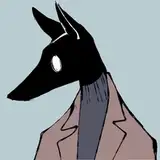
Here are some of the depictions of Huehuecoyotl from various codices.
1. Codex Borgia p.10
This is one of the most sexually explicit images from all Mesoamerican codices. Huehuecoyotl is completely nude apart from his headdress; his penis is exposed and ready to penetrate a male human whose hair is grabbed by the coyote. This man is also shown with his genitals exposed, further emphasizing that this scene depicts homosexual intercourse.
Huehuecoyotl’s headdress is similar to that of the fire god Xiuhtecuhtli from the same codex. It consists of a red headband, a blue cotinga (xiuhtototl) bird ornament, four firesticks, and a bundle of long feathers. The yellow stripe painted across his face is identical to Tezcatlipoca's. Relations between Tezcatlipoca and Huehuecoyotl will be a recurrent theme here, as they share a lot of characteristics, including the outfits.
2. Codex Borgia p.64
This is the most iconic depiction of the Old Coyote. Many elements in this plate appear in other codices as well. On the top of his head there is a red ribbon. The ribbon is topped with two strips of yellow fabric with turquoise and jade beads. On the back of his head is a bundle of quetzal feathers (quetzaltlalpiloni). He is wearing turquoise mosaic earplugs, bracelets, and anklets.
The seashell necklace is another link to Tezcatlipoca. Tezcatlipoca and his various manifestations wore seashell necklaces. On his chest is a cut conch shell pectoral called oyohualli. For the underwear, he is wearing a red loincloth (maxtlatl) with an eagle feather border. Over the maxtlatl, he wears a hip cloth (tzinipilli). He also wears typical sandals (cactli).
3. Codex Fejérváry-Mayer p.32
Interpreting Huehuecoyotl’s attire in this codex was the most challenging, because of its heavily stylized depictions.
The yellow stripe across the face, loincloth, hipcloth, turquoise mosaic anklet and earplugs are the same as Codex Borgia. He is holding a heron-shaped scepter in one hand and a forearm in the other hand. In Nahua society, the arm of a mocihuaquetzqui (woman who died in childbirth) was used by sorcerers because it was believed to possess a magical power. In the same codex, Tezcatlipoca is holding this arm as well, further corroborating Huehuecoyotl and Tezcatlipoca’s close association. His sandal seems to be made of animal skin or down feather, considering the drawing convention of the codices.
The most puzzling part was his bracelets, armlets, and headdress. I interpreted the bracelets as made of jade bars because similar ones are used elsewhere in Mesoamerica, notably by the Mayas. Bracelets are presumed to be made with wrapped clothes or paper because of the protruding ends. As for the extremely simplified headdress, it seems like a variant of a knot headdress. Two red and blue stripes are drawn as long paper bands tied to the knot. As for the green sphere on a white stick, this codex draws flower buds in the same way, so I put a bud of a marigold flower.
4. Codex Borbonicus p.4
This is another well-known depiction of Huehuecoyotl. The biggest difference is that his body is covered with red paint. Key elements such as the yellow facial stripe, knotted headdress, quetzal feather headdress, turquoise mosaic jewelry, and oyohualli pectoral are the same as other depictions.
He is holding a flower bouquet in one hand and a gourd rattle (ayacachtli) in the other hand. I interpreted the flower as a red poinsettia (cuetlaxochitl). Two flowers attached to the rope that hangs the oyohualli are the same. He has a red paper banner strapped to his back as well.
5. Codex Borbonicus p.30
This attire is the depiction of a priest dressed up as Huehuecoyotl during the Ochpaniztli festival. Instead of the usual clothing depicted in codices, he is wearing a paper cloak and loincloth, which were common in Nahua rituals. In the left hand, he is holding a white shield (chimalli) with a small banner on top. On the right hand, he is holding a bouquet of flowers, which I interpreted as polianthes (omixochitl).
6. Codex Zouche-Nuttall p.78
Unlike the other Central Mexican codices, this example is from the Mixtec (Ñuu Savi) codex. This white coyote god is wielding an atlatl. Iconographic elements such as the yellow facial stripe, shell collar, and cut conch shell pendant (ehecacozcatl) indicate that this deity is the Mixtec equivalent of Huehuecoyotl.
The rest of his outfit, such as the extravagant feather headdress, colorful headband, and buckler-like shield, are in Mixtec style. The symbolism behind the black handprints over his body is unknown.
7. Codex Vaticanus B p.29
This is iconographically similar to page 10 of the Codex Borgia. Naked Huehuecoyotl is pouncing upon a male human. The difference is that the human is facing the coyote. Huehuecoyotl’s genitals are absent here, but given the overt resemblance to the Codex Borgia, I opted to draw his penis here. Interestingly, yellow and white circles are all over Huehuecoyotl’s body. Its significance is unclear because it’s the sole example across various codices.
8. Codex Vaticanus B p.52
This scene is similar to page 64 of Codex Borgia. His collar is made of jaguar skin and shells like Codex Zouche-Nuttall. Other elements are consistent with other codices.
9. Tonalamatl Aubin p.4
Aubin Tonalamatl is made by Otomi people living in eastern Tlaxcala. Unfortunately, it is much cruder in style compared to other contemporary codices, which makes it tricky to interpret.
Some key elements, such as the seashell collar and pendant, are there, but other important ones, most notably the yellow facial stripe, are missing. Particularly convoluted are the objects that he is holding. I interpreted the sharp sticks in his right hand as sacrificial needles made of maguey thorns. As for the other hand, the only detail I could identify was three paper ribbons and small feathers. I put the two together and made it a simple red scepter with ribbons, but it is very tentative.
However, there are two very interesting elements that are unique to this codex. First, his sandal is adorned with the ilhuitl (day) glyph. Second, on his head are two branches of ezpitzal (blast of blood), which is another symbol of Tezcatlipoca that is included in his headdress in several codices.
10. Codex Telleriano Remensis p.10v / Codex Rios p.16v
Codex Telleriano Remensis and Codex Rios are closely related documents. Some suggest that Codex Rios was either derivative of Telleriano Remensis, or at least they are based on a common source. Huehuecoyotl in these codices was difficult to interpret because many elements were so densely packed. The codex portrays him as a man wearing a coyote helmet, but I drew him as an anthro coyote because that’s how I like it!
The biggest hurdle was his necklace and banners. His necklace is almost completely obstructed by the coyote jaw. However, there is a small part of red that suggests it is a red necklace. Under that is a strange white element that adorns the outer part of the necklace. It seems like the tlacuilo (artist) of Codex Rios was unable to identify this, as that part is left vague and uncolored. I interpreted them as coyote fangs based on iconographic conventions, yet I’ve never seen any example of animal teeth necklaces in pre-Hispanic Nahua culture.
His banner is similar to the Codex Borbonicus, with feathers added here and there. Again, it was impossible to determine how these feathers were attached to it. I interpreted it as a separate feather banner strapped alongside the paper one.
TulipFarthing
2025-09-08 16:27:14 +0000 UTC