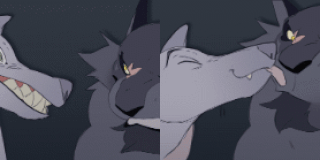
I feel like I'm finally getting up to speed with my inking! The downside to (long-running theme here) jumping in and out of disciplines as I have been doing (pencilling, then inking, then colouring, and so on, as opposed to inking the whole book at once) is that I get out of shape with my craft. But I like the marks on these pages. Also, at some point I realized my brush had worn out. Starting a new one helped more than I would have guessed.
There's an absolute cartload of inked pages in the carousel above, and as always, if you don't want spoilers, don't dig in. Especially since this sequence is — if I can say so — a pivotal sequence. On the other hand, it really needs its dialogue and narration to make the most sense, so if you do examine the pages I'd be curious to hear what you think it's all about.
More ink chatter and pics after a brief — hmm, maybe not-so-brief — detour.
THE FRENCH REVOLUTION
For someone who has been making comics that are historically adjacent to The French Revolution, I do not know much about it. Some elements sound familiar — I must have encountered them at some point — but I have always had difficulty studying history. I cannot keep the names and dates straight, and I have absolutely no brain for abstract entities like, say, "The National Assembly." I assume some people must be able to manage these things the same way I feel like I have an excellent sense of direction, and can navigate the world easily and with confidence. But History Brain is for other people, not for me.
But then I was talking with someone about the possibility of Napoleon and/or The Revolution playing a role in a DD story, and I had to ask myself, "do we like Napoleon? Do we not? How do we feel about The Revolution, broadly?" I wanted to know how these figures and events lined up with my own values. "Liberté, égalité, fraternité," was the rallying cry of The Revolution and is now France's motto. Sounds great to me, so why do people talk about The Revolution with so much condescension and tut-tutting? Is it just because of the rampant beheadings?
There's the other reason I wanted to dive into this — spoiler alert — I want to put a guillotine at the end of PRACTICAL DEFENCE, so I figured I should learn more about where I was sticking my head.
EDIT: two more motivations I forgot to mention before this went up:
I have a cultural background which is almost exclusively British, so have inherited generations of antagonism and propaganda (as Hari reminded me in the comments below) against Napoleon and The Revolution and,
the wealth inequality between the nobles and everyone else was absolutely appalling in the run-up to The Revolution. This coincided with a series of extreme climate emergencies. There were other parallels you could draw between then and now, but those two points alone make this study feel very relevant.
Here's what I put on my plate: first, I picked up A NEW WORLD BEGINS, by Jeremy Popkin. Then, I found VIVE LA REVOLUTION, by Mark Steel. I finally watched Ridley Scott's NAPOLEON movie. I'm listening to Mike Duncan's REVOLUTIONS podcast. That's where I heard about Hillary Mantel's A PLACE OF GREATER SAFETY; I grabbed the audiobook. And — don't laugh — I'm playing the notorious ASSASSIN'S CREED: UNITY, which I bought for pocket change a few years back and never bothered to start.
I haven't started A NEW WORLD BEGINS or A PLACE OF GREATER SAFETY yet. The former is a great big 600-page whopper. The latter is huge, too. Thirty-four hours long, and when Libby pulled it down to my phone, it dragged the whole system to a stuttering halt. They're intimidating. I'm scared.
I dove into VIVE LA REVOLUTION eagerly, though. I recognized Mark Steel's name from various BBC radio programming I thought I hadn't ever listened to, except I must have, because when I started reading I discovered — much to my surprise and joy — that I could hear his distinctive voice in the text. His language is straightforward and his angle I would describe as either "humane and common-sense" or "leftie," and your own political leanings will decide how close those two are to overlapping.
Fun things I learned from this book: France was a feudal state before the revolution? Is that right? It seems so recent for that to be the case.
And I can't tell if this is exaggeration or not, but apparently nobles would get their peasants to sit and swish reeds around the ponds on their estates through the night so that the croaking of frogs would not disturb their sleep.
Also, this gem:
…the most popular radical books, published and sold by the same people who published the rest of Enlightenment writing, were from the genre of philosophical pornography.
Count Mirabeau, a key revolutionary figure, wrote Ma Conversion, which is briefly described on Wikipedia as "obscene."
Between VIVE LA REVOLUTION, David Mitchell's UNRULY, and Natalie Haynes' telling of Greek myths, I have decided I only want to read history as presented by British comedians, please and thank you.
I enjoyed watching the NAPOLEON movie in the same way I enjoy eating an entire bag of salt and vinegar potato chips. That is, it was fun while it lasted but I don't feel great about it now. It was so nice to look at and revel in, but I'm not sure what I ought to take away from it, and it feels impossible that Napoleon was as drab and shallow as he is portrayed.
Then I read this on the film's Wikipedia page:
Scott dismissed criticisms of these historical inaccuracies. "Napoleon dies then, ten years later, someone writes a book. Then someone takes that book and writes another, and so, 400 [sic] years later, there's a lot of imagination [in history books]. When I have issues with historians, I ask: 'Excuse me, mate, were you there? No? Well, shut the fuck up then.'" Scott also declared, responding to French critics, that "the French don't even like themselves".
I am sympathetic to taking creative license and playing fast and loose with historical accuracy, and even I think that "well, shut the fuck up then," is the wrong response to criticism. Far, far too dismissive. It's soured me on the whole thing.
And then there's ASSASSIN'S CREED: UNITY.
A tangent on game design: when the game was released, all I remember hearing was how buggy the game was. They've since fixed it up pretty well — I've encountered some nonsense, but nothing game-breaking or horrifying. But it's still the peak of Ubisoft's tasteless game design decisions. Ubisoft's patented map-barf is as bad as I've ever seen it; the map is often indecipherable for all the little icons strewn across it. Microtransaction prompts are everywhere in the interface. The thing that bothers me the most, though, is the use of game-industry jargon inside the game. When you collect a collectible, it calls it a "collectible" on screen. When you buy more health or lockpicks, it calls them "consumables." There is no effort to build fiction around these elements. It bothers me because it feels lazy.
This is all a shame because they've built a pretty nice virtual Revolutionary Paris. For a ten-year-old game, it still looks and sounds really good, especially when you focus on any given scene overall, instead of at some of the character details of the bystanders. And I heard that the photogrammetry or studies that they made of Notre Dame for this game were instrumental in aiding the reconstruction of the cathedral after the big fire. What higher compliment could you receive for video-game craft?
Unfortunately, as in all Assassin's Creed games, I have no idea what's happening in the story. Understand I love this series — it might have inspired the first DD book — but story has never been its strong suit.
The REVOLUTIONS podcast is easier to follow, but is feeling too much like history class. This is not helped by the host's occasionally poor pronunciation — up until the fifteenth episode or so, "Mirabeau" is pronounced as "Mir-a-boo." I can not claim to be an expert on French pronunciation, but even I know that's not how that goes ("Mirabeau" rhymes with "deer, a doe," more or less).
Still, I think our host structures his episodes well and puts emphasis in the right places. It's hard work, but I feel like I'm starting to understand the flow of things.
What I'm starting to understand, primarily, is that The French Revolution is very difficult material to work with. There are so many of the abstract entities that I struggle so much with — The National Assembly; the Estates General; the First, Second, and Third Estates; the parlements; this Assembly, that Assembly; the Jacobins; the sans-culottes; and so on. Prominent figures flit back and forth between one and another — first Mirabeau is on the side of the revolution, then later is working for the King. The King himself waffles back and forth in his positions on key ideas. I am finding it extremely hard to pin anyone down, which feels like the most believable way for it to all play out, but also must make it difficult to tell a story about all of this. Listening to the way the REVOLUTIONS podcast skips from date to date and figure to figure, I find myself wishing there were more depth and character to these times and people. But how do you do that, considering the complexity and scale of The French Revolution?
I guess you write massive great tomes like A NEW WORLD BEGINS or A PLACE OF GREATER SAFETY, which I am surprised to find myself looking forward to.
Dear Reader, if you can recommend anything good on this topic, I'd love to hear it!
- - - - - -
DEEP INTO THE DRAWING BOARD
Thank you to everyone who commented on the last post to say, "you go ahead and prioritize the work over the Patreon posts." It has been a relief to dedicate all of Kiddo's preschool time to inking pages. I can ink roughly one page during his morning at preschool, which has made for a good routine (I am a fan of routine). It also means I've been able to make good progress on this pivotal sequence in the book.
 Above, I've been trying to experiment with watercolours again. The results on the page are fine, but I think colour will really help this treatment shine. I've been looking at some Mignola stuff lately — it's remarkable how little colour his artwork needs. It all works with the inks. That's not me, I guess, and it never has been, and that's fine.
 Maybe one day I'll figure out a balance between Mignola's success with shape and form versus my own tendency to focus on line and contour. But that's a different challenge for a different time, and I'm happy with the quality of lines and contour I've got out of panels like the one above. For some reason, ever since the new year, I've found my brushes more eager to dry out. I'm not complaining, though. I like the quality of a partially-dry brush line.
 You can see some of that dry-brush quality in the panel above, if you look at Alexandra's nose, around her shoulder, in the grass and, obviously, in the background. I know people who would call this "very loose." I like it, and again, I think colour will have a big effect here.
 More keeping-it-loose, above. I wonder what this will look like when I revisit it later, with more distance and fresher eyes. Right now I think it looks lively, in a good way. Like the roughness helps it sparkle brighter than if I polished it with precision. ;)
- - - - - -
Okay, I'm off to keep it loose and lively. As always, thank you all for being so lovely and supportive, in so many ways.
Until next time,
I remain,
very much a non-abstract entity,
TC
Madi VanDoren
2025-01-23 16:31:59 +0000 UTCglenn
2025-01-21 19:44:49 +0000 UTC