Visual Reference Keeps Giving Gifts
Added 2022-12-15 18:56:00 +0000 UTCWhile drawing pages of Chapter Three this week, I had an experience that really emphasized the importance of visual reference. And I already know visual reference is important. Here, then, is a small story about what I think is an interesting discovery about drawing, designing things for comics, and story-telling.
Note: minor story spoilers included in this post. Just a heads-up.

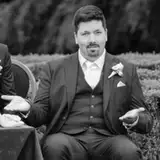
^ Everyone's having a good time at the ball.
VISUAL REFERENCE
Every baby artist knows that if you want to make drawings feel believable, you can't rely strictly on imagination to inform your process. If you're drawing a Ford Taurus, you want to go sit on the sidewalk and do a drawing from life or (more realistically) just type "1991 Ford Taurus" into an image search.
The act of observation answers questions like, "where are the wing mirrors in relation to the wheels?" and "do the wheel wells really take up so much space?" and "what shape are the headlight housings," and so on and so forth. The important part here is not that you are trying to intricately diagram a Ford Taurus, but rather that you draw such a natural-looking Ford Taurus that it doesn't distract from the rest of the image. Because we have all seen so many Ford Tauruses during our lives, when we see a poorly-drawn Ford Taurus we don't consciously think "hey, that Ford Taurus' headlight housings are not that shape," but we might think, "weird looking car."
And that's the be-all-and-end-all of why I thought I was supposed to use reference: so that no one tripped over my drawings.
There's also the question of "historical accuracy," but the whole topic gives me a headache. I acknowledge that it's part of process, but it's tangential to the thing I really want to talk about.
SPECIFICITY AND ITS GIFTS
There are a million reasons why it pays to be specific with your drawings. If you specifically draw a 1991 Ford Taurus, it tells us a lot about the character who owns it, especially if your story is set in 2022. That's a gift.
Another gift is when you search for answers to the question, "what might a pirate wear?" and learn things like, "oh hey, I can suspend a lantern over the street by a line strung between buildings," and "that pattern of cobbles makes a nice compositional element," and "ooh that's an interesting shape for a treasure chest." Reference can help build up a mental library of things to recombine, offering new compositional options.

^ Illustration by Howard Pyle, doing his pirate thing that he's (justifiably) famous for.
But something new happened this week for me.
I have this sequence where we're all at Vignelli's fancy manor home, and Alexandra sees her mother through the window panes of a French door. We all know what a French door looks like, right?

^ DuckDuckGo image results for "french door."
Yeah, like that. It's a big rectangular window broken up into smaller rectangular windows. That's what I was imagining, and that's exactly how I was going to draw Vignelli's french doors.
There's only one problem: my comic panels are already an array of rectangular frames, and drawing a French door (itself an array of rectangular frames) inside those other frames looked… boring. Or worse yet, maybe even confusing.
On a whim, I checked my visual reference, not expecting to find anything remarkable. For Vignelli's manor, I'm taking a lot of reference from Ca' Rezzonico, a big ol' fancy house in Venice (and now a museum—this "Online Exhibit" is legitimately astonishing). The doors off Ca' Rezzonico's ballroom look like this:

^ You can walk through the interior of Ca' Rezzonico using a street-view type of thing via Google's "Arts & Culture" site.
If I had been paying closer attention the first time I "walked through" Ca' Rezzonico looking for ideas, I might have noticed that the windows were not simply divided into rectangular panels, but I did not. Understandable: it's often hard to notice things you're not specifically paying attention to, and our brains are so eager to fill in the blanks with the lowest-common-denominator supposition.

^ Much more interesting than simple rectangular panels!
More interesting, for sure, but being "more interesting" or "more accurate" for its own sake is not the point right now.
We see Alexandra's mom through the window panes not once, but twice. The gift here, it turns out, is that the diamond-patterned window panes offer the reader a visual anchor that says "we are looking through the French doors."

^ First, we see her through a tight shot on the panes. If it weren't for the diamond-shaped decorations, would you have guessed we were looking through a window? Possibly, but…

^ Then we see the same angle, but wider. The diamond pattern makes it much easier to connect the first panel to this one.
We're already seeing our subject (Alexandra's mom) through one frame (the panel border) and then through a second frame (the French door). There's lots of potential for this to read confusingly. But the decoration gives the door more character and helps it read more distinctly, more easily.

^ As we keep seeing the distinctive French doors (and the regular windows, too), it's easier for us to orient ourselves.

The diamond-shaped leading is just a little visual detail, but having drawn the whole sequence now, I'm surprised by the positive effect that it has. I'd love to say that I would have come up with something from my imagination that had the same effect, but that's just not true.
Of course, when I have to draw a Ford Taurus, I know I need to look up reference. But this scenario—with the French doors—was not one of those times. I figured I either knew what the French doors would look like, and if I didn't, it didn't really matter. But I'm so glad I checked, because it did matter.
So I share this story with you to say yes, reference helps a car looks like a specific car. And yes, being specific helps our story in many ways (this is Creative Writing 101). But I hadn't considered the role it plays in helping our story read more easily. Just like distinctive character design cements a character in our minds (think Calvin's spiky hair or Asterix's helmet-wings and moustache), designing distinctive props and background elements makes for a better reading experience, too.
Frig. Having written it out like that, this all sounds extremely obvious. I already know I have to pay closer attention, do more research, dig deeper. I'm on board with those ideas. But maybe we all need little lessons sometimes to make us feel the importance of the principles we think we understand.
- - - - - - - -
SOCIAL MEDIA
Briefly: I've stopped using Twitter. If you were using Twitter to get updates about what's going on here at this Patreon, please consider enabling email notifications from me—that's the easiest alternative.
If you are thinking of "leaving" Twitter, I know a lot of people are rushing to find an immediate replacement. I invite you to also consider: just take a break! See how it feels. You might like the peace and quiet.
- - - - - - - -
COVER ART!
"Pencils" for Chapter Three should be finished by the end of next week. Exciting! Instead of rushing straight into inks, though, I might take some time to create "cover art" for PRACTICAL DEFENCE. It's not likely to be the cover art you end up seeing on any printed edition, but I've been feeling the need for some sort of cover art over the past few months. It's useful for promotion.
This will almost certainly involve some sort of poll about different options and which one you like most. Get your voting fingers ready!
Ever stumbling upon the obvious,
Your friend,
TC