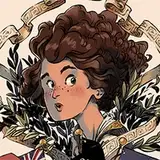
A curious thing about comic art is that comic art (or at least my comic art) never looks done until it's done done. It doesn't look complete until it's got the lettering—at least—in place, and the panel borders, and sometimes not until the colour is finished.
This is especially obvious in the page above where Alexandra's mom is hunched over, surrounded by exploded pottery. The background is supposed to be black, but I'm not going to waste time pouring black ink all over the paper when I can just do that digitally, later.
But I find it's also evident in pages like the first one above, and the one with the long hallway/falling bolts of fabric/polite Regency pose. To my eye, without the text in place, these pages look off-balance, compositionally weird, wonky (like Alexandra trying to balance on the tree branch in the third page above). I want to sit at my desk and hold the inked page at arm's length and think, "aha, another absolute banger," but I can't. I'm proud of the drawing (I really am!), but I can never be fully satisfied with the finished page, I suppose because (and here I hear you saying, "no duh") it's not finished yet. This stage is finished, but the page is not.
An inked page is not a finished piece of work the way, say, a completed painting is. Or, again, at least not in my case. It's material to be fed into the next stage of the process, the way pie crust takes some making, but is not often its own finished thing. I'll bet there are artists who make finished comic book pages that look like solid standalone artworks, even without their text elements. There must be, right? But looking through my memory, I feel like I've more often seen page artwork that looks "naked" without its text elements. Like, "we were really relying on that caption box to balance out the focus of the page," and without it, the weight of the composition is in the wrong place. So I am suggesting that it's not just A Me Thing.
Complicating the idea, every now and then I get a page where I think it works, and does look complete even without the text elements. Above, the last page is one that I think works well even though the text isn't in there yet. It's balanced, it has a strong focus, and it even tells its own little story without the text.
I don't have a keen conclusion here, and I'm not complaining about a problem. This is just something I have been thinking about this week. I don't think I want to do anything differently. I could hand-letter each page so that the inked pages do look more complete, but that would be very slow and/or I'd end up with pretty rough, inconsistent results. I could draw the panel lines on the page, but I like the consistency I get by doing that digitally. I could fill in all the blacks, but it's really not necessary, and I think it makes the paper page look bad; the india ink streaks are so distracting.
No, in the end, this is just my own brain giving me a hard time, as it is wont to do. Of course I want each inked page to be a sparkling little gemstone in its own right, but that's just me wanting something that I didn't set out to make. This isn't about the individual pages, it's about the story and the effect achieved panel after panel, page after page.
Or maybe I'll look back on this in a year and think, "you dullard, you can absolutely have your cake and eat it too. You just hadn't figured out how to do it yet."
Only time will tell!
HEY HOW'S THAT BOOK COMING ALONG?
Great! Gonna get past the 66% mark before the end of February. Just look!

READ ANYTHING GOOD LATELY?
Audiobooks, man. Really great to be able to "read" books while you're working.
Listened to Emily St John Mandel's STATION ELEVEN, which is a softcore version of Cormac McCarthy's THE ROAD. Recommended if for some reason you want to be tricked into feeling nostalgic for the apocalypse?
Recently loved this tweet from Gale Galligan (HI GALE), because I, too, am angered by cliffhanger scene-jumps in stories. GAME OF THRONES is king of this asinine, reader-hostile storytelling trick (before I quit during book three, I was just skipping to each character's chapters in order). I was curious whether STATION ELEVEN as a book would do that. Since the TV adaptation is HBO, I assume they do the cliffhanger scene-jump in the show. Can confirm: it does.
Currently on Guy Gavriel Kay's A SONG FOR ARBONNE, a massive beast of a fantasy book. Hard to keep all the names straight (especially listening to the audiobook), the politics are tricky to follow (but, to Kay's immense credit, not as tricky as they could be), and, like other of Kay's books, it has become so absorbing that I know this one will leave me with a book hangover (in a good way). I'm in deep. I roll my eyes at some of the stuff that I am obliged to roll my eyes at because I'm a grump, but in my stupid little heart of hearts this stuff really does the trick for me. Good news: Kay does scene-jumps right. I never felt cheated.
I listened to Terry Pratchett's THE LIGHT FANTASTIC (his second Discworld book and the follow-up to the cliffhanger COLOUR OF MAGIC), and very much enjoyed it. I think this makes me a solid Pratchett fan, as the number of his books that I like now heavily outweighs the number that I don't. COLOUR OF MAGIC and THE LIGHT FANTASTIC combine to make a really fun jab at traditional fantasy quest stories. He'll do a cliffhanger scene-jump, but he's usually so good at hooking you into a new scene that it's not a big deal. And the silliness throughout takes the edge off that sort of thing.
The Cliffhanger Scene-Jump feels like a phenomenon that people must have written about. Have you read anything about it? Let me know, I'm curious to explore the thinking around it.
Spring can't come soon enough,
TC
Nur Schuba
2022-03-10 13:59:53 +0000 UTCTony Cliff
2022-02-21 00:34:40 +0000 UTCNur Schuba
2022-02-20 19:07:37 +0000 UTCLex
2022-02-20 02:02:21 +0000 UTC