(in case you don't feel like reading all this, here's the Call To Action: if you have any triax cables with the big plugs and would like to donate or at least sell them for less than ebay prices, please get in touch. ty!)
So, a few days ago I heard about a set of three old broadcast cameras, complete with box lenses, camera sleds, CCUs and image control strip inserts, being auctioned by Oregon State University with a starting price of $500. There were just a few hours left and no bids; I definitely would have gotten the lot. It was tempting, but I have way too many plates spinning to get involved in this so I let it pass... only to later find out that if I had taken a bite, I'd have ended up bidding against Alyx, one of my own patrons. Since I didn't, she got it for just the reserve price, and she's local to me, so that worked out for both of us! I've been curious about these massive camera rigs for years (naturally) but never gotten to interact with one. Now I have, and hey - it's really neat! Shocking no one!
In a lot of ways, of course, it's Just A Camera: you plug it in, it produces an image, and the lens (despite it's massive bulk) has the same focus, iris and zoom controls as any other, you just can't operate them directly, you have to use remote pendants. Fortunately, a pair of those were included (though we could use two more sets, heh.) None of this is really astonishing on its face - once you get past the sheer size of the rig and the slightly odd way it's used, it's not really any different than a consumer camera. What makes it more interesting is all the meta stuff.
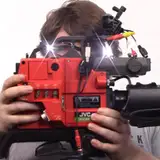
The cameras themselves are Philips LDK100s, which are ENG/EFP cameras, with built in shoulder pads and eyepiece viewfinder mounts and whatnot, as opposed to "studio" models designed to live their whole lives on tripods or pedestals. I'm not sure if dedicated studio cameras are still being made today, but when these rigs were built circa 2000 they definitely were, so while they're definitely designed for studio / event work, they were clearly lower-end options.
As a result, they aren't really fit to purpose. The LDK100 is meant to go on your shoulder or on a dinky tripod, so it has UI designed for that perspective and is not really big enough to attach to this enormous lens. So, in order to make it suitable, the camera is mounted into a Philips SuperXPander, an enormous cradle/dock that converts it from ENG/EFP into studio format. It adds a mount for the gigantic lens, a mount for a full-size 5" CRT viewfinder (with PIP support and realtime customizable safe frames!), rear-accessible controls, and a local power supply - though I'm not 100% sure why they bothered on that last part yet.
See, the LDK100 is a camera head, but like the equivalent Sony I reviewed many years ago, it's a "dockable" design that can be paired with a variety of "backpacks", including various tape-format recorders. But as I've addressed before, in studio work you don't record anything directly at the camera; instead, you hook up a CCU backpack, which takes the signals from the camera and simply spits them down a cable to a Camera Control Unit in a rack somewhere, to be further manipulated, switched and either broadcast or recorded by engineers and directors in a control room.
My 90s Sony camera would have been used with a thick, 26-conductor CCU cable, but this camera is enough newer that it uses an LDK200 triax backpack. This is an industry technology I had actually meant to touch on years ago when a patron sent me a triax camera kit from Norway, if I recall. It worked perfectly, to my delight, but I could never figure out how to make a video about it; I need to readdress that, but anyway.
Triax is a fascinating technology. The 26-wire cable used in older cameras carried a bunch of different signals - video in various formats e.g. composite/rgb, return video so the camera op can see what the live broadcast looks like, a few channels of audio including intercom channels so the director could talk to the camera operators, tally indicators, power to run the camera, and so on - but that resulted in very bulky cables and potentially high loss over long distances. Triax does the same job, but much more gracefully.
A triax cable is, as the name suggests, like a coax cable but with a third conductor. I'm not sure why that was necessary though, because I can't find anything that explains what the third conductor does. As I understand it, triax takes all the camera signals and packs them into a single, highly complex frequency-divided RF signal, using FM to keep all the signals separate. It seems like this should work fine over coax, but what do I know.
The result however is that you get a single, highly flexible, highly robust cable that can run really, really, really far - I've seen numbers north of a mile. It also includes power, so your camera can operate entirely off of a single cable. That's why I said it's weird that the SuperXPander has its own power supply; you have to plug a triax cable into it in order for most of this stuff to work, and that cable will power the camera, so why do it from the sled? my only guess is that, because Philips designed these to support various different use cases, maybe they envisioned a scenario where the camera is being used standalone with a local video output? But that's weird, because these cameras don't have local outputs; you literally cannot get a video signal out of them without the triax base station, only a black and white viewfinder feed.
With that said, what makes this kit we got neat is that it includes the base stations, which break out all the signals from the triax, provide intercom connections, and allow attachment to other control equipment including the "paintboxes." No, I don't mean the Quantel; paintbox is a very weird industry term for a unit that allows you to remotely control all aspects of a camera's image, including it's color balance, response curve ("knee", "flare", and other obscure terms) and iris. We got those too, so this is a VERY complete system... except for the cabling.
The paintboxes connect to the CCUs with a mix of D-sub cables and 4-pin Hirose plugs. We don't have any of them, and worse, we don't even have the triax cables to connect the cameras to the base stations. So while I was able to fire up each rig and check its most basic functions (good news: everything works except for one camera that has a failed imager block) there's no way to get a color image out of any of them, let alone run any of their more advanced features. And while I have no idea what a video about any of this looks like, I'd like to cover it, and to do that I need to get a hold of all the cabling.
The triax is technically the easiest part, since it's standardized and readily available, it's just incredibly expensive, so I'm hoping someone out there has some cable they've been sitting on that's looking for a new home. I know they're worth a lot, but almost all the cables on eBay are hundreds of feet, so maybe someone has a 25 foot patch they could part with? The important thing is that it has to be the Big triax plug; my other rig has a nice long cable, but it has the Small plug, which won't fit and AFAIK can't be adapted.
As for all the other cables, those seem like unobtanium, I don't even know where to begin searching for them, so if you have any leads I'll take em.
As always, no promises that this'll pan out into anything major, but I thought you'd all like to know about it, and if I can get a hold of the triax cables I'll at least make some kind of video showing these things in action, even if I can't figure out how to make something suitable for my main channel.
Oh, regarding the last three images I attached - the first two are shot from the viewfinder output on one of the Philips cameras, demonstrating that the lens works and produces a sharp image, but the third is output from the Sony camera that came with my other triax rig. I found that that camera would mount to the lens, so I was able to get a color image through it, but unfortunately it's not really a practical replacement for the Philips cameras since it doesn't actually fit the SuperXPander right, so it hangs off the lens instead of mounting firmly to the sled, and the viewfinder cable doesn't fit. Was nice to see it all more-or-less working, though.
Jared
2025-12-09 18:48:52 +0000 UTCdobroben
2025-12-09 17:20:35 +0000 UTCScott Kemp
2025-12-06 04:11:25 +0000 UTCadorfer
2025-12-03 03:20:31 +0000 UTCEyeMWing
2025-12-03 02:44:13 +0000 UTC