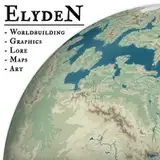
Thanks to my patrons I've reached my first Patreon goal - that of creating a globe of Elyden. Thank you so much for helping me reach this goal!This is something I've wanted to do for a very long time, since when I became serious about worldbuilding in Elyden. There's a few reasons for this. Most personal is that I think seeing the world represented in a globe will help me better see the relations between nations (distances and areas) that are not as immediately apparent on flat projected maps - simply, the ability to see a whole continent represented on a sphere will be something invaluable to my work on the world. And cool :)
Secondly, is something a bit more esoteric - fantasy maps are commonly depicted as flat surfaces - water in the west and land in the east (like Middle Earth and Hyboria, amongst MANY others) and things like distance and area are rarely taken into account by writers, which is very frustrating to me as an amateur writer and cartographer who understands the complexities of wrapping a curved image onto a flat surface. I've not seen many well-made of fantasy worlds (to be honest I don't think I've ever seen a professional-looking one before, though please correct me if I'm wrong!).
Why haven't I made one before? Anyone who's tried to make a proper globe with paper gore pasted to a sphere will know just how difficult and precise an ordeal globemaking really is.
Assuming you're using 12 gores, each of 30 degree (I'd prefer 18-24 separate gores, but worry that will incrementally increase the margin of error), I might cut the gore too small, or the sphere might not be perfect - every error has a cumulative effect on the next gore, and the next gore... until the last gore glued onto the sphere overlaps with the first one, which is not good! If you see a cheap mass-produced globe, you're likely to see this overlapping of gores, and it's something that I hate. Coming from a tiny country that can easily be completely obliterated by careless gluing of gores, this is something I want to avoid.
And most importantly - gluing flat pieces of paper to a sphere is incredibly difficult to do without either ripping the paper or creating folds.
How do I plan on making the sphere? work on the globe will fall into 4 broad steps - 1) creating the globe, 2) creating the image on computer, 3) attaching the gores to the globe, 4) attaching the globe to a stand.
1) I plan on basing the sphere on a polystyrene globe, covered in papier mache (to give rigidity) and then a layer of fine finishing plaster, sanded down to as close to a sphere as I can manage (to make it smooth). Now this sounds easy in principle, though getting the sphere as close to a pure sphere as possible might be difficult. I can't stress enough how precise the globe needs to be. A slight imperfection across the diameter on either of the 3 axes (X, Y, Z) could lead to exponential errors when gluing the gores down, leading to overlap between the first and last ones, which is something that needs to be avoided. at all costs.
Also in this stage I need to divide the sphere into graticules (at least lines of latitude) to make attaching the gores easier.
2) I've already started work on the image, though still need to add all the labels. Where my original idea was to print the colours with the gore, I've now changed my mind and decided to make it greyscale, and add the colours by hand later on once the gores have been attached to the globe. need to make sure to print with laser...
Funnily enough I imagine this to be the easiest part of the map. At first I'll add nations and capitals, and if there's enough room for more ill add major cities. I'm going to be working at a high resolution, at least 400 dpi, to make sure the printouts are nice and crisp.
3) I'm dreading this part, and rightfully so as I've never made any globes before, so have no experience with this. It's a difficult process, and a closely-guarded secret of bespoke globemakers, so it's something I'm going to have to improvise. The main problem is getting flat gores to curve around a globe without creasing or tearing them. They key is to wet them and use a bookbinding bone knife to scrape them along the surface of the globe until they lie smoothly on the surface (this is also why the globe needs to be rigid). as though that weren't difficult-enough I also need to worry about each gore lining up with the next one and, in the case of the last one, lining up with the first one applied...I forsee lots of swearing.
4) The least essential part of the process, and almost an afterthought, is the base and stand. I'll come to those once the globe is ready, though would like brass and hardwood.