Hi Folks,
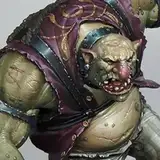
In this episode, we are going to paint the last missing element of our
goblin mercenary: the mace!

And the cautious observer will have noticed that we still have 3 techniques left from our 9 essential blending techniques. We still have the wash, drybrushing, and sponging left but those don't really fit the look I want to achieve on the mace.

So we will be using the mace to demonstrate a normal organic painting flow where we combine all used techniques as we would normally do. To be able to show all the techniques in this video series I decided to add a little tower bust base... but we will talk about this one in the next and final episode.

But before we jump to our goblin we also want to talk about another aspect of how to become a better painter.

As we have figured out... It´s important to tell a story when you paint a miniature, to shape a unique character.
To be able to tell your story you need view time!
Today we want to have a look at how to maximize the view time/attention that your model can get.
As you can imagine, if we think of a miniature painting contest environment, an exhibition, on social media, or even at your home showcase a miniature is rarely enjoyed on its own. Usually, miniatures are surrounded by other miniature projects.
So you need to peak out of the mass! You have to attract attention.
This brings us back to the 3 stages of perception that I have explained in the Sanguinius Video.

Level 1: The first impression of a model in real life happens with a bit of distance.
You see the figure from far away and there are usually 3 main elements that attract attention: The silhouette, the saturation of the colors, and the contrast.
Today we want to look a bit closer at what happens in detail once you have someone looking at your model in detail (Level 2).
To be able to tell a story we need that the viewer sees all the relevant elements of the model and is invited to explore the whole model.
In most parts of the world, we read from left to right and Top to bottom. This is also where we are searching for new visual information, even if we don't read.

In miniature painting, we work with centers of attention and we are using the reading directions to connect our center of interest.
Usually, the viewer looks at the face first.
It delivers the most information about the character and the situation and emotion he is in.
Use brighter or more saturated details to structure the order that people explore the model.
You kind of connecting dots on a map. And let you explore the model from top to bottom from left to right, connecting the different centers of attention.
Squint Test:
If you look at your model and squint your eyes and look at your model you the brightest and most saturated areas will be that you see first.

By using this effect strategically you can maximize the time someone spends exploring your figure before moving on to the next project.
Take our goblin here as an example:

We get attracted by the biggest and brightest highlight of the model on the top left of the helmet and the most saturated area of the face.
We get a first impression of the character!
Then our attention is drawn to the second brightest highlight on the top of the mace.
Our view wanders back to the right over the face to the golden pig shoulder pad, after that we are moving to the strong highlight on the silver shoulder pad. The strong center highlight on the plate armor of the torso leads to the second most saturated and colorful element the belt buckle.
The bright and colorful belt buckle draws us to the second center of interest his hand. Hands always tell us a lot about the situation the figure is in. Here in our case, the hand is holding a small sack with his payment for his mercenary deeds.
It is an easy story opener that wants to make you explore the model further to see if there are more traces of what he was doing before, what battles he fought, and what treasures he had gathered.
All the details along the way (like how worn a certain element is or what material it´s made of etc) should help to shape a believable character.
This way we have explored the whole model in an almost ideal Z shape.
Left to right, top to bottom.
Alright, now it´s time to move back to our goblin and get some color on the mace!
Alright, Have fun!