*Transcription
Hello watchers! Today, we're diving into one of my favorite topics: how to bring characters to life and make them truly unique. I'll share how I craft my characters from the ground up—what inspires their personalities, their visual traits, and how I ensure no two characters feel the same. By focusing on little details, emotions, and quirks, I aim to make each character relatable and memorable.
Let's get into the magic behind creating characters that jump off the page and stay with the audience long after the story ends!
Where do my characters come from? The answer could be endless—perhaps they come from nowhere or everywhere. Mostly, they emerge from my imagination. I’m not the type of cartoonist who carries a notebook to capture observations about people around me, though I admire those who do. I often start a new notebook with great excitement, only to abandon it after a few pages. So, I have a collection of half-filled notebooks and only a few complete ones—mainly my sketchbooks for comic pages, illustrations, and stories. I find comfort in these working drafts, even if they’re just rough pencil sketches.
As I was saying, my inspiration doesn’t come directly from real life, films, books, or comics. Perhaps my subconscious draws from those sources, mixes them into a creative cocktail, and presents me with a new character. My process usually involves relaxing with music or silence, taking a walk in the park, or traveling by train. During these moments, characters begin to take shape in my mind. Most often, these characters are for my current comic projects or potential future ones. However, sometimes a straightforward brainstorming session is enough to develop minor characters.
I’ve shared the story of how Jezzabel Avery was born before—it’s a tale I enjoy telling because of it’s quite magical. Today, though, let’s dive into the characters of my “Mademoiselle D’Artagnan” comics. There are many of them, which makes for a great exercise in character creation.
I did revisit Alexandre Dumas's book and watched several film adaptations. I love Dumas’s explanation for the success of his novel: the combination of the three musketeers and D’Artagnan represents the ideal medieval knight. D’Artagnan embodies bravery, Athos represents nobility, Porthos stands for strength, and Aramis symbolizes intelligence. In the book, D’Artagnan and Athos are the most prominent, though Porthos and Aramis are also important.
However, I’ve noticed that many films fail to capture the essence of these characters. Often, Porthos and Aramis are indistinguishable from each other, and Athos sometimes blends into his peers. Most frustrating is when D’Artagnan lacks charisma. The only film where the characterization really shines is Richard Lester’s adaptation, which pays careful attention to each character. I also have to give a nod to the animated series “Dogtanian and the Three Muskehounds,” which I believe is the best adaptation of Dumas’s book and its characters.


For my comic, I’ve drawn from a few key traits for each character and tried to avoid distractions, if you know what I mean. With so many characters, it’s easy to end up with a mess. I believe simplicity is better than confusion. For the less important characters, I use just one adjective: the king is bored, the queen is sad, Planchet is a rascal, Richelieu is sneaky, and so on.
For more significant characters, I assign two positive and two negative traits, which can sometimes be contradictory. As for the main character, Mlle. D’Artagnan, her traits are influenced by her interactions with other characters. She has several positive traits and an equal number of negative ones. Giving depth to my characters is important to me, but remember, this is only a first draft.
Then I explore how each character would think, act, or speak. I ask myself, "How would I think if I were them?" I start by identifying a characteristic of mine and build from there. Most of my main characters are my alter egos, shaped by my own thoughts and experiences. Despite this, they can be very different from one another, like Jezzabel and Anne.

In visual design, the goal is to make each character instantly recognizable, even at a glance. This is where the concept of silhouette becomes crucial. A strong character design should be identifiable by its outline alone. By focusing on distinct shapes, I ensure that no two characters look too similar.

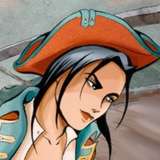
Next, I focus on the details: faces, clothing, accessories, and hairstyles. I also play with colors to make each character unique. For instance, Mlle. D’Artagnan’s usual outfit features distinct colors that no other character wears, and her hair color is equally unique.

Faces can be challenging due to the constraints of my cartoon style, but I use different noses, face shapes, eye shapes, and lip shapes to create variety. Hairstyle plays a significant role in distinguishing characters as well. Unlike some artists who make all their female characters look the same except for their hairstyles, I strive to avoid this. For example, my female characters have varying cup sizes to further differentiate them.
For historical characters, I aim to capture their likeness. Portraits of King Louis XIII and Queen Anne of Austria have been invaluable in creating their cartoon versions. I also draw inspiration from photos of models and actors. For example, Porthos is a blend of a blonde Viking and Jason Momoa, with some personal touches. I avoid making my characters exact replicas of real people, as this can limit their characterization and make them feel rigid. Inspiration is great, but replication is not the goal.

Characters often evolve as they develop their own unique traits. It's common for artists to see their characters change in style over time. For instance, Mlle. D’Artagnan’s curls have become looser since the early pages. This natural evolution is something to embrace rather than resist. I don’t spend excessive time perfecting endless sketches. Instead, I create an initial sketch with the main traits and let the characters grow organically on the pages. It’s through the comic itself, page by page, that characters truly evolve and gain personality.

Ah, that’s the billion-dollar question. My theory? It’s all about free will. From my experience, characters need space to develop and breathe on their own. Allowing them the freedom to explore their personalities is the best way for them to become unique and authentic, giving them a sense of real life. When a creator respects this process, they don’t have to constantly deliberate on every detail; instead, they let the characters guide the scene.
Of course, achieving this isn’t instant. It takes several months of working on scenes, drawing characters panel by panel, page by page. It’s a gradual process of earning and building trust between the creator and their characters. Over time, the characters start to assert their own voice, and the creator’s role shifts to transcribing what’s being dictated.
Ultimately, love and trust in your creation are essential for creating that magic. So, relax, embrace the process, and don’t push too hard.
And that’s all for now! I’ll continue to nurture Mlle. D’Artagnan with love. Do you feel she’s starting to breathe on her own? I do. She’s gradually gaining personality and a special place in my heart.