Hi Thinkers! I finally finished editing my article on Animate Objects, so I deleted Part I and Part II and I'm adding it back here as one long post.
-----
Animate Objects is a 5th level spell in D&D 5th Edition that turns objects in your environment into weapons. DM David recently observed that this spell suffers from two mechanical issues:
Thankfully, both of these problems are fixable. Let's unpack the spell and see what we can do to tweak it. Our goal here is not necessarily to come up with a solution (we do), but to give you the tools to understand and adjust the spell to your taste.
The spell animates a certain number of objects based on their size:
These objects gain different statistics based on their size. Here's the main ones:
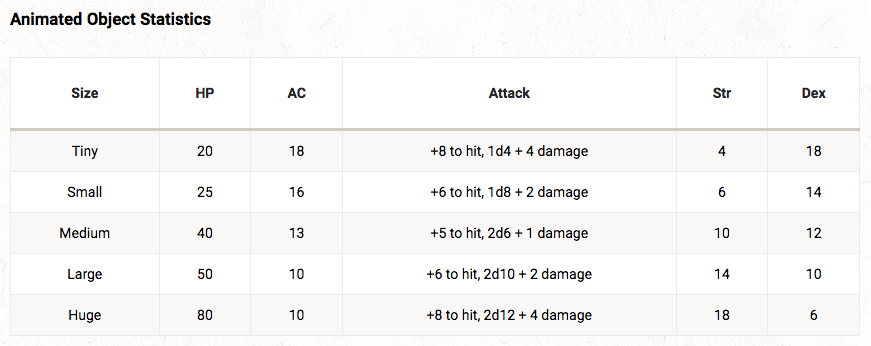
There's three components to analyze: offense, action economy, and defense.
These points suggest that bigger objects hit harder. That's mostly true, though medium objects are the weakest attackers pound-for-pound.
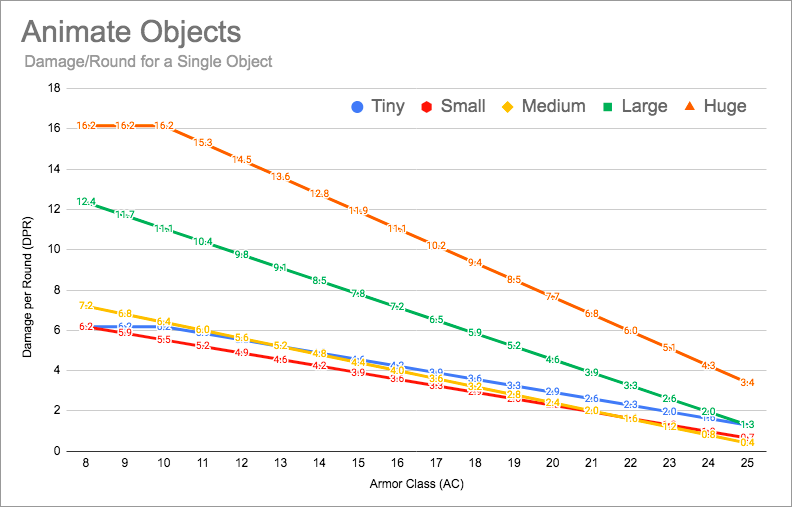
This doesn't bear out in total damage. While larger objects may hit harder, action economy quickly takes over. As a result, tiny objects are always the best offensive option. The bigger your targeted objects get, the less potent they become. Observe the stark difference:
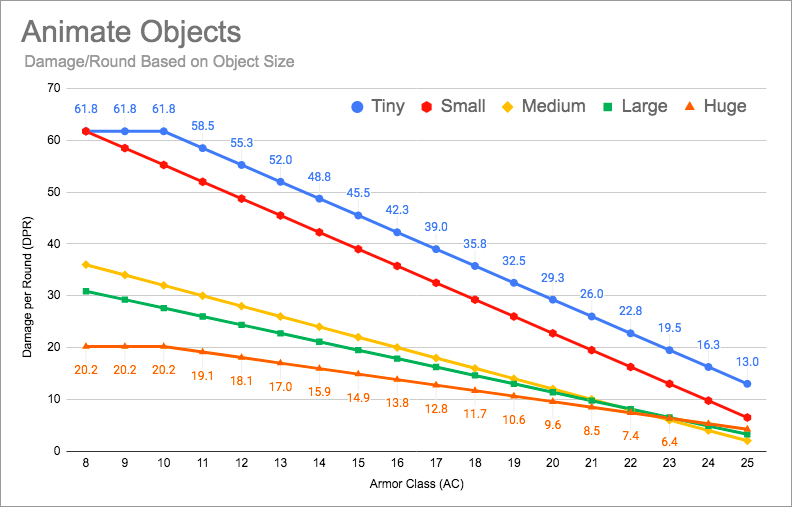 Note: To be fair to the big boys, their calculations are based on a pro rata fraction of the 10 objects you get. Effectively, we're counting 2.5 large objects and 1.25 huge objects.
Knowing that tiny objects are always the best solution, Animate Objects encourages the spellcaster to pick the option that requires 10 attack rolls. Since it takes a bonus action to proc, you're also grappling with the usual lengthy spellcaster action on successive turns. This becomes very time consuming, which can disengage other players.
There's a couple trends to note before we dive in:
Smaller Objects. Being multiple objects helps defense, for several reasons:
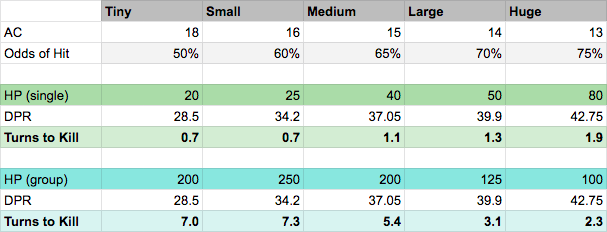
Even reducing this down to total HP, smaller objects take longer to destroy. Here's an example using the Dungeon Master's Guide's suggested stats for a CR 9 creature (+7 attack, 57 damage/round):

Larger Objects. The benefit of larger objects is twofold:
Larger objects maintain their full offensive potency until they're destroyed, whereas a collection of smaller objects will see their offensive prowess wane as they are dispatched. But, you need to get rid of a solid number of small objects before the damage levels out. It only takes three coins (tiny) to outdamage a bulldozer (huge)!
Swarms of smaller objects are susceptible to area of effect (AoE) damage. It's no surprise that Shatter is Animate Object's worst enemy. But, with a 30 foot flying range, the mage has effective means to spread this risk.
It's clear that we need to tweak the stats to make object size. If not only to make it an interesting mechanical choice, but to balance it enough that the player doesn't feel cheated enlivening whatever object fits the narrative. There are several things we can do to balance the spell.
First, we need to balance the offensive potency of the objects.
The question is whether to nerf the tiny/small objects, or to buff the medium/large/huge objects. So, we need to set a benchmark. Benchmarking the potency of this spell is not so simple, but we need to start somewhere. For that, we turn to the Dungeon Master's Guide:
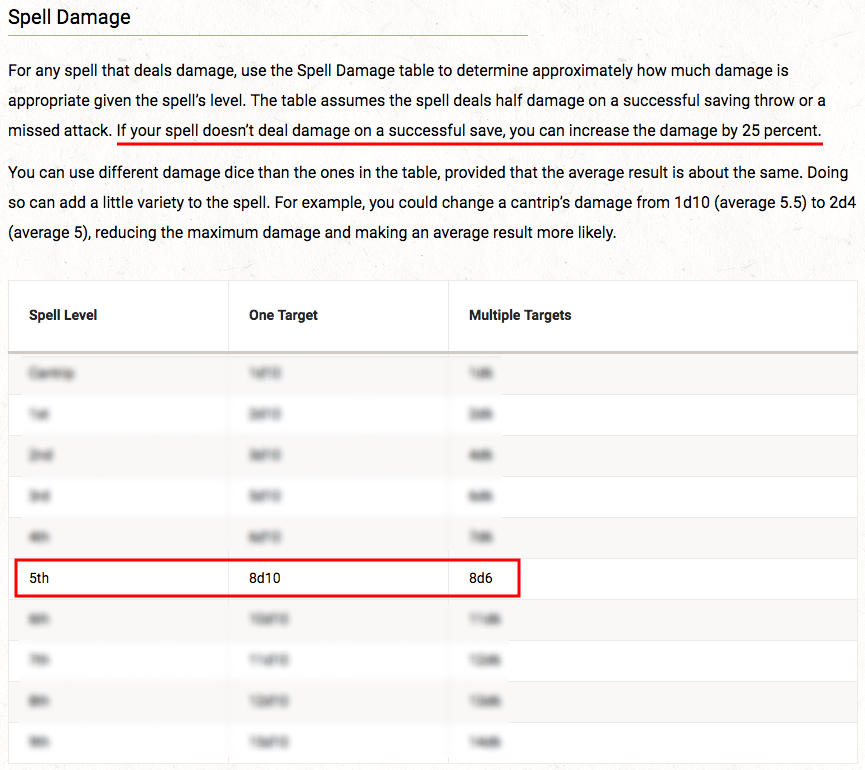
For a spell that works based on attacks, it's appropriate to use the single target damage benchmark, with the 25% markup (since attacks don't deal half damage on a miss). That sets our benchmark at 10d10.
But, that assumes that the spell only deals damage once. How do we balance for a spell that deals damage on successive turns? There's no guidance for that, but we can look to general design principles and other spells as a template.
When designing, we assume that combat will last 3 rounds. That means: if we're going to divide up the damage a spell deals, we should assume that it's not going to have more than three turns to deal it.
That doesn't mean you can just divide damage by three and call it a day. After all, you never know if that second or third turn damage will come. You would always take 99 damage now over 33 damage over the next three turns. Damage that happens now can remove agents from combat. There should be some value to waiting, beyond getting extra damage if combat runs longer than expected.
Assuming three turn combat, the floor should be 18.3 average damage per turn.
Summon Celestial Spirit. The latest design in the summoning space is this March 2020 Unearthed Arcana. We can use the 5th level spell Summon Celestial Spirit for to get an approximation of how the designers might benchmark the damage these days. It's worth noting that the summon will follow verbal instructions, and does not require a bonus action to command.
These summon spells come with a stat block. While the damage in the stat block scales based on the spell level, we can assume it's cast at base level 5 and back out the average damage per turn:
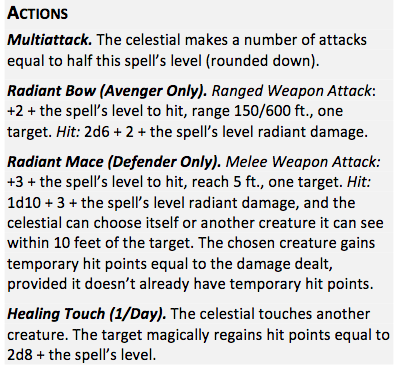
It makes sense to compare the stronger mace attack, since the spirit can move around the battlefield like animated objects. Radiant Mace attacks twice at +8 and deals 13.5 damage/hit. We can assume this damage is tuned down a bit to account for the healing rider. That doesn't change our calculation, but it's something to keep in mind when setting our own benchmark.
While matching the high range of the Animate Objects attack bonuses, Summon Celestial Spirit deals 27 average damage per turn.
Spiritual Weapon (upcast). In terms of structure, there are few spells more comparable than Spiritual Weapon. They're both pseudo-summon spells that make attacks when the caster uses a bonus action.
Since Spiritual Weapon has a less onerous initial casting, doesn't require concentration, and can't be killed, Animate Objects needs to deal more damage to justify its comparative deficiencies.
Note: The standard assumption is that you would have maxed your spellcasting ability score by level 9, so we'll plug in a +5 for the spellcasting ability modifier to our calculations. This won't be true in every case, but it's close.
Spiritual Weapon is a melee spell attack (+8) that does damage equal to 1d8 + your spellcasting ability modifier.
Unfortunately, the damage scaling is kind of wonky. Spiritual Weapon only increases damage when upcast to 4th level (2d8+5) or 6th level (3d8+5). Taking the middle puts Spiritual Weapon at 16.25 average damage per turn at a hypothetical 5th level upcast.
The question is where to set the benchmarks.
Attack. Considering both Summon Celestial Spirit and Spiritual Weapon attack at +8, it seems to be a good choice. Perhaps it should be a midpoint and not the end of the curve. Perhaps we shouldn't have a curve at all. If +8 attack is the right thing for a 5th level spell, it makes some sense to apply it uniformly. Using dynamic attack bonuses requires adjusting the damage dice to compensate, the result of which will vary depending on the AC of their target.
Damage. In consideration of everything above, I'm comfortable setting damage at 50% of the recommended 10d10 spell damage. This gives us ~27.5 average damage, which we can break down however we want. Remember that the smaller dice you use, the more likely you are to get an average result.
I've posted the damage calculator so you can tinker around with the numbers.
Now that we've established the damage paradigm, we need a way to implement them without endless attack rolls, regardless of the size you choose.
Note: I am not going to change the number of objects you get. While that's a valid thing to examine, it's a little more disruptive than I like when hacking a spell. At that point, I'd start rebuilding from scratch. I'm trying to make all my changes within the table while causing as few ripples as possible. For similar reasons, I am not adjusting the action economy of the spell itself (action to cast, bonus action to proc) or concentration. Rather, I am considering those aspects in benchmarking its strength.
There's still a few solutions.
Thankfully, the Dungeon Master's Guide comes to the rescue again, offering guidance on mob attacks. You could use this tool to run the attacks for tiny, small, and medium objects, and call it a day. If you're going to do that, I highly recommend checking out Sly Flourish's Mob Damage Calculator.
While I prefer things a little simpler, we can't exactly reverse-engineer the Mob Attacks table, for several reasons:
With that being said, damn the torpedoes! Here's your mob attack table with too many assumptions built in. Roll the number of dice indicated reduced by the number of lost objects. For medium objects, divide by 2.

You can always flip the attack roll into a saving throw. We already have the spellcasting DC to lean on. Here's how that would work:
As a bonus action on each of your turns while the spell is active, you can mentally command the objects to attack a target. The target is racked by flying debris, swarmed by small devices, assaulted by automatons, or some combination of the above. The target must make a Dexterity saving throw against your spellcasting DC. On a failed save, the target takes dX damage for each tiny object, dY damage for each small object, and dZ damage for each medium object.
We lose some granularity here in terms of attack bonuses. You could fiddle with this by adding +1s to the attack/DC column of the table, but I wouldn't. I'd just make up any differences by tweaking the defense.
In order to preserve the narrative, we should maintain this paradigm:
The fact that "11 + spell level" was used as the Armor Class for all the latest Unearthed Arcana summons tells us that 16 AC is a safe benchmark.
Large and huge objects can't expect much from 10 AC, so we should probably bump that up a bit. The lowest I would go is 13 AC, replicating the Hill Giant (admittedly whose stat block attributes this to natural armor).
Tiny objects are probably fine at 18 AC. That's a safe cap.
Interestingly, the large object stats and the celestial spirit (also large) share a similar HP benchmark:
So, maybe 50 HP is a good benchmark for a large creature, but that doesn't speak to survivability. If each large object had the celestial spirit's armor class, their survivability would increase 50% (against a standard CR 9 attacker). It goes up to 70% when you bake in the extra HP.

But, pegging large objects at 16 AC doesn't give us a wide spread of ACs to play with. I'd prefer to keep a lower AC and add more HP if I can achieve similar effective durability. It seems that the mark we want to hit in terms of survivability is somewhere around the 4 turn mark. This is much less than the full 1 minute duration of the spell, but it's longer than most combats are presumed to last. It's a healthy amount of life.
There's a variety of ways you can achieve 4 turns of survivability. I've shared the defense calculator so you can tinker with your own numbers, by adjusting the number of objects, their Armor Class, and their Hit Points.
Keep in mind, it might make sense to give one object class a little more firepower if its cousin has a little more durability. Consider how small objects deal less damage than tiny objects, but they have increased durability. Ultimately, how you dial these knobs brings flavor to the different options catered to your preference.
Here's a few simple solutions that I baked up using the calculator:
AC Adjustment. Bumping up the AC alone doesn't bring equity between the object classes. While it can be a start, you need to also adjust the Hit Points to achieve parity.
HP Adjustment. You can smooth out the balance by dropping the tiny objects to 10 HP and doubling their Hit Points for every size (20 for small, 40 for medium, 80 for large, 160 for huge).
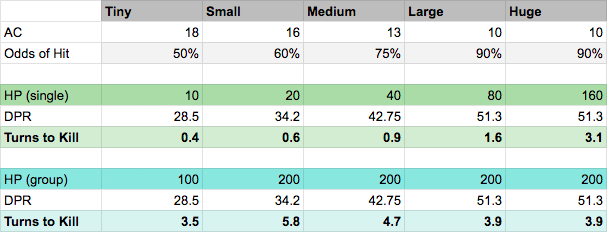
This leaves tiny objects a little less survivable, but don't forget they can likely fly. The more durable small object is likely to have something resembling legs. If you are not considering any AC adjustments, you can make up for the differences here by ensuring that the small and medium objects pack a little less punch.
Putting together a bunch of different ideas that I've discussed above, here's the updated spell table that I'll be working with in the future:
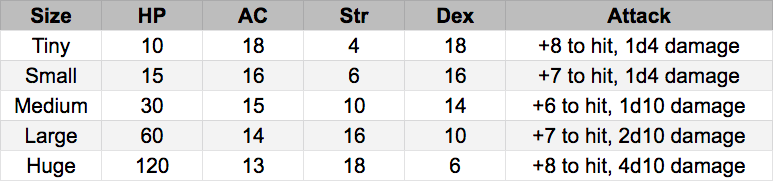
I made minimal adjustments where necessary. Here's a change log:
The benefit of removing modifiers is that it takes a lot of math out of the final damage. You just multiple the number of hits by the number of dice you need to roll, and throw the bones. This speeds up play without necessitating a different system for handling mob attacks.
In case you're wondering how this hack shakes out in the numbers, here it is plugged into the same charts and tables as above:
Look at this grouping:

Exactly how we want it. Generally, bigger stuff hits harder. You'll see a little bit of this ground made up on the defensive side. Similarly, small objects hit a little softer than tiny objects, but tiny objects are more frail. There's even some overlap between lines as the AC scales up. Tiny objects are also really good against high AC foes, but bottom tier against low-AC foes. These little quirks make for interesting choices between objects.
Admire how precisely we hit our desired 27.5 average damage benchmark:

On the defensive side, we have a nice progression:
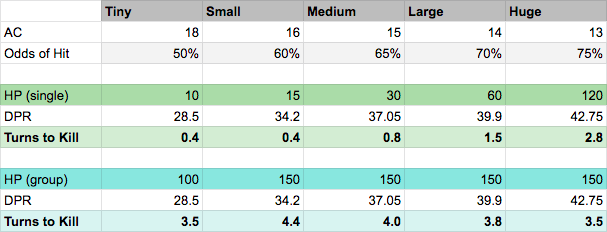
We're hovering right around the 4 turn longevity benchmark while providing some variety among the object classes. Small objects have the best longevity, but also deal the least damage. Huge objects have the least longevity, but also deal the most damage. While tiny things are easier to kill, they make up ground by having the same damage die as small objects and a higher attack bonus. Interesting quirks emerge that make Animate Objects an interesting choice when you cast it. That's what we're looking for.