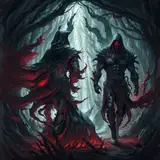
Prolog
Added 2025-07-09 16:07:18 +0000 UTC<author note>
So here we go this chapter was already shared once.
Synopsis:
Once, there was an ancient empire ruled by an immortal human. He was undefeated and feared throughout the realms of existence. After a battle with the avatar of the Voidgod—an evil that seeks to corrupt all life—demons, angels, and fae saw their chance. They sealed him in an amulet, hoping to control his power. Their attempts failed, and in their desperation, they sank his entire empire, hiding the amulet beneath the sea where it would never be found.
Now, the human kingdom is weak, a pale shadow of its former glory. Surrounded by elves, orcs, dragons, and dwarves, it is only a matter of time before they are conquered by the superior races. This is why the king launches multiple expeditions to find the amulet and restore humanity’s safety.
A Little Spoiler (since I’ll likely revise the synopsis):
The story is told in first person by Tiberus, the man trapped inside the amulet. Given the massive backstory, he will appear in Chapter 3, where you’ll also get a taste of the story’s true tone.
With that said, enjoy the new story—you’re among the first to read it! ;)
<author note>
The sun hung low over the small village of Bergin, casting long golden rays over its simple wooden houses. Located within the last remaining human kingdom, Thalindor, the village was a quiet, struggling place. Humans were among the weakest of all races, their lifespans barely exceeding sixty years, and their affinity for magic was nearly nonexistent. Only the high nobles and the royal family possessed magical abilities, and they guarded their secrets fiercely—if there even were any to share.
For the common folk, life was a relentless struggle. Taxes were high, often rising unpredictably, especially when the nobles decided to hold another extravagant tournament or festival. Marriages between the great houses frequently resulted in weeks of famine for the peasants, as their hard-earned resources were diverted to feed the celebrations of the elite.
Bergin had no more than a few hundred inhabitants. A single tavern stood near the heart of the village, beside the only well that provided fresh water. Most of the villagers were poor farmers, barely scraping by, while a handful of hunters ventured into the surrounding forests in a desperate attempt to bring back food. Their location was far from ideal, mere hours from the border of the Elven Kingdom. It was an ever-present threat—should war break out, Bergin would be the first to burn, its people the first to be enslaved. For years now, rumors of an impending invasion had hung in the air, carried by traveling merchants who spoke in hushed tones of the elven armies and their terrifying power.
Yet the elves were not the only danger. Thalindor was surrounded on all sides by mightier kingdoms, ruled by races that dwarfed humanity in both lifespan and magical prowess—elves, orcs, even dragons. The nobles, unwilling to provide resources that might one day aid an invading elven force, had abandoned border villages like Bergin to their fate. Tax collectors arrived every two weeks, demanding ever-increasing payments, forcing the people to rely on one another for survival. Without their mutual aid, many would have starved long ago. It was this communal spirit that kept the village's lone tavern alive, with farmers and hunters donating whatever they could spare to keep its doors open.
As dusk fell, the villagers gathered inside the tavern, the only place where they could enjoy a warm meal and a cold drink. Here, they exchanged stories, debated who had suffered the worst day, and shared the latest news from the outside world. Merchants and travelers were rare visitors, but they were always welcomed, their tales serving as the village's only real source of information about the rest of the kingdom.
But tonight was different.
The flickering lantern light danced off the wooden walls as an old man entered, his hood drawn deep over his face. His long, tattered brown coat draped over his frail frame, and in his hand, he carried a gnarled wooden staff, worn smooth by time and travel.
No guards patrolled the village—there was nothing worth stealing—so the stranger passed unnoticed through the dirt roads until he reached the lively tavern. A faint smile played at his lips, the only visible part of his face beneath the hood, before he stepped inside.
The moment he crossed the threshold, the room fell into an uneasy silence. Conversations died mid-sentence, tankards paused halfway to mouths, and every pair of eyes turned toward the newcomer.
Visitors were a rare sight in Bergin, appearing perhaps once every two months, aside from the tax collectors—who were more often referred to as parasites than as guests.
"Ah, a new traveler!" The bartender, a burly man with wide shoulders and a thick beard, broke the silence with a booming voice. "Been a long time since we had a guest passing through. Have a seat! First drink is on the house—if you tell us a good story in return."
The old man tilted his head slightly, considering the offer. Then, in a voice rough with age, he replied, "A story, is it? For honest folk such as yourselves, I will gladly share my finest tale. My name is Eldrin, and I am a storyteller."
With deliberate slowness, he reached up and pulled back his hood. The firelight illuminated a face lined with deep wrinkles, his skin pale with age. But it was his ears that drew the most attention—long and pointed, unmistakably elven.
A ripple of tension spread through the tavern. Some villagers instinctively took a step back, their faces pale with fear. Others merely stared in shock, gripping their tankards a little tighter. The only one who remained completely unfazed was the bartender.
"You’re a half-elf, aren’t you?" the bartender mused, stroking his beard. "No way a full-blooded elf would set foot in a place like this."
Eldrin nodded. "You are correct. I am an outcast, born of both human and elven blood. My name is Eldrin, and I have wandered these lands for generations. So, tell me—am I still welcome here? Do you still wish to hear my tale?"
The bartender let out a deep, hearty laugh, breaking the tension in the room. "Aye, we don’t turn down a good story, no matter who tells it! You might want to stay clear of the capital, though. People over there see things a little differently."
His laughter was infectious, and the tension in the room slowly melted away. The villagers leaned forward, eager now, anticipation lighting their weary eyes. A story from a half-elf—one who had roamed the world for generations—was an opportunity they would not let slip away.
The bartender grabbed one of the largest mugs, filled it to the brim with dark ale, and slid it across the bar. Eldrin caught it effortlessly, taking a long, appreciative sip before resting his arm on the counter.
The tavern was silent now, save for the crackling of the fire. Every eye was locked onto the old half-elf.
And so, he began to speak.
"Since you have welcomed me so kindly, I will share my finest story with you. And as with all great tales, it is rooted in truth."
The half-elf’s voice was calm but carried an undeniable weight, as if he had told this story countless times before. The firelight flickered across his aged features, casting deep shadows over his face. He took another slow sip from his mug before continuing.
"You may have heard this tale from wandering monks or zealous priests, each twisting it to serve their own cause. Many of their words are false, distorted by the passage of time or the needs of those in power. But I have traveled far and wide, across many lands, and after hearing the different versions of this legend, I believe I have uncovered the truth—the truth of Tiberius, the emperor and ruler of the greatest kingdom ever known, Aetherion."
A groan came from the back of the tavern, where a dark-haired man in his thirties slammed his tankard onto the wooden table. "Oh, come on! Not that story again. Every damned priest who passes through tells the same tale year after year."
Eldrin chuckled, seemingly unfazed by the outburst. "You're not wrong—every church spins this tale to glorify their patron deity. But what you likely do not know is that this story is not confined to the human kingdoms alone. It is whispered in the elven courts, recounted in the great underground cities of the dwarves, spoken in hushed tones within the dragon lairs, and even known in the realm of the fae. And just like in the human kingdoms, the rulers of these lands claim that their ancestors fought alongside angels and demons against Tiberius, the man who would later be known as the Mad Emperor."
He let his words linger, watching as curiosity slowly replaced skepticism in the faces around him. Eldrin had been prepared for interruptions. It was one of the things he loved most about storytelling—it meant the people were engaged. And so, with a knowing smile, he began.
"Four hundred thousand years ago, in the outer farmlands of what was then just a fractured collection of human kingdoms, a boy was born into hardship. He was the eldest of seven siblings—four brothers and two sisters—and like many of his kind, he toiled from dawn till dusk to provide for his family. His name was Tiberius."
Another voice cut through the tavern’s murmurs. "Old man, you’ve got it wrong. Everyone knows the farm boy was Jakob, who later became the prince’s servant!" The speaker, a burly man with a thick beard, glared at Eldrin, slamming his fist onto the table for emphasis.
Eldrin merely smiled. "Yes, that is how the story is often told. But through my extensive research, I have uncovered the truth. It would not do for human nobility to admit that their revered ancestor was, in fact, the very man history brands as a tyrant, would it?"
Silence fell over the room. The villagers exchanged uncertain glances. Politics meant little to those who struggled just to survive the coming winter, but the seed of doubt had been planted.
"Tiberius' mother was ill, her condition worsening with each passing season. His father, once a strong man, had lost an arm defending his home from bandits, leaving the family in dire straits. With little choice, Tiberius learned to wield both sword and bow at a young age, knowing that survival depended not just on hard work, but on strength.
As the years passed, his mother’s condition became critical. Only a skilled healer could save her—but such services required coin, and coin was scarce. With no other options, Tiberius took the greatest risk of his life. He enlisted in the king’s army, hoping that through battle, he might earn enough to save her."
Eldrin paused for a moment, letting the weight of the words settle before continuing.
"He completed his training in record time, surpassing recruits of noble birth with sheer determination and skill. Mere months later, he found himself on the battlefield.
Back then, humanity was divided into four warring kingdoms, each constantly vying for dominance. It was also during this era that humans first discovered magic, though—much like today—it was a power hoarded by nobles and royals. Magic was strictly forbidden to commoners, and any peasant born with magical talent was either executed or taken in by the elite, their past erased as if they had never existed.
For an ordinary soldier like Tiberius, the battlefield was a brutal, unforgiving place. Yet, against all odds, he not only survived—he excelled. His prowess soon caught the attention of a powerful noble, who, recognizing his potential, took him into his personal guard. It was this noble who, in return for Tiberius' unwavering loyalty, paid for a healer to save his mother’s life."
Eldrin leaned back, his eyes gleaming as he took another sip from his mug.
"From that moment on, his life changed forever. No longer a mere farm boy, he became a rising star within the army. He fought in war after war, carving out a name for himself with every battle. By the time he reached thirty, he was known as the only man who dared venture alone into the Dark Forests of the South—lands infested with vampires, wraiths, and creatures so vile that even the elves refused to go near them.
But Tiberius did not merely survive those cursed lands—he hunted within them.
Night after night, he returned with trophies—fangs, claws, and dark relics, most of which he delivered to his noble master. The rest, he sold in the black markets, earning wealth beyond anything his family had ever dreamed of. The elven kingdoms took notice, whispering among themselves about the human warrior who feared neither death nor darkness. Even the vampires, long thought to be untouchable in their domain, grew wary of the lone hunter.
By then, his family had left their life as farmers behind. They had a home in the capital and prospered off the wealth he provided. His brothers and sisters married, building their own futures. But Tiberius remained alone.
He had no wife, no children—only the hunt. He knew that any day could be his last, and he refused to leave a widow or orphans behind."
Eldrin's voice grew quieter, drawing his audience closer.
"This was when Prince Jakob a cunning and ambitious man, took notice of him. He saw Tiberius for what he was: a weapon. And so, he elevated him to the rank of general, placing him in command of an elite unit.
With Tiberius leading his forces, Jakob set his sights on conquest. He aimed to unite the fractured human kingdoms under his rule, and he was willing to drown the land in blood to achieve it.
It was extraordinary—a man with no magic, only skill and ruthless intelligence, shifting the tides of war. Some say his equipment had been enchanted, or that alchemists used the dark materials he retrieved from the cursed forests to strengthen his body beyond human limits. But none can say for certain.
What is known is this: the war changed. Drastically.
Tiberius and his unit became a shadow in the night—assassins, saboteurs, ghosts of war. They struck from the darkness, cutting down enemy mages, burning supply lines, ensuring that when battle came, the enemy was already broken.
For five years, the human kingdoms fell one by one. And as each kingdom crumbled, so too did the carefully woven lies of Prince Jakob.
Rumors began to spread. They spoke not of a noble-born war hero, but of an unstoppable warrior, a man who bathed in the blood of his enemies. A man who, with each battle, crept ever closer to madness."
Eldrin leaned forward, his voice now barely above a whisper.
"And that, my friends, is where the true story of Tiberius the Mad Emperor begins…"
For Prince Jakob, it had become clear that he needed to find a way to rid himself of Tiberius. Yet, his thirst for war remained unquenched—his ambitions stretched far beyond mere consolidation of power. He longed to subjugate the elven kingdoms, to turn dragons into mere pets, docile creatures that would carry his armies across the skies, and even to shackle the fae to his will.
His father, a man shrouded in mystery, seemed to support him without hesitation, granting him every permission he sought. But even with the vast might of the human empire, they stood no chance against the other races. They needed something more—a weapon of immense power. And so, Prince Jakob turned to the only source that could grant him such an advantage: demons.
While he schemed in the shadows, Tiberius was sent to the frontlines, waging war after war, kept occupied while the prince delved into dark and forbidden arts. Years passed before Tiberius returned, weary of battle, ready to lay down his sword and start a new life. He had found love—a healer who had mended not only his wounds but his heart. He dreamed of a peaceful life by her side. But it was all a lie.
The healer had been nothing more than a pawn in Jakob’s grand design, paid handsomely to weave dreams of happiness into Tiberius' mind—dreams that would soon be shattered.
Jakob had discovered multiple ways to bind demons through contracts, yet each method gave the demons ample opportunity to twist the terms to their advantage. His next experiment was more audacious: rather than merely summoning a demon, he would imprison one within the body of a human. The fae often used contracts to enslave humans; if a demon were bound within a human, then by enslaving the human, one could, in theory, control the demon as well.
But the process was far from perfect. More often than not, the human host would lose control, allowing the demon to break free, unleashing chaos upon the world until it was eventually put down. Many mages attempted similar experiments, earning them the reviled title of "demon worshippers." Unlike Jakob, however, they bargained with demons rather than sought to command them. How the prince managed his rituals without the approval of an archdemon remains unknown—some speculate that it had something to do with soul fusion.
One thing was certain: it was far too dangerous for Jakob to test on himself. He needed a subject—someone with an indomitable will, yet broken by agony and despair.
Tiberius, strong-willed as he was, merely lacked the final ingredient. Jakob would see to it that he suffered.
Edrion paused, taking a slow sip of his drink, letting the weight of his words settle over his audience. Murmurs had rippled through the room earlier, but now, silence reigned. This was not a tale told to common folk.
"At the victory celebration, Prince Jakob drugged Tiberius' wine and had him taken to the darkened depths beneath the castle, where his preparations had long been in place. He was not alone—his entire family, the one he had fought and bled for, was there, bound and helpless.
"The prince forced Tiberius to sign a contract, sealing his fate as Jakob’s slave. But mere servitude was not enough. True despair—true horror—was still missing. And so, the healer, the woman he had trusted, revealed her true nature. She had never loved him. She had only played a role, a cruel and meticulous deception.
"For weeks, she tortured his family before his very eyes. One by one, they perished in ways too horrific to describe. Everything he had fought for, everything he had held dear, was stripped from him. Only when his spirit had been utterly broken did Jakob deem him worthy of the ritual.
"No one knows which demon the prince used, only that it must have been powerful, given what followed. Something in the ritual went terribly wrong. Tiberius, consumed by unrelenting fury, slaughtered the prince in a blind rage. But he was no longer merely a man. He had become something else—something beyond mortal comprehension.
"This is where my tale begins to differ the most from the stories you've heard from wandering minstrels and drunken travelers. Tiberius was not a puppet of the demon. He was his own master. And once his initial rampage subsided, he did not vanish into obscurity—he rose. He took the throne. And from that moment on, a new era began.
"Magic, once hoarded by the elite, was made accessible to all. No one starved, no one feared the changing of the seasons. Within mere decades, the ingenuity of humankind, now intertwined with both magic and technology, had surpassed even the greatest advancements of the elves."
"Wait, wait, hold on a moment!" a woman interjected, her brow furrowed in disbelief. "Every story I've heard paints him as a tyrant—a madman who sacrificed thousands to fuel his magic. And you're telling us now that he was actually some kind of benevolent ruler?"
Edrion chuckled, a knowing smile playing at his lips. "Ah, you are not wrong—that, too, happened. But much later."
"Alright, but… wasn't his reign only a month long? Didn’t the hero rise and put an end to his rule?" she pressed, her curiosity undeniable.
"That is yet another tale I can disprove," Edrion said, leaning in slightly. "But allow me to continue. You will undoubtedly have more questions once I am finished."
The barman was the only one who moved now, weaving between tables, refilling mugs as his patrons sat transfixed by Edrion’s words.
"Tiberius ruled not for a month, but for thousands of years. Under his reign, his empire became the most advanced civilization the world had ever seen. Disease was eradicated. Machines toiled in place of men. Magic and technology intertwined to create a utopia unlike anything the elves, dragons, or fae could have ever imagined.
"But the churches, in the name of their angels, wove a different tale—one of dark rituals, of endless war against elves, dragons, and the fae. I have studied these claims, and I tell you now: many of them are false, fabrications spun to demonize the emperor.
"In truth, the rulers of the other races envied him. Worse still, their own people began to leave, abandoning their homelands to seek a better life within Tiberius' empire. Unable to match his power, they forged an alliance. Even the angels and demons, ancient enemies, joined forces to bring him down.
"But even as they waged war against him, Tiberius stood firm. It took the combined might of an archangel, an archdemon, and the Queen of the Fae—who, some claim, is more powerful than either—to finally defeat him. Yet, even then, they could not kill him.
"So instead, they sealed him. His soul—his very existence—was bound within an amulet, a relic of immeasurable power. Whoever wears it commands the emperor himself.
"But even that was not enough. His empire was drowned beneath the waves, lost to time, and the amulet was hidden away, taken by a lone human willing to sacrifice themselve to ensure it remained buried where no man, elf, or dragon could find it.
"To this day, both human and elven kingdoms launch expeditions in search of the amulet. For whoever finds it… will hold the power to rule the world."
Comments
Interesting
Jaden Smith
2025-07-12 20:15:37 +0000 UTC