
What Are Dungeon Encounters?
Added 2022-12-20 14:30:02 +0000 UTCThis is the ad-free version of the article, you can find this article also on DumpStatAdventures.com - Thank you for supporting us!
-----
So far for Dungeon December, we have gone over rules for creating dungeons along with the importance of creating factions to fill a dungeon and provide role-play opportunities for players. Today we are going to be talking about what is an encounter, how many encounters you should be including in various sized dungeons, and how to build your XP budget. If you haven’t already, check out my post on How to Run an Adventuring Day as many of the things we reference here have been explained in more detail in that post.
What is an Encounter?
Before we can really jump into it, we are going to first talk about what makes an encounter, an encounter. The classic example of an encounter might be fighting a dragon, dealing with a horde of goblins, or being turned to stone by a medusa. These are all combat encounters, which are just one type of encounter.
Other types of encounters include traps, hazards, role-playing, exploration, puzzles, and any other activity that the table takes part in and requires resources to complete. When the party comes across a trap, and they must spend a spell slot, run the risk of taking damage, or make skill checks, the trap is an encounter. On the other hand, if the party is talking to an NPC, but they don’t overcome any obstacles, like making a Charisma check, that isn’t an encounter. It is just story-telling.
Dungeons are built out of bubbles of encounters strung together with story-telling. As the party explores the dungeon, they reach an encounter where they then have to expend resources and use their abilities. Each time the party completes an encounter, they should be awarded XP, or if you are doing milestone leveling, something to help them know that they are progressing to their next level up.
Ultimately, what this means to the gamemaster, is that players should earn XP by not just winning combat encounters, but any time they overcome a trap, they win over NPCs and monsters to their side, they explore key locations on a map that are difficult to get too or solve puzzles. If the players accomplished something, it was an encounter.
Four Pillars of Dungeons
There are four main things to do in a dungeon. You can engage in combat, social encounters, exploration, and problem-solving.
Combat is pretty to easy to understand and is the one that Dungeons & Dragons is most focused on. Players get TONS of abilities that all involve them beating the snot out of monsters, they get stronger, and then they get to beat up even stronger monsters. It’s a vicious cycle for the monsters.
Social is a key component of ensuring that a dungeon doesn’t become stale. The gameplay loop of fighting monsters in a room, going to the next room, and doing the same thing, can turn the most exhilarating game into a bit of a drag. By bringing in creatures for the party to talk with, you break up the repetitions of the dungeon and provide an opportunity for the party to run the narrative.
Exploration involves the dangers and hazards that the party will face as they travel through the dungeon, like dealing with traps, finding secret doors to hidden treasures, and stumbling across important places. Exploration is often in the narrative control of the gamemaster, though players can gain access to spells and abilities that allow them to create huge passageways through solid stone, throwing the GM for a loop.
Problem-solving is the last category, and probably the one I struggle with the most, which might be ironic given its name. This includes puzzles, dealing with complicated social situations, and can even drift into overcoming obstacles and hazards. This one is more of a nebulous pillar that is often hand-in-hand with another pillar, but not always
Combining the Pillars
By taking all four of these pillars, we can create exciting and interesting encounters that award XP, allow progression in the dungeon, and create excitement at the table. While combat will probably be the most used pillar in a dungeon, since it is such a major part of the game, you can combine that pillar with other pillars to provide variety in your dungeon. This is especially needed for mega-dungeons that might otherwise feature endless rooms full of monsters to fight.
Encounters in a Dungeon
Dungeons are made up of encounters, typically in separate rooms that are connected by hallways. Each encounter is, normally, constrained to a single area and does not merge into other encounters in the dungeon. While they can, most encounters are budgeted as if they are separate from one another - if they combine, it is because of the actions of the players that caused them to combine. If you are planning for encounters to combine, like waves of enemies, it is actually a single encounter and should be budgeted as such.
Dungeon Size
When deciding how many encounters you need, you first need to decide how much XP a dungeon is worth, even if you rely on milestone leveling. Do you want your party to level up only at the end of the dungeon? Do you want them to not level up while in the dungeon, but instead at a more important moment further along? Do you want them to level up multiple times while in the dungeon?
Depending on your answer, you are either making a Mini-Dungeon, a Dungeon, or a Mega-Dungeon.
A Mini-Dungeon does not have enough XP for a party to level up with - though if the party enters only needing 10 XP, obviously, they will, but rather it won’t take them from 50% away from getting to level 2 to 50% away from getting to level 3. They do not gain a FULL level worth of XP - just a smaller portion of it.
A Dungeon has enough XP within its confines that the party will earn a level from venturing into its depths. This is regardless of where they are in the process of leveling up, even at 99% away from leveling up. What should happen is that they are given enough XP to guarantee that if they entered the dungeon at the very bottom of level 4, they will exit at the very bottom of level 5.
A Mega-Dungeon will feature enough XP that the party will go up multiple levels while inside it. There is no maximum or minimum to how many levels an adventuring party has to go up while in a Mega-Dungeon, but they should level up at least twice while within it - otherwise, it is just a regular dungeon.
Planning Encounters
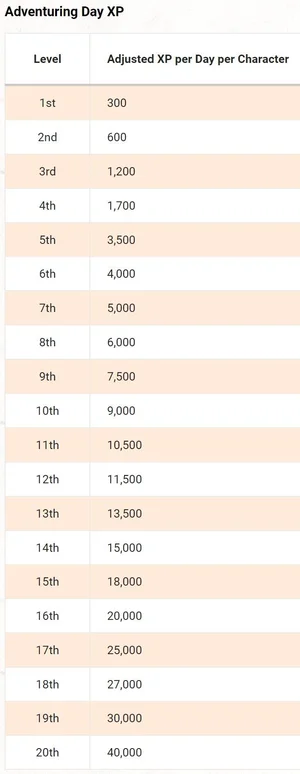
Dungeon Master’s Guide, 2014 Wizard of the Coast
Once we decide on what type of dungeon we want to create, it now comes to the part where we figure out our XP budget. As a reminder, the charts on page 84 of the Dungeon Master’s Guide (2014) inform us of our Adventuring Day budget, and you can typically fit two to three full Adventuring Days in a single level.
So if you want to run a mini-dungeon, you can just take a single Adventuring Day Budget, spend that, and you have a mini-dungeon - something that I’ve done in my previous article on How to Run an Adventuring Day!
For those wanting to run a dungeon or a mega-dungeon, you will instead take multiple Adventuring Day budgets and spread them out through your dungeon. For something like a mega-dungeon, you could assign each floor of your mega-dungeon a specific level, so that once the party completes the first floor and make it to the second floor, they should level up.
For example, let’s look at the provided chart and figure out what a mini-dungeon, dungeon, and mega-dungeon might consist for a Lv5 party with four characters.
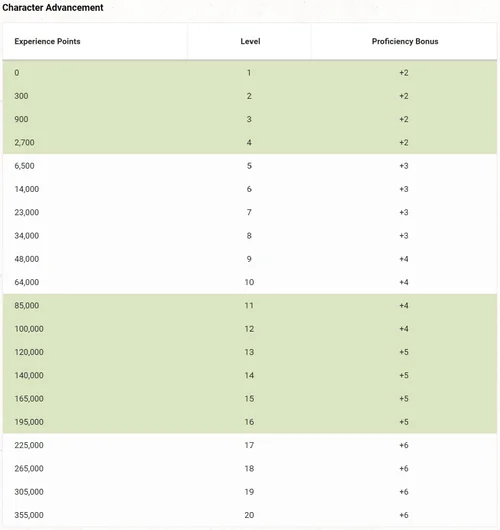
Player’s Handbook, 2014 Wizards of the Coast
Mini-Dungeon An Adventuring Day would be 14,000 XP for the party (an individual character would earn around 3,500 XP). We could divvy that amount between six to eight encounters in that day. The dungeon would then be done, with the final encounter signifying the end of the dungeon. Because it is only a dungeon worth 3,500 XP - this amount would not be enough for the party to level up unless they had already done a serious amount of adventuring already as a Lv5 party.
Dungeon Let’s go ahead and assume that we want the party to spend three Adventuring Days within the dungeon, thereby guaranteeing that the party would come out the other side leveled up and about the same progress into Lv6 as they were into Lv5. This means we would have a total of 42,000 XP to spend on 18 to 24 encounters. This can help us figure out how many rooms we need in our dungeon and how severe to make them. If we want to be on the lower end of that scale, we will need to make several scary fights that will test the party to their limits, but allows us to use up more of that XP budget and keep the numbers of encounters, and thus rooms in the dungeon, lower.
Mega-Dungeon We want the party to level up two times in our dungeon, which means we will do three Adventuring Days at Lv5 and then another two or three Adventuring Days at Lv6 - this gives us a combined XP budget of 74,000 to 90,000 XP for a total of 30 to 48 encounters. That is a huge area and we can already tell that we are going to need a BIG dungeon for all these encounters to take place in.
Plotting Out Encounters
So we have a general idea as to the number of encounters we would need, depending on what dungeon we are making, as well as our XP budgets. By taking this amount, you can start breaking it up into chunks and planning when and where your encounters will take place in your dungeon. When you do so, keep the following in mind:
- You can add lots of minions into a single fight. The more monsters you add in a fight, the more XP it costs as there is a multiplier in effect, BUT the party does not gain that extra XP. This is a good way of spending your budget quickly, but ensuring that the party doesn’t level up as a quickly if they only fought single monsters. They earn less (comparative) XP when they fight more monsters at a single time than if they fought fewer monsters at a single time.
- Monsters should have some variety, like kobolds with giant lizards that they ride into combat or fire giants hanging out with earth or fire elementals. There should be more than just one or two stat blocks that the party is fighting during their dungeon dive - this allows them to use different abilities that they have and keep the fights from feeling too samey.
- While it can be very tempting to just have a single, high CR boss monster for the party to face, it will quickly become one-sided with the party on top. It is better to have a lower CR boss monster with minions to help break up the attention of the party.
- You can combine traps and monsters - keep in mind that you should treat any suitably dangerous traps as monsters of a comparable CR or you could quickly turn a moderate fight into a deadly one.
- Since any type of dungeon will see the party having to fight for several encounters in a single day, or across multiple days, think about how the party could take a short or long rest. If you intend for the party to leave at the end of every day while exploring a mega-dungeon, give them a reason or a place to leave too, like a small town or point of interest. When they return the next day, describe how some bodies they had killed have been moved, that certain traps are reset, and more. This gives them the idea that they are entering a living dungeon.
- If the party overcomes an encounter and ends up not having to use resources because of clever planning, they should still be rewarded XP that had been set aside for that fight.