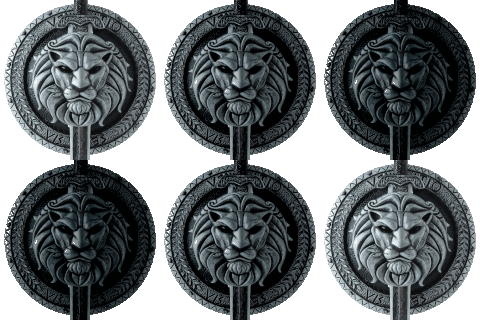
Maskmaker, Maskkeeper, Maskmatcher
Added 2022-12-05 16:37:52 +0000 UTCThis story is set on, and introduces, the world of Larvanin to the Aetheriad.
(Content warning: contains discussion of self-harm and body dysphoria, though nothing too severe or descriptive.)
------------------------------------------
Maskmakers were feared more often than nearly any other soulweaver.
Oh, the horror stories were all about body-thieves, who hid memory traps in soulwoven tools they gifted to others, to hijack bodies and preserve their own lives. Or about the soul-desecrators, who tore apart the memories preserved in the soulweavings of strangers, leaving only those useful to them. Or any of a dozen other types of evil soulweaver.
But malefactants on that order were rare. Most people went their whole lives without ever encountering anyone so monstrous.
Everyone, however, interacted with maskmakers. Everyone knew them, relied on them, even understood their craft to some degree. They’d greet them cheerfully on the street, treat them almost like any other neighbor.
But when it was time to set foot in a maskmaker’s shop, lit entirely by the soulthreads woven into the hundreds of masks on the walls, people shivered. All of them looked about nervously, twitching whenever they heard the inhabited masks on the walls whisper to one another. All tread quietly across the shop to the maskmaker’s desk.
So when a barefaced, sweaty middle-aged man burst into Valaskia Tolpez’s mask shop and practically ran to her counter, she raised an eyebrow behind her own mask in mild surprise.
“My brother just killed someone!” the sweaty man gasped out.
“I would imagine that’s a matter for the constables,” Valaskia said dryly, then turned back to the soul-spindle she was drawing thread onto. She was always brusque while wearing her soul-weaving mask. She had inherited the mask it from her teacher, and he’d always been much grumpier than she was, and that grumpiness lingered in the mask and his memories inside.
Any soulweaver could draw and spin thread from the astral, could turn its liquid magic into shimmering, almost physical form, so Valaskia could easily have hired someone to spin it to her specifications— or, for that matter, she could have just bought it in the market. She enjoyed spinning her threads herself, though, and she was sure that the final product worked better this way.
“He was one of your clients, and his body died three weeks ago.”
The shimmering, intangible thread between Valaskia’s fingers frayed and split at that, and she jerked her gaze back up to the man’s uncomfortably bare face.
The masks on her walls immediately noticed her mood, and their whispering ceased as they all focused on her and the barefaced man.
“Someone stole his mask from its mask-keeper?” Valaskia asked.
The bare-faced man hesitated, and Valaskia scowled. “You didn’t bring his mask to a mask-keeper. You kept it in your home, and now someone’s stolen it.”
“We’re his family, he should stay with us,” the man protested weakly.
“Unworn, unmatched masks belong with other masks. You should have brought it to another mask-keeper or back to me. If you’d kept it long enough, you’d be lucky if it didn’t drive at least one of your family-members mad,” Valaskia said. “And now you’ve had it stolen.”
The man shuffled awkwardly, and Valaskia finally had enough of staring at the man’s face. She reached down and offered him a blank, un-Woven half-mask.
“Oh, no, my family and I are Single-Faced,” the man said politely, though she suspected she’d offended him by offering.
Valaskia raised both eyebrows at that, not that he could make them out through her full-face mask.
“Why in the world would a faceless man have a normal brother?” Valaskia asked, making the gesture for puzzlement with her left hand.
The man winced a little at being-called faceless, and Valaskia sighed, then corrected herself. “One-Faced, sorry.”
She did want to be polite— if this man had been one of the more aggressive faceless, he would never have even set foot in her shop. She’d even heard tales of One-Faced attempting to assault maskmakers, but that was sheer foolishness on their part. Maskmakers were always well-defended.
Still, she wasn’t exactly fond of an entire spiritual movement that condemned her career and her entire way of life as evil.
“We didn’t know my brother’s mask was, well, a soulmask,” the man said. “He told us he was just commissioning a mundane mask from you. And when he died, and we realized it was a soulmask, well… we couldn’t bear giving it up.”
That caught Valaskia’s attention. Not the last part about keeping the mask, that was a fairly standard story. No, it was the fact that the man’s brother was commissioning a mundane mask from her that caught her attention.
“What was your brother’s name?” Valaskia finally asked.
“Hyamir Hachyn,” the Faceless man said. “I’m Ilas Hachyn.”
Valaskia reached out with her soul and touched her soul-weaving mask. Ilas Hachyn shifted backward as the soul-threads woven intricately through the blue-green foamwood lit up, sparks racing along their lengths and into Valaskia’s mind as she sorted through the memories stored in her mask.
It didn’t take her long to find her memories of Hyamir Hachyn— she kept her sales records well sorted.
Ah. Yes.
Hyamir Hachyn had been a veteran— had lost his face in the war.
--------------------------------------
Older wars were fought with swords and bows, trebuchets and catapults. The Mortal War, the rebellion against the body-trading Immortals, was fought with far worse weapons.
Admittedly, swords and bows were still used, in the Mortal War, still carried the skill and experience of expert swordsmen and masters of the bow soulwoven into their hilts and grips. The rawest recruit could yet pick one up and immediately become a skilled fighter.
But in the Mortal War, the trebuchets and catapults were no longer firing rocks, but barrels and jars filled with horrible weapons of soulchemistry. The battlefields turned from contests of skills to simple slaughterhouses, where injuries of the mind were even more common than those of the flesh, leaving soldiers broken and mad without taking a single stab or cut.
Depression soulwoven into water left soldiers unable to force themselves back into the fight as they were overrun. Fatigue woven into scraps of cloth blew about the battlefield, driving soldiers to collapse.
Rumors of far more esoteric, disquieting weapons traveled through both armies.
Worst of all, suicide gas drove thousands to death at their own hands, and lingered in lowlands and ravines for weeks and months, a hellish trap for unsuspecting civilian victims.
Even after both sides had agreed to stop using suicide gas in the war, mutually horrified at the monstrous effects, soulchemical weapons had remained prevalent. Dysphoria dust had been far and away one of the worst of those.
The mist was only effective for a few seconds, a minute at most, but it carried with it a profound, intense feeling of self, of knowing precisely who you were. It was a rare soulweaver who could weave that emotion at all, let alone into dust to be loaded into catapult-shot.
The problem was, of course, that said sense of selfhood revolved around the very particular self of the weaver, not the victim. An overwhelming feeling of wrongness struck the afflicted, a sensation of being trapped in someone else’s body.
Most soldiers hit by dysphoria dust collapsed and huddled into fetal position until the effects wore off, or just stood there and screamed, but a sizable contingent reacted far more violently, often lashing out at their own bodies with their own weapons.
People with experience battling dysphoria, who had felt in the past, for whatever reason, that their body was wrong, resisted the dysphoria dust better than most, as did soldiers who had been dosed before. Soulmasks could also provide a small level of resistance to dysphoria dust and most other soulweapons, though the effect was small.
Hyamir Hachyn had no such resistances, and he’d been one of those soldiers who reacted violently to the dysphoria dust, and had carved off large chunks of his own face before the dust wore off.
He’d been sent home from the front-lines after that, and that’s when he’d come to Valaskia.
Hyamir was far from the first One-Faced soldier who had facial injuries that came to her for a realistic face-mask, one close enough to their original, uninjured face that someone seeing them from a distance wouldn’t realize they were wearing a mask.
He was also far from the first One-Faced veteran who had her secretly turn his replacement face into a soulmask.
Hyamir Hachyn’s case had been an unusually challenging one, though, and even Valaskia’s unreliable flesh-memories quickened at the thought of him.
Hyamir not only had lingering mental damage from the dysphoria dust, along with the physical scars, but he’d been exposed to many other soulweapons, in ever-more terrifying mixtures, far beyond that of average soldiers. Depression fogs, proprioception blockers, and bizarrely even agoraphobia caltrops, of all things. He’d also had the extreme bad luck of standing next to multiple mask-breaks, his mind temporarily flooded with foreign memories rushing out of soulmasks shattered by sword or mace, and many of those memories had buried themselves like thorns.
On top of all that, he’d suffered more than a few plain old-fashioned head-wounds, including at his own hands under the influence of the dysphoria dust.
Hyamir Hachin’s mind was more broken than not when he came to Valaskia and begged her to help him.
The lacquered ceramic mask she’d crafted for him had been a work of art, both in its similarity to his original face, and in the sheer number of soul-constructs she’d woven into it. It had been singular in the density of its memory storage, the speed of memory retrieval, even the ability to handle some basic mathematical and spatial calculations for Hyamir.
If she had been another, lesser maskmaker, she would have counted it among her greatest works.
Valaskia frowned as she stared at Ilas Hachin, then sighed and reached under her desk for another mask— this one entirely her own.
She took off the foamwood Weaving mask and replaced it with the tiled mother-of-pearl mask she wore for customer service. Crafter Valaskia at once became a new person, became social Valaskia, saleswoman Valaskia.
“I apologize for my earlier tone, my soul-weaving mask isn’t the… most polite.”
Ilas Hachin looked disquieted at that, but waved off her apology.
Valaskia cursed internally— of course a Single-Faced would be uncomfortable with mask shifts. She quickly moved on. “I’d be happy to help you with this situation. How can I assist?”
“The constables found something… strange in Hyamir’s room, and aren’t sure what to make of it. I figured you might shed some light on it. They don’t want me to tell you more, though, so as not to give you leading impressions.”
Valaskia nodded. “Very well, let me just gather some things.”
As she put together a bag of tools- astral calipers, soulwoven lenses, and the like — she idly wondered why the constables would send Ilas at all, rather than one of their own.
No way of telling. Constabulary masks were strange and inscrutable even to Valaskia.
After she packed her tools, she strung a bandoleer over one shoulder, and began clipping masks to it.
She seldom brought her soul-weaving mask with her when she left the shop, but she clipped this one on first— this case might have need of it.
She attached her multicolored petalwood analyst mask next. This was one of her strangest, most esoteric masks. It held little in the way of memory storage, but had been heavily layered with external reasoning features and sensory filters. Most of all, it inhibited one’s ability to sort the relative importance of the pieces of their immediate environment, leaving the mind nigh-crippled by distraction, but also capable of noticing objects and connections others would miss.
Valaskia had needed the aid of quite a few children who struggled with their homework to build that one.
Next she turned to her shop walls, to the masks of strangers.
For all the dangers of wearing strange masks, the rewards were immense as well. If you were compatible with someone else’s mask, if the fragments of their soul inside the mask were amenable to working with you, you could gain access to their stored skills, memories, and abilities. You could add to them, even become a new person in their mask, a blend of the best of both. It was in some ways similar to borrowing the skills of a soul-woven sword or paintbrush that held the talents of its former master, but far less limited and specific.
Valaskia did plenty of business as a maskkeeper and maskmatcher— people were always looking for masks to help them in their careers, love lives, or hobbies. Or, sometimes, even just to rent a carpenter’s mask for a weekend to help them fix a cabinet.
There were hundreds of masks hanging on the walls of Valaskia’s shop, and she was compatible with all of them. She wouldn’t accept any she was incompatible with.
First she grabbed the battered brass mask of a private detective who had died six months ago. He hadn’t been one of the greats, but he’d been competent enough. It rumbled agreeably in her hands as she clipped it onto the bandoleer.
Valaskia wanted to be able to defend herself, so she carefully ran her eyes across the soldier masks on her walls, eventually selecting the leather mask of a long-dead infantrywoman with a love of brawling, and whose emotions weighed lightly on its wearer.
She was just settling that mask on her bandoleer, ready to follow Ilas Hachin to his home, when she felt another mask call to her.
She did her best to ignore it, to pretend she hadn’t heard it, but it called wordlessly to her again, and the other masks in the shop all went quiet.
Valaskia took a deep breath, then stepped back behind her counter. Took out a heavy, complex key, and inserted it into the lock of the sturdy cabinet below the counter.
Even with the key, the hysterical fear she’d woven into the lock was a struggle to get past, but she eventually drew the cabinet door open.
There was only a single mask inside the cabinet— an ugly, heavy, crude iron mask with scattered patches of rust.
Reluctantly, Valaskia drew the iron mask out and hung it at the bottom of the bandoleer, careful to keep the detective and soldier soulmasks between it and her analyst and soulweaver masks.
Then she closed the cabinet up and followed Ilas Hachin out of the shop.
--------------------------------------------
As always, the transition from the quiet of her shop to the noise and bustle of the Immortal city of Yuzagrad was an abrupt one, but Valaskia was long used to it at this point.
She carefully locked her door— this lock had profound homesickness and realization of forgotten chores knitted into it— then followed Ilas down the cobbled road.
The days were growing shorter, and even so early, the street-threads provided more light than the sunset. As Valaskia walked, she continually drew magic from the astral, but instead of spinning it into thread, poured it into the soul-threads woven throughout the cobblestones. They lit up a little more around her as she did so, carrying the greens and purples of her curious mood into the intangible threads.
The entire city’s outdoor light was provided by that interweaving network of soul-threads, all powered by the unspun, unwoven magic of its pedestrians. Everyone contributed as they traveled, and failing to do so would get you dirty looks, or sometimes even tripped or punched. Each infusion of magic brought with it the emotions of its giver, and you could tell exactly what the mood of the city was from its shades.
Right now Yuzagrad was tired and afraid, the soul-threads filled with dull blues and sickly yellows. Even the customers leaving the expensive restaurants selling soul-woven food, magically guaranteed to cheer you up, seemed burdened by worries.
No surprise, with the rumblings of renewed tensions between Yuzagrad and its Mortal rival Sagrabera. The war between the Mortal and Immortal cities was only three years past, fought to a bitter, indecisive standstill, and none of the cities close to the warfront was ready for it to resume, could bear to bleed again so soon— but those cities farther away clamored for war’s resumption once more, unable to bear the other side’s existence.
Given how near Yuzagrad and Sagrabera lay to one another, just a week’s travel with only a pair of shallow, gentle rivers to cross, they’d bleed most of all.
It was a short walk to the Hachin family home, only ten minutes, and they were greeted at the door by three constables, each wearing identical grey robes and blank grey masks. If you looked close, you could tell that there were eye-holes, covered with a fine grey mesh, but at casual glance, the masks were entirely featureless.
“You are known to us, Valaskia Tolpez,” one constable said, in their buzzing, indistinguishable voice.
“You may enter and assist,” another said. Or perhaps the first one— it was hard to tell. The constables always traveled in groups, finishing each others’ sentences in a way that perplexed the ear.
The constable standing in the middle turned and stalked up the stairs into the Hachin home, and Ilas and Valaskia followed.
------------------------------------
Valaskia probably wouldn’t have suspected the Hachin home to belong to a Single-Faced family if she hadn’t already known. The house held a normal number of soul-weavings, was lit by soul-threads, and was generally no different than any other house in Yuzagrad. A bit on the large size— the Hachins were farther from poverty than from wealth— but otherwise ordinary.
There were seven members of the family waiting for them in the parlor, along with several blank-faced constables, and Valaskia took care to remember them not just with her mother-of-pearl social mask, but with her unreliable flesh memory as well.
She could feel the detective mask’s suspicion toward the bitter aunt even with it on her bandoleer. It wasn’t just the ordinary distrust and dislike of the One Faced toward maskmakers, either.
Soon enough a constable led her alone upstairs, to Hyamir Hachin’s room, where several more constables waited silently.
“It was the aunt who stole Hyamir’s mask, I presume?” Valaskia asked.
“You are perceptive,” one constable said.
“We believe so,” one constable said.
“She did not wear it herself, we found no traces of it in her,” one constable said.
“We have several leads, though,” one constable said.
“We expect answers within a day,” one constable said.
The constables fell silent, and faced Valaskia expectantly.
She nodded, then traded the mother-of-pearl social mask for the multicolored petalwood analyst mask, and Valaskia the conversationalist became Valaskia the obsessive.
The world erupted with sound, color, and smell. It was technically no greater than it had been a moment before, but now, little creaks from the floorboards and shifts in the soul-thread lighting in the walls commanded her attention as strongly as the constables or the fact that she was aiding a murder investigation.
Valaskia pushed herself to focus, to seek what did not belong. The hardest part was mastering the constant distraction— once she had, the answer revealed itself within seconds.
There was a door in the room that had been concealed by soul-craft, that disinterest and boredom had been knitted into with astonishing density. The weaving was haphazard and amateurish, but robust and powerful. Whoever had knitted the soul-threads into the door had been immensely patient and determined to keep everyone else out.
Against Valaskia, it was no barrier at all.
“Very perceptive indeed,” one constable said, as she opened the door.
“She found it more quickly than anticipated,” one constable said.
“We wonder about her mask,” one constable said.
Valaskia ignored them, and stepped through the doorway.
And was confronted with dozens of masks, all of the same face.
It was not Hyamir Hachin’s face, sitting on the shelves above a work desk. It was not any face Valaskia knew, not any face remotely familiar to her.
Nor were all the masks identical, despite depicting the same visage. Each seemed subtly… off, with shifting brow shape, nose length, and mouth width.
Her analyst mask pulsed on her face, and Valaskia was filled with an over-riding urge to re-order the masks.
Her hands began to fly over them, moving them about the shelves rapidly. One of the constables spoke to her, but she ignored them, obsessively trading the masks about.
And then she was done, and forced herself to take off the petalwood mask before the obsession shifted elsewhere.
Valaskia was careful not to look at the facemasks again until she donned her foamwood weaver’s mask— she didn’t want her judgment distorted by her unreliable flesh-mind.
Once she peered at them through the eyes of her foamwood mask, though, she immediately understood what her obsession had wrought. She had re-ordered them by order of their creation.
At the beginning of the sequence, the simple pine masks were crude and poorly made, their soul-threads crudely tied and sewn. The features shifted drastically from iteration to iteration among those early masks.
As that sequence continued, however, the soulcraft grew more skilled and professional, as did the woodworking. The changes within the features shrank in severity, and the last few masks were nearly identical.
All of the masks were strangely resistant to her astral senses, giving her no information as to what they contained, save their relative soul-density.
“He was practicing,” Valaskia said.
“Explain,” one constable said.
Valaskia did so, but traded her soul-weaver’s mask for her detective’s mask, and peered about the room, memorizing the every detail of Hyamir Hachin’s workshop into the detective’s memory weaves, down to its smallest grains of dust.
Nothing offered the slightest clue as to whose face was carved into the wooden masks.
--------------------------------------
The next day was a long, slow, tired one for Valaskia. Once she had returned home, she had spent hours poring over the memory of the room in her detective mask’s memory weaves, but hadn’t turned up any clues or options.
Despite her fatigue, she had a productive day in the shop. She spun the soul-thread for several masks, and perhaps enough left over for a soul-woven tool or two, though she was too tired to work on any actual masks.
She accepted a recently deceased fisherman’s mask for safekeeping, and spent an hour or so finding where to rest it among her other masks to keep it happy. It had no interest in being placed with her other fisher masks, and she ended up placing it with the masks of several ladies of negotiable virtue. One of those masks disliked the fisherman’s mask, however, so she was forced to find that mask a new home, and so on and so forth. She ended up moving fourteen masks before her collection settled down once more. Quite a lot of disturbance, for a new mask, but that was likely due to her own unsettled mood— the masks could tell something was on her mind.
She had just finished matching a blacksmith’s mask to a new blacksmith apprentice when the constables arrived. She accepted the nervous apprentice’s payment, and his promise that he would take care of the sturdy stone mask, then ushered him out the door, which she locked behind him.
Then she traded her mother-of-pearl social mask for the battered brass detective mask. The fragments of the detective immediately began muttering to her, convinced there was something odd about the constables today.
She frowned behind the brass, then turned to face the three constables through its eyes.
“Greetings, Valaskia Tolpez,” one constable said.
“We come bearing news,” one constable said.
“We know who wears Hyamir Hachin’s mask,” one constable said.
“He is broken-minded, emptied.”
“His family was negotiating the sale of his still-living body to the Immortals when Hyamir Hachin’s aunt stole it and placed his mask on it.”
Valaskia scowled behind the mask, and felt the dead detective’s urge to chew on a bitter wad of wakeleaf, but suppressed it.
One of the Empty. It made perfect sense, but it was a fool’s move.
Rarely, a head injury would leave someone’s body… emptied out, their mind broken, while their body yet lived.
They weren’t truly empty, of course— but what remained of their flesh-minds were so fragmented that even their own masks were insufficient to bring thought back to their body.
What was an impossible task for a normal soulmask, however, was easy for the Immortals, whose masks could quite easily wipe away the remaining fragments of the body’s former inhabitant, and allow an immortal to live once more.
Stealing one of the Empty, delaying the rebirth of an Immortal, was a deeply foolish move, for the Immortals ruled Yuzagrad, as they did most other cities. There were only two dozen known Immortals in Yuzagrad, and seldom more than seven or eight were embodied at any one time.
“The Hachins?” Valaskia inquired, though she suspected she knew the answer already.
“They are already paying the price for stealing from the Immortals,” one constable said.
“Their name and family is no more, and the servants of the Immortals prepare their home and goods for sale,” one constable said.
Valaskia and the detective’s mask both shuddered at that.
In one of the Mortal Cities, that called themselves the Free Cities, the Hachins would have been lucky enough to face execution for a crime of this magnitude— though their punishment would have been for attempting to create a new Immortal, for using a stranger’s body to attempt to extend the life of their kin.
In the Immortal Cities, the Hachins would not be so lucky. The surgeons, soulchemists, and soulweavers of the Immortals would already be sinking their knives and poisons into the Hachins.
Even after centuries of study, since the birth of the eldest Immortals, no one had found a way to reliably create one of the Empty. That had never stopped any of the Immortals from trying, though, and only the astrals knew how many thousands, tens of thousands of criminals and enemies of the state had died in the efforts to systematize the creation of Empties, to ensure the Immortals were always embodied.
“And the Empty itself?” Valaskia inquired, rubbing the back of her neck, an old habit of the detective.
“We have not found its body,” one constable said.
“Nor the mask of Hyamir Hachin that wears the Empty,” one constable said.
“But it has struck twice more,” one constable said.
“Killed twice more,” one constable said.
“We have found a pattern to Hyamir Hachin’s killings,” one constable said.
“All three of his victims belonged to his squadron, from the war,” one constable said.
“All three were dosed with dysphoria dust at the same time as Hyamir Hachin,” one constable said.
“All three mutilated themselves badly under its influence,” one constable said.
They fell silent, at that, and after a moment, Valaskia asked the first question that popped to mind. Perhaps not the most important question, but the one that interested her most.
“There is no way that the mask I crafted for Hyamir was good enough to make him an immortal. This is surely just the fragmented, disjointed actions of an insufficient mask struggling to control the Empty it wears. So why do you keep speaking of Hyamir doing the killings?”
“You sell yourself short,” one constable said.
“Your masks are works of art,” one constable said.
“Far superior to nearly any other maskmaker in the city,” one constable said.
“The witnesses agreed— the Empty acted with Hachin’s mannerisms, spoke in his cadences and tones, said things that only Hachin would say,” one constable said.
“But… perhaps not a full Immortal, no,” one constable said.
“The witnesses all agreed that he was… disjointed, erratic,” one constable said. “That he spoke to people that weren’t there,” one constable said.
“Forgot himself at times,” one constable said.”
“Sobbed as he stabbed his former comrades,” one constable said.
Valaskia groaned. “So I’ve had a hand in creating an unstable, failing Immortal, then. Wonderful.”
“Yes,” one constable said.
“It is wonderful,” one constable said.
“None have been as close to Immortality as you in Yuzagrad,” one constable said.
“For decades,” one constable said.
“We anticipate you will help rule over us,” one constable said.
“After the death of your flesh,” one constable said.
Valaskia scowled harder, wondering at what soul-weaves lurked in the blank grey masks on the constables faces, doing her best to ignore their prediction.
“I’m sorry to say I don’t have any more clues or ideas,” Valaskia said. “Those masks are still a mystery to me.”
“We did not come to ask for your help solving the mystery,” one constable said.
“We came to beg you to solve it,” one constable said.
“What?” Valaskia demanded, bewildered.
“Our superiors have ordered us to find the Empty,” one constable said.
“And reclaim it for the immortals,” one constable said.
“But to abandon searching for the why,” one constable said.
“For the motive,” one constable said.
“For the truth,” one constable said.
“This displeases us,” one constable said.
“Which superiors?” Valaskia asked. “The Immortals? Because I’m not crossing them by hunting a mystery they don’t want solved.”
“No,” one constable said.
“Nor would we ask you to,” one constable said.
“Our orders came from the military,” one constable said.
“But not from its peak,” one constable said.
“Not nearly its peak,” one constable said.
“Will you find the truth?” one constable said.
“I do have a business to run,” Valaskia complained.
The grey masks of the constables glanced at one another, and then one of them removed a bag from its featureless robes and set it gently on her counter.
“A donation to the maskkeeper, so that her masks may be well-tended,” one constable said.
Valaskia could immediately tell there was a lot of money in that bag, even without opening it. Her astral senses could feel an absurd amount of the Will of the Immortals soul-woven into the coins, far more than she saw in a month, two months.
There was no way to forge the coins of the Immortal Cities— because it didn’t matter what material they were made of, only how much of the Will of the Immortals was woven in. A wood chip with enough Immortal Will was worth more than twice its weight in gold or silver.
And you could always tell the difference between the soul-weavings of an immortal and those of anyone else.
She found it rather alarming that she hadn’t felt even a hint of it until the bag had been removed from the constable’s robes. It hadn’t been a dull, muted sensation, like that coming from Hyamir Hachin’s closet masks, but a complete absence. There was something eerie and strange about the robes.
Then the constables spoke. Not one at a time, in a way that concealed who the speaker was, but in an eerie, perfect unison.
“Find Hyamir Hachin’s motive. Find the truth, Valaskia Tolpez.”
One of the constables— not the one who had left her the coins— pulled a thick folder from inside their robes and set it on her counter next to the bag of coins.
Then the third constable left a mask on her table.
One of Hyamir Hachin’s masks— the last one, the best made of those in the hidden workshop.
And then, in unison, the constables swept out of her shop.
“Well, shit,” Valaskia the detective said, then rubbed the back of her neck.
------------------------------------
Valaskia relocked her shop after the constables, put up her closed sign, then spent the rest of the day reading over the files the constables had brought her.
There were three types of documents in the folder.
The first type were witness accounts of the murders. These basically conformed to what the constables had told Valaskia, and she didn’t spend too long on them— she wasn’t trying to catch Hyamir Hachin’s mask, after all.
The second type of files were far more interesting, and took up the vast majority of the detective’s time. These were biographies of Hyamir Hachin’s squadron— those who had died in the war, those who survived, and those who had been murdered in the past days.
One thing that stood out immediately to Valaskia was the percentage of the squadron that had inflicted grievous self-harm under the influence of the dysphoria dust. It was much higher than it should have been, which could have boiled down to two factors— either the squadron had the bad luck of having more susceptible members than the average, or some confluence of factors had rendered the effects of the dust more powerful.
Looking at the files, Valaskia was convinced it was the latter. Few of the squadron members were Faceless, and she didn’t see any particular reasons why they might be more susceptible to dysphoria dust than normal.
So it had to be something else. Maybe they’d been struck with a larger than normal dose. Maybe they’d been pinned down so they couldn’t escape the dust cloud, maybe there had been little enough wind that the cloud lingered. Maybe the dysphoria dust was especially concentrated, or maybe the soulchemist who had created the nasty stuff had a particularly strong self-image.
Almost certainly some combination of the factors.
When she turned to their later lives, the stories were almost depressingly common. Many of the survivors had committed suicide, or become alcoholics. A few had stayed in the military, rising to higher ranks, and subsuming themselves almost entirely in their work to evade their trauma. A bare handful had managed to live somewhat normal, healthy lives.
The only unusual part was the degree to which they stayed in contact with one another. Of the original twenty-eight survivors, seventeen still lived and stayed in contact with one another. They met for dinner and drinks at least once a month as a group, and more frequently in smaller gatherings.
Hyamir Hachin had been part of the core group, meeting with others more days than not.
The detective frowned, and rubbed at his neck. He…
Valaskia tore the detective’s mask off and set it on her counter, reaching for an intricately soulwoven ceramic helmet, one without ear- or eye-holes. She forced it over her head, and felt herself bask in her own pure sense of identity.
The detective’s mask had a stronger sense of self than she had expected. She’d never used it much before, and it had seemed a fairly harmless mask, but there was always a risk using an unfamiliar mask, especially one that had a great many dissimilarities to oneself.
Valaskia spent a quarter of hour inside her identity helm, centering herself once more. The helm was the benevolent cousin of dysphoria dust, made to help wash away any negative influence from other masks. She’d last updated it just a week ago, so there were no particularly noteworthy identity discrepancies.
Self-identity helms or masks were a vital tool of the maskkeeper trade— it was easy to lose yourself in the crowd of masks, otherwise.
Finally, Valaskia felt comfortable enough to take off the identity helm and put it back into its place.
She scowled at the detective’s mask, then took a quick walk around the store, looking for other masks that might aid her.
None of her current stock of masks seemed very promising, so she scowled and returned to the detective mask on the counter.
Before she put it back on, though, she was careful to flip an hourglass— she should be alright wearing the detective’s mask if she took breaks frequently enough.
She spent the next hour charting connections and schedules among Hyamir Hachin’s squadron, and came to a few conclusions.
First, the fact that each of Hyamir’s victims were members of the inner circle, the core group of the surviving squadron.
Second, the fact that most of the high-ranking members of the military among the survivors were in the core group as well.
Third, at least a few of those active military members were highly-placed intelligence officers. Little else would explain the strange lack of detail in their personnel files.
Fourth, that an unusual number of the survivors— not just in the core group— had taken up soul-weaving since returning home.
And fifth, she figured out the schedule of the group’s meetings, and where and when the next one would be.
The day after tomorrow, an hour after sundown.
She took off the detective’s mask, then turned her attention one last time to the final type of document from the folder.
There was only one document here, just a few short pages.
Information on the life of the Empty Hyamir Hachin’s mask was wearing.
There was no relevance to the case, no potential clues here, but Valaskia read it with great care, nonetheless.
And she read it mask-less, and could feel the attention of the rusty iron mask in the locked cabinet the whole time.
------------------------------------
Valaskia kept her shop closed the entire next day, and wore her soulweaving mask the whole time, focused on building a filter for the mysterious mask from Hyamir Hachin’s closet.
It was dangerous to wear an unfamiliar mask, with no clue as to whose mask it had been.
It was dangerous to wear a mask by an amateur soulweaver, with no idea of what flaws or mistakes they had made in their weaves.
It was insane to wear a mask that was both.
Hence the filter. A mask to be worn under the closet mask, to limit its access to her. To feel what it contained at a distant remove, and probe its weaves safely.
Valaskia had made filter masks often enough before, but sadly there was no such thing as a universal filter mask. Each had to be made separately and fitted perfectly, its weaves made precisely, to interface between a specific mask and a specific maskkeeper.
It was late in the evening when Valaskia finished. She forced herself to eat before she put on the filter mask.
She didn’t put on the closet mask right away after that, instead retrieving her identity helm, retreating upstairs, and laying on her bed. Then and only then did she place the closet mask atop the filter mask.
The mask stayed on her face only heartbeats before Valaskia hurled it off of her. She desperately grabbed for the identity helm and forced it over her face, then curled into fetal position and started shaking.
It was hours before she eased off her identity helm with shuddering hands and staggered out of bed.
She understood whose mask Hyamir Hachin had been carving, now. Understood exactly what he had been trying to achieve. Suspected she knew the purposes of Hachin’s squadron as well.
And she knew precisely why they would fail, and why Hyamir Hachin was killing.
-------------------------------------
Despite herself, Valaskia opened up her shop the next day, at least for a few hours. She wore her social mask most of the day, dealing with a backlog of customers that had built up while her store had been shut.
In the late afternoon, a constable had shown up. Just one.
“We have captured Hyamir Hachin,” the constable said. “The Empty he stole has been restored to the Immortals, his faulty mask broken.”
Valaskia nodded, then told the constable her suspicions about Hachin’s squadron.
“This is monstrous,” the constable said. “There is nothing we can do.”
Then the constable turned and walked out of her store, pausing only at the door.
“What will you do, Valaskia Tolpez?”
---------------------------
The first thing Valaskia did was choose her masks.
The first was easy— the detective’s battered brass mask.
The second was likewise easy— the brawler’s leather mask.
The third choice was taken from a hidden section of her store, a grey-cloth mask with carefully concealed soulweaves. A thief’s mask, the kind of mask the law forbade Valaskia to keep.
Each of those masks chose its equipment. Daggers, lock-picks, rope, pen and paper, brass knuckles. Not all of it chosen by the mask that one might expect, but all three masks agreed on the items.
She did not bring her social mask, she would have no need of it tonight. She chose not to bring her analyst’s mask— she had too much need of clarity tonight. She would not risk her soulweaver’s mask, for without it she could make no living.
The fourth and final choice was hard. Valaskia did not want to make the choice, but it wasn’t ever her choice to make.
The last mask to go on her bandoleer was the rusty iron mask from the locked cabinet beneath her counter.
------------------------------------
The grey cloth mask made it trivially easy to ascend the military officer’s home. Valaskia the thief clambered up its walls silently and swiftly, reaching the roof within minutes, and positioning herself by the great circular skylight, that looked down into the central parlor, though she did not risk peeking through it just yet.
She traded the thief’s mask for the detective’s mask, for the detective’s mask was better suited to eavesdropping, could make better sense of the fragmented conversations below.
Their words confirmed Valaskia’s fears.
Oh, there was plenty of relief and mourning over Hyamir’s death and his mask’s murders. Plenty of gossip and reminiscence between the members of Hyamir’s old squadron.
None of that mattered, though. All that mattered was the fact that they each and every one of them called each other by the exact same name.
And, when Valaskia the detective dared lean forward and finally peek down through the window, she saw, to her horror, that each and every one of them wore the exact same mask.
The mask with the exact same face from Hyamir Hachin’s closet.
The face of the soulchemist who had brewed the dysphoria dust that had afflicted the squadron.
The face of the man whose identity members of the squadron had pursued intelligence careers to find and learn more about.
The face of the man whose sheer, unnatural self-assuredness, self-regard, and self-identity had broken and killed so many of them, had warped them into this disgusting pursuit, into this monstrous conspiracy. They were still victims, unlike those disgusting souls that called themselves actors, but being a victim did not excuse this hideousness.
As Valaskia struggled with herself, trying to decide whether to take action, or just to abandon these poor souls to their mass delusion, she shifted her weight just a little too far forward. The thief’s mask cried out in warning, too late, and Valaskia was falling through the shattered window.
-----------------------------------------
In rare moments of danger and stress, powerful maskkeepers could reach out to their masks, wear them without wearing them.
For only the third time in Valaskia’s life, she did so. Reached out to the thief’s mask as she fell, managed to wear it and hit the ground rolling, avoiding any broken limbs.
There was a brief pause as the madmen and madwomen around her stared, and then they began drawing their knives, and Valaskia the detective thief began running.
She lost her connection to the thief’s mask within heartbeats, and yanked the detective’s mask off her face, trading it for the brawler’s leather mask off her belt.
The next few minutes were a desperate blur, as Valaskia the soldier fought her way through the same face, again and again, taking minor cuts and bruises as the brawler’s mask struggled to fight with a body so much weaker than she was used to, a muscular young soldier’s build replaced with that of a tired, middle aged woman.
And finally, Valaskia found herself trapped in a bedroom, faced with crowd of identical faces. The one in front carried a sword, and Valaskia could feel its power through the astral, could feel the swordmaster’s experience and skill racing through the soulthreads woven into it during forging.
And the soldier knew she couldn’t fight it.
So Valaskia stopped being the soldier, took off the leather mask and threw it to one side.
And replaced it with the final mask on her belt. The rusted iron mask.
Valaskia the soldier became Valaskia the monster, and the world went red.
She felt the rusty iron mask’s bloodlust run through her, felt its killing-skill and slaughter-will seep into her very bones. That was the least of the mask’s power, for it was unlike any other mask.
Its power didn’t stop with her.
The bloodlust spread throughout the room in heartbeats, and what had started as an organized advance on her turned into an orgy of violence as the survivor cult turned on one another and themselves with tooth and nail, all thought and even tool use lost to them.
And through it all, Valaskia strode like a god, cutting down one thrashing form after another, the only one to maintain any semblance of intelligence, any vestige of will.
She did not make it through unharmed, would have wounds to bind later, but the mask didn’t care. The Mask of Red Revels only cared for its bloody dance.
And when the revel ended, and Valaskia took off the mask, she carefully didn’t look behind her as she stepped out of that cursed house.
The memories were bad enough in her own flesh. She couldn’t bear them entering any of her other masks.
-------------------------------------
It was several days later when an Immortal showed up in Valaskia’s shop.
She knew they were coming well before they arrived— all the masks in her store fell into nervous silence, uncannily similar to the fear normal people felt when stepping into a maskmaker’s shop. The Immortal’s presence screamed at her through the astral, drowned out everything else her magic could sense.
Valaskia carefully replaced her foamwood soulweaver’s mask with her mother-of-pearl social mask before the autocrat stepped into her shop.
“You have done your city a great service,” the Immortal told her.
Valaskia looked up at the finely-wrought wire mask. You could see the face of the Empty, if you looked closely, between the beautiful patterns of soul threads and red-gold wire.
The delicacy of the Immortal’s mask scared Valaskia. It was either madness or implacable confidence to have chosen such a fragile construction for immortality.
Probably both.
Valaskia said nothing, and the Immortal tilted the head of the body it wore curiously.
Was it the body that Hyamir Hachin had worn, just days before?
She couldn’t help but notice that the Immortal’s robes greatly resembled those of the constables, albeit dyed a rich crimson, and she could no more sense through them than through the constable’s robes.
“Yes, a great service,” the Immortal continued. “Brought a whole cell of Sagraberan saboteurs to justice.”
“We both know they were no such thing,” Valaskia said.
“Yes, but it’s more… palatable to our public than the truth,” the Immortal replied.
“The families?” Valaskia asked.
“Unharmed,” the Immortal said. “Save for the families of the military officers. The rest of the squadron survivors committed no crime, but the officers interfered with an investigation, deliberately subverted the constables’ orders to prevent their dirty secret from slipping out. Their families will be processed.”
Valaskia didn’t bother hiding her shudder, and she could see the lips of the Empty curve up behind the Immortal’s masks.
“You will get over your discomfort someday,” the Immortal promised her. “I have little doubt you will join our ranks sooner than later. The quality of your maskmaking is truly wondrous. I will admit to some curiosity as to your methods in slaying the squadron. How many killer’s tools do you wield? Do you keep the mask of an assassin or champion, perhaps? But I will not press, it would be rude towards a future colleague.”
“They would have killed themselves off, sooner or later,” Valaskia said. “Hyamir Hachin’s death merely accelerated the process.”
“Explain,” the Immortal said.
“Isn’t it obvious?” Valaskia asked. “They all wanted to be the Sagraberan soulchemist, after all. How could be him if they were surrounded by others seeking the same?”
The Immortal considered her. “The brilliant are often surprised to find that what is obvious to them is less so to others.”
Valaskia scowled behind her mask, not trusting the flattery, then changed the subject.
“I do have two questions. How did the soulchemist’s self-regard grow so monstrous? No sane, reasonable human being could be possessed of something like that. For that matter, I struggle to imagine any madman being so self-fixated. And second, why couldn’t my astral senses feel anything inside their masks?”
The Immortal gestured lazily at Valaskia’s counter, at the her identity helm atop it.
“What do you think would happen if you wore your identity helm for weeks, months at a time? What do you think would happen if you then broke that mask, embedded its shards in your flesh so it would always be with you, then crafted a new identity helm to repeat the process? What, other than a truly unparalleled solipsism? Which also explains why your astral senses could not penetrate their masks— what could possibly breach such solipsism?”
Valaskia paled. “You’re saying the Mortal Cities have created some sort of… madness farm in the body of an individual.”
The Immortal laughed musically. “Oh my, yes. And not just solipsism. They have found so many other delightful ways to break a mind and still get soulcraft from its body’s fingers.”
The Immortal sighed irritably. “It saddens me oh so greatly that they’re following so closely behind our footsteps. You would think their claims of moral superiority would delay them more.”
Valaskia said nothing at that horrible and horribly unsurprising revelation about Yuzagrad’s own weapons programs, and the Immortal turned to go.
“I’ll be seeing you soon, Valaskia Tolpez, and I look forward to centuries of knowing you.”
Valaskia held herself together until the Immortal left and she’d locked up behind them. Waited until her masks were chattering with one another once again.
Then and only then did Valaskia tear off her social mask and let herself weep.
Finally, she contained herself once more, and slowly walked behind her counter. Slowly unlocked a cabinet sealed with hysterical fear. Slowly pulled out a rusty, iron mask.
The Mask of Red Revels was not the mask of an assassin. Not the mask of a champion.
No, this was the mask of a failed Empty. The mask of a man treated with horrible soulchemistry concoction after soulchemistry concoction, until his mind broke irreparably into something monstrous, into something that lived and breathed violence. Until he was simply tossed out into the streets and forgotten by the Immortals and their servants.
The mask of an innocent man arrested in a case of mistaken identity thanks to poor due diligence on the part of Yuzagrad’s military intelligence, tortured beyond belief, all in an attempt for the Immortals to extend their own lives.
The mask that defied all rules of maskmaking and soulweaving, that Valaskia had stretched her craft to the very limit to create. Her greatest and most horrible creation.
Because it wasn’t just the mask of that one man, that one failed Empty.
It was the mask of dozens of failed Empties.
Valaskia had searched them out one by one in the alleys and sewers of Yuzagrad, forcibly taken their madness and woven it into the hideous slab of iron. Had layered and layered soulthreads beyond what she’d ever thought possible, filled them with wrath and resentment and hate from broken creatures that carried little else.
But it was the first failed Empty, the unjustly accused man, the innocent man, that would always be the most important part of that mask.
The Mask of Red Revels would always, first and foremost, be her brother’s mask.
Valaskia Tolpez would never choose immortality. No, she proudly chose mortality.
And she’d gift that mortality to the Immortals of Yuzagrad someday.
Comments
You're more than welcome to show your professor one or both Larvanin short stories, no need to mess around with your pledge!
John Bierce
2023-09-08 07:01:11 +0000 UTCHi John! My creative writing professor just gave us an assignment to write a short piece in a setting of our choice (either real or fictional) as a setting building exercise. I mentioned a brief description of Larvanin when I was explaining what setting I was planning on using to her and she was interested in reading about it. I was wondering if it would be okay to show her the Larvanin short story if I maybe customized my patreon pledge and doubled it or something?
Kendelle Trotter
2023-09-07 23:29:35 +0000 UTCJust reread this short story for the third time. God, I want to read more about Valaskia and her secret plans to assassinate the tyrant Immortals!
A
2023-07-03 02:36:43 +0000 UTCThank you!
John Bierce
2023-01-10 09:47:29 +0000 UTCThis was absolutely amazing, truly such a cool concept and an even cooler story!
Otto Schloegl
2023-01-10 08:31:25 +0000 UTC