Commentary: Pages 42-43
Added 2025-02-25 20:45:45 +0000 UTCPage 042 - Way Back When
LASER MAGNUM!!!!

Look at her. Isn’t she beautiful? On this page I wanted Cliff to use a one-handed weapon, since he was carrying Allen in his other hand. My mind immediately leapt to the Magnum from Half Life 2, which hit like a runaway train despite its small size. But the Magnum’s power was communicated by sound and animation, so if I wanted an equivalent here I needed to draw a weapon that had power built into its visual design. It remains as a homage to the Half Life weapon with its revolver-chamber battery, but the wide jaws and massive laser communicate her sheer power more effectively in a static medium.
Speaking of beautiful women, Say hi to Cliff’s wife Mesa:
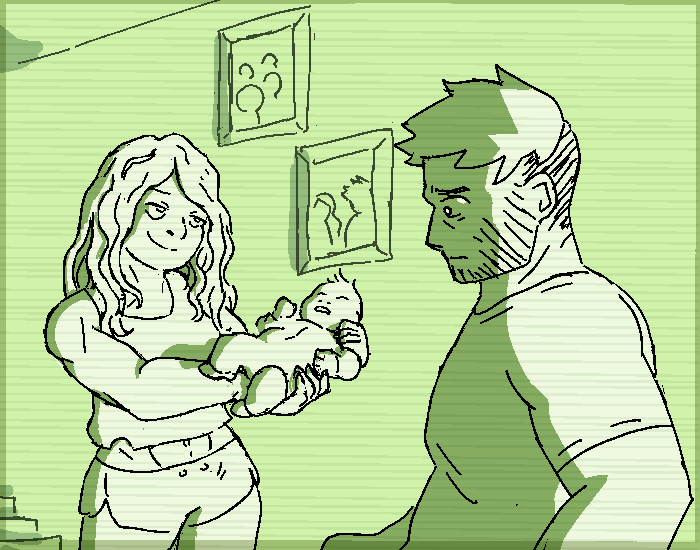
Mesa might not have a huge presence in Foreach, but she ‘s been a part of the narrative a long time. As soon as Cliff was ideated as a character I knew he had a family he couldn’t reach, it was essential to closing the loop back around to Jasper’s side of the story. He’d have a wife, and he’d have a kid. Despite leaning deliberately into the cliche of the grizzled hardman with a girl back home, I still wanted to make sure Mesa felt like a genuinely interesting person so that you could actually sympathise with Cliff on a baser level of wanting to see more from this woman.
There’s a very particular Wife Archetype that Rhys would call “barefoot in the kitchen” of the kind of wife this type of character always has, some demure symbol of purity, skinny brunette wearing white who goes “hahaha, stoppp” when our brick shithouse hero squeezes some facsimile of affection out his rugged jaw, and I very definitely wanted to avoid that here. It’s just, like… have you ever wanted to meet that woman? Have you ever sensed any kind of chemistry between John Wick and his porcelain perfect wife? We gotta do better than that.
I decided quickly Mesa should be cooler than Cliff. Like yeah, Cliff Mason kills three million bad guys per hour, but he couldn’t spin a one liner to save his life. She’s still a noncombatant (Peri: but we do know she’s techy, because Cliff mentions on pg 43 that she would know how to debug a radio relay!) – trying to make her some kind of superbadass murderkiller felt like it would be overcompensating – but she’s got a lot more baseline charisma and social confidence than him. It felt like a good compliment to him, and you can see what he would value in a relationship like that. Cliff yearns to be something other than a world class murder machine, Mesa has the confidence to make him feel like a chill goofy guy by comparison.
Mesa has four lines in this chapter and she, uh, she doesn’t get many more opportunities to talk in the rest of the comic, so it was important that what she does say implies a wealth of character. I want you to want more from Mesa. At the same time I was cognizant that if I wasn’t careful I would just end up writing Sunny again. Outspoken rudegirls are just great fun as an archetype.

My thinking for Mesa is she’s a jock. This already distinguishes her from Sunny because Sunny is actually a massive nerd. I imagine she and Cliff met at the gym and they hit it off from there. Undoubtedly she’s always talking about protein and reps and shit. All four of Mesa’s lines are her lightly jeering Cliff, but you can tell she’s intending to lighten the mood as she does it. I actually almost lost my nerve here and changed one or two of her lines to be more traditionally kind, like “hey, cmon, its okay”, but Peri encouraged me to keep it as-is. I appreciate her guidance there, because it was the right call. It gives more of a sense that these two are real familiar to each other – she knows Cliff knows her well enough that her intention is clear to him.
Peri perpends:
Adding a little more about the character design, there was also a bit of evolution in Mesa’s wardrobe on this page. Originally, she was in a sports bra!
Goddamn, she’s ripped. Anyway, I asked Lum why have her shirtless, and they said it was to convey her buff jock status. Which it is definitely doing… but it’s a bit overkill, which means we can claw back some of that narrative potential and put it towards conveying exposition that isn’t otherwise coming through on the page. Clothing is an important part of storytelling, it can tell you about a character’s situation, setting, and preferences all in one go. We don’t want to let that go to waste!
So what is Mesa’s situation? We know that Cliff was on deployment when she went into labor, and it’s probably been at least a few months since then. Mesa has been presumably single-mothering, along with the general stress of living on a planet that’s under invasion. She’s going to be a little stretched thin between the baby-rearing and everything else right now! I think what I told Lum to aim for was "gym rats mom's sloppy comfortable outfit bc she's overworked with a newborn", which landed us on keeping the shorts and adding a look tanktop over it. It’s exactly the kind of thing a gal might wear on laundry day when she isn’t too fussed about how she looks and wants to be comfortable.

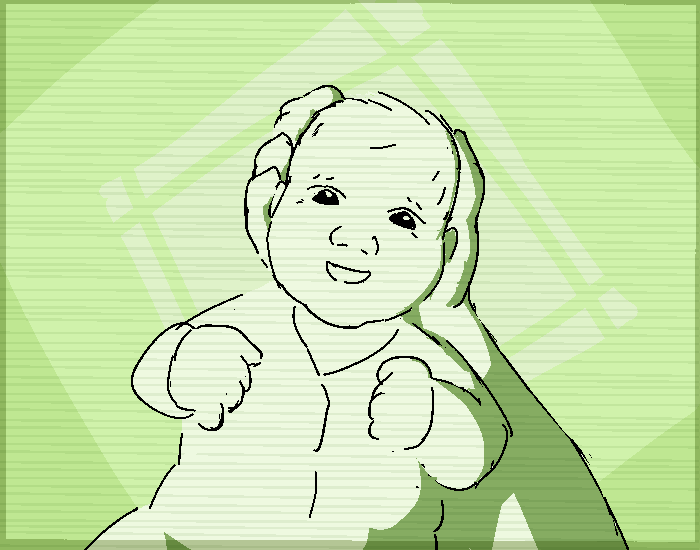
Babies are hard to draw. Adorable in real life but it’s so damn tough to communicate what makes them cute with lines alone. The artistic style of Last Gun meant I wasn’t able to push the stylisation much farther so I just had to be smart about it. Don’t overdo it with the linework, let the reader’s imagination handle the heavy lifting. This particular shot was referenced from a photo of my niece!
On another note, you’ll notice Cliff himself has short hair in the past. I like changing up hairstyles to communicate the passage of time, but you need to have a fair amount of confidence in your design skills to get away with it, because you’re abandoning one of the primary markers that the audience uses to tell your characters apart. I couldn’t get away with that so much with the anime girls, for example, who all have some pretty similar facial features. Cliff has a pretty distinctive look, though, although note that I didn’t get rid of his stubble – that really would be a step too far in undermining his recognisability.
Peri puts in:
Jumping topics, let’s talk flashbacks! This is our first ever instance of it in the comic, but besides Mercy’s sequence in Chapter 3 I’m honestly not sure how many more we’ll have in the future. Foreach isn’t a comic with a lot of backstory. The very premise depends on the fact that all of the worlds are video games, all of which have fairly simple set ups and draw on well-established tropes so you “get” what they’re about without too much heavy exposition. Of the four settings, Last Gun is definitely the one that lends itself most to flashbacking–after all, you can’t have a grizzled, traumatized hero without something in his backstory to grizzle and traumatize him!
And it’s a lucky thing too, because Last Gun also has the visual interface that lends it best to flashbacks. The visual shorthand of monochromatic tinted panels with horizontal striations evokes old VCR screens, which fit in perfectly with Last Gun’s retro-futuristic and tech-focused aesthetic. And the solid black text boxes make it easy to put a scene inside of a single character’s dialogue box, making it clear who is speaking and relaying the flashback. You could probably pull off something similar with the Homebound text boxes without too much trouble, and even Lovebomb (though the screen effect wouldn’t fit nearly as well), but Hellfuck? I have no frickin’ clue how we’d do flashbacks with angel-style text. Hopefully we never have to figure it out.
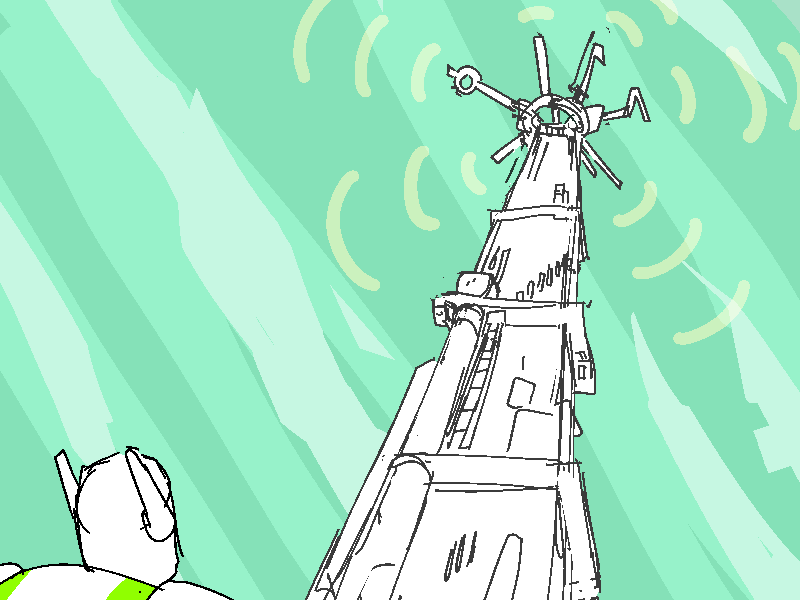
One last little note: this comms tower uses the same art as the one in panel 1 of page 40. You just don’t notice because it’s flipped around and it’s not covered in explosions this time! The wonders of reusing artwork…
Page 043 - Communications

Hanging a lampshade like this is a dangerous game, because you risk deliberately undermining the fabric of your own narrative. Here I use the captain to deliver some timely exposition, but I am fully aware that they don’t really have a good reason to exposit this information. So, I have the grunts point out they already know what’s being explained here. The risk being generated here is that if you point out the problems in your own writing, you don’t necessarily fix them, and in fact by actively drawing attention to logical inconsistencies you can stress on your reader’s suspension of disbelief. The reader often wants to give you the benefit of the doubt, but if you don’t bother to hold up the charade it’s hard to expect them to do it in turn.
There’s cause for it here though. The main important part is the Captain’s response – sternly admonishing the grunts for undermining their captain, and explaining the Captain's motivation. Rather than yielding narrative control, the Captain reveals themself as one of those bosses, who treats everyone under them like a pack of idiots. Calling out that exposition in-universe as being clumsy and unmotivated leads into the Captain delivering an in-universe explanation for why it was that way. The thread isn’t just left hanging! Thus, the integrity of the world is preserved.
Peri quips:
Also, it’s funny.
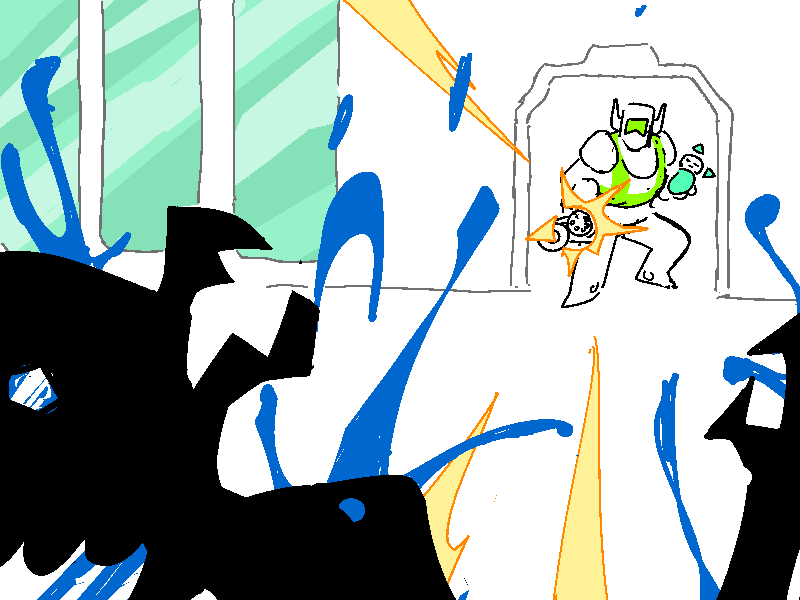
We get another new gun from Cliff here, a minigun. Once again this is driven by a narrative need; I wanted Cliff to kill everyone in this room in the space of one panel, but I also wanted that killing to feel justified considering the presence of some higher level enemies. Blasting everyone to death with an assault rifle would undermine the implicit power level of the Captains, so for this scene Cliff whips out something with a little more firepower.
Peri puts in:
Cliff switching out his gun multiple times a scene is a bit of a quiet gag we have going. Or rather, that Lum put in at the start and it took me an embarrassingly long time to catch onto. (Seriously! I once tried to point it out as a continuity error. Silly me! You can tell I don’t play a lot of shooters.) It’s one of the videogamey aspects that makes it way into the reality of Last Gun–in this world, Cliff can just store an unspecified number of weapons in hammerspace. It becomes more obvious in some later sequences (particularly in Chapter 4, when Mercy summons her Resupply), but I think it's fun that the gag stretches back for the entirety of the comic.
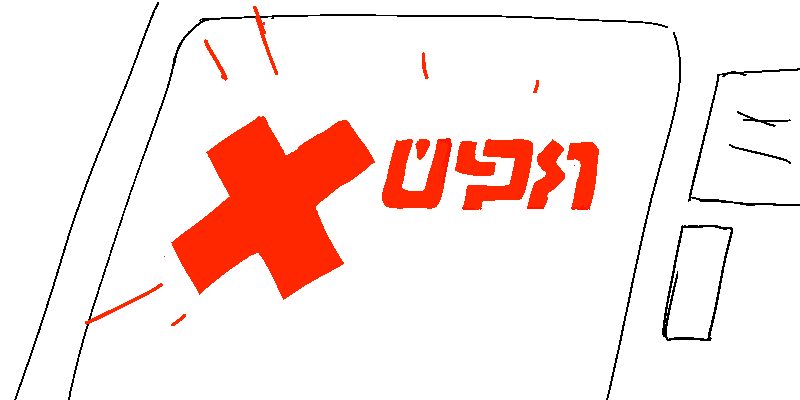
Cliff attempts to contact Earth here, but he gets no signal. If you’ve read past Chapter 3 (and if not, why are you reading the commentary?) you’ll know this is because Earth is gone.
I don’t really want you figuring out the twist just yet, though. So though this is information that is consistent with that Chapter 3 twist, I would prefer the reader doesn’t quite figure it out just yet. As with the example mentioned on page 33, that means we gotta hide our foreshadowing in both a logical sense and a narrative sense. Let’s talk narratively.
There’s a recurring theme in this chapter. Each character wants something, they have it in reach, and then by the end of their sequence it gets taken away. With Jasper it’s the promise of a break from exorcisms, with Jiro it’s his new ghost friend, and with Nix it’s the promise of freedom (facilitated by bazooka). Cliff gets Allen at the start of this sequence, and that initially seems like it fits the bill, but I can’t take Allen away from Cliff just yet without exploding the narrative flow of Chapter 3. Instead, Cliff gets the promise of contacting his family, established here with the comms tower, which is then immediately taken from him.
Cliff getting “no signal” when he tries to contact Earth risks being a dead giveaway of the big twist, so to reduce its importance in the reader’s mind we reduce its importance in this narrative sequence. Consider the beats we need to hit: there is the promise, there’s a sustained note of hope, and then there is the denial. For Jiro the promise is the initial conversion with the ghost, the sustained note of hope is his second conversation where he gradually becomes at ease, and the denial comes when the ghost vanishes.
If we really wanted to fuck this twist up, we would have made the “denial” come when Cliff makes this attempt and there is no signal. Maybe he would have gone “what the hell… why can’t I contact home!?” and we would have left off on that unresolved note of tension. The question would have remained, boiling in the reader’s mind, and when considering possible explanations they would invariably stumble on the possibility that there is no Earth to contact. Twist ruined, reader spoiled, now that future time we spend building up tension for the reveal is gonna feel like dancing around a something that the reader already knows.
Instead, we take a different tack. Rather than the “no signal” message matching up with the denial part of this chapter’s narrative structure, we fit it into the sustained note of hope. We achieve this through Cliff’s dialogue:

When he fails to connect to the Earth network, Cliff doesn’t place much emphasis on it, and he immediately offers up an explanation to the audience as to what went wrong. Even note the ordering of this: we get Cliff’s emotional response to this situation – the “Damn it!” – before we get the information that hints at what happened. Before you even know he can’t get a signal you’ve been primed to assume this problem is no big deal, it’s annoying, clearly, but it’s not something that our man seems particularly cut up about.
Then comes the actual denial: the console explodes.
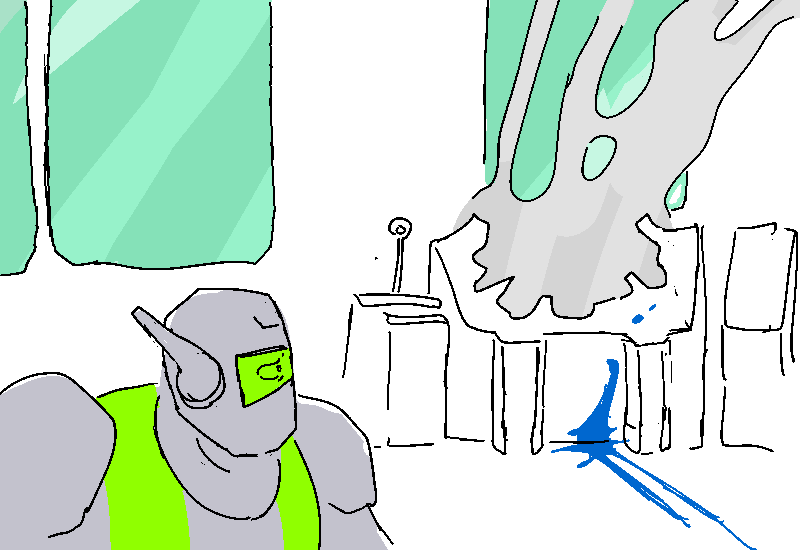
In contrast to the hypothetical given earlier, the reader is given an implicit explanation for why Cliff was unable to contact home, he simply didn’t have enough time to do so in an active warzone. There’s also a secondary explanation given by his dialogue, which is that unlike his wife Mesa he lacks the technical skill to do this quickly. These two explanations can work and be satisfying because they aren’t just logically sound, they fit in thematically with everything going on in Cliff’s arc. Cliff is frustrated by the inescapable violence in his life and his separation from his family, and in an ironic twist these are also the factors that bar him from contacting home. If the Aveans weren’t always firing on him he would have had the time he needed, if Mesa was around she could have helped him work the problem faster– or so he thinks.
Peri picks up:
So right about you’re probably thinking, “Wow! Those Foreach writers really thought this all out! They must have planned it way in advance!” Which, you know, we do plot the comic quite a ways out–you have to when working on a story this complicated! But in this case, I’ll tell you a little secret…
…the whole comms tower mini-quest was actually a last minute addition.
Okay, not that last minute. We worked the gist of it out right around when we started on the earliest pages of Chapter 2. The original outline stated that Cliff would be “doing the usual (murder)” when he finds Allen, has his flashback, and then encounters some kind of boss fight. I pulled the original text:
Cliff fights a boss, some kind of dinosaur in a mech. Cliff is almost hit by a devastating beam, but Allen projects a shield and saves him from it. Cliff defeats the dinosaur boss guy. The dinosaur taunts him… tells him it’s impossible for him to win. Cliff says no… all the people back home, still counting on him… they’re who give him the resolve he needs to go on. The boss goes “Whaaaat!?” and explodes.
This is good fun, but it has the problem where it doesn’t really advance the state of Last Gun at all. The unspecified mission has nothing to meaningfully distinguish it from the usual (murder) of Chapter 1. The boss’ exclamation at the end was supposed to be a kind of hint that Cliff talking about the people back home was surprising, but it doesn’t really land.
So instead, we pivoted to the idea of him finding and using some comms equipment. As a sequence, it’s fulfilling a lot more narrative functions than the original. First, it characterizes Cliff–we find out that he’s a little bit techy, even if he’s not primarily trained for his work. It also reinforces that working alone for so long has given him a bit of a cavalier attitude towards rule breaking (I love that you can also see this reflected in his non-regulation long hair and his casual tone with Mercy.) Second, it tells us more about the world–Cliff mentions that the human relays are reverse engineered from Avean ones, which hints at a bunch of world building wherein human space technologies may have been derived in a hurry after they got invaded by aliens. And third, it gives us stakes the audience will actually want to invest in. “Will Cliff get to talk to his family?” is a much more compelling dramatic question than “Will Cliff be able to defeat this slightly larger boss enemy?”
And the icing on top: it turned out to be a perfect retrofit to this line from Mercy in Chapter 1:
I don’t think Lum planned it that way, but it worked out awfully well!
Final thought: This page has our first ever mention of General Ribrax! I don’t think I’ve seen anybody pick up on that before, and certainly not at the time when the page originally went up. There’s no explanation of who she is, but it’s a nice hint that there’s more to the Avean world than we’ve seen so far.