“Do you love him?” I ask.
This question she does not deign to acknowledge, but I can tell it’s because she doesn’t want to talk about it, not because I’ve asked something outré. It’s not her fault I’ve noticed… I have grappled with Tsevet and Kor directly, and a little with Kef and Amath, and after four Shames’ worth of psychological prowess, one Guardian, no matter how exquisitely trained, is going to be an open book. She speaks in a lyrical mezzosoprano, and, as I expect, it’s not an answer. “You have poorly translated these caste-ranks, Scribe.”
That, on the other hand, is the height of courtesy, calling me ‘scribe’ instead of ‘aunerai’, and intimating that my mistake is a minor one, rather than the egregious one I suspect it is. I was never happy with how I described the ranks within the Guardian caste… but then, they were never interested in educating me, either, so this would be my opportunity.
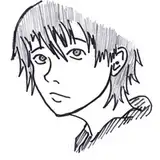
My guest is one of the rare female Guardians: a bit shorter than typical, though taller than, say, Kor. Like him, she’s compact and dense, with no wasted mass. Though her build is more competition gymnast than weightlifter, I can easily see her taking a punch without dropping. Her training with weapons is visible in the highly developed sinews of her arms, twisting under her pelt during the most minor of gestures. And all that power is hidden under a velveteen hide a light, cool brown in color. Her hair is a shade darker, straight and severely pulled back into a club behind her long neck. She has the expected enaril—ribbons—bleached to show against her fur, and they’re four stripes over her neck with a dot near the opposite collarbone, and two more dots above her brows. I’m expecting green or gold eyes because of domestic cats, so her gray ones are startling.
She’s in a Guardian uniform, wearing a sash marked with the seal of her Regal wards, and the badge on her tunic finally surprises me: a three-pointed leaf that looks almost like poison ivy but that I know instantly as nanain,a plant used to make salves for wound-healing. Kor and Vekken told us that some Physicians take the Guardian training; they neglected to mention it operates the other way as well, and some Guardians can become doctors. That’s what she is: the equivalent of a combat medic.
Her name is ran Doval a’Elidzin-gunedkedi, which makes her (I think) the head of a private detail of bodyguards for the Regal family Elidzin. I wanted someone to tell me about the next story who wasn’t directly involved; looking at her, I question if she qualifies. At last, knowing she was aware of my scrutiny and allowing it, I say, “Educate me, please, gunedkedi.”
“You have attempted to make sense of our ranks by assigning us tasks,” Doval says in that mellifluous voice. I wonder if other Ai-Naidar find it distracting. “And that is not badly done, as other castes do order their ranks that way.”
“Because,” I say, “ascending ranks have more responsibility, and for more people. So as they rise, they have different tasks. Broader ones.”
“Yes.” She is looking at my book of notes, but her ears are constantly moving. And casually, so that she never appears stressed. You relax, because you think she’s paying attention to everything, so you don’t have to. “But our caste, as in so many things, is a special case. The ranks denote knowledge and training, not what we do.” Straightening, she finishes, “all of us begin with what is considered basic knowledge: body training, such as the ability to run a certain length of time and distance; and task training, such as what we are called on to do in the event of a fire. We continue learning and training, however, and our native ability and our ambitions are our only checks, until we reach the top of the caste.”
“The nakked,” I say. “They ward Thirukedi. Not… because it is their caste-rank’s task, but because… they are the most capable and extensively trained?”
“Correct.”
“That makes sense,” I say. “And… you probably have some cheeky way of referring to all this, don’t you?”
“We say we want more chek.”
I pause. “That means… scratches?”
“Because the journey up the caste-rank involves a great deal of training, which involves many bruises and scratches. And caste-rank is visually denoted on our uniforms, when we are dressing formally, with horizontal marks.”
I imagine that and laugh. “Yes. I can see how ‘oh, you’re gunning for your next bruise’ would totally be Guardian-speak. You people.” Shaking my head, I say, “but to return to the topic… are you all really trained to do every task a Guardian needs to do? I wouldn’t have thought everyone would have the time to learn all the specialized knowledge—does that have a name, by the way?”
She dips her head. “We call it pasolith.”
I start laughing, because while the textbook definition of that is ‘areas of interests and aptitudes’—it’s a ‘find where people fit’ word from above the Wall—what the Guardians have made it mean in their jargon is ‘hobbies.’ “Do you really?”
Her smile is too quick to have lit up her face like that, made it unforgettable. Her features are not ‘fortunately arranged’ by Ai-Naidari standards, but when she smiles, she’s breathtaking. “We do, yes. Insolence is something of a caste habit. We defend the Ai-Naidar with our skills and training, scribe, but we use humor to defend ourselves. From the tragedies and unfairness and the hhalet.”
That’s an interesting one, hhalet. I think it means… ‘things you can’t change because they are real, or natural.’ “Many of our guardians do the same,” I say. “And you find the same sort of humor in aunera in any of the professions that face… hhalet… on a daily basis. Like physicians.”
She touches her badge and nods. “You are not translating our prefixes correctly, either. Ran and kin are not hierarchies of rank. They are… hierarchies of specialized knowledge. That is where the pasolith come into the picture. When one Guardian spends enough time in an arena—dealing with dangerous animals, for example—then he begins accruing experiential knowledge, the kind of knowledge that cannot be imparted by training. Training can prepare you for a situation, but only experience can truly teach, we say. When someone has been in a pasolithi for long enough to become an expert in it, then we use the ran prefix.”
“And kin?” I ask, because that’s what I thought belonged in front of her name before this explanation.
“Indicates people who have been practicing in their field of specialized knowledge long enough that moving them would be a waste,” she said. “They are more than generalists, but not quite experts yet.”
“So,” I say slowly. “You are ran Doval a’Elidzin-gunedkedi… because you are a Guardian expert in medicine.”
“Yes,” she replies, quiet.
“And you were sent for,” I continue. “To replace his former Guardian—”
“Yes,” she says. “He wished to take up his responsibilities on the colony world, scribe. They wanted someone assigned to him who could help him, since he no longer had access to all Kherishdar’s experts while away.”
I think about that for a while. “The Gate,” I say at last, “is not that far.”
“The Gate is forever away if you need immediate aid.”
I can’t argue that. “Do you love him?” I ask instead.
She sighs. “A useless question. We all love him, scribe. That is how Kherishdar works. And if you press me to say ‘ah, but don’t you love him more,’ I will say that all of us love him more, because he is worthy of it.”
A very Guardian reply… and also a personally revealing one. I bow to her, and she dips her head back.