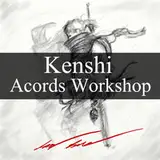
We continue our week of free coffee-cup content! Today, a digression about worldbuilding that occurred to me while working on more of my "author doodle" books. I've done several of these so far--all of them sold out!--but I wanted to do something special for the first edition Admonishments I had left. Since this setting has my most fully developed constructed language, the obvious choice was adding calligraphy.

Most of this was a straightforward process. I won't call it simple, because it required me to look up words, match up letters, and do a little practice on a different sheet of paper before applying myself to the final process. But the Ai-Naidari lexicon is vast, the orthography stable, and honestly, it was kind of relaxing. Doing calligraphy, even the simplest kind, is meditative. Unsurprisingly, since anything having to do with Kherishdar seems to inspire a slowing-down.
I bet they have word for that, even.

No, the only place I tripped was the title. Because despite having 854 words ranging from 'window' to 'eleven' to 'emotional balance, in the sense of feeling that you have contributed as much as you are receiving (from life, people, society, etc)', I did not have the word for 'to admonish.'
...
Finding new words when you have 854 of them already is an adventure, particularly when you have grammar to complicate their endings, middles, and beginnings. I've been developing this language for over a decade, and it's supposed to be the sole language of an empire that's over five thousand years old and spans multiple worlds. I know that solidarity is sufficiently important to them that, like some human cultures that enforce 'language purity', they attempt to keep this one tongue intelligible for all its speakers... so we're talking about a single language that's been in continuous use over several millennia.
A lot of history happens in thousands of years.
I am fascinated by etymology, and have been since I realized that the spelling of English words is related to historical events. People like to dismiss English spelling as inconsistent and baffling, but it's not, so long as you understand that all the historical and cultural influences that have washed over English speakers over generations of history have left clues in those "inexplicable" spellings. If you assume that English spelling should be solely about how a word sounds then... sure, you're going to be completely confused. But if you realize that the spelling of every word is a treasure trove of information about how that word came into the language, and when... well, how can you not want to go diving into it to see what you come out with?
Spelling isn't the only way that language hints at culture. When you run into situations where a language has multiple words for the same thing, that's a good time to wonder why. Why do we say 'horse' as well as 'steed'? They came into English from the same root language, but they used to mean distinctly different things. Now, to most modern English speakers, they're interchangeable, except one is 'old-fashioned' and makes you think of fairy tales. (Which, incidentally, is not what it originally meant!)
The ways that languages squirrel away information about the people who speak them are myriad. These are just a few examples!
So moving on to worldbuilding... being knee-deep in, and fascinated by, languages, my instinct when worldbuilding is to use language to spot historical information. That's how I went into the lexicon looking for the word 'to admonish' and decided that the word was 'old enough' that it must have a separate noun form ('admonishments'). Modern Ai-Naidari has both declension of nouns and conjugation of verbs, so newer words don't have separate noun and verb forms... they use the same root, and are either declined to form the noun, or conjugated to form the verb. But 'to admonish' felt like a word they've had for a long time, from before the language began evolving ways to gracefully handle social courtesies that used to be harsher when the society was younger.
Thus, to admonish, deshet, and admonishments, darishet.
My point in all this is not to give you a language lesson (not today, anyway!), but to make it clear that history doesn't clean up after itself. No matter part of society you peer into, if you dig you will find evidence of all the antecedents that made Now possible. Whether your interest is money, food, fashion, transportation, or technology, if your society's been around long enough, it's accumulated a lot of cruft. And the cruft that's so annoying in software is a goldmine for those of us trying to design (or learn about) a culture. If you're chasing verisimilitude, you could do worse than to investigate the ways that real cultures accumulate this accidental metadata. Start with your own! You'd be surprised what you'll discover when you start looking, especially with things you take for granted. One of my favorite games is to try to figure out where common expressions come from. Why do we say we're 'pulling your leg' when we mean 'we're making a joke'? Where did that come from? Why are so many American beers made with adjunct grains? Why do brides have something borrowed and something blue?

It's all waiting for you, in the corners. How lucky we are that history is such a poor housekeeper!
Lemurvid
2018-07-07 14:11:11 +0000 UTCErin Hartshorn
2018-07-05 14:22:41 +0000 UTCfilkferengi
2018-07-04 21:05:33 +0000 UTC