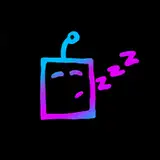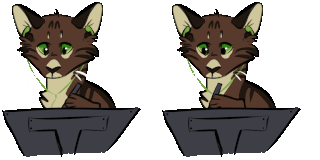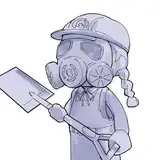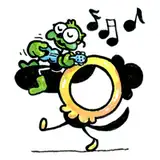
Two brief process-related snippets this week. One is my continued attempt to train myself to flow more seamlessly between the more dimensional approach I am most used to, and the more flattened symbolic approach I have been enjoying so much lately. The above header image was a doodle made during an online board game session, and does a decent job of capturing what I'm after, despite my having run into the previous half-drawing of that other vehicle-thing floating in the air there. whoops!
At the bottom of this post is another drawing, made earlier the same day (i think), where I was consciously trying to re-find that balance after noticing myself slowly reverting to my old way of engaging with drawing (a change I made in the first place to re-inject my practice with the joy of drawing, and something I'd really rather not let fall by the wayside).
The next thing I want to share is the conclusion of a bit of a side-quest I've had on my mind for the last 5 or so years. While studying at the Sequential Artist's Workshop in Florida I encountered the comic strip "Buzz Sawyer" by Roy Crane (and assistants). Roy Crane's comic have been an inspiration to me in many ways, and I was even lucky enough to spend an entire day studying pages upon pages of his original comics, writing, other related material at Syracuse University in upstate New York where they have a special collection containing more or less everything the man made in his professional life.
The comic Buzz Sawyer itself is not my favorite of his strips, but with it Crane used a particularly interesting method of shading which I have been fascinated by since I learned about it. How it worked was, using a specially treated paper called "Doubletone," a cartoonist could then use a watercolor brush to paint on the paper with one of two special chemical solutions. Depending which solution was used, either a lighter hatched tone or a darker cross-hatched tone (combining the pattern revealed by the first chemical alongside it's mirror-image) would be revealed wherever the chemical touched the paper. In effect, you were able to "paint" with screentone. Crane and other cartoonists used this to spectacular effect, sometimes revealing the underlying patterns with painterly flourish, other times using it to draw background elements or patterns on clothing. I haven't yet read through all of this, but looking for something to link here, I found this page which links to a lot of information which I ma eager to read myself. Scroll down to the section of links under the header "CRAFTINT SINGLETONE AND DOUBLETONE."
Here is an image describing the process from the manufacturer themselves:

One thing that really appealed to me about this was the idea that one could easily control focus and visual weight by selectively choosing which elements to draw with pen and with tone. The really struck me when I first saw a panel of Buz Sawyer where the titular character and a love interest were dancing in the foreground, and the rest of the dancers at the ball were rendered using only Duotone.
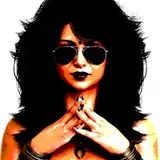
I had tried to figure out how to replicate this using photoshop a couple of times, but never really put the time in to getting it to work correctly/smoothly (though I'm sure it's possible. With my recent re-discovery of the program "Clip Studios Paint," I have finally figured out a very simple and intuitive method to replicate the Duotone process using the computer. As alluded to above, my current experiment is that I want to draw all characters and objects directly relevant to the strip in ink as usual, and then, after scanning the original into the computer, I want to draw any backgrounds and incidental shading using my NeoDuotone method. My first attempt, shown below, is quite simple, but hopefully it will give you an idea of what I'm on about!

And here are some images showing Crane's much more involved usage snapped from my copy of Buz Sawyer volume 2 (published by Fantagraphics).


Oh, and below is the image I mentioned back in the second paragraph. On the left is a frustrated doodle of an area in the Turtle Library's world, and on the right, the same scene drawn with much less frustration by flattening and simplifying the background, and allowing dimensionality to enter tin the form of the mullet-turtle in the foreground

and with that, adieu!