LWiA 4.4: Sebastian O
Added 2025-11-18 23:20:14 +0000 UTCAt its core, Sebastian O is very much the sort of thing Moore was describing when he talked about his Image work aiming to be “better than average stories for 13-to-15-year olds.” Its central narrative engine is simply an adventure story—a fellow named Sebastian O escapes from prison and confronts the man who put him there after working his way through a motley of underlings and meeting up with the other surviving members of his and his betrayer’s old gang. It is plainly a book whose primary goal is making sure that it’s fun to read.
The main way Morrison accomplishes this is by being very funny. This is made clear from the first page, which opens with a quarter-page caption box directly addressing the reader with over the top faux-Victorian moralism. “Hypocrite reader,” it proclaims—which is already funny just two words in, ”do not seek to avert your eyes from this dreadful spectacle! Ask yourself only what has brought you here to gaze upon this miserable scene and find in the suffering of your fellow men some measure of sensation and entertainment. Do you seek, perhaps, some foretaste of hell so that you will know it well when the time comes?” This also serves to set up the book’s central pleasure, namely the fact that Sebastian O is an absolutely magnificent bastard. He’s the sort of protagonist who will quip to someone “don’t fred… the lad’s simply stunned. He’ll wake up in an hour none the wiser,” and, when it’s pointed out that Sebastian has in fact slit the lad’s throat, will simply shrug and say ‘Oh, dear. My mistake. My diagnosis regarding his recovery would appear to have been somewhat premature. Forgive me if I raised your hopes unduly,” or, when a man pleads for his life on the grounds that “you’re a gentleman, sir. You won’t shoot a poor bloke off the streets, will you now?”, will consider for a moment with a “well, perhaps not” before shooting him in the head and walking off with a “how I detest the poor.”
In this regard, at least, Sebastian O is most comparable to Big Dave, which Morrison was working on at around the same time (they discuss both in a 1992 interview)[1]. Both are based around fundamentally horrible protagonists who spend much of the comic being awful to people, with the pleasure being in just how outlandishly awful they are. Crucially, neither Big Dave nor Sebastian are ever put in any significant peril. Sebastian is periodically attacked by assassins, but there’s never any sense he might lose. The worst it gets for him is when he takes a bullet early in the second issue, and he spends more time, which is to say any, dealing with the fact that his clothes got soiled than he does with the nominal injury. Instead he floats above the action, an unstoppable force in a world of eminently movable objects. This is crucial, as it means that the book does not require the reader to be invested in Sebastian, there being no dramatic tension around whether he’ll succeed. Instead one is free to simply be invested in the question of what bon mot he’ll be delivering next.
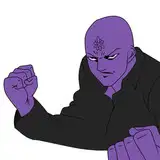
But where Big Dave took pleasure in quasi-ironically reiterating the bigoted sewage of the red tops, Sebastian O’s approach to reveling in a horrible person being hypercompetent is altogether weirder and more interesting. Sebastian is a Victorian dandy—Morrison’s comparison in interviews was “what would happen if Oscar Wilde met Die Hard,”[2] although in practice Steve Yeowell modeled him off of Aubrey Beardsley, particularly his distinctive split bangs hairstyle. Unsurprisingly, the innate weirdness of this combination provides much of the humor. The first issue’s cover emphasizes the Victoriana—Sebastian stands in the foreground in an immaculately tailored powder blue suit, leaning on a cane with one hand, pinky extended, while the other holds a lengthy cigarette holder. His companions are similarly debonaire, and decorative touches like the art nouveau vases of flowers or the flower wallpaper design that occupies the Vertigo stripe on the left further emphasize the period setting. Nothing about it implies either the utter bastardry of its protagonist nor, for that matter, the fact that the book is an action-adventure yarn save the charming melodrama of the caption box offering the quote “One must commit acts of the highest treason only when dressed in the most resplendent finery.” This quote is characteristic of the book’s sense of humor, which leans into the mismatch between Sebastian’s aestheticism and the action book—gags like him taking a break for an elaborate toilette despite the knowledge that the police are on their way, or his recurring concern for the state of his clothes after a fight.
There is one aspect of the Victorian decadent movement, however, which sits quite oddly within Sebastian O for reasons unrelated to the frisson of the book’s central premise, namely queerness. It’s not quite that this topic is downplayed within the book. Both of the old friends who Sebastian visits over the course of the book are overtly homosexual, and Sebastian is freely denigrated as a “pansy” and a “sodomist.” But there is something intensely unpleasant about the book’s handling of the matter. One of the aforementioned old friends, the Abbe, is specifically a gay pedophile, a fact Morrison plainly finds hilarious. And Morrison’s accounts of Sebastian’s sexuality in interviews are scarcely heartening, talking about DC”S surprise that “this book about a Victorian faggot sold so well,”[3] and complaining that they’ve “written loads of positive, strong gay characters into my comics, not least of which is Sebastian O, who is probably the only gay character with his own title, and not once has the gay press commented on or publicised these pieces of work[4].” Which is pretty rich given that nowhere in Sebastian O does the lead character actually say or do anything that points towards his homosexuality. His only comment on the matter is the complaint that he was judged “a sexual pervert, on the basis of a small book of essays and poems on a theme of Uranian love,” which, taken alongside the fact that his bath is administered by a collection of topless French maids, leaves the distinct implication that everyone’s accusations of Sebastian’s homosexuality are, in fact, misguided.
The Victorian dandy as action hero aspect of the book is not, however, the only striking thing about its premise. Sebastian O is not set in actual Victorian England, but rather in a technologically advanced version of it that has television, helicopters, horseless carriages, and, most significantly, computers. The implications of this can’t be described as what the book is about per se. This is largely what characterizes the “above average stories for 13-15 year olds” concept—stories that are at their heart about simple thrills, but which gesture at larger themes. In the case of Sebastian O, this comes with the climactic reveal that Lord Lavender, the treacherous former friend responsible for Sebastian’s imprisonment, has replaced the real world with a virtual reality simulation—“A purely artificial world” of ‘pure, undying beauty” in which he is god. (“Haven’t you heard? God is dead,” quips Sebastian as he shoots him.) As Morrison later explained it, “Decadent authors were obsessed with artifice and they affected a hatred of gooey, slimy nature so I thought that tied in nicely to ideas about virtual reality which were starting to show up when I was writing the book. I saw virtual reality was the decadent dream come true - a world where everything could be artificial, synthetic and perfectly beautiful.”[5] These are by and large familiar concerns for Morrison—Animal Man’s notion of the main character discovering he’s fictional, for instance, trods similar conceptual ground, and he’d return to the notion of artificial worlds plenty of times. But here, even as it’s the thematic linkage that ties the book’s otherwise wild melange of themes together, it functions more as a sort of narrative ornamentation than a subject to be explored with any substance.
[1] Martin Conaghan, “Well ‘ard,” Xstatic #1
[2] Joe Nazzaro, “Doomsayer,” Comic Scene #28
[3] Steve Darmall, “What’s Buried in Grant’s Tomb,” Hero Illustrated #9
[4] Martin Conaghan, “We Are Now Greater Than Ever,” Comic World #18, archived at https://sites.google.com/a/deepspacetransmissions.com/site/interviews-1/1990-s/199308-comic-world-18
[5] Daniel Robert Epstein, “Grant Morrison,” SuicideGirls, https://www.suicidegirls.com/girls/anderswolleck/blog/2679166/grant-morrison/
Comments
Caught the misgendering in the final paragraph just after I hit post, but Patreon is returning an error when I try to edit the post for some reason, so I can't actually fix it. Is fixed in Scrivener at least.
Elizabeth Sandifer
2025-11-18 23:22:47 +0000 UTC