more at http://quickfound.net/
American birds of prey: general characteristics talons for grasping and carrying prey, curved beaks for tearing flesh;
classes: owls, vultures, hawks, and eagles;
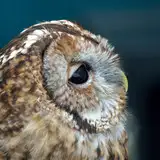
barn owl, great horned owl, screech owl, and snowy owl;
turkey vulture, black vulture;
sparrow hawk, marsh hawk, rough-legged hawk, red-tailed hawk
Originally a public domain film, slightly cropped to remove uneven edges, with the aspect ratio corrected, and one-pass brightness-contrast-color correction & mild video noise reduction applied.
The soundtrack was also processed with volume normalization, noise reduction, clipping reduction, and/or equalization (the resulting sound, though not perfect, is far less noisy than the original).
https://en.wikipedia.org/wiki/Bird_of_prey
Wikipedia license: http://creativecommons.org/licenses/by-sa/3.0/
Birds of prey, or raptors, include species of bird that primarily hunt and feed on vertebrates that are large relative to the hunter. Additionally, they have keen eyesight for detecting food at a distance or during flight, strong feet equipped with talons for grasping or killing prey, and powerful, curved beaks for tearing flesh. The term raptor is derived from the Latin word rapio, meaning to seize or take by force. In addition to hunting live prey, most also eat carrion, at least occasionally, and vultures and condors eat carrion as their main food source.
Although the term bird of prey could theoretically be taken to include all birds that primarily consume animals, ornithologists typically use the narrower definition followed in this page. Examples of animal-eating birds not encompassed by the ornithological definition include storks, herons, gulls, skuas, penguins, kookaburras, and shrikes, as well as the many songbirds that are primarily insectivorous...
Eagles tend to be large birds with long, broad wings and massive feet. Booted eagles have legs and feet feathered to the toes and build very large stick nests.
Ospreys, a single species found worldwide that specializes in catching fish and builds large stick nests.
Kites have long wings and relatively weak legs. They spend much of their time soaring. They will take live vertebrate prey, but mostly feed on insects or even carrion.
The true hawks are medium-sized birds of prey that usually belong to the genus Accipiter (see below). They are mainly woodland birds that hunt by sudden dashes from a concealed perch. They usually have long tails for tight steering.
Buzzards are medium-large raptors with robust bodies and broad wings, or, alternatively, any bird of the genus Buteo (also commonly known as "hawks" in North America, while "buzzard" is colloquially used for vultures).
Harriers are large, slender hawk-like birds with long tails and long thin legs. Most use a combination of keen eyesight and hearing to hunt small vertebrates, gliding on their long broad wings and circling low over grasslands and marshes.
Vultures are carrion-eating raptors of two distinct biological families: the Accipitridae, which occurs only in the Eastern Hemisphere; and the Cathartidae, which occurs only in the Western Hemisphere. Members of both groups have heads either partly or fully devoid of feathers.
Falcons are medium-size birds of prey with long pointy wings. They belong to the Falconidae family, rather than the Accipitridae (accipiters). Many are particularly swift flyers.
Caracaras are a distinct subgroup of the Falconidae unique to the New World, and most common in the Neotropics – their broad wings, naked faces and appetites of a generalist suggest some level of convergence with either the Buteos or the vulturine birds, or both.
Owls are variable-sized, typically night-specialized hunting birds. They fly almost silently due to their special feather structure that reduces turbulence. They have particularly acute hearing.