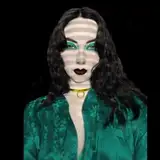
When I saw that SZA had released Good Days, a music video throughout which she uses pole dance as a vehicle for metaphor, I was reminded of Cellophane by FKA Twigs, and I started reflecting on how music videos have used pole dance to signal a variety of things: from fragility, grace, ascent and descent of the soul, and in the case of Montero by Lil Nas X, homophobic hell-bound damnation. How has the pole been appropriated as a visual metaphor in music videos lately; what work are those metaphors performing; and how does the popularization of pole performance affect the community where this dance discipline was born: aka strippers?
When I look at these videos, while I recognize the dance form the performers are using, what I see presented is utterly alien compared to what I do in the club. While the tricks and movements are the same, the difference between what I do and what they do is immediately evident: they are performing for an audience of cameras, I am performing for an audience of people. While it may seem that they too are performing for people--in fact for a much wider audience than most strippers will ever reach--they are not. Strippers move the way that we move because we are specifically targeting a live audience whose desires we play to constantly, and whose movements we improvise with synchronistically. When I dance, I make eye contact with every person in the room. I select each move and gesture to beckon reluctant tippers to the stage to give me their money. Sometimes I perform with every ounce of energy in my body, and it’s thrilling. Other times, if the money I’m receiving on stage is inadequate compared to the amount of physical effort I’m exerting, I literally stop and do nothing. There’s no choreography, there is only living in the moment and improvising to milk the room for as much money as possible.
Why would I pause, if I enjoy pole dancing for its own sake? The answer is because stripping takes a major toll on the body. All of these musicians who have picked up pole dance for the sake of a music video can verify that learning to dance requires literal blood, sweat, and tears. When I’m not dancing on stage, I’m wearing six to eight-inch heels, walking around for six to ten hours, and performing private lap dances which require additional physical effort. While many *younger* dancers enjoy practicing on the pole for the love of it, those of us who have been in the industry for longer know the price our joints pay to play, and we mitigate the strain we put on our bodies. Pole dancing has given me crunchy knees, crackly shoulders, wrist pops, lower back stiffness, and a litany of other ailments that have accumulated over time. For me, while I enjoy the art of pole performance, it’s not a one-off show where I can bring everything to the stage, it’s a long game of risk analysis. How much can I do and retain mobility into old age? How much can I do without incurring major medical costs that I will have to pay for out of pocket, because my industry does not provide healthcare plans? If I incur a major injury, will I have enough saved so that I can take off from work without going into debt, because in my state, strippers are not entitled to workers’ compensation? These are things the many pole dancing celebrities do not have to consider. For them, it is simply art, expression or exercise. Accepting that this is the difference between our two paradigms, let’s examine a few of the most prominent music videos featuring pole dance.
Let’s begin with Cellophane by FKA Twigs, since it was perhaps the first music video to centrally feature an advanced pole routine. In this music video, Twigs performs pole dance in a golden fantasy space where she ascends via a stripper pole to the top of a vine, where’s she’s met by an alien who kicks her down to some muddy underworld where woman-like creatures cover her in the mud, symbolizing some sort of rebirth. We see the themes of fragility, struggle, and rebirth communicated via the stripper pole, which made me wonder why the stripper pole was selected as the medium to convey these themes? As a stripper, we are not allowed to be personally fragile. There is not a stripper who can survive the industry without developing an incredibly thick skin. We face constant rejection, criticism of our appearance, bullying and harassment due to the stigma of our labor, and a constant lack of attention to our safety. And yet, we are in a fragile position. Because of the lack of enforcement of safe workplace standards at the majority of clubs; because of the thin line many of us toe between legal and illegal activities; and because we are one injury away from being out of a job--we must build up a personal defense system to survive the constant threat of our worst case scenarios becoming our reality. While we are strong in the ways we navigate the dangers of our jobs, we are forced into a state of fragility by the external forces around us. We struggle against the friction of these opposing realities constantly, whether consciously or not: whether we give names to the discrimination we face or accept that a stripper’s life will inevitably be hard until our government sees us as laborers deserving as much protection as taxation; until our neighbors see us as friends rather than threats to familial stability; and until our future employers see our job experience as valid and worthy of a line on a resume. In the end, at least Twigs gets to enjoy a sense of rebirth--recovery from her fall. For strippers, there is no equal sense of resolution.
SZA’s Good Days takes place partially in an Alice in Wonderland magical mushroom kingdom; a Beauty and the Beast magical library with a stripper pole where SZA dances while reading books; and an empty gas station with a solitary stripper pole where she dances at a pump that says “self-serve”. While Twig’s video is narrative heavy, SZA’s video seems to not necessarily have much to say. It’s more a series of visual tableaus intended to look dope, and visually, it is cool, but there isn’t much substance. The lyrics behind the song don’t provide many additional clues as to why SZA’s creative team selected any of the imagery. The end result is a visually striking yet superficial music video. If I look purely at the pole dancing segments, there is something appealing about the juxtaposition of stripping in a library setting. The learn’ed bimbo trope has been taking off lately, and perhaps the video plays against the stereotypes of sex worker ignorance in this visual juxtaposition. Another generous interpretation would be that her pole dance in front of the “self-serve” pump is an illustration of her liberation and a sense that she is now serving herself, instead of focusing on the damaging relationship she meditates upon in the song lyrics. SZA uses pole dance to symbolize her liberation and a renewed sense of personal identity. In contrast, many strippers have found their own sense of personal liberation significantly reduced due to the numerous, and heterogenous laws governing strip clubs. When I applied to work in San Diego, I had to pay $400 to purchase a license where I was 3D fingerprinted and had to register with the police department, all to simply work a job that many people do out of desperation. I don’t mean desperation in a pejorative sense, there are many reasons to want to be a stripper, however stripping has always been a sanctuary industry where you can show up any night without a penny to your name, and leave with a couple hundred dollars to continue surviving. The point has been that the barriers to work were so low, most people could work whether they have papers, an education, job experience, or other requisites that can make employment unattainable for people. Laws like the one in San Diego, and a similar one in Las Vegas make it difficult for those who are most desperate for employment to access a vital job in their moments of need. Additionally, strip clubs have been pushed to industrial areas in most states, where there is hardly any pedestrian traffic, making it much less safe for strippers to come and go from work. Our movement is restricted due to the safety concerns around the areas where we are allowed to work. Finally, to speak to the “learn’ed bimbo” trope, while there is beauty in seeing this represented in such an elaborate, high-budget way, the many strippers who are pursuing education while dancing face additional barriers to acceptance. If we out ourselves in many academic settings, we will face discrimination from people who disapprove of the profession entirely, and harassment by the men who believe that because we work in the sex industry, we are constantly open to sexual solicitation. I have friends who have lost internships, scholarships, and other opportunities one depends upon for success in higher education. The learn’ed bimbo’s life is one of ostracization and catch-22’s.
Finally, there is Montero (Call Me By Your Name) by Lil Nas X. Lil Nas X’s Montero video whipped the internet into a frenzy. Montero begins in a mythological Garden of Eden-like paradise, moves to a fantastical Pantheon-style court, and finally descends into hell where Lil Nas X gives the devil a lap dance and then becomes the devil himself. The music video gives a giant middle finger to homophobes who have been threatened by Lil Nas X being a male hip hop artist who is openly gay. There have always been lesbians *relatively* accepted within the hip hop community, but Lil Nas X is one of the first black gay men to come out (admittedly after Frank Ocean and Tyler the Creator who both identify as bisexual), and top mainstream hip hop charts. He has faced vitriolic hatred from the hip hop community, a community that is notoriously homophobic, as well as backlash from the fundamentalist Christian community for his use of sacreligious imagery to celebrate his homosexuality. In beginning my criticism of Montero, I cannot help but acknowledge the amount of hate Lil Nas X has faced by simply existing and being himself.
The actual pole performance part of the video takes up only a small percentage of the video, but there was something about the way Lil Nas X used it that was less problematic than some of the other examples: in his rendition, he is literally using the pole as a one-way ticket to hell. As a stripper, I know I’ve been damned to hell in the minds of many a pearl-clutching Christian. Strippers are treated as soulless succubus leading men to their doom, destroying families in our wake (And yet so many of us have families as well that we support? Go figure!). There are a lot of parallels to the ways sex work and queerness are spoken about, and the marrying of the two in this video leads to a surprisingly harmonic representation of pole dance. The pole retains its edge, as a symbol of sexuality and deviance. Additionally, unlike the two previously discussed pole-based music videos, this one at least leads to a lap dance. When pole performances are divorced from the lap dance, it feels further neutered and divorced from its stripper origins, so extra points to Lil Nas X for the satanic lap dance. In Montero, Lil Nas X rises from condemnation to a position of power by undermining his own condemnation and over turning the system. As a stripper, I am constantly up against the condemnation of the world around me, and I fight through my labor activism to overturn the system that hates me.
My problem with Montero is not the video itself, but the campaign around it. Along with the video, Lil Nas X’s publicity team launched a #poledancetohell challenge where participants create their own pole dance video to Montero for the chance to win $10k. You would think that this could enable strippers to participate, however social media platforms have become increasingly hostile to strippers and other sex workers. While some will be able to participate in the challenge, many others will get caught up in social media terms of service violations and will find that their videos get taken down for “violating community guidelines”. Strippers pole dancing is against the TOS on many platforms, yet “pole dancers” pole dancing are allowed to post videos without much friction. This discrepancy highlights one of the biggest sources of friction between strippers and the various musicians who utilize pole dance as metaphor: they are allowed to create these videos using the art form we created, and they can exist with high visibility performing pole routines while we are pushed further and further to the margins. And in the case of Monterey, we can hardly participate in a challenge that should be for us because of the discrimination we face.
As a stripper, when I see nonstrippers approach pole dance for the sake of aesthetics and a one-off music video, I can’t help but view these works with a degree of skepticism. My personal position on whether or not civilians (non strippers) should pole dance has been that it’s fine as long as you credit strippers, pay strippers to teach you, and vocally contribute to sex worker causes while you engage with our art. The only person of these three who I can definitively confirm has engaged with strippers and worked for our causes (admittedly with a bit of prodding from me and other dancers), is FKA Twigs. I don’t know who taught SZA or Lil Nas X, so I can’t confirm if they met this baseline, but at this point, neither SZA nor Lil Nas X has said anything in support of strippers with the release of their pole dance videos, in fact Lil Nas X specifically shouted out “pole dancers” not strippers. There is space for all of us to engage in this discipline, however participation in disciplines created by marginalized communities requires giving back. And right now, Lil Nas X and SZA need to be doing more.
i don’t have a final thesis, so i will continue tinkering with these ideas over the next few days. ty for reading 💛