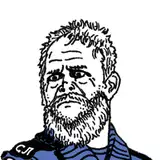
Here are some old-fashioned dogfaces for this week and some writing to accompany them.
(A few points of order:
"Fantasy" Firelock is the original black powder, horse-and-musket version of my setting. It and 198X are simply different points on the same world's timeline- for those not already in the know.
Seahawk Publishing is a name I use now and again when I'm writing fantasy-era lore from the perspective of a 198X publication; it's a riff on Osprey Publishing, a real-life company that makes military history books with lovingly detailed full-color art.
The numbering below is from left to right. Anything not italicized is just some artistic commentary from me.)
-----
Excerpts from Seahawk's Men-at-Arms - Armies of the Lupar Clans
Plates A and B - Common and Elite Infantry of the Lupar
1. YOUNG FALXMAN
Clan Olariuma
A lupar warrior, with few exceptions, provided his own equipment. Young and unmarried warriors formed the lowest martial class: drawn from the surplus children of both destitute and wealthy families alike. While a first or second son might inherit his father's armor and house, his younger siblings would strike out with "blade and pelt" alone, regardless of their family's means. The traditional weapon for this caste was the curved, two-handed falx.
Without any defenses at hand, falxmen relied on pure aggression and speed to survive. Undisciplined and bloodthirsty, they were typically posted on the flanks of a chieftain's army. There they could encircle the enemy and cut off their lines of retreat. Though eating the flesh of a dead or dying man was taboo in all clans, it was generally understood that young warriors--driven into a frenzy after a bloody melee--would break it.
This guy represents the most basic warrior: the "stereotypical" dogface with the striped Asterix pants and a falx. I didn't want them to all seem so desperately poor or suicidally aggressive, so I made this a rite of passage for non-inheriting young lupar. Pretty much every lupar has broken the man-eating taboo at least once--this being an unspoken paradox in their culture--and this part of their life is when they do it.
I must admit some artistic cowardice here: the original intent was to have him be altogether naked (like the fanatics in Rome: Total War). That didn't play out for three reasons. First, I like the pants and think they're funny; two, it felt too on-the-nose bestial for a culture that is deeply uncomfortable with outright displays of savagery; third, I don't draw anything I wouldn't show to my dad.
2. COMMON WARRIOR
Clan Toskona
After some time a-wandering, falx in hand, a young lupar would usually marry and settle down. As freemen, they would hunt and forage in the commonwoods; raise livestock in their lord's valleys and unforested land; and occasionally work trades in the oppida (seasonally-inhabited market-cities). In any case they were obligated to muster and fight on their chieftain's behalf. This militia service was unpaid, short-term, and the duty of every free lupar. Entire villages, men and women alike, would leave for war with the exception of the old, the young, and those necessary to remain.
Common levied warriors made up the center and the bulk of a clan army. They carried whatever they owned; most often, a sword and wooden shield, augmented by one or more pistols fired just before contact. Most could only afford a helmet. Their mode of fighting was aggressive, mobile, and essentially individualistic. Warriors could be trusted to march as a unit, but on the charge every man was his own beast.
Firelock factions (both in fantasy and 198X) spring from a few cornerstone units. In 198X's case, the basic traits of every faction (both in terms of aesthetics and balance) sprung out of some exploratory sketches for the regular infantry of each:

(Santis were the last to be drawn- which is why their FM is 100-4-8X.)
Lupar warriors, as the basic unit of the clan armies, are their equivalent to 198X's chasseurs. They define the faction's looks and sensibilities: aggression and an Iron Age bloodthirstiness mediated by some level of conscious decoration and refinement. I'm particularly pleased with their helmet (to the point where, if I hadn't already set it in stone, I'd change the 198X "ballistic mask" on chasseurs into a similar one). The samurai look both makes sense (the wings protect the ears) and lines up with some of their cultural inspiration and attitude.
I imagine that traditionally warriors carried javelins or iron darts as their pre-contact missile weapons. But by the fantasy era, with gunpowder being universally prevalent and their smiths at work making barrels and locks, they've switched over to pistols as the go-to sidearm.
The lore entry mentions both men and women--lupar sexual dimorphism is somewhere between that of humans and wolves, leaning towards the latter, and so their females are pretty close in terms of size and strength to their males. A non-lupar might have difficulty telling them apart at a glance. Given this and their low population, a band of warriors might be built of husband-wife pairs as its most basic element, or have "squads" of a dozen or so family members and blood relatives watching out for one another.
3. HIRELING ARQUEBUSIER
Clan Koskal
Above the unpaid, short-term levies, but below the chieftain's own professional warrior-retinue, existed a variety of paid hirelings. These men regularly trained, guarded the chieftain's hill-forts and bridges, collected his taxes and road tolls, and generally augmented his own retinue. They represented a more reliable and disciplined force than the levied warriors, willing to campaign so long as they were continuously paid (whether in bone tokens or in flesh).
With better training and cohesion than the levies, hirelings typically made up the vanguard of a chieftain's army. They would range ahead of the horde to scout and to harass and wear down the enemy. While most could afford armor, their role as skirmishers meant that they would usually eschew it in favor of mobility. Their favored weapon was the short-barreled arquebus, fitted with a snaplock action that would not betray one's position with the scent of smouldering slow match.
As above, this is a unit that has replaced a traditional weapon: in this case, the bow. Probably some northern lupar (who are more sparsely peopled, in deeper woods farther from flat-faced men) still carry longbows. With their high racial strength they could probably shoot these with great power and range; but ultimately firearms are still better as actual battlefield weapons.
I prefer fun and functionality over excessive realism, but I like tactical authenticity and hew to it where possible. In real life, even primitive muzzleloading firearms didn't display the artificial hobbling they often get in games to turn them into a sidegrade to bows. They outranged archers, were often more accurate (aimed "by rule"--down the barrel, rather than "by guess"--by intuition), and were vastly more powerful. They weren't adopted because they were cheaper or easier to train with, but rather because they could earn their keep.
That means that even if archery might have some adherents still, the majority will carry firearms. These are still fairly archaic compared to the long-barreled muskets carried outside the Ebon Forest, but a short barrel makes them easier to carry and wield in dense forestry. They use a 16th-century side-mounted button trigger, a lupar-specific style that you also see on chasseurs' weaponry in 198X. Their ammo-carrying setup is similarly outdated: no pre-measured cartridges, just a powder horn and pouch of bullets & wadding. The powder horn is made from the spiralled shell of some nautilus-like cephalopod swimming in the coastal waters around the Ebon Forest.
4. HIRELING SPEARMAN
Clan Abhais
The reserve of a clan army, arranged behind the commoners in the center, consisted of the best-armed and trained men. These invariably were experienced hirelings and the wealthiest freemen, who were no less exempt from the levy than their poorer countrymen. They had the means to afford armor and a polearm or arquebus, favoring these over the traditional sword and shield. Though a far cry from the chieftain's own chosen retinue--by now, steel-skinned in foreign plate armor--a clan army's reserve still formed a solid backbone that could reinforce a crumbling flank or crack an enemy that had withstood the common warriors' charge.
I wanted with this guy to show that armament varies among lupar: since it's what you can bring, some can afford armor or better weapons. I went with mail as a traditional set of armor for them and as a contrast to the more elite types' foreign plate. Their placement in the reserve is both a matter of practicality (same reason the Romans had the triarii in the rear) and as a sly way to not get killed in a bad fight: while lupar are generally fighty, some might not be too keen to throw their lives away once they've built them up. Originally I wanted the mail to cover his legs as well (without a skirt) but he looked weird wearing a mail onesie. I might go back to that nonetheless.
The crossheaded boar-spear is another basic lupar weapon that warriors could carry along with a falx or sword, board and pistols. They don't form spearwalls, but I think they'd still be effective against cavalry, aggressively hunting them the way you would a boar or bear.
5. FOREIGN MERCENARY
Confederate service
Outside of the Ebon Forest, lupar were feared, hated, and always in demand. Their beastly qualities made them ideal scouts, bodyguards, and soldiers--so long as they could be kept loyal and at arm's reach. With demand came opportunity, and many lupar left the forest to seek adventure in the lands of the flat-faced men. Far from the eyes of their people they could also act on base impulses more readily. Their notorious reputation as savage fighters and man-eaters only added to their appeal.
Many veteran mercenaries permanently settled outside the Ebon Forest, forming their own enclaves loyal to flat-faced barons and governors. Others returned to their misty homeland, bringing with them a thousand stories of wealth, danger, and astonishingly large cities. While their habits rarely ingratiated them with their chieftains' courts, many were still sought for their knowledge of what lay beyond the mist.
I wanted a funny contrast with this one between the refinement of his dress and his behavior: far from his friends and family, with flat-faced mercenary brethren outright cheering him as he tears chunks from an enemy's corpse. He carries a lupar-made musket, but one designed to foreign specification including a long barrel; the cartridge box and cuirass are foreign, although the latter has been built or re-forged to fit an inhuman torso.
His clothes went through a couple iterations. I started with the long, droopy sleeves of Irish kerns, but they hid the lankiness too much and didn't communicate "wastefully-spending mercenary" enough. Landsknecht garb worked, but I wanted to find a way to tie it to later 17th-century styles for coherency with the greater setting. His current sleeves are inspired by some illustrations of Spanish soldiers in the 1680s. The tight hose on his forearms and calves is a compromise to still retain some of the inhuman lines of the body.
6. CHIEFTAIN'S RETAINER
Clan Abhais
A clan chieftain's retainers formed his council of advisors, thanes, bodyguards, and trusted friends: in essence, his fighting court. As the chieftain's best and most experienced men they were lavishly armed and armored at his expense. In return, the retinue swore loyalty unto death (and, in some clans, beyond). The retinue represented the hard core of a clan army, whether commanding in the chieftain's stead or fighting alongside him. If all was lost, they were his last line of defense.
No chieftain worth his bones would spare any expense in arming himself and his retainers. Trade with flat-faced nations led to bespoke sets of plate armor as their usual protection. Skinned with hard steel and carrying shields of stout ebon oak--vaunted to be able to stop bullets--retainers were extremely difficult to kill with cold or fiery weapons alike. As courtier-soldiers, they painted their shields both as a way of identifying themselves under armor and to demonstrate their cultured status.
There's something of an incestuous inspiration-spiral happening with these and the Santagrine Black Fangs: as some old Fangs returned to the forest, or news otherwise travelled of them to their original home, chieftains might've sought to copy those steel-skinned janissary-berserkers in equipment (if not practices). The design thus had to share a common ancestry but be immediately distinct.
The curving horns and sickle claws on hands and feet are recurring plate-lupar elements: the former to cover the ears fully; the latter because it makes you a living blender. This one has only pointer-finger sickles, unlike the Fangs' full gauntlets, as a compromise to let him wield regular weapons without changing gauntlets. He might use the pointer-claws to pierce eyeslits or armor joints on a downed foe the way you would use a misericorde. The nose-censer is something I think they use to distract themselves from the scent of blood.
The cape and spear-shield combo are a way to demonstrate that even if they're armored in the most modern style, they're still set in an Iron Age warrior's mindset; it'll be a while before equipment inertia catches up and they switch to more powerful weapons. This also lets me mechanically distinguish them: whereas Black Fangs are silent berserkers--all aggression--clan retainers are instead all defense. They might be some of the only lupar to fight in close formation, and would be the very last ones standing during a mass rout.
The shield illustration is a warrior bursting from the ribcage of a wolf: cultured lupar enjoy various decorative depictions of humanity overcoming the beast.
-----
As you've seen and read, the society and military of the lupar was very different in the fantasy era than in 198X. Comparisons might be drawn to the Sengoku Jidai in Japan and to the Celtic & Germanic barbarians encountered by Rome. This was an age when there was no de-facto central authority or standing army, and when a chieftain's entire fighting-aged people constituted his army, scattered across the forest and only occasionally gathering in seasonal cities for trade and ceremony.
One last aside, to do with the art style: this is the first time I've applied my usual inked art pipeline (including color adjustment in Krita) to pencil artwork. That was honestly laziness on my part (I wanted to draw a bunch of ugly mugs and didn't want to ink them) but the feedback I've gotten is remarkably positive. I might experiment with doing more pieces like this.
Shas
2024-07-27 22:43:23 +0000 UTCThe hairless ape
2024-07-27 21:58:24 +0000 UTCTom Currie
2024-07-27 19:36:50 +0000 UTCTom Currie
2024-07-27 19:34:38 +0000 UTCRifle Infantry
2024-07-27 19:27:20 +0000 UTCTom Currie
2024-07-27 19:20:10 +0000 UTC