Eskew by Episode #4: Culpability
Added 2021-01-11 12:56:51 +0000 UTC
In which Jon and Muna offer commentary, anecdotes & random thoughts on every episode of I Am In Eskew.
This week, we're talking about Episode IV: Culpability, in which a young boy receives a visitor that is very much not his mother.
Jon:
I don’t think I’m necessarily a subtle writer. I'm basically just spelling my worries out at the start of this episode, for example.
But I also don’t believe that subtlety (as distinct from grace, or nuance) is a universal virtue in writing - and horror, for me, is the best genre for exploring the topics that we need to be raging about, shouting openly about.
For example, we have evidence that the noise pollution of traffic is lowering our ability to react rapidly to external stimuli, when we’re walking on a crowded street. We have evidence via the bystander effect theory of social psychology that large crowds and unfamiliar, chaotic environments may actually inhibit us from stepping in to help others.
In other words, we may be actively building an urban environment around ourselves - one that becomes more inescapable and essential to our functioning society the more life we pour into it - that alters and deadens our own ability to protect ourselves and others within it. We’re dogs building their own cacophonic, maddening network of Pavlovian bells.
Isn’t that ludicrously fucked up? What would be the point of trying to explore that idea only via buried subtext when it’s already so wild? You only need to stretch it very slightly to make it terrifying.
We’re very attuned culturally to the fact that our human adaptability might be our greatest collective flaw as well as our greatest collective strength - we worry rightly about how easy it might be for us to fall into place within genocidal regimes, or to adapt to destructive new technologies.
But I don’t think we spend as much time considering how the places we build around us might be rebuilding us in turn.
Just what are these invented landscapes shaping us into? And how far can they take us?
Muna:
Without traumatising people further, we’ve been discussing this a lot this week, haven’t we? It’s not just physical as you’ve already mentioned, it’s mental too.
With the constant barrage of news and social media, disinformation and “alternative facts” I’ve been quietly worried we are creating mental cages around ourselves, as people, as communities. It takes an enormous amount of pressure to even be aware of what you mention above, let alone try to combat it.
But maybe that too, is folly. Hubris. Do you spend your energy on that? Or on...living as best as you can?
A little like the Eskovians trying to pretend they live in a sane world.
Jon:
Yeah, absolutely! And I think we'll get into that a lot with later episodes; in a place like this, what does living well mean? And what does living well take from you?
Jon:
I mentioned in a previous episode commentary that I have a fixation around doors and what might be lurking behind them. This episode plays heavily on that, but also on another fear that I think every child has - that our parents, who operate on a rational level distinct from our view of the world but who have absolute control over our fate and insist on enforcing normalcy at all costs, might not believe us when we tell them the monster is coming to get us.
I have vivid and much-loved memories of the children’s book ‘Not Now Bernard’, where the parents ignore the kid as he’s eaten by a monster, and then ignore the *monster* as it replaces the child. Brilliant book.
There are about a million Amazon reviews complaining about how traumatising it is, but to me that just suggests it’s tapping into something all children know in their hearts; that adults exist in a boundaried, rational world and are therefore congenitally incapable of understanding the threats that children face.
Muna:
So I moved here when I was older, and thus read this book as an adult. And still the sense of being gaslit first and then devoured is palpable to me, as a woman and a black person. I think this is a fear that can follow certain historically excluded communities well into adulthood.
Being in danger, while the world tells you that you’re not in danger. That safety, mental and in some sad and heartbreaking cases physical, is awarded to all. When you’re aware on a very visceral and personal level that it might not be true. And of not being believed when you speak out as not feeling safe.
I mean, recent events of 2020 and beyond are a fantastic example of that, aren’t they? There is still a level of refusal going on when it comes to the rights of historically excluded communities.
These are themes explored often in Black horror, like within the film Get Out. The sense of isolation and fear the main character feels, even as he consistently tells himself he’s fine. But unlike Bernard, thankfully he escapes being devoured.
Jon:
This isn’t really even strictly an Eskew episode, I think - David plays basically no role in it other than to support the framing device, and the concept could work just easily as a horror story in the ‘real’ world. It's about a scared kid, and a changeling who takes over the role of his mother.
But it does begin to play with one of the series’ recurring fears about a world that deliberately pulls the rug out from under us when we begin to hope for better things, or when we take action to try and make that change happen.
I was obsessed with magpies, when I was a teenager, when I was really struggling. I was fixated on the traditional rhyme (one for sorrow, two for joy). I used to see solitary magpies everywhere, hopping around on the grass or in the trees. Never in pairs.
And every time something bad happened to me, which seemed to be the case pretty much all the time, I’d blame the magpies for always appearing to me in lonely sorrow, and never offering me joy.
But I’d also blame myself. After all, I’d spotted the solitary magpies, which meant that I’d called the sorrow down upon me.
It can be difficult to understand the universe as a truly random place, when you’re struggling. We want to understand why these things are happening to us.
Muna:
Mm. A close family member does have schizophrenia, and patterns were indeed part of their delusions (I must note here I am only making a comment about how this close family member experienced their diagnosed illness). So it’s not an unreasonable fear.
But I think we all look for a reason, an explanation that can bring some sort of sanity to events that hurt us. I myself as a teenager was obsessed with patterns in time. 22:22 or 00:00.
It’s a way for us to reason with the world which consistently reminds us that good always wins, bad things happen only to bad people. If they happen to good people, good people triumph, often by the end of the book or the film. So when we go through these bad things as children, we start to think that either something is wrong with us or we cling too fiercely to patterns that are meant to save us from these bad things.
I honestly think it would be better for us to just be honest with children from a young age, sometimes. We can’t keep shielding them.
Jon:
I think I once had a delivery from someone who rapped at the door with two slow, symmetrical knocks.
It really messed me up. I hated that sound, and it took me ages afterwards to realise why.
Most people, when they knock at a door, do three taps. Or we do a little tune with the door-knocker, combining speed and slowness - rat-AT, rat-atat-tat. We humanise the noise to let the other person know there’s someone there who means no harm.
Who does two slow taps, though? Bizarre.
Muna:
This episode really brings to life one of my most feared dreams...actually a fear I have about the very fabric of reality.
The dream - set nightmares I should say - are based around the same concept we explore in this episode. Usually it’s a family member or a close friend who seems normal to everyone, but beneath the mask that is their face, lies a broiling mass of darkness. No one believes me that they are dangerous, and thus there is no safety offered to me.
And...what if this is true beyond just nightmares? Our entire relationship to every person around us is based on faith. We believe that they will adhere to the norms we have established in society, that those we surround ourselves will on the whole extend love, friendship and kindness to us. Of course this isn’t true for every relationship, but on the whole.
But how can we prove that beyond a doubt? None of us know what is going on in someone else’s mind. None of us know what someone else means when they use terms of endearments towards us. Who knows what lies beyond their masks?
Jon:
Yes, and another theme appearing here that gets fleshed out more later in the series on is the fear of stagnation or inertia, the fear of getting left behind.
Inhuman body horror is transgressive by design, but it can also carry a crudely conservative undercurrent. Change is associated innately with dehumanisation, those who change become feral (The Fly) or mindless collectivists (Body Snatchers) and often infectious (The Thing). Maintaining autonomy and individuality means maintaining the status quo at all costs.
And these are very universal, human fears around change, but we need to be aware of the political implications to that, especially when you have the spectre of Lovecraft hanging over the entire sub-genre.
I think the opposite is worth exploring too. What if we’re so fearful of change, or of the unknown, that we end up caught in place? What if the world is transformed but leaves us behind? What if we miss our chance for a confrontation that helps us to understand?
Again, that’s a great childhood fear - that we end up excluding ourselves from the world because we’re too afraid to engage with it. The kid on the diving board who’s too scared to jump off it, even when all of their peers have already taken the plunge.
Muna:
At the risk of sounding like a robot, I don’t have any fears I can trace back to childhoods, and I am laughing as I write this! As someone who was a refugee as a child, I don’t remember any of these fears - is this a fear we remember semi-fondly when we grow up in relative safety?
Perhaps I did have some of these childhood fears, but then there was the war and the world was unsafe. So I just accepted that, and have sort of always had that belief.
Or I suppose this is what we were trying to reflect with Riyo’s character in the world: if meaningful revolt is possible, there must be leaders that don’t have the comfort or nostalgia for society and can bear witness to it as clear-headedly as possible, to see what can be saved and what can’t.
For me, I suppose that’s why I don’t have a fear of the status quo changing; in fact, I hold a firm belief that the status quo has no choice but to change. As a society it is up to us to ensure it is changing in a positive direction.
The truly fearsome aspect of Eskew is an entire city that reflect the fear I described above: of not knowing the very rules of reality, of being unable to grasp them no matter how much you try.
Jon:
Completely! And when we get to the ending (which we will eventually), I think that very much plays into the idea that even if David is too marred by his time in Eskew and his complicity in Eskew to ever truly escape it...he can still pass the torch on to someone else who can more fully break free.
Jon:
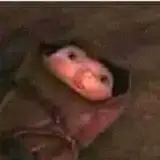
I genuinely think the faces left pegged and dangling on the washing line is the most horrific image in the show. But people don’t seem to dwell on it as much as moments from the other episodes. Not sure why. You almost want to go back and unpick it - 'how could I have made this moment land harder?'
Muna:
Oh yeah. It reflects another nightmare I’ve had, which I won’t detail too much here as it is rather graphic. But I had that nightmare only once, seventeen years ago and I still remember it vividly. Maybe it’ll jump out in future listens for others!
Jon:
Perhaps we see the first real indication of a love story between David and Eskew in the final moments here - as he says, he spent his time in London longing in vain for tragedy or trauma to enter his life in a way that could explain how he feels and how he behaves.
But in Eskew, his paranoia, his anti-social tendencies, his anxiety, are all reasonable responses to this reality. It’s a place that makes sense of him. All of us need that.
Join us next time for Episode 5 - and the railway bridge that won't leave David alone.