[For Beginners] A Guide for Anyone Who Wants to Start Garage Kits
Added 2025-09-05 14:00:12 +0000 UTCThe other day, I asked a question like this in my YouTube community, and I got quite a few comments.

The types of people who replied could generally be grouped like this:
People who are interested but haven’t taken the plunge yet (questions were more abstract)
People who are clearly already doing it (questions were very specific)
My intention was to ask: “For people who are interested in starting garage kits but don’t know where to begin — what would you like explained?”
But it turned out that most of the viewers on my channel were already doing it.
At first, I thought about making a members-only video, but that would probably end up being more of a specific techniques collection for people past the beginner stage — and it would take a long time to produce.
So for now, I decided to write up a lightweight version here, covering what I can answer easily.
This article really is the absolute basics:
Where to buy garage kits
The minimum tools beginners need (and rough prices)
Tips for building kits (ways to handle common issues)
I kept it as concise as possible (…don’t say “It’s still ridiculously long,” okay?).
You can find plenty of technical tutorials anywhere, so instead of rehashing that, I focused more on the way of thinking behind the process.
As a reference for beginner tools, I’ll link an excellent, easy-to-understand article from Daiba Kobo:
*This is a Japanese page, so please translate it to read.
1. Where do you buy garage kits?
┃You buy them at in-person events or via online shops
If you want to start garage kits, the first step is buying one.
In the past, they were mostly only sold at real events, like Wonder Festival (with some exceptions, but that’s a complicated topic).
As of 2025, you now have more options beyond in-person events:
Kits sold only at in-person events
Kits sold both at events and online
Kits sold only online
Garage kits are usually made and sold by individual creators. They can’t produce many (and the more they make, the more inventory risk they take). Sometimes there are also licensing limits on how many can be sold. In short, they’re produced in small quantities.
That’s why, whether at events or online, popular kits often sell out within a few minutes to half an hour after sales open. (An exception: pre-order systems, where you can buy within the designated period.)
If you find a kit you want, follow the creator (the “dealer”) who makes it, so you can get the latest sales info quickly.
Here are some of the major garage kit sales events:
★ In-person events
Wonder Festival
Official site: https://wonfes.jp/
A long-running event hosted by Kaiyodo, held every February and July. Attracts dealers (and visitors) from all over the world, featuring both licensed and original works.Tonari no Mokei Festival
Official site: https://www.tonamo.jp/
An emerging event, held in June and November (dates not fixed). Includes a display area for general attendees, combining exhibition and sales in a unique way. After the in-person event, kits are sold via BOOTH — currently the only event doing this.Hobby Round
Official site: https://hobby.volks.co.jp/event/hobbyround/
An event hosted by Volks, held twice a year (around May and October). Features both licensed and original works.
★ Online events / platforms
Treasure Festa Online
Official site: https://tfo.hobima.com/
A quarterly online sales event (March, June, September, December). Features both licensed and original works.Tonari no Mokei Festival
Official site: https://www.tonamo.jp/
Sells licensed kits via BOOTH the day after the in-person event — a big deal, since normally licensed kits can’t be sold outside the event day.BOOTH
Official site: https://booth.pm/ja
A popular platform in recent years for selling original kits and legally-permitted derivative works.
※ Note: Licensed kits (event-limited “same-day license” works) are generally not sold outside events.
FAQ (quick answers)
Q. Why are online shops full of kits from specific IPs?
A. Because they follow each IP’s derivative-work guidelines. If it’s not within those guidelines, online sales aren’t allowed. That’s why BOOTH sales of licensed kits after Tonari no Mokei Festival are such a big deal.
Q. What about kits sold on auctions or flea-market apps?
A. Those are second-hand. However, if there’s no box photo, overseas shipping only, or just CG renders, there’s a high chance they’re bootlegs or unlicensed prints. Lately, some sellers are 3D-printing STL data they don’t own and reselling it. Beginners are better off avoiding auctions and flea markets.
Q. What about second-hand stores like Surugaya?
A. They’re also second-hand, and usually overpriced. Buying at events is better. Finding a discontinued kit there might be worth considering, but beware — even they sometimes have bootlegs mixed in.
2. The minimum tools beginners need (and rough costs)
┃What you aim for determines what tools and total investment you’ll need
When you decide, “I want to assemble and paint garage kits,” the tools and budget depend on how high you want to aim.
Some people just want “something finished, no matter the level.”
Others want “a figure on par with those high-end, tens-of-thousands-of-yen figures.”
The first group wants short-term satisfaction; the second wants long-term skill growth — potentially years of hobby work.
Because those are totally different goals, there’s no single “Just buy this set!” plan that works for everyone.
So, here, I’ll consider two patterns:
Short-term satisfaction (about 3 months)
Long-term production (1+ years, aiming for multiple works, exhibition-level or even professional quality)
Of course, you might start short-term and later decide to keep going — or start enthusiastic, then get busy and stop. So pick tools with your lifestyle in mind.
※ I call this an “investment” rather than a “cost” because this hobby can provide long-term enjoyment and value.
What you need to consider when preparing tools:
The absolute essentials (you can’t do anything without them)
Helpful tools (make work easier)
Productivity boosters (improve speed and quality significantly)
Here I’ll focus on the absolute essentials.
The main steps in garage kit building:
Check parts (contact seller within a week if anything is missing)
Surface prep (remove flash and seams, fill bubbles, repair defects — a dust collector helps)
Test-fit assembly (brass/aluminum rods, nippers, tweezers, needle-nose pliers)
Remove mold release agents (wash with warm water, mild detergent, cleanser, or resin wash)
Painting (spray booth, airbrush, respirator, brushes, paints)
Final assembly (use adhesives that won’t damage paint; usually need a separate base)
┃From a short-term satisfaction perspective: necessary tools and total investment
If your goal is simply to get one kit finished, then it’s perfectly reasonable to keep tool costs down. Here’s a summary of what you’ll need for the processes I outlined above.
Total: probably somewhere between ¥10,000–¥30,000 (around $70–$200).
If you include a paint booth and airbrush, expect around ¥100,000–¥150,000 ($700–$1,000).
The wide range is because there are optional tools that, for just a little extra, make things much easier. If you’re stubborn and want to do everything as cheaply as possible, you can — but it’s going to be a lot more hassle.
Surface prep
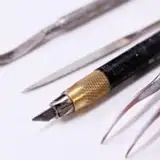
Design knife
Sandpaper or cloth sanding sheets (around 300–600 grit)
Sponge sanding pads (around 300–600 grit)
Cianon DW (for filling bubbles and missing areas)
Primer spray (to accelerate Cianon curing so you can work right away)
Cutting mat (obviously)
Dust collector (even a nail-dust one is fine)
You can get most of these at home centers or 100-yen stores (Daiso, Seria).
Cianon DW and primer spray usually need to be ordered online (like Amazon).
※ A dust collector is highly recommended. Inhaling resin or plastic powder can increase the risk of pneumoconiosis. Whether you’re doing this long-term or just trying it once, please get a dust collector for your health.
Test fitting (mock assembly)
Brass wire (Φ0.5, 0.8, 1.0, 1.5, 2.0 mm) or aluminum wire
Pin vise (hand drill)
Drill bits (at least 0.5, 1.0, 1.5, 2.0 mm)
Nippers (for cutting brass rod or resin gates)
Needle-nose pliers (for gripping brass rods)
Tweezers (for small parts, applying/removing masking tape)
Brass wire is sold in multiple sizes at most home centers — check the materials section.
Nippers: If they can cut brass, they’ll work for resin too. Never cut brass with nippers meant for plastic — you’ll chip the blades.
Needle-nose pliers help you press rods firmly into their holes.
You can get all of this at a home center or 100-yen shop for maybe around ¥2,000 total.
With garage kits, the material is polyurethane (unlike most plastic kits which are ABS), so cuts don’t turn white. Basically, anything that cuts is fine, but avoid using premium plastic model nippers (like GodHand) — they can chip. If you want to use nippers, get ones sold specifically for resin.
Removing mold-release agents
Neutral detergent
Cleanser (mild abrasive)
Wash basin
Toothbrush
Hot water (~40°C)
All of these except the water are available at 100-yen shops — probably around ¥600 total.
Do this after surface prep and test-fitting so you clean both mold release and skin oils at once.
Soak the kit in ~40°C water, add neutral detergent and cleanser, then scrub the parts with a toothbrush.
The detergent removes mold release; the cleanser micro-scratches the surface, which helps paint stick better.
If you want to make this easier, use a specialized resin wash.
I sometimes soak parts in paint thinner, but that requires constant ventilation with a paint booth — do not copy this casually.
Painting
Holders (e.g., DIY with bamboo skewers)
Cat scratch boards (for holding skewers)
Masking tape
Paint booth (at minimum, something like Tamiya Twin Fan)
Airbrush (compressor + handpiece set)
Respirator (for paint and organic solvent safety)
Nitrile or polyethylene gloves (same reason)
Paint (lacquer, water-based, enamel — whatever you like)
Thinner (matching your paint type)
Scissors for cutting masking tape (don’t tear fine masks by hand)
Brushes (size and count as needed)
※ This assumes mainly lacquer paints, enamel for eyes, and that your home setup allows for a paint booth.
Masking tape is available at home centers; different brands vary in stickiness and thickness.
Expect to spend about ¥100,000 for a paint booth and airbrush combined.
About paint booths
Use the best-quality, proven paint booth you can afford (very important). Ideally, use the same kind of booth experienced builders rely on — e.g., Nero Booth or similar. These have excellent exhaust systems, cost more, but are worth it long-term.
The Tamiya Twin Fan is under ¥20,000 and okay at first, but after a year, its exhaust will probably feel lacking. Not recommended if you plan to keep building. DIY is technically possible but not really cost-effective unless you love that kind of project.
About airbrushes
You can pair a compressor and handpiece to make an airbrush. Buying a pre-made set is easier — Mr. Hobby’s L5 set is perfectly fine for beginners. At first, swapping paint in a single handpiece is annoying, but you can add more later.
While overseas brands are becoming more available, considering maintenance and spare parts, Mr. Hobby handpieces are the safest bet right now.
Personally, I’ve been using just the L5 set (no pressure gauge) since I was a beginner — no compressor issues, quiet operation, no complaints.
About brushes
Most painting is done with an airbrush, but brushes are still essential for retouching and fine detailing — eye painting, washes, drybrushing, etc. The right brush size and shape matters, so research as needed.
For figures, Tamiya’s Modeling Brush HF ultra-fine detail brush is cheap, versatile, and great for eyes, touch-ups, and detail work, though it doesn’t last long.
Final assembly
Tweezers
Cemedine High-Grade Model Glue (water-based adhesive)
Base (acrylic discs, wooden bases, MDF boards, etc.)
Once painting is done, you assemble. If the figure will just sit at home, glue isn’t strictly necessary, but parts prone to falling should be glued. If you’ll bring it to events, leaving it unglued for easy packing can be better — case by case.
Avoid instant glues like superglue if possible — they can cause whitening and make maintenance difficult. Personally, I recommend the slower-setting high-grade model glue.
Bases rarely come with kits. Order acrylic discs in the size you need from a supplier like Hazaiya. For small sizes, even 100-yen shops sell some.
Hazaiya: https://www.hazaiya.co.jp/
Hazaiya’s physical stores have great outlet deals on acrylic discs — highly recommended if you can visit; it’s really fun.
If you need wooden bases, check the materials section of home centers. For temporary mock-up stands, MDF boards from 100-yen shops work well.
Conclusion:
You can do this cheaply, but you’ll still need at least around ¥30,000.
For easier, higher-quality work, consider upgrading your tools.
If you want to work seriously with an airbrush and paint booth, expect around ¥100,000 total.
From a long-term builder’s perspective: tools worth having
Once you’re comfortable and want higher quality and more efficient work, consider these optional upgrades. These aren’t necessary for beginners.
They fall into two categories:
Tools that make things more convenient
Tools that make work significantly faster and better
Some examples:
Dish dryer (prevents dust + speeds drying; handy for gloss or matte coats)
Thermometer/hygrometer (for estimating drying times)
Extra handpieces (reduce time lost swapping paints)
Water separator (prevents water spraying from the airbrush)
Masking tape holder (Nichiban Push-Cut recommended)
Cloth sanding sheets (like Super Assilex)
Plastic containers (great for organizing parts)
Power tools (electric sanders, drills)
Bits for power tools (e.g., zirconia bits)
Specialized diamond files (greatly improve surface finish speed and quality)
Dropper bottles (for pre-mixed paints)
Solvent-resistant spray bottles (for thinner)
Circle cutter (make custom circular masking tape easily)
Calipers (essential for measuring parts)
Tweezer-scissors (great for cutting thin masking tape)
High-quality PVC finished figures (Alter, AMAKUNI — great for paint references)
These are the kinds of tools to gradually add as needed.
There’s no end to how much you can invest — adding all at once could easily cost another ¥100,000.
3. Tips for Building Kits (How to Handle Problems Effectively)
When we say “tips,” what counts as a tip really depends on your situation and skill level.
Pinning, masking, painting, surface prep… many people want to know “the tricks” for doing all of these smoothly.
This might sound discouraging, but honestly—there are no real “tricks.”
Personally, I think there aren’t any secret shortcuts that let you breeze through every step; it’s just that after repeating a massive amount of work, your process becomes optimized. There’s no magic one-shot technique.
Disappointed? But in the end, it’s the steady trial and error that leads to a completely different level of finish.
That said, there are ways to deal with “things that just keep going wrong no matter what you try,” so let me share those.
The skills and steps you need depend on what quality level you’re aiming for
If you want to build something really well, it’s going to take proper steps, time, and effort. If you’re not particular and just want to finish it, it can be done quickly.
Ultimately, the quality you’re aiming for completely changes what tasks and skills are needed—there are no universal “tips.”
If you want to build something truly high-level, you’ll need to master surface prep, experiment with painting, and have the grit to repaint over and over. (By the way, if you’re working as a professional finisher, you often don’t have to do surface prep at all—you can just focus on painting.)
If you just want to enjoy the hobby casually, you don’t need to study or practice much. If you want to make it a job, then you should study like crazy.
So, deciding at the start what quality you’re aiming for is useful—it lets you work backwards to figure out what skills and tools you’ll need.
If you just want to quickly see what garage kit building is like, do rough surface prep and assembly, do simple painting—that alone will give you a feel for the process. You can work carefully later.
Some people burn out by being too careful on their very first build, so I recommend adjusting based on how you feel.
How to pin accurately
Sometimes your pins end up misaligned, leaving gaps or making pieces float. Usually it’s one of these:
The kit’s pegs are loose or off-position
The brass rod you inserted is misaligned
The rod is too long or the hole too shallow
Most of the time it’s #2 (misaligned brass rod). In this case, drill one side normally, then drill the other side with a slightly wider hole—this often fixes misalignment or gaps.
If the pieces fit together properly but there’s still a visible gap, fill it with a bit of Cianon DW.
If it’s just that the rod is too long or the hole too shallow (#3), just trim the rod or deepen the hole—easy fix.
If the brass rod feels loose even when properly inserted, try adding a few tiny dots of Cianon around the peg area, let it cure, then reinsert. It should fit snugly. Just don’t leave it too long—otherwise it may permanently bond. You can heat it (with an embossing heater or hot water) to separate later, but that’s annoying.
Preventing masking leaks—and fixing them when they happen
The key is to prevent leaks as much as possible. Look ahead and identify spots likely to leak and apply masking fluid (like masking sol) there.
There are rubber-based and vinyl-based masking fluids; both work, but if you want speed, rubber-based (like Good Smile’s) is faster.
Also, masking tape tends to lift on curves, so snip small relief cuts with fine scissors to keep it down. Apply masking sol over the cuts for extra safety.
Still, leaks will happen—so plan how to recover:
Gently wipe the leaked paint with enamel thinner
Mix enamel paint to match and retouch with a brush
Ideally, you should be able to do both—and even combine them. It’s rare that the leaked area is an easy-to-match color like black or white. So keep pure-color enamel paints ready. If you already mix paints regularly for lacquer painting, this won’t be a big problem.
Dealing with dust
If dust lands on the paint mid-work, pause, wait for it to dry, then gently scrape it off with the tip of a hobby knife.
If you try to remove it while wet, you’ll just ruin the paint—be patient.
Dust happens due to seasonal factors (like dry winter air), or simply because your workspace is messy.
In winter, we wear more layers, which shed more dust. One fix: keep a static-resistant work jacket just for painting. I keep a dedicated jacket just for this.
And honestly, some of you probably haven’t cleaned your painting room in a while. Used wipes, gloves, paint bottles left out…
Are you emptying your trash regularly? Changing the air purifier filter? Vacuuming at least once a week?
If you’re still getting dust, fix your workspace first—then consider work clothing.
Paint large areas first, small ones later
Start by spraying the big areas, then move on to small details. If you do small areas first, masking becomes a nightmare.
Garage kit building takes a long time—you want to avoid wasted effort. Efficient painting and masking save a ton of time.
For example, if you paint tiny shirt buttons first, how do you mask them perfectly when painting the shirt later? It’s way harder. Instead, paint the shirt first, mask it, then do the buttons.
Mask carefully, plan your order, and you’ll be fine. And even if a little paint leaks, you can retouch later—no big deal.
Don’t waste time worrying “what if it leaks?”—just mask carefully, and if it leaks, retouch. That’s it.
How to improve paint and prep quality when there are no books or guides
Use your imagination.
If no guides exist, it means either nobody cares about that specific technique, or it’s a field where sharing info could be disadvantageous (e.g., trade secrets).
So first: imagine how it might be done. Then: experiment yourself.
My learning method: I save posts on X (Twitter) from extremely skilled painters showing techniques or final results, then try to apply them myself. This is very practical and sticks fast.
Second: study and replicate. Even when someone shows a gorgeous paint job, they rarely tell you step-by-step how.
So you have to imagine. Combine everything you’ve learned, think hard: how did they do this? Is that shine from pearl effects, brushwork, gloss variation? Then test your theory.
For me, the most imagination-heavy was semi-realistic skin tones. Nobody really detailed how to paint veins or subtle skin texture with an airbrush—I had to experiment a ton.
I still can’t match the people I learned from—they’re on another level—but I did find a method that works for me.
Generally, when you see something amazing, no one will tell you how. That’s why using your full imagination and testing it yourself is the fastest path.
The same applies to scribing panel lines or adding details.
First, study reference parts carefully. Try copying them. You’ll fail—your version will look wrong. So adjust the shape, repeat. This trial and error leaves a strong impression, much better than just reading a guide.
Staying true to a character’s image when painting
First: observation. Even if you can identify the right colors, it’s useless if you can’t reproduce them in paint. So next comes understanding color mixing and layering.
Some colors can be made by mixing; others by layering.
You can use off-the-shelf colors, but to nail a character’s palette, you’ll need to practice both mixing and layering.
I wrote more about this in an earlier blog, but in short: there’s a sort of convention—for example, shadows on white clothes often use lavender or bluish tones. If you look at skilled people’s posts on X or even pre-painted PVC figures on AmiAmi, you’ll see this pattern everywhere.
So just observing PVC figure promo shots already teaches you a lot. Buying some and studying them is even better—you’ll notice highlight placement, shadow gradients, even subtle pearl coats in places you didn’t expect.
Whether you find this “study” boring or fun makes a huge difference in how much you retain. If you can enjoy it, you’ll learn faster.
Also, since “the face makes the figure,” I try to keep eye painting as close to the official image as possible.
Summary: In the end, it’s the people who enjoy themselves and turn the work into a habit who get good at it.
I’ve been writing on and on here, but are you actually reading this…?
If you are, thank you.
So, did it make you want to give it a try?
No? Still not? I see…
Well, honestly, garage kits are basically a series of tedious tasks, so the more you learn about them, the more you think, “Ugh, what a pain!” and I totally get that.
I understand the feeling of wanting to shove the kit you bought into the back of a shelf. You don’t even have to bother with all this when you can just play games or scroll through social media and find plenty of short-term entertainment instead.
But think about it. Doesn’t it feel kind of frustrating, even infuriating — especially at yourself — to just drift through your days without ever trying the thing you really wanted to do?
┃ Isn’t it better to regret doing something than to regret not doing it?
Lately, I’ve been thinking a lot about “what if I died tomorrow?”
There are so many fun things right now, so many things I want to try. But dying with the regret of “I wish I’d done that” without ever having tried? That feels like the absolute worst outcome to me.
One of the reasons I finally started taking ZBrush seriously was because I didn’t want to leave that kind of regret sitting there.
We all think “I want to try this, I want to try that,” but we don’t act on it. It’s a common trap. So if you really want to do something, it’s easier to change your activities into action-based habits by judging each day simply by “did I do it or not?”
For me, instead of just thinking “I should work in ZBrush, I want to do it but I won’t,” I shifted to an action-based approach: if I can’t make time to work, then today I’ll at least open ZBrush. That’s it. Just open it. Sounds stupid, right? No work time, just launch the program?
But surprisingly, it works. Even just launching it makes me recall, “Yesterday I worked on this, so next I need to work on that…” Techniques and tasks naturally come to mind. Then I close it and go to bed.
But the next day, the memory is fresh, and I can get into the work smoothly. Don’t you think that really helps with forming a habit?
Humans are creatures ruled by habit — we repeat behaviors on autopilot. So if you start with something as simple as opening ZBrush, even a grade-schooler could do it, you can slide right into the work.
I think this is an essential trick for turning something tedious into a habit.
┃ Why are you watching X, Instagram, TikTok or YouTube instead of doing what you really want to do?
Right now you want to get better at painting, or you want to work on garage kits — and yet somehow, without thinking, you open social media and scroll through random posts, or maybe even while reading this article, you’ve got it open on the side… That’s exactly the kind of bad habit we repeat on autopilot.
You can either build habits that don’t teach you anything but feel kind of fun, or build habits that are a little challenging but valuable and productive. It’s one or the other.
I’ll keep building my habits myself, but the one who builds yours is you. I can write blog posts that are a little bit useful for garage kits, but I can’t do more than that.
But if you really decide to give it a shot, I think my past blogs and YouTube videos will start to look completely different to you.
It’s not that I can do this because I’m special — once you build the habit of working, literally anyone can do it. That’s just how garage kits are.