A Small Change to My Work Desk Setup
Added 2025-08-21 07:04:36 +0000 UTC
I made a small change to my work desk setup, so I’d like to introduce it.
I’m literally in the middle of working right now, but the sanding work just never seems to end. My routine was temporarily disrupted, but I managed to get back on track in about three days, so I’ve been continuing as usual.
Since my workspace is still cramped and difficult to use, I regularly clean, tidy up, and review the placement of my tools. Items that I hadn’t used even once over the past year stayed in storage boxes, while frequently used tools, or those I expect to use often, are kept within my line of sight.
This time, I’ll show you lots of photos.
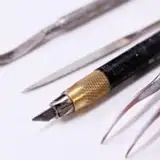
Because my desk is small, I try to keep it minimal, avoiding leaving unnecessary items on it. As you can see in the thumbnail, honestly, it doesn’t look all that different from my previous setup. What you see is simply what remained after removing anything unnecessary.
Introducing What’s on My Desk
First, the duct right in front. Originally it was placed to the left side of the desk, but I moved it toward the center.
If you follow the top of the frame, you can see I’ve set up a sirocco fan above the paint booth.
The duct is an aluminum type, but there are actually two kinds: aluminum wire ducts and aluminum flexible ducts.
The one in the photo is an aluminum wire duct. Its feature is that it’s soft and highly flexible, so it can bend and stretch quite freely. On the downside, its fixing strength is weak, so it tends to sag easily.
 On the other hand, the aluminum flexible duct I used before is sturdier, so it doesn’t require suspension with wire as much, and it’s easier to fix at an angle—it will keep drawing in air at the set angle once fixed.
Each type has pros and cons, but personally, I switched to the wire duct because it offers more freedom of movement.
Beneath that, I keep a stock of brass rods.

I mostly buy sizes between 0.3mm and 1.5mm at hardware stores, since they’re the ones I use most often. For 2mm and larger, either Wave brand or hardware store products work fine.
On the right-hand side of my desk, I placed frequently used tools for quick access. The container is from a 100-yen shop. It’s originally designed to stand upright, but I laid it sideways because it’s easier to take things out that way. Since this tends to make the depth too much, I added some filler inside to raise the tools to a more convenient height.
Here’s what I keep in it, roughly:

Cutting tools: design knife
Surface finishing tools: Wave specialty diamond files, sculpting knives, Magisk, figure engraver, etching saw
Masking tools: scissor tweezers, tweezers (cheap & expensive types)
Eye-painting tools: GodHand brushes, custom-shaft RubiHead
If you want to know exactly which items I’m using, you can check my Amazon storefront.
As a side note, scissor tweezers are sold in the medical field under the name “micro scissors.” If you’re not satisfied with Tamiya’s scissor tweezers, you might want to look for those.
There are other tools in there as well, but basically, with this setup, I can handle most tasks.
In the drawer under the desk, I keep boxes containing motor tools and other equipment.
 For example, I moved my Argofile motor tool from the desktop to the drawer. Inside the box are tools I don’t use very often, such as measuring tools and drill bits.

These aren’t items I use often, but when I need them, I do—so they stay here. I imagine Artima7 would be used in this way.

I have it set up so it operates with a foot pedal, meaning I don’t have to touch the dial at all, which is convenient. If you’re interested, look it up. It does require some wiring modifications, so I’ll skip the details here.

On the left side of the desk are sponge sandpapers, spare brushes, Spin Blades, etc.

The Cemedine high-grade model glue you see in the photo is great for attaching small parts on finished works.


I keep sponge sandpapers in different grits:
240 grit and 360 grit Super Assilex
400 to 800 grit range
polishing sponge sandpapers at the bottom
As you can see, I store them pretty roughly. If you organize things too strictly, management actually becomes a hassle, so this level of looseness is ideal.
Above them are bits for the Artima AT.

You don’t need a bit holder—if you have a cat scratching post, that works just fine.
In the drawer on this shelf, I keep RubiHeads and airbrush parts.

On the pegboard above the desk, I hang nippers, pliers, etc.

On the lower row, I placed large flat diamond files, which I thought might be useful when I need to flatten surfaces.

Further below are masking solutions, syanon adhesive, primer sprays, and other frequently used items.

The container holding syanon also doubles as a temporary storage for small parts.
That’s pretty much my current workspace.
Nothing particularly new, but I hope this gives you an idea of the environment I use for surface finishing and eye painting.
Difference Between 1,000-yen and 6,000-yen Tweezers

The day before Wonder Festival, someone told me about a good pair of tweezers, so I bought them. I haven’t used them in actual work yet, but as a test, I tried picking up thin strips of masking tape without disturbing the area to the right, and they performed really well.

The ones in the back are the 1,000-yen type, and the ones in front are the 6,000-yen type. They look the same shape, but if you look closely at the tips, the 6,000-yen ones have sharper edges.

Here’s a close-up: the expensive ones are sharp, while the cheaper ones are more rounded at the tips.
Just imagining how painful it would be if the sharp ones poked you is enough, but I’ve heard they can actually be used to stab masking tape and peel it off. I’m really looking forward to testing them in actual use.
Comments
Oh, that’s probably just your eyes playing tricks. I don’t do anything special to the masking sol.
SUKIMA SANGYO
2025-08-31 12:13:11 +0000 UTCI wanna ask when you using masking coat/sol it look more fluent than mine. Do you do anything on it or its just my illusion? Thanks!
FatDaddy6969
2025-08-30 14:15:29 +0000 UTCHello~! I use a DSLR camera along with a camera arm that can hold a ball head! Please look for something shaped like this! https://www.hatdw.com/product/7016/
SUKIMA SANGYO
2025-08-25 12:46:11 +0000 UTCHi Sukima-san! Would you be able to share how your camera stands are set up? I want to start to record my kit building process but I'm struggling with camera placement. Thank you!!
Toshki
2025-08-25 12:33:47 +0000 UTC