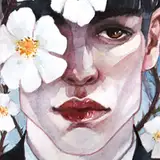

How to draw a semi-realistic male eye.
INDEX:
1. Brushes and custom brush settings.
2. Structure and basic shapes
3. Painting process and color choices
In this tutorial I’m going to show you how to draw a semi-realistic male eye, using Clip Studio Paint and basic brushes which can be found by default, with the exception of one custom brush I made for myself by changing some of the settings. I will provide you with all the needed adjustments to make one of your own.
1. Brushes and settings.
These are the brushes I use for most of my artistic purposes.


I use a gray background for this study since it helps to see colors as they are and works well as a neutral base for my artwork.
2. Structure and basic shapes.

Even though my finished work is going to be line-less and painterly, I still prefer to start with a linear sketch. It helps me to get the anatomy and shapes right.
I start with the most simple forms. Basically an eye is a sphere inserted into an eye socket and covered with folds of flesh. So I first draw the circle which will be our future eye and a line that connects the tear duct and the outer corner of the eye.
Of course male eyes (as well as female) come in all shapes and sizes, and there is no single definition of male eye anatomy. But here we are working with what I should call an “average male eye” or sort of a stereotypical white male eye, simply to know those basics to begin with.
A male eye tends to have less oval shapes and more angular shapes. Quite often in males the eyes seem more narrow and have heavier eyelids. Also, they tend to be set deeper into the eye socket and the eyebrows are closer to the eye than in women.
Also, the eyelashes tend to be shorter and have less volume (there are of course some gorgeous exceptions to this statement ;-)
It’s better to sketch the eye exaggerating the angular shapes a bit. Once we paint it, it won’t look like that, the angles will soften but it helps to keep it organic with a more masculine look.
At stage 2 I only mark the position of the iris and the general shape of the eye.
At stage 3 I start to refine my sketch, adding the shapes of the upper and lower eyelids. It’s very important to keep in mind that the flesh of the eyelids has volume and we can see it both on lower and upper eyelids as shown in the picture.
The upper eyelashes look as if they curl up from the inner edge of the eyelid though it’s technically not like this, that’s an optical illusion created by the angle we look upon them.
The lower eyelashes are better exposed to our view and it’s essential to draw them growing from the outer edge of the eyelid.

So we have our sketch. As you can see I roughly sketched in the eyebrow so our study has a more finished look. As they say – eyebrows are the frame of the eye.
Don’t worry about making it very clean or nice, since we are only using it as a guideline and will end up painting without it. But make sure to have it on a separate layer to be able to switch it on and off in case you need to use it as your reference. Its purpose is to have all basic shapes and proportions right and be clean enough for you to not get lost with your drawing.
3. Painting process and color choices.

In this study we will be painting a fair-skinned male in a daylight environment.
Daylight, in general, is slightly yellowish and warm yet we also have some blue color coming from the sky, so the local color of the skin which is a peachy–yellowish beige alternates between relatively warm and cool versions of itself. Using only warm colors might make the skin look dull and waxy so I suggest using temperature variations to achieve a realistic and vibrant look.
Highlights are very light in value so they naturally get cooler related to the other colors.
Also, deep shadows need relatively warm colors since the local color of the flesh is warm. That’s why I don’t use any saturated blues or purples in shadows, in this particular palette.
The same is with eye color. Even though the lighted area is relatively warmer than the shadowed one, I still use a pretty warm-ish blue for the shadows since it tends to be closer to muted greenish-blue, not violet-inclining blue. The highlights in the eye are almost purely white – which means ultimately cooler than all the other colors.
I use the same palette (brown, beige and a bit more orangy brown) for the eyebrows, only more saturated than the skin to make it look natural.
Before I start the coloring process, I create the color layer under the sketch layer and that’s where I will be painting.


Then I switch to opaque watercolor brush, also small size. And paint the hairs of the eyebrows and eyelashes. I showed the direction of the strokes I used to create a realistic hair pattern. Keep in mind that men tend to have less prominent eyelashes. So I work lightly, only suggesting them. Especially the lower ones.
Then I take the dry gouache brush and add some texture using the lighter versions of local colors. I use this method to avoid a too “digital” and too “blendy” look. Especially when it comes to painting males, whose skins are often rougher and have more texture on their own.
I also add some white highlights with the dry gouache brush, which creates an illusion of pores.

So here it is!
I hope this tutorial was helpful and easy to follow!
Thistle Arts
2020-04-05 05:35:36 +0000 UTCEver Feather
2020-04-05 02:59:49 +0000 UTCOneThousandBooksLater
2020-01-22 15:55:07 +0000 UTC