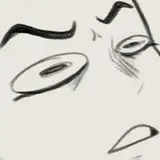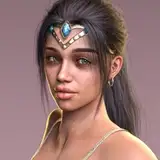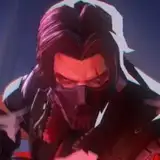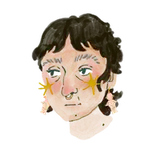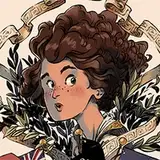
Last time, Alexandra's Father revealed his secret obligation, the reason that the "Red Dirk of Meles" is so important to him… and to England. He also had a personal moment with a god that, until that point, Alexandra did not know played any sort of role in his life. He asked Alexandra to inherit his mission. She refused, but his uncharacteristic appeal to a higher authority softened her anger. But how can she be expected to ferry the dirk to England, she wonders? As she says, she's never even been there.
NOTES
After the first round of thumbs, I injected two pages into this sequence to give it some breathing room. As I'll mention later, I've been absorbing the game Clair Obscur: Expedition 33 and I think one of the things it does really well is that it gives lots of breathing room to the characters and the moments. Seeing that reminded me how valuable it is and made me grateful to have added in these extra pages.
Thinking about how many elements are working at a time in any given section of story, and thinking about how much space those elements get, it all reinforces a suspicion: the best stories are relatively straightforward, but the character development and behaviour is explored fully, and a simple story feels complex and dynamic thanks to that thoroughness, that depth. ("Yeah, no duh," says the Internet Commenter in my head.)
I think Dad's "hoo do you doo" punchline might be just right: it's not the obvious punchline ("whooo's there"), and it's a broken in a stupid way – "hoo" in place of "how" is clumsy – and that clumsiness might make it perfect. Still, I can't help but feel like I can do better. Intentionally trying to write dumb things is hard.
- - - - -
As I've been sweating to finish colours for Chapter Five, in order to shut my horrible brain off for the night, I've been turning to a playthrough of recent video game Clair Obscur: Expedition 33. If you told me fifteen years ago, "you will enjoy yourself watching other people play video games," I would have snorted and scoffed. Turns out, though, actually playing the game is my least favourite part of video games. Mostly, I love to see the invention and imagination on display, and the way worlds are realized out of polygons and pixels. It's just math! Beautiful math! The novelty of it does not get old for me.
Clair Obscur didn't look like my sort of thing. I've never been a fan of turn-based RPGs. But enough people were saying enthusiastic things that I wanted to take a look. I got sucked right in. It's visually stunning (for a game); it moves nicely; the world is imaginative; and since it's narrative-heavy — most importantly for me — the dialogue is well-written and well-delivered. That last point is usually what bounces me off things like Final Fantasy, with which Clair Obscur has been compared. It gave me a Rock and Rule, Metal Hurlant, godly-power-in-the-hands-of-a-mortal feeling that I like — a sort of spacy, epic, moody quality — plus, the characters are actually worth caring about. I can heartily recommend the first 99.98% of the game.
Unfortunately, I found the ending to be a genuine disappointment. It's interesting that a project can get so much right — there are so many rich and interesting developments along the story's course — and I can look forward to each chapter with so much enthusiasm, and it all evaporates after that ending.
If you want specifics, I'll stick them in the postscript.
- - - - -
In the next post, we'll find out what, exactly, Alexandra chooses to do, and what fate awaits her mother, her uncle, and Katerina as we approach the end of Chapter Five. Yikes!
Until then,
I remain,
relatively straightforward,
TC
- - - - -
More on the ending of Clair Obscur:
Here's a Kotaku post providing a decent outline of the story and its endings.
Basically, my problem is this: in one ending, the dead are brought back to live seemingly haunted lives as Maelle's playthings. In the other, all the "fictional," painted characters are deleted (Lune's reaction is perfect: she simply sits down, disappointed). They're both endings that feel, to me, like the authors are doing a thing I try to avoid: they're trying too hard to deliver a point, or a clever message (about grief and acceptance, in this case), and it doesn't feel true to the characters. Not all of them, at least. It feels too much like the authors taking too much pleasure from being withholding. "You wanted the happy ending? Well ha ha, you don't get it. You only get this message about life."
I think authors can get away with that, but it's harder to do in games. You can do it in movies and books because your cruel authorial twist isn't happening to the player. Treating your characters cruelly can make a story interesting. Treating your audience cruelly only makes people mad. Or me mad, I guess.
If you say, "but the things in the story are happening to the characters," you're half-right. When you ask a player to inhabit the character of Lune and company, and take on those characters' wants, the player becomes part of the story.
In Clair Obscur, the main characters have an intergenerational communal goal of defeating the cruel god which ends their lives prematurely. At a certain point, the circumstances are revealed to be something other than that which they first appeared to be. But Lune still has the same goal: I want me and my friends to survive and live full lives. The game's author can reveal specifics about the story that change the circumstances, but none of that changes Lune's goal: to survive. That might not be an issue, except you're allowed to play the game as Lune — you can float through the whole game as her. You can spend all that time becoming more and more powerful, getting closer and closer to your unchanging goal, only to find that the ending deletes you anyway. Then you/she get/s either a moral lesson about Maelle and power corrupting absolutely, or a moral lesson about the nobility of accepting loss, all at your/her expense. None of the numerous foreshadowing incidents do anything to mitigate the frustrating finale, and all the times you (now forced to play as Verso) are mechanically motivated to strengthen your "relationship" with these characters (Lune & co.) makes the "point" of the ending feel that much more manipulative and heavy-handed.
This is all especially frustrating because there's could have been a third option. Maelle and Verso could have accepted the reality of their situation, grown and moved on, and — because this is very, very fantasy — they could have come up with a way for the painted world to continue ticking along just fine, happily absent the cruel idiots who spun them into existence and squabbled over their maintenance.
I guess I'm just asking for justice for Lune (and Esquie, obviously).
Maybe, later, if I still care about this as much as I do right now (it made it hard to sleep one night), I'll write and draw the correct ending. ;)
glenn
2025-07-18 00:06:48 +0000 UTC