I've reached the last page of Chapter Five! Old hands will know, however, that this does not mean the chapter is done yet — now it's time to loop around and finish the first ten-or-so pages. A closer look at inks in a second.
First, a casual salute to anyone who was laughing at me for even pretending to have a vague sense of the French Revolution and offering opinions on it without having got even half way through the history.
Wow, what a dumpster fire.
It is a fun coincidence that the image at the top of this week's post is clearly inspired by Jaques-Louis David's Napoleon Crossing the Alps, as well as Eugene Delacroix's Liberty Leading the People (which I found by searching "French Revolution painting" — now that's some good SEO).

I've got to the end of the Revolutions podcast's discussion of this particular revolution and inched forward in my other readings. This includes Assassin's Creed: Unity, but unfortunately that game does not count, because the story is at best a jumble, and the historical figures are plopped in with all the sophistication of cameos on The Muppet Show. No, that's too much credit. Anyway, having made at least one lap through the history, here's a jumble of my own thoughts:
I double down on my take from the last post: The French Revolution is difficult material. The list of abstract entities only gets longer. Treaties, coalitions, alliances, conspiracies, assemblies, clubs — whoof, it's hard to visualize. The whole thing is also a lot about economics, which is (as the title crawl for the first Star Wars prequel movie makes clear) boring.
There are no good guys; no bad guys. The only thing to root for is the ideals from the start of the revolution, which somehow — somehow! — make it to the end of the story, more or less. Everyone seems to play both sides at different points, and for any of the characters who manage to stay consistent, the turbulent weather of the political climate means the People's Champion of April can be Enemy Number One by June.
Further to that theme: okay, I'll be honest: one of the reasons I dove into this topic was because I might have been looking for a little vicarious class justice / head lopping. I did not find that. The king at the time is not cruel, just indecisive and hapless; we do not feel he especially deserves his fate. The royals (and everyone in the story, really) are just doing what they can to survive. As for the men fighting for liberté, egalité, and fraternité? As Mike Duncan says, the revolution devours its children. Paranoia and infighting destroy its leading figures. On top of it all, the Pepto Bismol to Paris' churning guts is a clever but megalomaniacal military man. Vicarious thrills are thin on the ground, which, if I'm really honest, is a good thing. Bloody revolution should not be exciting, not really. This is a sobering, cautionary tale and no one on any of the many sides of the conflict wins, at least not in hindsight.
Napoleon does some absolutely wild shit and is fascinating. One of the proper, noble reasons I wanted to dive into the Revolution is that I wanted to understand Napoleon better and correct for centuries of British propaganda. I have not been disappointed. On one hand, he does some absolutely brilliant things and makes thrillingly clever political and military moves. On the other, he demonstrates an appalling level of arrogance and inhumanity. He helps calm the murderous violence in Paris, but he'll sacrifice thousands of soldiers in a single battle. He crowned himself Emperor — so the French were back to having a king again — but he also shepherded The Napoleonic Code, which (to quote Wikipedia), "was a major milestone in the abolition of the previous patchwork of feudal laws. Historian Robert Holtman regards it as one of the few documents that have influenced the whole world." If you want to hate Naploeon, there are good reasons to do so. If you want to idolize him, I can see that too. No wonder the world has been obsessed with him for two hundred years.
I wish the Ridley Scott movie was even half as interesting as the man deserved.
We all ought to note The War in the Vendée. Mike Duncan in the Revolutions podcast points out that for all the attention that The Reign of Terror receives, many, many more people died in the Vendée. (My understanding is that sentiment toward the nobility was kinder in the Vendée, and the populace was heavily Catholic. The revolution was against both these things and, in addition, imposed forced conscription on the people. The situation deteriorated.)
One of the many political apples that bobbed to the top of the bucket was The Committee of Public Safety, which is the most Orwellian name I have heard outside a work of fiction. This group was "charged with protecting the new republic against its foreign and domestic enemies," which meant guillotining royalists and counter-revolutionaries and, oh, I don't know, that guy down the block who always parks his car in my spot on street-sweeping days. It is frustrating and disturbing to remember that, of course — facepalm — something must have inspired 1984. I think about that when I hear about things like "The Patriot Act," or other, more recent, similarly-named governmental effluence.
Speaking of things which feel timely, whoof — listening to the podcast, there were many occasions when I grimaced and thought to myself, "this sounds familiar." Sometimes it was the arrogance of the rich. Other times it was infighting among leftists. Elsewhere it was simply the suffering of the average civilian while political, economic, and climate emergencies battered them from all sides. Sure, "those who do not study history, etc. etc.," but absolutely (as I saw somewhere online), "those who do study history are doomed to watch those who haven't, repeat it."
I am part-way through Hillary Mantel's A PLACE OF GREATER SAFETY, and feeling as though there's room in the world for a telling of these revolutionary stories that is not as finely-grained as Mantel's book, or the NAPOLEON movie, but are also not so abstract as the bird's-eye view that the REVOLUTIONS podcast takes. Or, alternatively, someone give me THE WIRE, but in Revolutionary France.
Personal note: how did I get here? I hated history in school. Hated it! Is this all because I walked through the living room that one time while dad was watching HORATIO HORNBLOWER? And I thought it looked silly, but then I watched MASTER AND COMMANDER one bored afternoon, and it was good, and a friend had a complete set of Hornblower books, and I needed something to read on the bus, and one thing led to another, and…?
The lesson is clear: be careful what you watch in front of your kids, or next thing you know they'll start identifying as a Jacobin and subscribing to contemporary radical periodical Teen Vogue.
- - - - -
Meanwhile in PRACTICAL DEFENCE, our radical teen has encountered a serious hiccup in her fight against the invading pirates and the megalomaniacal tyrant of Istoria.
 I've drawn a lot of creek-side pebble strands over the last few weeks, and each time I've tried a different tool. Brush pen, felt pen, pencil, brush and ink, different felt pen… My conclusion is that they're all fine. The linework disappears and the visual impression is dominated by the pattern.
I do really like that use of pencil to describe the water (above), in the bottom-right corner. Ironically, pencil works best for water, and watercolour works best for tree foliage, is what I have discovered.
 I am also pleased with this misty effect on the pirates (above), also executed in pencil.
 Between the challenges of trying to remember horse anatomy, figuring out all the overlapping characters, looking up elephant reference, and trying to find different cheats, this panel (above) took almost as long as most entire pages. It is one of six panels on its page.
To be clear: no regrets.
 Our heroine puts that small sword to good use (above). Is this a callback/foreshadowing to the end of DD2, when DD "pins up her dress?" Whatever you think is the most satisfying answer to that question, choose that.
Whoops, I just noticed I didn't draw the scabbard in the second panel. Sorry.
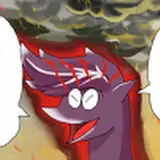
 As I mentioned way, way back, probably while inking Chapter Two or Three, I have fallen in love with Windsor Newton Series 7 brushes. Unfortunately, they only last so long — maybe 80 pages or so, in my experience? 100? That's a guess. Anyway, I swapped an aging brush out for a new one and the new one is not as easy to handle. The thick-thin is more abrupt, like someone monkeyed with the pressure curve on my Wacom. Anywhere you see a line of consistent weight (as in Nikos' headwear, above), it's a minor miracle these days.
On the other hand, even if the sensitivity is a little off, I still love the line quality from these brushes. I feel like I've been getting better with my gestures and my confidence, too, and I'm getting good marks and good shapes as a result. (This is exactly the reason I save the first few pages of the chapter to ink last, as I mentioned at the top of this post. I want the first pages to leave the strongest impression, and subtle as the effect might be, it's easier to achieve after I have several dozen pages' practice under my belt.)
These days, when "The French Revolution" feels like a good and valuable thing to study, it's nice to have a tactile craft I can practice and disappear into for a few hours each day. I hope you have the same! If not, shoot me a message and I'll try to help you find one. For example, I also find that fiddling with music is a good way to get completely lost for a while, and it's easier than ever these days. Knitting works for lots of people. Let's get you sorted, too. You could post in the comments, if you're willing; everyone around here is lovely and smart.
- - - - -
The next post will have the final inked pages for Chapter Five! It'll be done, and I will be a little happy but also sad, because I have been enjoying it.
I still have not decided whether I should zip straight into pencilling Chapter Six. I probably shouldn't. No, better to let the thumbnails simmer a little longer and get Chapter Five all finished for the summer (knock on wood).
Until next time,
I remain,
difficult material,
TC
glenn
2025-02-01 01:22:08 +0000 UTCTony Cliff
2025-01-31 20:34:27 +0000 UTCKae M
2025-01-31 20:27:44 +0000 UTC