Making Connections and Communicating Subconsciously
Added 2021-02-26 22:03:57 +0000 UTCYears ago, I heard this great recording on CBC Radio 2, where the host reviewed a Mozart work passage-by-passage, pointing out the repeated themes and talking about how mathematics informed (or could be rationalized onto) the music. I took away a strong feeling that the principles that are used to build music apply in similar ways to story-building.
One idea that stuck with me is the way musical elements (passages, themes) are repeated—sometimes surreptitiously, or in disguise—in order to reinforce an idea in a way that the audience doesn't notice, per se, but which nonetheless might be "felt" or subconsciously registered. Ever since hearing that, I've tried to look for ways to do the same thing in my own work. Sometimes that means similarities shared among character designs, sometimes that means lines of dialogue that get re-used in new ways, or sometimes it's things like this, from Chapter 1 of DD4…
Delilah and her family are sailing home. But! There is a pirate threat upon the waters. Here is one of the pages illustrating that threat, as it was thumbnailed:

We see pirates in a montage composition. A big pirate figure looms with fire in the foreground.
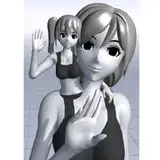
Later, separately, a midshipman who knows his facts is telling Delilah the truth about what will be required of her as a Young English Lady in Society. Most frighteningly, Delilah is confronted with the miserable prospect of having to dance.

We see Delilah's alarmed expression. She is the large figure here, terrified about the threat posed to her by having to dance, the idea of which is represented by the two small dancing figures.
When I got around to roughing-out the pirate page, I added a small boat into the montage. The page says, "here is the threat," and the little sinking boat says, "and here is what will happen to their victim."

(Sorry for the image quality. I had to enhance lines that are, by design, hard to see.)
When I came to enlarge the "dancing" thumbnail, I noticed, "hey, I have a similar composition with a big/small, threat/victim relationship." In the thumbnails for the dancing scene, though, the visual relationship is reversed: Delilah (the victim) is larger than the dancers (the threat). So, even though, in the dancing image, I like the composition better with a big Delilah and little dancers, I figured it would be an opportunity to reinforce meaning in the reader's mind, so I reversed the relationship. Big dancers montaged behind a small DD.

So now we have a visual pattern, shared between two pages:


Readers encounter the pirate page first, and the relationship there is easy to understand: pirates are scary, they'll sink your boat. But readers will be learning that Young DD is terrified of dancing. That's new information. But by using a visual arrangement that is similar to that of the pirate montage, perhaps the reader can take a shortcut to inferring "oh dang, DD is terrified at the prospect of having to dance."
Does this sort of thing work? I am not really sure. It does absolutely make me feel like a real clever-tits, though, and even though I have been actively trying to be less of a clever-tits, there was an opportunity here to create meaning and if I had turned it down, I would have gained nothing. Worst case scenario, this little rearrangement makes no difference to the reader. But! If there's a possibility that a subconscious connection can be made, that's worth the little extra work.
Feel free to use the comments to share your thoughts on whether this stuff is worth working towards. Have you learned any lessons or taken any principles from other creative fields?
Meanwhile, I'll keep trying to find that Mozart programme, because I think there's a lot to take from it.
It's hard for me to tell if this kind of stuff is worth writing about, because years of Twitter have poisoned my brain into thinking there's always someone out there who will say, "yeah, duh." But I figure that for every know-it-all, there's someone for whom this idea might be new. So this post is for them. And also so I can mention that great Mozart programme.
Comments
I think the parallel images work really well. It reminds me of using specific movie angles. When the director wants to convey that the MC is weak or in trouble, they shoot a downward angle. When the MC is triumphant they will usually shoot form a low angle to build the MC up. I think it's the same thing. And from a story standpoint the MC has to be up against a lot of obstacles (perceived or real) and I think the smaller DD really works. Disney also did a lot of parallel images and symbolism in Encanto. Love hearing about all this stuff. Validates my journey as a creator and I love seeing all this stuff behind the scenes.
Rebecca Gage
2022-01-13 03:52:14 +0000 UTCNo kidding! Ha ha, thank you for letting me know!
Tony Cliff
2021-12-23 21:58:19 +0000 UTCI noticed this while reading the previews you put up online! It was what made me pay attention to the rest of the story. Good symbolism makes for good storytelling, and that can really hook me in and make me invested. Thanks for explaining this here, its amazing to know that this was intentional!
Neha Dinesh
2021-12-22 04:52:52 +0000 UTCI love hearing artists talk about this kind of nuts and bolts work!
Charles Riffenburg
2021-03-01 02:03:32 +0000 UTCThis is great! Even if it is just you being clever tits. Even from the sketch I get the threat on the page and poor D under fire from evil things like being a proper young lady 😁
Jessica Trevino
2021-02-26 23:32:58 +0000 UTCI think it's a neat way to add an other layer to the reading, and even if the reader does not notice it, maybe his brain does. And who knows, maybe he will notice upon re-reading the book !
Guy Pradel
2021-02-26 22:39:43 +0000 UTCIf it were so easy to remember where one might have heard or read or seen something once, then academics wouldn't hate the citation pass so much!
Tealin
2021-02-26 22:31:34 +0000 UTCHa ha ha ha, poky and dangerous. And of course—"rhyming"—I should have known that, guessed at it, or remembered that from almost certainly having heard it at some point. *Sigh*
Tony Cliff
2021-02-26 22:23:28 +0000 UTCIn screenwriting, this is called 'rhyming'. Always really satisfying when pulled off successfully! Whether people get the rhyme here consciously or unconsciously, it'll give the visual experience some cohesiveness. If nothing else, Big Triangle Threat/Little Triangle Victim is good code, both emotionally and because, like, triangles are poky and dangerous shapes.
Tealin
2021-02-26 22:10:02 +0000 UTC