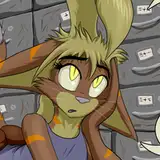
Why have I started dropping more Friday sketches lately? The short answer is, I'm tapped out for ideas. I don't want to just draw a cute sketch of Riley or Max and have that be my post each week. I don't want to just draw Patreon character sketches and have THAT be my Friday post either. It gets tiring, really, to do the same type of drawing over and over, but coming up with new ideas each week is hard too and I'm kind of tapped out. That's why I need your help!
So if anyone has any suggestions for things they want to see, any questions they want answered, please let me know and I will do my best to draw THOSE on Fridays. I'm talking about character Q+As, lore questions, or really anything pertaining to God Slayers that you would like to see me sketch!
Comic this week: Again I'm so far behind on the next page, again I need to work my ass off today and tomorrow if I want to get it done. I will try. It's also my husband's birthday, and I wanted to draw him something nice. I've gotten really bad at time management lately. If I fail to finish the comic on time this week, I will be sure to communicate why.
Drawing: Page 123
Playing: XCOM 2: LWOTC (Probably the reason I fell behind this week. Because losing a soldier to getting crit through full cover by a disoriented alien that my six soldiers failed to kill last turn with 70-99% shots is "fun" to me)
Rambling:
I feel like it's been awhile since I talked about game design? I don't know. I feel like I've probably touched on this topic before but I can't remember! XCOM always gets me thinking about this though. It's sort of a mountain of a franchise that simply cannot be ignored.
There are few games that have me so invested in them yet have me cursing at the monitor in anger and frustration the entire time I play. There are few games that are as iconic and near-genre-defining as the XCOM franchise. There are few games that get me pumped up and excited to either win or fail spectacularly.
Although I am not quick to criticize XCOM, which boasts its proven success through its iconic nature, well-known name and the sheer number of copycat games, it is a flawed masterpiece. Not for the reasons I noted above, however, what with the losing a soldier to an impossible shot through full cover by a disoriented alien that survived because your soldiers missed several 75+% chances to kill. I AM a little salty about it, yes.
Indeed, it's those moments that make the game interesting, if frustrating. But I want to examine WHY those things are good, and when they are bad.
First, the bad. Why, oh why, does your character have a flat 5% chance to miss their swing in many turn-based RPGs? What does it add to the game? If it is there only because it is copied from Final Fantasy (xany) or any of a thousand other JRPGs, I would argue it adds nothing aside from unnecessarily prolonging combat and potentially giving the opponent a random chance to win despite the player's best efforts.
Think that if you have 100 HP, and you are going up against a level 1 slime with 10 HP, and you do 2 damage to them while they do 1 to you. The game is designed for you to win that encounter. Many RPGs of this nature are designed to be long-form world-spanning adventures with scattered dungeon crawls that are endurance races to the end, requiring you to shore up your health with potions and to upgrade your damage as you go with the weapons you find, while facing expectedly harder foes before you reach the bottom. Adding in a 5% chance to miss your attack means that you will do zero damage (effectively you're losing your turn) roughly every 20 swings, which enables most enemies to probably get an extra hit in on you. Unfortunately, because it's random, there's the potential to miss many swings in a row, as well as miss none at all. In any given fight, however, with bad enough RNG, combined with a potential for an enemy to crit you for double damage, you could end up suffering a lot more damage in a much shorter time period than even the designers expected. Over time, these battles can stack up over a long-form dungeon, draining you of your resources and your patience. When you start taking more damage than you are intended to take, you start using more of your consumable potions, which are a buffer or crutch for when things don't go as designed, and that further slows down the gameplay by the extra time spent healing and not dealing damage. Not only causing the battles (and therefore the dungeon) to take longer, but creating an unfun play experience for the player, who is expected to reach the bottom of the dungeon and be the foretold hero from whatever prophecy was exposited at you by the old man/woman in the starting town.
Granted, it is an extreme stance to argue that simply having a flat 5% chance to miss your attacks leads to a game-over in any given RPG. In all the RPGs I've played, it is exceedingly rare, even in the most poorly designed ones, for a Game Over to be the result of pure luck, and not a combination of poor luck and low player skill or knowledge.
My point, however, is that these sorts of mechanics often do not add anything GOOD to the gameplay. It is only a negative design element that serves no benefit to the game and exists only because it was used in similar games before. Or because it is the default setting in RPGMaker that the designer did not feel like changing.
Compare an average JRPG made in RPG Maker, however, to a game like Darkest Dungeon. It is similar in a few ways, as it is a long-form dungeon crawl: an endurance test. But in this case I would argue the chance to miss your attacks and the chance to be crit by enemies create a much-needed tension that adds to the overall gameplay experience, rather than detracting from it. Darkest Dungeon is more of a roguelite game. In Darkest Dungeon, you aren't expected to win. The game tells you that from the start. Your heroes die often and they die quickly. They gain stress and go insane. It is a very different experience. Your success or failure in a single battle may depend greatly upon your Leper landing their attack, and when they miss, it fuels excitement, fear of what is to happen next, an emotional response that leads to a very tense gameplay experience. When these random moments occur, they force you to adapt your strategy, they force different choices, and one such choice may be to simply retreat from the battle. The penalties for having bad RNG are minimal, however, since at the end of every dungeon, no matter whether you win or lose, the player is always returned to the Hamlet, where they have the tools they need to try again. There is no real Game Over in Darkest Dungeon. You can try to win for as long as you like.
XCOM finds itself sort of in the middle of these two types of games. It is a long-form endurance test, with short dungeon crawl elements, but you are expected to win... kinda. XCOM 2 technically has a Game Over condition, which usually appears in the middle of the game after you've been beaten down again and again and you have nothing of value left to defend yourself from the UFO that comes hunting for you. Secondarily, the game can end in Game Over when you fail to stay on top of the alien's win condition, and you haven't kept up with knocking their facilities down if and when they are built. The problem with XCOM is that the game is almost never harder than it is in the beginning, when you have your team of four untrained rookies in crap gear facing off against aliens that are better equipped and more skilled than you are. Most streamers who play the game on the hardest difficulty seem to agree that if the first tutorial mission, Gatecrasher, does not go flawlessly, it's better to simply restart the game than it is to try and continue, because the loss of even one of your allegedly expendable soldiers will set you back too far for the rest of the campaign. In this way, it seems like XCOM isn't quite sure what it wants to be. Its difficulty curve is sort of backwards, with the game getting easier the further into it you progress. It could be a roguelite if your progress didn't depend quite so much on the survival of your individual soldiers and the success of your various missions, leaning far more into the metaprogression elements of building up your base and your equipment, or it could be an RPG if it leaned far more into your soldiers and dropped all pretense that they are at all even remotely "expendable."
At its core though, XCOM is a tactics game, with the gameplay during the various "dungeon-crawl" missions being the highlight. I used to HATE missing those 99% shots or being crit from across the map by aliens I couldn't see, but I've come to appreciate those moments, in the context of XCOM. I've learned that the way to succeed is to plan your strategy around mitigated risk. The random elements add in those moments, much like Darkest Dungeon, where you are forced to adapt and evolve your strategy to the unpredictable changes to the battle, and they add a reliance on the few abilities in the game that can inflict guaranteed damage. I used to scoff at the value of Combat Protocol, the ability that sends your little robot to any enemy to hit them for a whopping 2 damage. But once I learned that damage cannot miss, I have since used that stupid little robot to save the lives of my soldiers countless times when my 99% shots keep missing. The fact is, XCOM would not be XCOM if your soldiers had a guaranteed chance to hit or avoid damage. The random elements make the game what it is.
This has become quite the ramble, and I need to get drawing, so the point I'm getting at is simply this: Some game design elements may seem essential because they have been used in the genre forever, but we need to examine each one to determine what it is actually ADDING to the gameplay. What makes a game "fun" is a sort of vague, nebulous thing, and the things that add to or detract from the "fun" aren't always obvious. But when designing an RPG, or a roguelite, or a tactics game, it's important to ask yourself, WHY is this game mechanic here? If everyone has a flat 5% chance to miss their attacks, what is that adding to the gameplay? Why give everyone a flat 5% chance to lose their turn? Would the game benefit without it? Would it be better to convert those outright misses into grazes instead? Why can the enemies crit? Does it give the player interesting choices or create situations that forces the player to adapt their strategy? Or is it just there, just because? Why does a game have fall damage? What good is a stamina bar? Is there a better way to handle Mana or HP?
Not every wheel needs to be reinvented, but I guess my point is simply this, in game design, it is important to question everything. If you don't know the answer, maybe the game would be even better WITHOUT the extra complexity? Anyway, I'ma shut up now.
And for anyone that reads these rambles, please don't be scared to argue with me or correct me or tell me I'm too repetitive or point out any mistakes or inconsistencies or logical fallacies. I'm always open-minded to the possibility that I am wrong, and I would love to hear other perspectives on the topic! And if you have any other topics you want me to ramble on about, feel free to toss them my way!