Hey Folks,
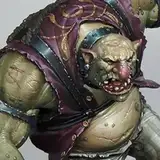
Welcome to another episode of our quest on how to become a better painter, while continuing to paint our Goblin Mercenary!

So far this series has focussed mainly on the technical aspects of painting
and we have neglected what lies beyond techniques and blendings...

Don't get me wrong refining your technical finesse will always be a part of your journey. We as model painters need a certain level of skill before someone would be willing to really look at your piece in detail and explore it in all its details and search for the story your piece is telling.
We need both! If we only focus on the technical side of painting we might end up creating something that is totally shallow. Maybe even something that is almost boring in its perfection
But the viewer gets the subconscious feeling that the figure does not make sense.
When we paint a model, we do not create something entirely on our own. We are not creating something in a vacuum, we are not working on a blank canvas... we are working on a 3-dimensional playground that another artist has created. It is the base of our creation and we should
observe it, respect it, and adore it.
But we need to make sure to add our own layer of interpretation on top of what we find. We should not fall into the trap and just focus on the technical aspects of painting. The more we entirely focus on the technical side of miniature painting, the easier it is to lose the ability to create something that tells a unique story.
Don't just lay color on surfaces, this is not paint-by-numbers or a coloring book.
When we present a model at a contest it can happen that someone has painted the very same model and it´s directly next to yours and
next to the technical aspects of your paint job, it´s also a question of how believable your character is... it´s more of a subconscious feeling.
But if you look at a model you will ask yourself:
Is the scene working..are the lights and the shadows consistent?
Does the model look like it is part of the scene, is it well embedded?
Do the materials and the wear fit? The longer you are looking the more it should make sense, you offer the viewer something beyond a beautifully painted model.
You are offering emotions wrapped in a story banned in a miniature scene.
The "One-moment-in-time" method can be used to create a more believable character.

We take the role of a portrait painter (or a photographer).
We are meeting with the person we going to paint.
First, we need to define the person we are portraying.
What are its physical features? But also what is its motivation?
Why is he/she/it in the situation you are portraying it in?
What happened right before and what will happen to your character right after your "portrait"?
You have to understand that you are capturing one exact moment.
So, next to the personal features we have other influencing factors that are related to the scene or the setting.
Where is your figure located? At what time of the day is your scene set in - how is the light situation? How warm or cold is it ... etc.
All these elements come together and create a unique character.
You as a painter have another objective, you have to define the message you want your character or scene to send.
Is it a heroic story, a story of despair and loss, or a story of love...
It is upon you to create a setting and a character that work hand in hand to tell your story
Give your model a personality.
Try to write a detailed profile of the character that you are creating.
We have personal features as well as scene features that influence our depicted character. These influence everything from the choice of colors to the smallest detail.
As mentioned there will always be also the strive for technical perfection and we want to use our goblin to explore another technique: the loaded brush.

As mentioned in the video, the loaded brush is something that you need to try out yourself, you need to practice it, and refine it.
If you see it in a video you might think ... whoa .. looks like magic... I will give it a try. Then you try it and discover it´s a technique that looks easy but it´s hard to master.
I can only encourage you to pull it through and paint a segment or even a whole model using the loaded brush technique.
You need to develop a feeling for the pressure you apply to the brush. You need to get a feeling for the right about and consistency of both paints in the brush.
There are many little things that influence the result of your loaded brush
like, for example, the consistency of the paint.
If you observe the videos carefully you can see that I am not always picking up the color at the very same spot on the palette.
I look for different fine nuances in the consistency with what appears one dab of color on the palette paper.

I have attached the loaded brush exercise guide because it describes the process very well.
But for now, I want you to observe the different usages of the loaded brush to create sharp and crisp details on the backpack and also the soft organic little Gobbo here in this video!
Have fun watching and thanks for your support!
Dwayne Spencer
2022-12-22 16:27:41 +0000 UTC