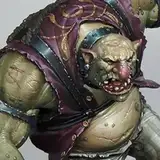
The wings are one of the parts, that have benefitted from the pre-shading technique. We have a great placement of the highlight color and still see the base color shining through in just the right amount, but we want to tie things together a bit more.
We will be using glazes of translucent paint to reestablish the color transitions. We are using a combination of wet-blending and washing the surface with the glaze.
Here the word "glaze" just describes a color that is thinned down to a level where it gets translucent and you can see the paint underneath still shining through. You can use the glaze-like consistency paint for various techniques, such as a wash, where you want the pigments to accumulate in the recesses and indentations, to give you a shading that will define the textures and deeper areas. For a wash, you need to apply plenty of color on the surface so it can gather naturally.
If you use the very same consistency paint and just apply it as a very thin controlled layer we call that "glazing".
But we can also use the very same paint to do a wet-blending, where the color underneath will still shine through. If you have not done much glazing before it can be helpful to wipe off the brush on a paper tissue before touching the model, this way you avoid the diluted paint running out of the brush onto the model, flooding the surface and creating those typical "coffee stain-like marks".
In this video, we can really observe nicely how diversely we can use glazes.
I hope you enjoy that, have fun watching