Shedding Light on Shadows
Added 2024-10-31 23:57:18 +0000 UTC
I have been doing digital art for the better part of my life, from 2008 to now. And let me tell you; it’s been quite an arduous journey trying to figure myself out as an artist, working through many programs and tablets, and relearning fundamentals I was not taught well in middle and high school. Essentially, this has been my path from 12 to now 32.
---
So, I have a little treat to show how far I’ve come as an artist. At the time, I had a YouTube channel and several compilation videos relevant to what I wished to divulge.
This was my first major foray into digital art as a whole, and the three programs I had access to at the time were Microsoft Paint or MS Paint, Photoshop CS4, and Corel Painter Essentials four that came with my first tablet. At first, I learned how to draw with a mouse because it was just what I believed was needed for “digital” art at the time. It was a new medium, thus a new tool, and I was too young and had too little access to the internet to know better at the time. It was not till I started paying for higher internet and had access to Broadband vs. dial that I started to learn and be able to post things to places like Elfwood and DeviantArt.
I learned about the tablet and bought my first Wacom bamboo through browsing other digital media artists at the time. And man, this opened a whole new ballgame for me then.
But then I found channels on YouTube like
Seeing those similarities and how they went about this digital canvas fascinated me. Back then, I knew nothing about the tools or the absolute power some of them had. It was still such a new medium for me that it was banned in our art class then, as it was seen as a means of circumventing traditional media. (Yes, our school was very Puritan about this) However, I used it to help me improve my traditional work by making all the mistakes on the digital canvas and then having a mockup to play with as a reference for my traditional canvas at the time.
But Noct, what does this have to do with shading? Oh, e v e r y t h I n g dear.
I will fully admit that when I was much younger and in various phases of my life, I had an abhorrent distaste for color, and I struggled with even the mere thought of color theory and learning colors to shade. It was D A U N T I N G to myself, who had been predominantly a monochrome-based artist just drawing things in graphite and Bic pens. And I would like to admit at least to myself…Oh, I coped and seethed so hard with this aspect. My “gothic” dark, brooding phase of color made me “hiss” at the whole point.
The mere thought of picking up acrylic paint, a colored pencil, or anything color-related came from two sore points in my life. One was that I had been predominantly surrounded by a lack of color my whole life, and the second was my extreme lack of experience and knowledge.
So, in my first experience with even digital art, I did what I learned later was “one of the Art taboos:” Never shade with black and white, and I was dumbfounded.
It was a complete and utter “bruh” moment because I felt like I was knocked back to square one; in truth, it was not far off, but it led to how I learned from far better sources than what I was initially taught.
That channel I linked was, for lack of a better term, my coping mechanism and crutch at the time. Because he shaded in black and white in my simple brain at the time, I did not learn later that he was shading with two tools that I would know as Taboos—the oh-so-well-loathed “Dodge & Burn” tools. And yet…those two tools carried my art for the longest time from 2010 to 2017—seven years of it, seven years of my essentially drinking my crutch-copium.
This is why this compilation video has two songs that, at the time, I felt were very relevant to my struggle to find a place to fit in and learn this digital Schtick.
The idea of fake it till you make it was very sorely indoctrinated into me, but it also plays into why I struggle at times with my identity as I struggle to understand what is real and not. I grew up struggling with it and still do it as an adult. The notion of I tried so hard to be like others to be relevant, to be someone others might find enjoyment in…Yeah, well, I’ve come to see the whole chameleon act does not do it for me, fam. I feel worse and empty doing it. Trying to be true to myself and being authentic or, at the very least, genuine has been more rewarding than any face I’ve ever worn.
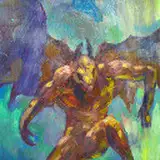
I wish I had learned this earlier, but I was young, inexperienced, and trying to find a community. However, it reflected in my art to some degree, as I was still highly attached to the whole Dodge and Burn, and it became a drug in a way. And some of my darkest pieces came forth even to the point of doing straight monochrome pieces with just those two tools. I do not know how public knowledge it is, but I was not only predominantly a monochrome artist, but I was a Horror, dark art artist. So, things that go bump in the night were my forte, from getting a chance to draw werewolves, battle scenes, epic scenes inspired by heavy metal music, power metal, etc.
But I liked shading with black and white like this because it felt natural to me. I wanted shadows to read as shadows and lights to read as lights, and yet this made my learning easier as I grew more experienced. I will adamantly say this: shading with black and white is not inherently evil; what is is not understanding how to use them.
With great power comes great responsibility, a phrase I use for those who want to shade in black and white. But I’ll tell you a little secret: They are called shades. Thus, simply speaking, it can be said that you can shade it in black and white. So truthfully, the hardest part is how do you shade with an extreme in this way and not make it look well…like ass.
I had to learn colors and how they are affected by these shades. So you know how most art programs have a Color wheel or something akin to
this?
Well, I learned something from that: the shades on the left of the square affect the various hues and saturation of the colors. This blew my mind because it allowed me to experiment with color and not see it as just the all-the-way saturated color I was used to seeing. So, in that compilation video, I started experimenting more with colors, though I would still shade with dodge and burn at the time. But this is where I hit my next problem: how these two tools would eat color when abused too much.
This last compilation will greatly show this struggle in that I would try to find harmony with these tools, but in my own self-critique, I know I missed the mark horrifically.
It was not long after this, and from 2014 to 2017, I was on the path to try and find a better means of shading and understanding what I came to learn as “Value to Color” because these were all terms I never understood.
I discovered Udemy and Gumroad first, and these two places afforded me what I desperately lacked: information and instruction.
• Ty Carter’s Value to Color Lesson
• Eytan Zana Color and Light Lesson
• Devin Korwin Creative Fundamentals Vol 1-2
• Chris Legapsi Laws of Color Vol 1-2
These classes, I will say, gave me more instruction than I thought possible, and I absorbed all I could. It was such a massive deal to me at the time. I also started getting more comfortable with values and Colors and learning how to harmonize them better. Yet there was something I started to struggle with and something that led to a substantial fundamental burnout.
I started to see my Shades becoming greyed out…. The values were too similar. All my hard work was getting ruined in the coloring phase, and I would have to spend sometimes 2-3 times as long on a piece trying to correct this. It was infuriating….
• 2022
It was a massive leap as I fell into a decline from 2017-2021. No matter what I did, I was doomed to fall into this weird hole I did not understand. And I did not understand the Muddiness and why things would look washed out now when in my old Dodge and Burn would not…. but a piece of advice that changed that was….I was not coloring my shadows….I was leaving them grey, and that, well….it was not working. So, something I experimented with was over my shading layers. I would place a colorizing hue saturation layer, which would be the beginning of what led to this current version. There was one more roadblock I overcame recently that changed everything.
Instead of a hue saturation, I changed it to a Gradient map layer, where I could fundamentally control the whole shadow with whatever color I wanted. This gave me back my more dynamic shading and ability, which I had thought I had lost in images. It turned my greatest strength, which had become my greatest weakness, back into a strength.
How can I save time by getting all my values down with monochrome, then applying a gradient map to colorize my shadows in a far more dynamic way, and then color? Voila, this is how I do things now.
But I figured it would be fun to explain where I came from, I hope you all will enjoy this.
Cheers Noct.