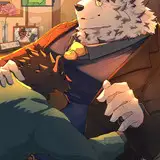
Okay so, this spotlight isn't necessarily going to read as a start-to-finish narrative, because Calu is basically a "secondary" character who has important parts to play — but he's not really a protagonist with a complete storyline of his own. However, his very nature goes along with some neat worldbuilding, and he appears in the stories of several of our "primary" characters. In a sense this spotlight will be more meta and peek-behind-the-scenes-y than usual, and I hope you enjoy it!
First of all, Calu is a character from our Gods Among Us (GAU) setting, in which all non-human beings from myth, folklore, and horror stories are real. Our characters range from being formidable gods to local cryptids; from well-known, classic monsters to obscure or unique creatures.
Calu himself is an Etruscan god. The Etruscans were one of numerous peoples inhabiting the Italian peninsula before the Romans started making a name for themselves. I can personally attest to how amazing the Etruscan culture was, because a few years ago I was able to attend a historical course in Italy which included travelling through ancient Etruria to visit tons of archaeological sites. I would show you pictures, but during that trip I decided to be a ~live in the moment~ kind of hipster and not even bring my camera. A decision I regret, so much. Anyway, I wrote a paper about the terracotta tiles of Acquarossa and ... that's quite beside the point. The point is that Etruscan culture was dope long before the Greeks and Romans started influencing it.
Back to Calu. In short, he's a wolf god of the underworld. I admit I haven't been able to find as much trustworthy information about this deity as I would like, so I've based him on various snippets I've dug up from various sources and depictions in art. Luckily this is not an academic paper, because I wouldn't be able to cite that many respectable sources for what follows...
Calu is connected to Aita (another Etruscan underworld god) and Hades (the much better known Greek god of the dead). But the details are fussy--Calu seems to have been there first, and Hades arrived with the Greeks, but I'm not sure if Aita was an original Etruscan god in his own right, or if he's a sort of amalgamation between Calu and Hades, assuming characteristics of both.
For GAU, we have chosen to portray Calu as one separate character, while Hades is another person, and with both of them sharing characteristics of Aita. They're both gods of death and the underworld, but they have different vibes. Hades is a ruler of an actual place inhabited by the dead; he's regal, cold, dignified, and reserved. Calu has a more approachable personality--but at the same time he's also more violent and primal, like a hunting predator. All souls of their shared realm ultimately belong to Hades, and he doesn't need to be anywhere near you to claim your life. Meanwhile, Calu is more likely to rip your beating heart out with his own hands.
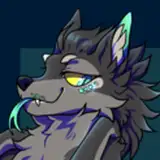
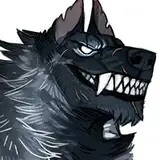
In art Calu/Aita can be depicted as (or represented by) a man with a wolf cap; a therianthropic wolf (so essentially a werewolf); or a regular four-legged wolf. It seems like Calu was originally depicted as a wolf, with Aita taking on a human appearance due to Greek influence on Etruscan culture. To mirror this development, my Calu is a wolf who can shift into a man, rather than the other way around. In his human form he wears his own wolf pelt slung across his shoulders, with the upper jaw covering his head, or tied around his waist; to shift back, he wraps it around his torso and pulls the snout down over his face. The idea is similar to a selkie’s pelt, plus I think it's brutal to wear your own goddamn skin as a cap. I admit I haven't settled on the colour of his fur yet so I might yet change it, but then again he might just look like a pretty regular wolf, except Huge.
His human appearance is primarily inspired by Etruscan art (specifically the sculptures on the lids of funerary coffins) but also by depictions of Spartan men, simply because it fits Calu's vibe. It's not always possible to tell if the statues I used for reference have braids or stylised locks, but I remember hearing something about Spartans braiding each others’ hair before battle, so I rolled with it. His style of facial hair was at times a hallmark of grown Greek men, as opposed to clean-shaven youths. I kept thinking of the vase paintings of Exekias, too, and since I wanted Calu to look like a Dad™ it seemed like a good choice to give him a beard.
All that said, he's a wolf at heart. Yes, he can shapeshift into a humanoid form, but he's not human and he never was. Therefore his outlook on life is not human, and he has even less in common with mortals than most other gods of the Etruscan/Greco-Roman pantheon.
As a wolven death god, one important purpose of his existence is to hunt and to kill. Like any predatory animal, he doesn't think about death in terms of human morality and ethics. A hunting wolf doesn't feel sorry for its prey, and it doesn't regret having to take lives -- but it also doesn't kill for pleasure.
Somehow, he always knows when it's someone's time to die. He doesn't need a thread to be cut, a book containing names, or someone else's telling him whose life to claim. Rather, he operates on pure instinct. Once Calu has started hunting a target, their odds of escaping are slim indeed. He's as dangerous and deadly as you'd expect, with a capacity for gory violence and a single-minded focus on the task at hand. However, he's not volatile, aggressive, or sadistic. He'd never toy with his prey, or kill needlessly. In many cases Calu brings the souls of his prey to Hades, but he's not subservient to him. He just takes them to where they belong.
But there's many things that matter to a wolf, besides hunting. First among those is family. Calu has an inherently fatherly vibe, and is more concerned with the well-being of his pack than with his own person. Some level of respect and discipline is in order, but he rarely takes things personally, and doesn't trouble himself with matters of pride or glory. He usually makes a gruff first impression and can be unpolished, brusque, and a bit primal. But even then he's quite easy to get along with and at heart he's grounded, reliable, and even-tempered.
Calu has an underground realm of his own, but it's not an underworld where dead souls go. In essence it's a Wolf's Den, inhabited by canines of all kinds. This includes any wild wolf, dog, or fox that happens to find their way to it, but more importantly it's a safe haven for supernatural beings. Werewolves are the first that come to mind, but any non-human that somehow falls under the canine umbrella are welcome. Once you've been allowed to enter Calu's Den you're essentially part of his pack, and he's very protective and caring of his own. Of course, the other side of that coin is that anyone who willfully acts to harm his ragtag family will suffer very dire consequences. Don't anger a death god.
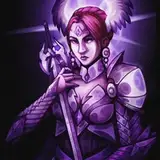
If you've read the Samuel spotlight, you might remember something very important about the worldbuilding of this setting: our take on the Abrahamic god is a bloated deity, who gained so much power and influence by consuming other divinities and amassing their followers to himself. We refer to this entity as Shaddai. In GAU, the gradual spread of Abrahamic religions throughout history is the result of Shaddai absorbing the deities that were there before him, replacing them as the object of human worship in one locale after another.
As an old Etruscan god, Calu was there when it all started. The Greco-Roman deities reacted in widely different ways to the growing threat Shaddai posed: some tried to fight and resist, others to flee and hide, and others still to barter and negotiate. But ultimately, most of them were defeated and devoured by Shaddai, including Zeus, Hera, and Poseidon.
However, Shaddai seemed unable to enter any underworld realm. Now Hades, who had once been dealt the short straw by being tasked with ruling the gloomy land of the dead while his brothers lived the good life on Olympus and in the sea, was in charge of an underground sanctuary out of Shaddai's reach. The same held true for other chthonic gods, including Calu in his Wolf Den.
Honestly, Calu didn't mourn most of the other deities that much. A lot of them were selfish and abusive narcissists, and Calu had never humoured their intrigues and petty squabbles. As soon as it became clear that none of them would be able to stop Shaddai, Calu had retreated to his Den. Some of the gods let their pride lead them to ruin, stubbornly deeming it better to die a "glorious" death than admit defeat. In Calu's opinion, that's stupid as hell. A wolf doesn't throw himself into a fight he knows he can't win. A wolf knows his limits and returns to safety, where he can live on to care for his pack.
As Shaddai's influence spread, many beings who had once been respected, revered, and/or worshipped were now being shunned, hated, persecuted, and murdered. The bloated god’s followers came to view any non-humans as demons and monsters that need to be banished or destroyed. Calu saw their need and opened his Den to non-humans fleeing persecution, giving them a place to rest while looking for a new home.
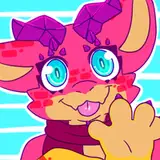
That's how he first met Flora, the faerie queen. She and her court were forced to abandon their home when Shaddai reached the shores of the British Isles, where the fae were as old as the land itself. Flora came to Calu asking for sanctuary, and it has to be said that he was initially hesitant to grant it. Even a god needs to be wary when interacting with faerie tricksters, especially if any kind of deal is on the table. Thankfully he's had enough experiences of dealing with nymphs and satyrs and similar beings (in fact, Flora made him feel a bit nostalgic over long lost friends) to choose his words wisely and broker a successful arrangement.
In essence, he agreed to help her people if she would help his. Calu views (almost) all wolf folk as his kin, as members of a world-wide pack. He knew that too many of the Irish faoladh -- benevolent werewolves -- were suffering at the hands of Shaddai's worshippers, and he wanted the faeries to help him find them and lead them to the safety of the Wolf Den.
To accomplish this, he also needed Flora's help with a more ... delicate matter. The easiest way from Britain to his realm goes through the portals of a liminal forest that is nowadays under Charlie's care. Back then, however, its guardian was an eccentric, bizarre, kooky old woman known simply as Greta. She has been royally pissed at Calu ever since he hunted down one of her associates (it was their time to go). At first, Calu cared little for the ire of a nutty witch, but it became a great inconvenience when she refused to give him passage through her forest. Flora convinces Greta to let him and the faoladh pass through, saving many from the unforgiving prejudice of Shaddai's followers.
In return, Calu helps Flora carve out a new queendom for herself, somewhere in the liminal space between his underground Wolf Den and the flowering earth. The faerie queen and her people overlap a lot with the various nymphs of the land, and she ends up adopting the name Flora, to carry on the legacy of the original goddess who had not survived Shaddai's arrival. Many of the nature spirits who had once thrived in the Italian countryside flock to her realm, feeling quite at home among the faeries.
Some of the faoladh take up residence there, too, and at first people think that Calu keeps visiting simply to make sure that the wolf folk are faring well. Once he starts coming and going to the queen's bedchamber, however, it's obvious that there's more to it.
At first glance, they make an odd pair. Calu is grim, rough, and stoic, with his rugged pelt and his scars and his unpolished ways. Flora is glamorous, whimsical, and colourful, enchantingly charismatic and in command of any space she's in. But she's also fickle, petty, and unpredictable. Flora doesn't hesitate to punish someone for personal reasons, and to draw it out for as long as she thinks they deserve. In fact she can be just as bloodthirsty as Calu, and more cruel. For example it's Flora who cursed Andreas, after he killed a monstrous wolf that was endangering his village. The wolf person in question was part of Calu's pack and he wasn't happy about their death, but he was willing to let it slide, since he understood that the mortal at fault only wanted to protect his own family. Flora, however, showed Andreas no such mercy.
Flora is a queen, but Calu is not a king -- he's simply her husband and consort, the leader of his own pack, and the father of their many children. Honestly, raising a bunch of faerie kids is hard enough -- he couldn't imagine having a hand in ruling a whole nation of tricksters. Jokes aside, he was made to be a dad, and loves every second of it. As a death god, it's an odd and wonderful feeling to help create life.
Not all of their children are blood related, however. On one of his journeys to the British isles, Calu comes upon a faoladh pup hiding in the bushes. None of his parents are anywhere to be seen, so Calu ends up bringing the orphaned werewolf back home. The pup's name is Cian, and Calu admittedly enjoys raising a kid who's more like himself than his and Flora's faerie children. It's not long before Cian proves himself a rambunctious little rascal, and Calu sometimes acts the exasperated father, but he really doesn't mind. He teaches Cian how to be a good wolf and a good man, and once he's all grown up he embarks on adventures of his own.
Somewhere around the same time, Flora's animosity towards a certain Italian family has her hatch a plot against them. She essentially gives one of their children away to a pair of mortals, in an arrangement that will ultimately end in their grim demise. The baby is named Amato, and with the legacy of both faerie and death god coursing through his veins it's no wonder his human family comes to fear him on an instinctual level. They lock him away in a tower, where he's eventually visited by a strigoi named Vaska, drawn there by the smell of delicious blood. Long story short every member of the doomed family ends up dead and Amato escapes his prison. Eventually they return to the Faerie land, and Amato is reunited with his parents.
Both Flora and Calu are glad to meet him, at last, but Amato doesn't stay that long. Vaska doesn't like Faerie, and home is where his vampire boyfriend is. The queen and her consort had never stood in the way of their children's independence, so Amato is neither the first nor the last to leave home for different corners of the world. What matters is that they can always return to either Faerie or the Wolf Den, should they want to.
If you're wondering why Calu is absent from the spotlights about Vaska/Amato, Elena/Cian, and Andreas, it's because he either didn't exist back when I wrote them, or we hadn't yet figured out how he fit into those stories. Adding him made so much sense, though, and when the puzzle pieces fit together so beautifully I'm happy to retcon stuff.
You can probably tell that I went full nerd on this, since the Ancient Mediterranean happens to be my area of expertise. I'd love to answer any questions you may have about Calu, whether about his mythological role, his design or personality, or his part in various stories. Just comment below!
// art + calu + andreas + vaska © me; flora + cian + amato + greta © kubi.