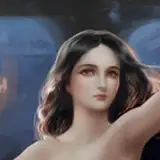
New nude version with jewelry.Beautiful Byzantine eunuch: https://www.patreon.com/posts/eros-angel-78460025
First version with covering is here: https://www.patreon.com/posts/eros-angel-57117535
***
The special artwork that I started in June 13, 2018, finished on October 8, 2021.
In the post an excerpt from the book "Beauty and the Male Body in Byzantium: Perceptions and Representations in Art and Text by Myrto Hatzaki. Chapter: Angels and Eunuchs: The Beauty of Liminal Masculinity" that inspired me to create the painting.
I'm posting it here, free for all of you, I think you'll be interested! :)
***
Chapter: Angels and Eunuchs: The Beauty of Liminal Masculinity
"If Makrembolites's handsome, young Eros acquired his winged feet as Magdalino suggests from the hexapteryga of Byzantine religious imagery, one could equally argue that in the mid-thirteenth-century world of Livistros and Rodamni it is the attendants of Eros (rather than the king himself) who evoke the imagery of the angels in the Byzantine collective imagination. Portrayed as 'Love's executioners who punish crime' these figures are described as a crowd of fearsome men with wings springing from their shoulders and a fiery, formidable nature." They are strikingly beautiful, moreover, and appear to serve a role similar to that of angels in the heavenly court: standing between mortal Livistros and the all-powerful, god-king Eros they match the position of angels in their attributes, their physical appearance and their role of mediators between the human and the divine.
Whatever the eros/angel parallel may have suggested about the emerging image of the love god in Byzantium, its implications for the Byzantine perception of the angel and his body are significant. The analogy underlined in the texts suggests that the image of the angel may have fuelled the Byzantine imagination in creating written images of erotes in the twelfth century. That the imagery of the angel was so readily adapted to the secular setting of the iconography of eros and his court underlines, moreover, that the angel was somewhat secularized by the Byzantine gaze. There is the possibility in other words that the visual and verbal images of angels in Byzantium, with their gendered bodies suggested by the manly Adam's apple, their elaborate wings, blond curly hair and tactile drapery, allowed for a level of 'humanization', linked to their all-too-physical and tangible rather than abstract and spiritual beauty. This may in turn suggest a possible sensuous undercurrent to the image of the beautiful angel.
Ascribed as a physical attribute to beings inherently spiritual, the angel's complex beauty underlines the importance of this quality in the Byzantine mind, which caused beauty to be read as a tangible quality even in the immaterial body of an incorporeal being. Young, male, and above all beautiful, the angel stood in alignment with the Byzantine eunuch. Their special kind of beauty, a beauty of 'eternal springtime', revealed itself as a Byzantine obsession; it was praised in texts and elaborately depicted in visual imagery, with saintly bodies evoking nuanced representations of youthful manhood caught before their beauty hardened by the roughness of mature masculinity. Represented upon church walls, standing between the world of the viewer and the realm of the divine, the angel's beauty is ascribed a purpose, serving to direct both the viewer's gaze and his mind to the contemplation of higher truths. Yet this brightly coloured, visually captivating image of angelic beauty also appeared to secularize the angel, lending his attributes to the figure of Eros in Byzantine literature. In this, Eros's beauty underlines the extent to which beauty stood liminally between sanctity and sensuality in Byzantium, bridging rather than dividing these two theoretically divergent but secretly overlapping worlds. Inherent to both and exclusive to neither, beauty not only served both sanctity and sensuality, but also underlined the blurred boundaries between the two. The parallel between angel and eunuch, moreover, by identifying a particular kind of beauty that befitted, and also defined and expressed the curiously masculine, sexless yet gendered status of the angel, looks further into some of the ways in which beauty and masculinity were seen to relate to each other in Byzantium. The beauty of angels, like that of eunuchs, reveals further nuances of the Byzantine perceptions of beauty, masculinity and the relationship between the two. "