Secondarily flightless gondwanatheres?
Added 2019-08-29 12:15:56 +0000 UTC<figure>
 </figure>
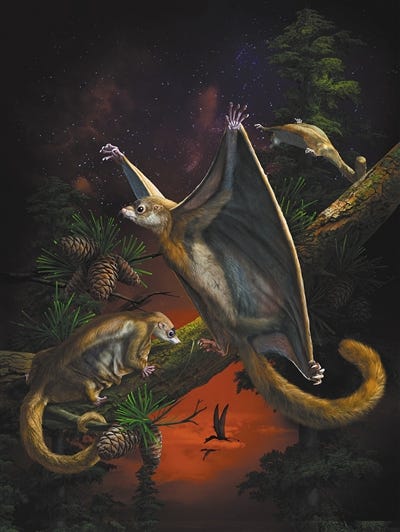
Maiopatagium furculiferum, artist uncredited.
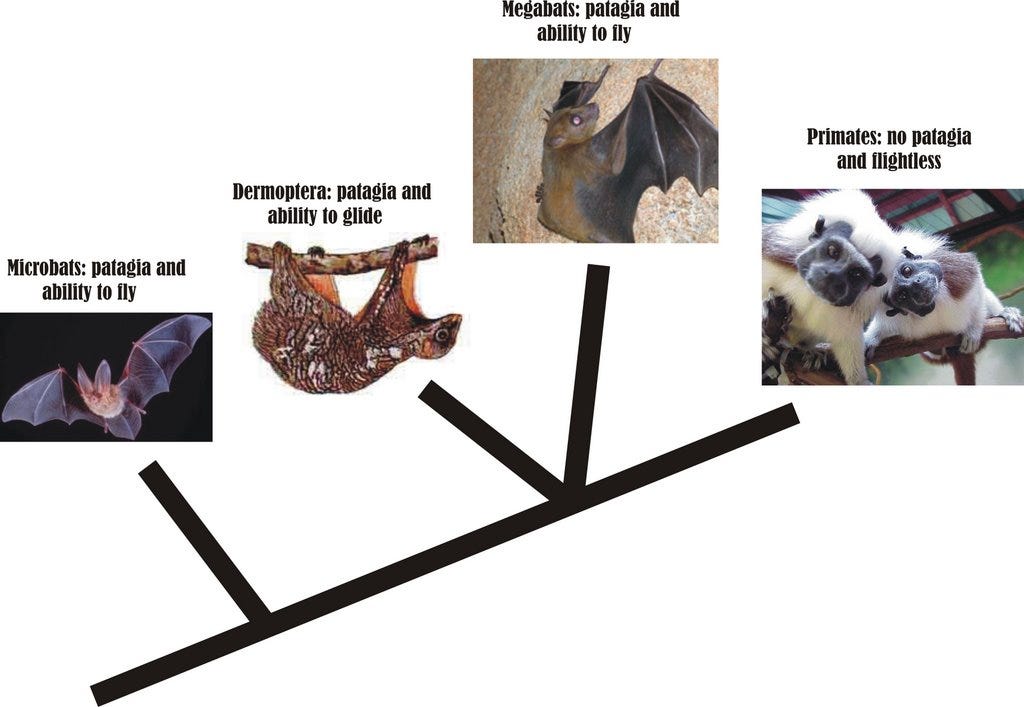
So people who are aware of the “flying foxes are primates” hypothesis may also be aware of its twin hypothesis, that primates evolved from gliding or flying ancestors. This is due to the assumption that primates are nested deeply in a clade of gliding/flying mammals alongside colugos and flying foxes, with microbats being the alledged closest outgroup.
<figure>
 </figure>
Flightless primate cladogram by Darren Naish.
Of course, now we know these ideas are rubish. Bats are now known to be monophyletic and not even remotely related to primates, being closer to carnivorans, pangolins and ungulates. In general, the idea of secondarily flightless bats (or flying mammals and pterosaurs period) is growing dimmer in terms of likeliness,
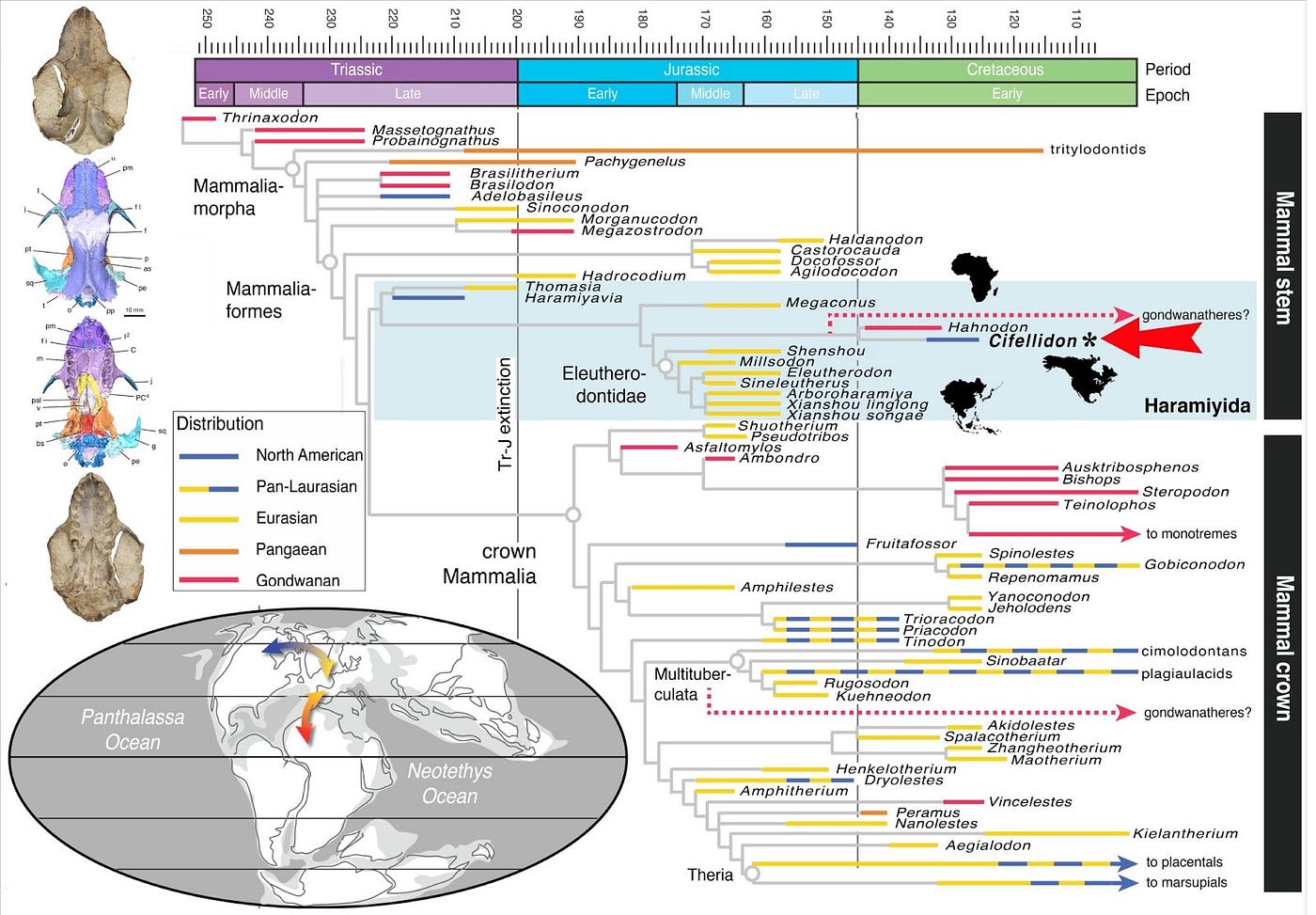
However, recent reveals on the phylogeny of gondwanatheres, a successful group of herbivorous synapsids, has left me wondering. Traditionally assumed to be multituberculates, gondwanatheres have recently been recovered as nesting deeply within Haramiyida (Huttenlocker 2018), a clade of non-mammalian synapsids. Haramiyidans themselves have had a very complicated history as either non-mammals or true-mammals within Allotheria, but most recent phylogenetic studies seem to favour a non-mammalian identity (Luo 2015, Meng 2017).
<figure>
 </figure>
Cladogram from Huttenlocker et al 2018.
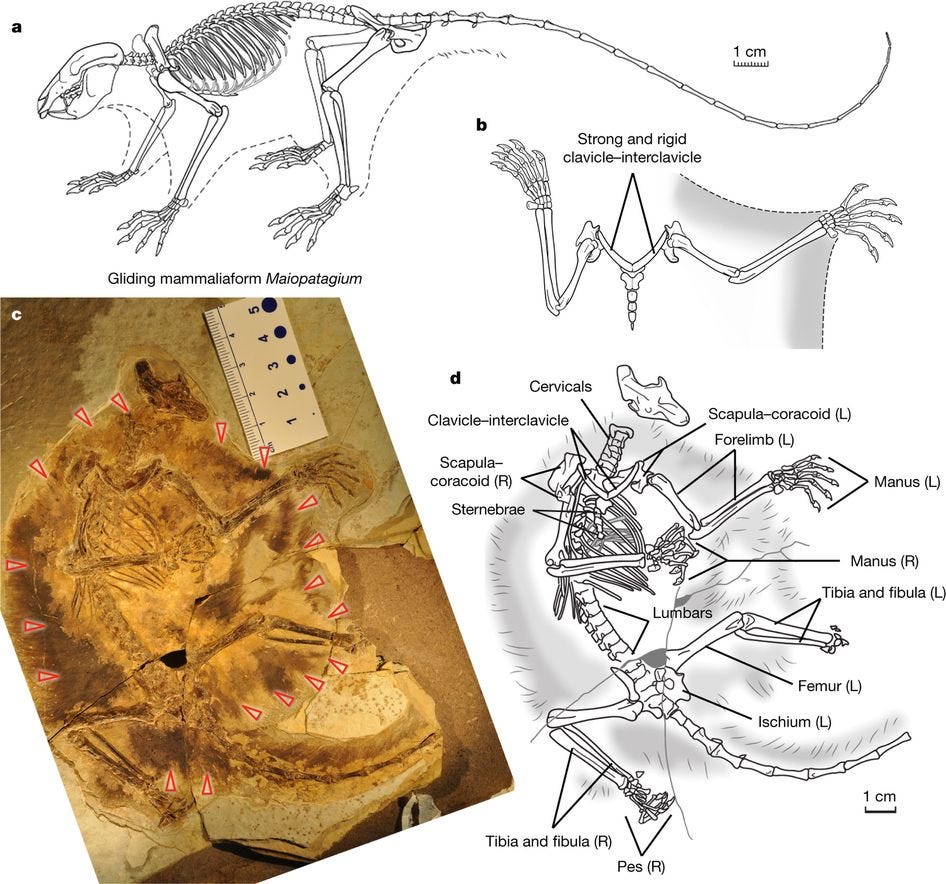
Haramiyidans are extremely rare in the fossil reccord, an attribute that has been suggested due to putative arboreal habits. This hypothesis was confirmed with the discovery of various Chinese haramiyidans, alongside another mindblowing characteristic: many of these animals were actually gliders.
<figure>
 </figure>
Starting with the Xianshou species, Vilevolodon diplomylos and Maiopatagium furculiferum, the list later expanded to include Arboroharamiya jenkinsi (Han 2017) and its likely other known arboreal taxa were gliders as well. These animals occupied a broad range of herbivorous diets as to be expected of gliding mammals (Meng 2017), but most closely resembled colugos in terms of hand and foot anatomy, implicating similar hanging behaviours much like the flying lemurs and bats (Meng 2017).
So, in short, a lineage of clearly terrestrial mammals nested among a clade whose best known representatives are colugo-like gliders. Where have we hard that before?
Currently there are no known arboreal gondwanatheres, with sudamericids in particular being thought of as fossorial (for instance Patagonia peregrina, formerly thought to be a marsupial, was described as a “marsupial tuco-tuco” [Pascual & Carlini 1987]), contrasting heavily with their colugo-like ancestors. Such a transformation is rather exotic, and and it is likely that gondwanatheres evolved from non-gliding haramiyidans (such as Megaconus mammaliaformis, hyrax-sized and similar in terms of ecology), they nest deeply among the gliding taxa.
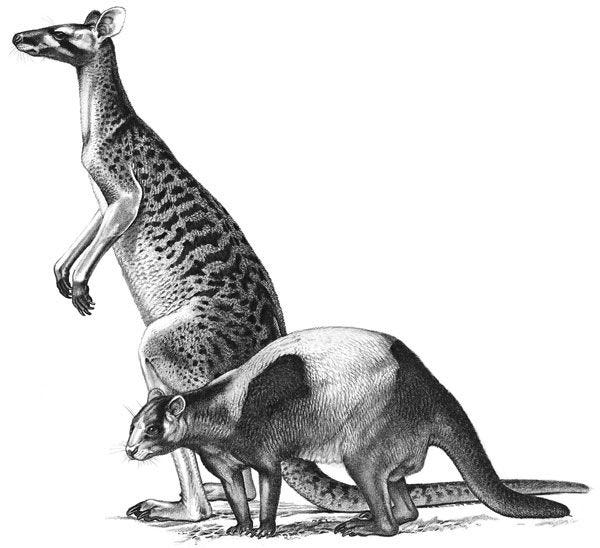
A possible transitional form can be seen on the subject of that paper, Cifelliodon wahkermoosuch. This was a rather large haramiyidan, about the size of a rabbit, but more gracile than gondwanatheres. Typically reconstructed as a squirrel-like animal, I would like to imagine it as something more akin to a miniature Protemnodon, long limbed and maybe even with wing membranes but already specialised to walk and run efficiently on the ground.
<figure>
 </figure>
Protemnodon species by Peter Schouten.
From then on, further speciation towards a terrestrial lifestyle would have been easy. In particular, gondwanatheres are best known from, where else, the southern continents, where maybe competition with multituberculate was minimal, allowing these older synapsids to prosper on the ground. Then again, multituberculates are known from the Cretaceous of Madagascar (Krause 2017) so who knows.
This could have some interesting implications in the reconstruction of gondwanatheres. Maybe vestigial gliding membranes would have remained even in specilised burrowers?
References
Huttenlocker AD, Grossnickle DM, Kirkland JI, Schultz JA, Luo Z-X. 2018. Late-surviving stem mammal links the lowermost Cretaceous of North America and Gondwana. Nature Letters
Luo, Zhe-Xi; Gates, Stephen M.; Jenkins Jr., Farish A.; Amaral, William W.; Shubin, Neil H. (16 November 2015). “Mandibular and dental characteristics of Late Triassic mammaliaform Haramiyavia and their ramifications for basal mammal evolution”. PNAS. 112 (51): E7101–E7109. doi:10.1073/pnas.1519387112. PMC 4697399. PMID 26630008. Retrieved 17 November 2015.
Qing-Jin Meng; David M. Grossnickle; Di Liu; Yu-Guang Zhang; April I. Neander; Qiang Ji; Zhe-Xi Luo (2017). “New gliding mammaliaforms from the Jurassic”. Nature. in press. doi:10.1038/nature23476.
Han Gang, A Jurassic gliding euharamiyidan mammal with an ear of five auditory bones, Nature doi:10.1038/nature24483
Pascual & Carlini 1987
David Krause, Simone Hoffman, Sarah Werning, First postcranial remains of Multituberculata (Allotheria, Mammalia) from Gondwana, August 2017Cretaceous Research 80 DOI: 10.1016/j.cretres.2017.08.009