Tingamarra Fauna
Added 2017-01-26 01:26:37 +0000 UTC
Australia is easily one of the most undersampled of all continents when it comes to fossils. Great patches of the Late Cretaceous and early Cenozoic are unknown to us, being devoid of known fossil-bearing formations. We know nothing of what lived in Australia at the time Tyrannosaurus rex roamed North America, and the following 40 million years are just barely better.
To these ends, the Murgon Fossil Site in eastern Queensland is almost a life-saver. The exact age of these deposits is not entirely clear, but it is generally agreed that these deposits, the remnants of a lake system, paint a picture of Australia somewhere between 55 to 48 million years ago. The youngest previous inland deposits in the continent belong to the mid-Cretaceous some 55 million years prior, and there’s almost nothing for the next 30 million years.
Australia in this epoch just began to separate from the rest of Gondwanaland. A connection between Tasmania and Antarctica probably still existed, but otherwise the continent was entirely isolated. Global temperatures rose during this epoch, the “Paleocene-Eocene Thermal Maximum”, and although Queensland was much further south than it is today the climate was just as warm, if much less dry as Australia was entirely covered in lush rainforests.
Around ten million years passed since the KT event wiped out terrestrial ecosystems. Combined with the increased isolation of Australia and the hothouse environment, the conditions for an unique and diverse fauna were set into motion. The subsequent fossils found in the locale collectively form the Tingamarra Fauna,
Marsupials and other Metatherians
The mammals of the Murgon Fossil Site are easily among the most fascinating finds because they offer insight to how the modern australian groups evolved. Among these are the earliest australian metatherians, some of which early marsupials.
Marsupials evolved during the Paleocene in South America, descending from Cretaceous metatherian mammals from North America. Around this time period they managed to disperse eastwards across Antarctica, colonising Australia through the tasmanian bridge. Although all modern marsupials belong to a clade known as Australidelphia, some marsupials in the Tingamarra fauna may belong to groups otherwise found in South America, implying many waves of migration across Antarctica.
Djarthia is one of the earliest australidelphians. Known from a molar, an ear bone and a heel, Djarthia is an animal very similar to the modern Monito del Monte from today’s South America, a small, tree-dwelling insect eater. Combined with indeterminate fossils that may represent actual microbiotheres (members of the Monito del Monte line), it suggests that these small insectivores crossed Antarctica multiple times during this time period and were common across both Australia and South America. Although marsupials as a group have an ultimate american origin, it’s unclear whereas australidelphians specifically evolved in Australia, South America or Antarctica.
Other marsupials are less clearly related to modern species. A tooth belong to a rat-sized omnivore has been attributed to the genus Chulpasia, an animal closely related to the modern shrew-opossums (both are part of Paucituberculata) of South America and otherwise attested from the Eocene of Peru. If this is the case it offers a very clear example of trans-antarctic travel for non-australidelphian marsupial groups. However, it has recently been suggested that this tooth does not belong to Chulpasia or any other paucituberculatan, though this is still up in the air.
The similar Thylacotinga is a larger species, also known from molars, that may be similarly an omnivore or herbivore. It has been suggested to be closely related to Chulpasia, but with the current uncertain of the “Chulpasia tooth” its own affinities are also currently up in the air. Both could just as easily be non-marsupial metatherians.
The latest and perhaps most impressive find is Archaeonothos, an animal estimated to weigh around 40 g, also known from a molar. Opposed to the above omnivorous species, it belongs to a clear carnivore, being specialised to slice through meat. Like “Chulpasia” and Thylacotinga, it’s affinities are currently uncertain, but it is quite similar to the south american sparassodonts, a non-marsupial metatherian group noted for a variety of large sized carnivorous taxa like Thylacosmilus.
Murgon’s metatherians clearly show an early radiation of species in Australia. In spite of the uncertain status of many of these, it is clear that only Djarthia appears to be closely related to modern australian marsupials. Some time in the 30 million years between this era and the Oligocene - to which the Riversleigh deposits are dated -, only this line survived while the other local metatherians went extinct, and gave rise to all manner of forms from quolls to kangaroos.
Other Mammals
One of the Tingamarra Fauna’s most notable members is the eponymous animal, Tingamarra. Known from a single molar, this 20 centimeter long omnivorous mammal would perhaps only have been a mild oddity at first sight. However, it did raise a stir in zoology headlines for a while.
This is because it might have been not a marsupial, but a placental mammal, more specifically a primitive ungulate. Australia is notable for being one of the few landmasses where terrestrial placental mammals have been absent through most of the Cenozoic; only bats have been consistently present, and rodents arrived rather recently in the Miocene. If Tingamarra is a placental, and an ungulate at that, then it would mean that terrestrial placentals did arrive to Australia alongside marsupials, and later on became extinct.
However, more recent studies conclude that there is nothing in Tingamarra’s sole dental remain that determines a specifically placental identity. It could just as easily have been yet another metatherian, a bat, or perhaps more tantalisingly a member of another mammal group, perhaps one of the members of the groups that inhabited the continent during the Cretaceous (see below).
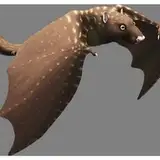
A clear placental is a the bat Australonycteris, known from surprisingly complete remains. This bat is among the earliest in the world, suggesting that it didn’t take long for chiropterans to colonise the entire planet thanks to the power of flight. It was a carnivore, similar to the modern ghost bat, and perhaps the largest mammalian predator alongside Archaeonothos.
There are no known fossil monotremes, though the presence of the group in the Early Cretaceous of Australia and the Paleocene of South America would imply that they were in the region, unless they underwent a local extinction and recolonised Oceania from Antarctica.
Relevant also the absence of old, non-therian and non-monotreme mammals groups. Early Cretaceous Australia had a variety of australosphenidans and at least one multituberculate, while the Cenozoic of South America and Antarctica have a variety of dryolestoids and gondwnatheres; New Zealand also boasted an ancient mammal lineage represented by the Miocene “Saint Bathans Mammal”. Some mammals of the australian Miocene, such as Yingabanalara and Yalkaparidon, are sometimes interpreted as relics from Cretaceous Australia, when not considered particularly weird marsupials.
The absence of such mammals from Murgon is intriguing. Did metatherians outcompete them, or did they all perish alongside the dinosaurs? Perhaps they simply wait discovery; maybe it is just a matter of time until the ancestors of things like Yingabalanara make themselves known.
Birds
Several bird remains have been found in Murgon. Two remains - a wing and a leg - have been interpreted as the world’s oldest songbirds, one an animal probably similar to a wren and another about as big as a black bird.
A quadrate represents the oldest australian waterfowl fossil. This is very similar to the well known Presbyornis from the northern hemisphere, and it was probably a similar lithe, long-legged species. Remains normally assigned to shorebirds may also belong to this waterfowl.
There are foot impressions that might belong to dromornithids. These birds, already large sized, would have without doubt been the largest land animals in the region, as they would be for most of Australia’s history.
Paleognaths, though currently unknown in Murgon, were likely present as well. Various lineages are known from most landmasses in the Paleocene and early Eocene, and Australia’s own endemic groups probably diverged from each other back then. These Murgon paleognaths probably remained volant, similar to the modern tinamous or the Miocene Proapteryx, though it is equally as likely that they already became flightless, as the first ratites appear around this time in South America and Europe.
Crocodiles
Two species of crocodile are known from Murgon, both belonging to the genus Kambara.
Kambara is the oldest known mekosuchine, a lineage of australian crocodiles that specialised to a terrestrial lifestyle. Although Kambara was probably still mostly aquatic, both known species already show limb adaptations that suggest more efficient walking and running. At sizes comparable to those of modern saltwater crocodiles, the Kambara species were almost certainly the apex predators of their environment, on land and water.
Mekosuchines group among various crocodile taxa from the northern hemisphere, suggesting that they might have arrived to Australia through marine travel across the Indian Ocean.
Snakes
Three snake species are known from Murgon, all part of the family Madtsoiidae. Now extinct, Madtsoiid snakes were common across Gondwana and Europe during the Cretaceous and early Cenozoic, gradually becoming extinct until only a few species remained on the Pleistocene of Australia, giants such as Wonambi.
Murgon’s madtsoiids are generally much smaller than their ice age successors. The largest is a species tentatively assigned to the genus Madstoia, at around 2.5 meters. The smallest is Patagoniophis, at around 50 centimeters, while Alamitophis reached around 80 centimeters.
Currently there are no named lizard fossils from Murgon, which could offer an insight to the group’s absence in early Cenozoic Australia. Squamates took over 10 million years to recover from the KT event in many parts of the world, so it would make sense that they were regionally extinct in Australia. With the exception of madtsoiid snakes, all australian squamate groups are thought to have originated from the Oligocene onwards, representing various waves of invaders from Asia.
Turtles
Like many other australian fossil sites, Murgon boasts a large variety of freshwater turtle species.
Some, like Murgonemys, are representatives of Pleurodira, the side-necked turtles, an ancient lineage that found a particular refuge in Australia, where they diversified to become the dominant freshwater species throughout the Cenozoic.
Some, however, are instead soft-shelled turtles, a group currently extinct in Australia. A distant relative, the pig-nosed turtle, occurs currently in New Guinea and northern Australia, but it clearly represents a more recent invasion from Asia, where most of its closest fossil relatives are found across the Cenozoic.
Currently there are no known meiolaniid fossils in Murgon. As Meiolaniidae is predicted to be an old lineage, in particular due to a vicariant fossil in New Zealand - which separated from the rest of Gondwanna in the mid-Cretaceous 80 million years ago -, it would seem likely that they were present in the early Eocene of Australia as well.
Amphibians
Murgon boasts Australia’s oldest frog fossil. Represented by various postcranial remains, these are clearly Leiopelmatidae remains, close relatives of the modern New Zealand frogs. Thought to be an old lineage that survived in isolation in eastern Gondwanna, these fossils suggest that they weren’t restricted to Zealandia.
Lechriodus is also present. Like the modern species Murgon’s one probably inhabited the forest floors of the region’s rainforest environments.
More controversial are possible salamander remains, which to this day have only been a passing note in Murgon fossil guides. If these fossils do belong to salamanders, they are the only gondwannan examples of the group prior to the arrival of lungless salamanders to South America in the Miocene.