May 1st, 2020: What We've Missed, Exception Player Rule, 2020 Draft, Mailbag
Added 2020-05-01 13:53:22 +0000 UTCPSA: The Yankees have announced you can get refunds or credit on tickets purchased for games in April. Here's all the info. It's basically the bare minimum given the circumstances, but it's better than nothing. Hope you're all staying safe (and sane). Now let's get to today's thoughts as the calendar flips to May.
1. What we've missed: March and April. According to Jayson Stark, this season is the first time a Major League Baseball game was not played in the month of April since 1883. 1883! Back then they played a 98-game season that started in May. What a bummer this all has been. The Yankees should be 32 games into the season right now. They've missed 15 home games and 17 road games, a 2017 ALDS rematch, an interleague series, and a West Coast trip, among other things. Dayn Perry recently looked at 10 MLB moments we've lost to the shutdown this season and I wanted to do something similar for the Yankees. With any luck, we won't have to do another one of these after May. Here's a recap of the things we missed this past month.
Gerrit Cole's debut
Might as well start with the obvious. Cole was likely to start Opening Day against the terrible Orioles in Baltimore. It would've been a start 11 years in the making, dating back to when the Yankees drafted Cole with their 2008 first round pick. CC Sabathia made his first start as a Yankee at Camden Yards and it was awful: 4.1 IP, 8 H, 6 R, 6 ER, 5 BB, 0 K. It was his 255th big league start and only the fifth (and final, believe it or not) time he did not strike out a batter. I reckon Cole's debut would've gone better, if only because the Orioles are so bad. Starting Opening Day would've put Cole on track to make his second start in Game 6 against the Rays at Tropicana Field on April 1st, and his Yankee Stadium debut in Game 11 against the O's on April 7th. Well, technically it would not be his Yankee Stadium debut. It would've been his Yankee Stadium debut as a Yankee. Cole has made two career starts in the Bronx. He threw six good innings at Yankee Stadium with the Pirates in 2014 (box score), and then there's Game 3 of last year's ALCS, when he worked over the highest scoring offense in baseball for seven innings despite not being razor sharp (box score). At some point Cole will be able to throw a meaningful pitch as a Yankee. I hope it's soon.
New digs in Texas
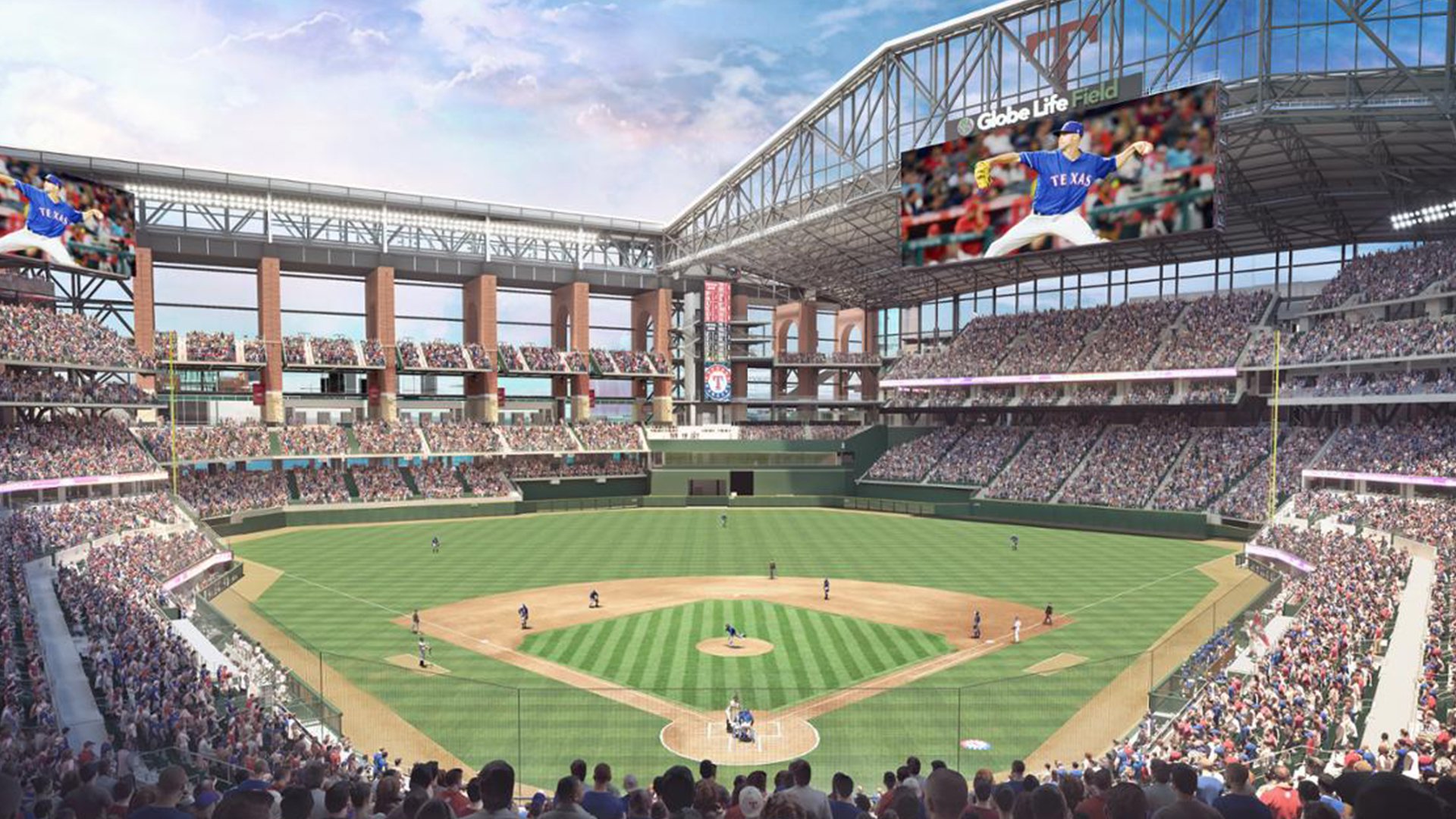
The Rangers will open a new ballpark, Globe Life Field, whenever baseball returns. Their old stadium, Globe Life Park, was only 25 years old, but that seems to be the lifespan of a Major League ballpark these days. Maybe the Yankees will start kicking around the idea of a new ballpark in a few years? This will be Year 12 at the current Yankee Stadium. Anyway, here's what Globe Life Field looked like about three weeks before Opening Day (photo via Dallas Morning News) (here's a rendering of the finished product):

Hooray for the retractable roof. Even at night, it is brutally hot in Dallas during the summer months. The players hate it, the fans hate it, everyone hates it. Going to an outdoor game in Texas in the summer is a miserable experience all around. Now there's a roof and it'll be nice and comfortable at all times. The Yankees were scheduled to make their first visit to Globe Life Field from April 13th through April 15th. Three-game midweek series. In case you're wondering, the Yankees went 62-50 all-time at Globe Life Park (57-48 during the regular season and 5-2 in the postseason).
Sonny's return (maybe)
The Yankees are scheduled to play the NL Central during interleague play this year and their first interleague series was supposed to be a three-game weekend home series against the Reds from April 17th to April 19th. Sonny Gray may have made his return to Yankee Stadium that series. Basically a three-in-five chance he would've pitched that weekend. Gray flopped as a Yankee, though I suspect his reception would've been mostly indifference rather than vicious boos. A smattering of boos throughout the stadium and that's about it. Nothing extreme like what David Ortiz heard. Sonny famously complained the Yankees tried to get him to throw his slider more often, then he went to the Reds and had a career year in part because he threw his slider more than ever. To wit:

Some guys, man. In addition to Gray's return, this series may have also been Mark Payton's Yankee Stadium debut. The Yankees selected Payton in the seventh round of the 2014 draft and he spent five years in their farm system before going to the Athletics in the Triple-A phase of the 2018 Rule 5 Draft. He had a great 2019 with the rocket ball in the Pacific Coast League (.334/.400/.653 and 148 wRC+), then the Reds grabbed him in the Major League phase of the Rule 5 Draft this past winter. I don't think Payton would've made their Opening Day roster -- the Reds selected him before signing Shogo Akiyama and Nick Castellanos, and those moves probably pushed him out of the outfield mix -- but you never know. Had he made the roster, this series could been his Yankee Stadium debut. I'm sure he thought about the day for years while in the farm system.
Lotsa Orioles and Tigers
On paper, the Yankees had a very favorable March and April schedule. They've missed 32 games to date and 14 of the 32 would've been against the Orioles and Tigers. FanGraphs projects those two teams at a combined .389 winning percentage in 2020, or 63 wins across a full 162-game season. Throw in a three-game series with the Blue Jays and the Yankees were scheduled to play 17 of their first 32 games against teams with projected 75-win roster or worse. Playing bad teams doesn't automatically mean you'll beat bad teams -- the Yankees lost home series to the Orioles, Tigers, and White Sox last April, their only three home series losses all season -- but hot damn, the schedule was set up for the Yankees to get fat early. I have no idea how feasible this is now, but MLB's master plan is picking up the schedule at whichever point the season begins, in which case the Yankees won't get to play all those March and April games against bad teams. The ultra-imbalanced schedule could factor into the various postseason races. If that happens, you just have to deal with it, but damn, the shutdown robbed the Yankees of a chance to get out to a very hot start this year.
2. Exception Player Rule. If you've read RAB long enough, you know hockey is my second favorite sport. I love the combination of speed, skill, and power. It's also my escape sport. I love baseball an embarrassing amount but it's also my job, so I follow the game differently now than I did years ago. With hockey, I can shut my brain off and watch the sport, and not pay attention to certain trends or nuances so I can turn them into posts. I bring this up because earlier this week I was reading a Craig Custance (subs. req'd) article about an NHL player agent's idea to create an Exception Player Rule. The short version:
- Each team would be able to designate a player as an Exception Player. That player would not count against the salary cap.
- Teams that opt-out would be entitled to some sort of luxury tax payment. (Not every team spends to the cap. In fact, some are only barely over the salary floor.)
The Exception Player Rule would help teams retain their stars and attract others, and also push salaries upward. If you know you can sign a big name free agent and not have him count against the cap, you might be more willing to overpay him to seal the deal. It's an interesting idea the NHL will almost certainly never adopt because it'll funnel more money to the players, and lol at that ever happening. The article had me thinking about a similar system for baseball. The luxury tax acts as a salary cap for large market teams but that's only a handful of teams. The luxury tax threshold is $208M this season and only five teams are over threshold or within $10M of it:
1. Yankees: $258.5M
2. Astros: $228.7M
3. Dodgers: $222.8M
4. Cubs: $212.8M
5. Phillies: $201.8M
The Red Sox ($195.8M), Mets ($194.5M), and Nationals ($192.8M) are the only other teams with luxury tax payrolls north of $190M. We complain about the luxury tax here because the Yankees are perpetually up against it. The fact of the matter is very few teams league-wide are impacted by the luxury tax. Most are well below the threshold and for that reason I have always sorta dismissed any talk of making players exempt. Even something similar to the NBA's Bird Rights, which allows teams to exceed the salary cap to re-sign their own players, doesn't seem possible in MLB because it would apply to only a few teams. That proposed NHL Exception Player Rule compensates teams that do not use it, however, which is not something I ever considered. How's this work for an MLB version of the Exception Player Rule:
- Teams can designate a player as an Exception Player and he does not count against their luxury tax payroll.
- Teams that opt-out get a bigger piece of the revenue sharing pie.
MLB could tie the compensation for opting out to the luxury tax itself (i.e. teams that opt out split that year's luxury tax pot) but that doesn't really work because some years luxury tax is not paid, or the total paid is so small that it's negligible. For this to work, the teams that opt out have to benefit in a way that makes it worth it. Wiping Gerrit Cole off the payroll would save the Yankees about $18M in luxury tax this year, though that's an extreme case. The Astros shedding Justin Verlander's salary would save them about $4.2M in luxury tax. That's a more typical luxury tax scenario. The Yankees are outliers this year. Compensating teams that opt out with a payment that typically falls in the $2M to $3M range seems fair enough. It's a good chunk of change but not so much that every team would opt out of the Exception Player Rule. Teams on the bubble would be encouraged to spend more to get a bigger discount, in theory. The revenue sharing system is pretty straightforward. Each team pays a certain percentage of their revenue into the system based on their market size (the more you make, the more you pay), then every team gets an equal share of the pot. Instead of giving each team 1/30th of the pot, maybe they could get 0.9/30th instead, and the extra 3% left over then gets split among the teams that opt out of the Exception Player Rule. I have no idea whether 3% is the right number. Maybe it's 5% or 9% or 2.7853768%. There's a sweet spot somewhere. At its core, this is a simple math problem. Teams will use the Exception Player Rule if they save more in luxury tax than they would receive through the compensation package. The Yankees would obviously use it on Cole this year. The Astros and Verlander? I dunno. Maybe it's right on the bubble. Most clubs will opt out because they are not close to the luxury tax threshold, so it's essentially free money. For big market teams at or over the threshold, it's a little more complicated. I don't expect MLB to ever adopt a system that makes players exempt from the luxury tax payroll -- they want the luxury tax to act as a hard salary cap and this goes against that -- but the MLBPA should absolutely push for it. It would encourage teams to keep their star players -- remember when the Red Sox cited the luxury tax as a reason for trading Mookie Betts? -- and push salaries upwards, at least for the top of the market. Do the Angels go to $37M per year for Cole if they know he wouldn't count against the luxury tax? Would the Yankees then counter with $38M a year? Maybe! For now, this is a fun thought exercise and nothing more. For an Exception Player Rule to be fair, it has to benefit every team, not just the teams near the luxury tax threshold, and that could be accomplished with a compensation system.
3. 2020 draft prospect: Isaiah Greene. We don't know when the 2020 amateur draft will take place just yet -- MLB can hold it anytime between June 10th and July 20th -- but there will be a draft this year, and I'm gonna break down potential Yankees targets the next few weeks. We've already covered Nick Bitsko, Tanner Burns, Pete Crow-Armstrong, C.J. Van Eyk, Luke Little, Max Meyer, and Austin Wells. Greene, a high school outfielder from Orange County, jumped onto the radar last summer when he wowed against top competition during showcase events. Reports indicate he started slowly this spring before the shutdown. Baseball America (subs. req'd) ranks Greene as the 49th best prospect in the draft class. MLB.com has him 63rd. The Yankees hold the 28th overall pick. Here's a chunk of MLB's scouting report (here's video):
Greene has as impressive raw tools as anyone in Southern California. There's no doubt he can stay in center field, where his plus speed will allow him to stay in the long-term, though he has much to learn in terms of reads and routes. That speed also allows him to be aggressive on the basepaths. He can really hit with a contact-oriented approach. His swing is pretty flat, but he still can drive the ball at times, with scouts thinking power will come as he figures that part of his game out. He's relying on hand-eye coordination and feel for the barrel more than his swing mechanics and approach at the plate.
For what it's worth, Baseball America's report compares Greene's game to Garret Anderson and Michael Brantley in part because he's a contact-oriented lefty hitting outfielder, but also because he's ultra-professional and not at all flashy. Left-handed hitters with the innate ability to barrel up the baseball are an obvious long-term fit for the Yankees and Yankee Stadium, and the fact Greene is a good athlete and a no-doubt center fielder only makes him that much more valuable. As for the general lack of power, I don't sweat that too much. Power is hard to project these days -- remember when there was talk Gleyber Torres might be a 10-15 homer guy? -- because the baseball changes seemingly every year. We have no idea how the ball will play one year to the next. A good hit tool plays in any environment and Greene has one. Scouting director Damon Oppenheimer has a known affinity for Southern California prospects and Greene seems right up his alley as a toolsy and athletic up the middle player. The Yankees will have only three picks and $3.7M in bonus pool money this year, and my hunch is clubs have Greene higher on their internal draft boards than the scouting publications have him in their rankings. The Yankees could maybe target him with their second pick (99th overall), though at that point the bonus pool will be an issue, and it may not be possible to buy him away from his commitment to Missouri.
4. Remembering a random Yankee: Chris Parmelee. Our next random Yankee comes by request. We've already covered Juan Acevedo, Erick Almonte, Oscar Azocar, Colter Bean, Brandon Claussen, Kevin Elster, Greg Golson, Nick Green, Aaron Guiel, Brandon Knight, Blake Parker, Mark Reynolds, and Kerry Wood. Parmelee played for the Yankees in 2016 and I could've sworn it was much earlier than that. I would've guessed 2013 or 2014. The Yankees signed Parmelee right before Spring Training to provide first base depth in the wake of Greg Bird's shoulder surgery. He started the season with Triple-A Scranton and was fine, hitting .248/.335/.449 (124 wRC+) with 11 homers in 64 games. Parmelee and Nick Swisher (yes, the Yankees had Swisher in Triple-A that year) were sharing first base and DH duty with the RailRiders. Mark Teixeira suffered a knee injury on June 3rd and it was initially thought to be very serious (there was talked he'd need season-ending surgery), though it wasn't and he was able to return later in the month. In the interim, the Yankees summoned Parmelee to fill in at first base. His first four appearances as a Yankee came as a late-inning defensive replacement for Rob Refsnyder. Remember when the Yankees just threw Refsnyder to the wolves at first base after an afternoon crash course? Good times. Parmelee made his first start on June 8th. It was an eventful day. He doubled against Jered Weaver in the fourth inning and later came around to score the tying run, hit a go-ahead solo home run in the sixth inning, then added two insurance runs with a seventh inning homer. Parmelee went 3-for-5 with a double and two homers in his first start as a Yankee. Here's the video. Believe it or not, he was the first player to hit two home runs in his first start as a Yankee since Roger Maris in 1960 (Giancarlo Stanton has since done it as well). Parmelee of course got the start the next day, and he singled in the game-tying run in the fifth inning. Two innings later, his stint in pinstripes ended. He blew out his right hamstring stretching for a throw at first base. Here's the video. "As a teammate, you feel bad. He's just trying to make the play. He made the play, but ended up getting hurt," Carlos Beltran told Danny Knobler after the game. Parmelee got healthy in mid-August, but by then Teixeira had returned and the Yankees had committed to their youth movement, meaning Tyler Austin was getting regular at-bats at first base. The Yankees dropped Parmelee from the 40-man roster and he spent the rest of the season with Triple-A Scranton. Set the minimum to a laughably low eight plate appearances, and Parmelee has the highest OPS+ in franchise history:
1. Chris Parmelee: 374 OPS+ (4-for-8 with a double and two homers)
2. Tom Sheehan: 217 OPS+ (5-for-8)
3. Babe Ruth: 209 OPS+ (lol)
4. Slade Heathcott: 208 OPS+ (10-for-25 with two doubles and two homers)
5. Dave Kingman: 208 OPS+ (6-for-25 with two doubles and four homers)
Parmelee spent 2018 in Triple-A with the Marlins and Athletics, 2018 out of baseball and working to become an EMT (Barry Lewis has that story), and 2019 in Double-A with the Dodgers. He's still with Los Angeles as best I can tell. Parmelee has not played in the big leagues since the hamstring injury. He turned only 32 in February though, so he might be able to hang around a little longer and get back to the show.
Mailbag Question of the Week
Sal asks: Can you do a quick analysis on which Yankee system-wide players are hurt the most/least by this shutdown? For example, an upper level pitcher who needed to build up their arm (Clarke Schmidt?) maybe is hurt more than a 17 year old like Jasson Dominguez who won’t miss getting 300 ABs in short season as a teenage, after this is past us. Thanks for a great blog!
Earlier this week Minor League Baseball shot down a rumor that claimed MLB has already decided not to have a minor league season this year. That's the most likely scenario -- I'd bet on expanded big league rosters and what amounts to Extended Spring Training for all (most?) other minor leaguers at each team's complex -- but it's not official yet.
The shutdown hurts every player, majors and minors, but some more than others. One year in complex ball won't be the end of the world for Dominguez at his age, for example. He'll be fine, developmentally. This just delays his arrival. Using my top 30 prospects list as a guide, here are the prospects who I think will be most hurt by the shutdown:
5. Luis Medina. Medina has a long way to go with his command and throwing bullpen sessions is only going to help so much. Who knows if he can even throw them at home anyway? Medina needs game action to continue with his development. The same applies to Luis Gil, though his command is a tad better than Medina's at this point.
7. Albert Abreu. I wrote about his situation recently.
8. Estevan Florial. The prospect I'm most worried about during the shutdown. Injuries have limited Florial to 158 regular season games the last two years and he's hit .247/.318/.380 (105 wRC+) with a 28.5% strikeout rate in 113 non-rookie ball games since coming back from wrist surgery in 2018. His pitch recognition stinks and he needs to see live pitching -- pitchers who are trying to get him out and advance their own careers -- to improve that. Batting practice ain't cutting it. Florial needs to play and play a lot, and he can't do that right now and maybe not at all this year.
19. Anthony Seigler. On one hand, Seigler has only played 54 games since being the team's first round pick in 2018. Dude has to play. On the other hand, maybe the time off will help him get healthy and stay healthy? I suppose it's possible, but I lean toward not playing being a bad thing for a soon-to-be 21-year-old catcher. (When Gary Sanchez was Seigler's age, he'd already reached Double-A and had nearly 300 pro games behind the plate under his belt.)
26. Josh Breaux. Ongoing elbow trouble limited Breaux to 51 games last season, including only 22 at catcher. He is rough around the edges defensively and he also has to work on his approach at the plate, so the shutdown is a double whammy. He needs reps on offense and defense and he's losing both. Breaux turns 23 in October and could enter 2021 with fewer than two dozen games caught in the previous 24 months. Yikes.
30. Josh Stowers. A .273/.386/.400 (135 wRC+) batting line with a 26.7% strikeout rate in a full season at Low-A for a guy who played three years at a major college program (Louisville) is decidedly meh. That's what Stowers did last season. He's got some ability, but he also has some 'tweener risk, and it's entirely possible he will go into 2021 as a 24-year-old who has never played above Low-A (or at all in a calendar year). Not a good place to be.
I touched on Alex Vizcaino, Yoendrys Gomez, and Oswald Peraza earlier this week in the Rule 5 Draft section. Beyond missing out on necessary reps, they are missing out on an opportunity to show the Yankees (and other teams) they will be worth a 40-man roster spot after the season, when they become Rule 5 Draft eligible. This was going to be a critical year in their careers.
Deivi Garcia and Clarke Schmidt have to build up their innings and they can't do that with no games, which sucks, but I imagine they'll be on the expanded MLB roster, so they have that going for them. Same with Mike King and Nick Nelson. Roansy Contreras is more refined than the typical 20-year-old. He's losing out on innings but should be okay on the other side of the shutdown.
Similar to Dominguez, I think teenagers like Antonio Cabello, Everson Pereira, Anthony Volpe, and all those touted international signings (Alex Vargas, Kevin Alcantara, etc.) will be fine in complex ball. It might even be a good thing for Cabello and Pereira to have a year to catch their breath a bit. They have been moved pretty aggressively, especially Pereira.
Bonus Mailbag Question of the Week
Brad asks: If no season is played, do Paxton, Tanaka and LeMahieu all get qualifying offers?
I would say no. DJ LeMahieu doing that again this year would've made him a qualifying offer candidate, for sure. James Paxton and Masahiro Tanaka though? Eh, they probably would've had to have been better this year than last year, and of course Paxton had the back surgery too. All three were on the qualifying offer bubble as it is.
A season with no revenue would presumably make teams risk adverse in free agency, and that includes qualifying offer decisions. Mookie Betts and George Springer would still get the qualifying offer with no season because they're elite players worth much more than $19M or so. Maybe Marcus Semien too. Beyond them, the 2020-21 free agent crop is thin.
If there's no season, I would expect every team to be cautious with their spending this coming winter, including the Yankees. That will lead to fewer qualifying offers. My guess is the Yankees would not make any of three the qualifying offer, and instead try to re-sign them all to short-term deals at average annual values lower than the qualifying offer.
(Send your questions for Friday's mailbag to RABmailbag at gmail dot com.)
Comments
We're going get baseball!!
KT
2020-05-02 04:56:56 +0000 UTCAw man, I've never been bummed after reading one of these until today. I had managed to forget how much I wanted to follow Jasson Dominguez' progress in the minor league this season...I know it's dumb to get my hopes up for a guy that hasn't taken a swing as a professional yet but man anyone that gets compared to Mike Trout is someone I want to see as often as possible.
Tabasco_Larry
2020-05-01 19:10:36 +0000 UTCLaugh all you want those stairs never scored as single hit off him
W.B. Mason Williams
2020-05-01 18:18:28 +0000 UTCI'm guessing that no Rule 5 picks will be returned this year. If MLB carries an uber-expanded roster this year, can't see how any Rule 5 picks don't make those rosters.
MikeD
2020-05-01 15:04:04 +0000 UTCYeehaw!
I'm Not The Droids You're Looking For
2020-05-01 14:52:35 +0000 UTCWill add him to the list.
Michael Axisa
2020-05-01 14:38:23 +0000 UTCIs Stairs ever going to get a Remembering post?
I'm Not The Droids You're Looking For
2020-05-01 14:37:09 +0000 UTC*lurks*
W.B. Mason Williams
2020-05-01 14:34:21 +0000 UTCOh, that Slade Heathcott line. *sniff*
I'm Not The Droids You're Looking For
2020-05-01 14:10:13 +0000 UTC