LWIA 4.3: "Love is enough"
Added 2025-10-03 23:30:33 +0000 UTCThis is actually two separate chunks of chapter, which will be interrupted by another section. They read perfectly fine as a contiguous stretch, however, so I'll leave the interleaving for the omnibus.
----
The first part of From Hell to be originally produced for Kitchen Sink and not Taboo was chapter eight, “Love is enough,” a transitional work in every sense. Campbell was drawing it in 1993, meaning Moore wrote the script prior to his magical awakening. Indeed, the timeline suggests it originates in the same period as 1963, a document of Moore at the nadir of his tailspin, moments before he abruptly pulled up and took flight anew. Certainly it marks the point where it is easiest to imagine From Hell going the way of Big Numbers, drowning in the sheer complexity of its own ideas.
Even the centerpiece of the issue is unruly, with Moore confronting the so-called double event, the twin killings of Elizabeth Stride and Catherine Eddowes on September 30th. As with the murder of Anne Chapman in “A Torn Envelope,” neither is given singular focus within the issue—indeed, Gull doesn’t even show up until page twenty. Neither do the victims dominate proceedings—Stride only appears on four pages prior to the scene in which she’s killed. Eddowes gets a bit more, but this is mostly necessitated by the contortions necessary to get her killing to work with Moore’s larger plot—Eddowes was not a sex worker, and was not among the four women involved in the attempted blackmail. Instead Moore contrives to have her murder be a matter of mistaken identity, with Gull getting bad information that she’s Marie Kelley. Setting up the mechanics of this, and more broadly introducing Eddowes as a character at all (her only previous appearance being a two page cameo in chapter seven), requires some work.
But while getting his ducks in a row with Eddowes requires some effort, it’s no more the focus of the issue than Stride. Abberline and Marie Kelley get just as much attention as her, if not moreso. And there’s also room for a two page scene catching up with Prince Albert Victor, and another, wordless scene of Netley having a nervous breakdown over the stresses of being Jack the Ripper’s driver. There is simply too much going on to describe the issue as having a singular focus.
The problem—if it even is a problem—is not that Moore is unfocused, but that there is simply an awful lot of things he needs to focus on. The hubris of solving the entirety of Victorian England and the dawn of the twentieth century via an unfounded conspiracy theory about Jack the Ripper is making itself known. The result is that even substantial elements rich with thematic weight are pushed down in the mix, not for any reason but by the sheer cacophony of ideas and concepts.
Perhaps the biggest sign that things were getting out of hand came behind the scenes, however. “Love is enough” marks the point where Moore stopped delivering complete scripts to Campbell, instead sending a couple of pages at a time. This was not the first time that something like this had happened—Dave Gibbons loves to recount how Moore would send chunks of script for Watchmen by taxi as they were completed, although the logistics of that raise questions. But it highlights the sheer difficulty of what Moore is doing in these pages—the basic unmanageability of what he was, somehow, managing.
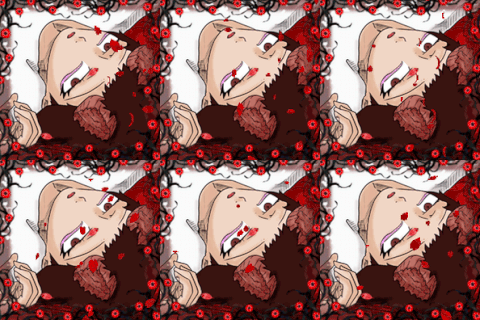
No, more than just managing. It would be easy, amidst the density of the book’s thematics, for From Hell to lapse into being a sterile intellectual exercise. Indeed, some of Moore’s critics, not least Grant Morrison, largely suggest this is his primary failure mode. But even amidst the mad bustle of “Love is enough” Moore repeatedly finds time for the human scale. Stride may not get much page time prior to her murder, but the scene of her being thrown out of her lodging after a fight with her boyfriend is quietly devastating, made all the more so by Campbell’s decision to have her clothes, thrown out the window after she’s been evicted, land on the sidewalk in the same arrangement that her corpse will be found in twenty-six pages later. Similarly Abberline’s flirtation with “Emma,” who the reader is led to conclude is Marie Kelley (though her face is never shown in the scenes with Abberline) paints both with a kind of innocent despair, made all the more heartbreaking when his wife, also named Emma, remarks on how sweet it is that he’s been murmuring her name in his sleep. Even the murders are studded with stark details like the beat where Gull “bares his teeth, and he is paleolithic, even pre-human. No civilization remains,”[1] a point emphasized by his reduction to guttural grunts of “nnugh” and “mrrooargh” as he dismembers Eddowes.
Of the many elements in From Hell that resonate with Moore’s descent into wizardry (or, if one prefers, ascent into madness), one of the most straightforward are the series of increasingly intense visions that accompany Gull’s murders. These began with his seeing light spilling out of the disemboweled body of Polly Nichols, then with the unexpected vision of a 1960s living room on the way to his murder of Anne Chapman. Chapter eight, containing two murders, unsurprisingly escalates the matter considerably. The murder of Liz Stride, which is interrupted with the inaccurate news that Marie Kelley has just been released from jail in Bishopgate, only has the opportunity for a small hiccup—Gull, dazed, remarks that “I remember now… this is the one that I didn’t finish isn’t it?” before confusedly asking “has this… has this happened before?” Once Gull is hied off to Mitre Square to intercept Catherine Eddowes, however, Moore is able to up the stakes considerably, with the climactic moment of the murder seeing Gull standing, arms raised in triumph and dripping with blood, beneath a skyscraper from the modern-day Mitre Square—an image depicted in the comic’s first splash page since his earlier vision of Jahbulon.
[1] Script quoted in From Hell Companion