"The Serpent is in Ouidah a superior and excellent Divinity. He looks after and into everything, everybody appeals to him for advice, for rain, for good weather or in case of sickness or war, for trade, for harvest, for weddings."
Reverend Father Labat, 1730.
Serpents may have a negative reputation in Abrahamic religions as the symbol of evil, but in many societies across the world, the serpent is a powerful symbol associated with spiritual forces. Serpents are prominent in the mythology of ancient Egypt, India, and China where they were/are considered divine beings and guardians of temples.
Across Africa, the serpent has always held great significance for multiple cultures and societies, especially in West Africa; where serpent deities are associated with wealth, fertility, and political power. From the ancient empire of Ghana to the early-modern kingdom of Dahomey, snake deities occupied an important position in the belief systems of the region, with dedicated temples, an active clergy, and complex religious practices.
These serpent deities were later transplanted to the Americas, especially in Haiti, Brazil, and North America, where they are considered an integral part of the traditional African religions that constitute spaces of agency within a mostly non-African society. It's within such spaces that Africans could be perceived as agents in shaping the history of the New World.
The persistence of these African religious traditions within a predominatly European cultural environment reveals the salient but often overlooked spread of African social institutions beyond the continent and highlights the contributions of Africans to the diverse religious landscape of the Americas.
This article explores the history of the serpent deities of the African Atlantic, tracing their evolution across the West African Middle Ages, the emergence of the gods Dan and Dangbe; and their spread to the Americas.

Temple of Dangbe at ouidah, Benin. early 20th century.

Festival of Dangbe at Ouidah, Benin. 19th-century engraving by Giovanni Antonio.

11th-17th century, statue of a Serpent devouring human figure, Inland Niger Delta region of Mali, New Orleans Museum of Art.
Slaying the Dragon: The Snake deities of the West African Middle Ages.
The foundation epic of the medieval empire of Ghana as recalled in the traditions of the Soninke-speakers of West Africa centers around a mythical creature known as Biida with whom the Soninke ruler Kaya Maghan struck a pact. Biida was a sacred snake and protector of the pre-Islamic soninke of Kumbi, the capital of Kaya Maghan's kingdom of Wagadu (Ghana). Biida was associated with water and gold, the former of which was an especially scarce resource in the semi-arid Sahel and the latter being a source of Ghana's wealth.
(Camel Tracks: Critical Perspectives on Sahelian Literatures pg 19)

Present day distribution of the Soninke (shaded), Bambara, and Dogon populations.
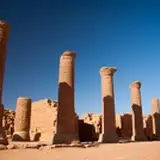
 10-12th century ruins at Kumbi Saleh, Mauritania. showing an elite house and the great mosque
Similar snake cults* are also found among the Dogon of central Mali, where a deity known as Lebe Serou was responsible for the integrity of the cultivated land, but the snake was later cursed and sacrificed to return to the sky-God Amma. The Dogon also believes that the world is a flat circle surrounded by water and is held together by a snake biting its tail.
[the term *cult as its used in this essay refers to its non-pejorative definition as originally employed by scholars of religion to signify a system of activities centering on an object of worship]
Among the Bambara, the importance of the snake is traced back to one of the group's ancestral figures; Musso Koroni Kunje. The latter was married to Ngorongo, a spitting cobra, to give birth to Ciwara, a creature who gave them the gift of farming by fertilizing the soil with his venom and tilling the soil with the claws of his feet. Another similar creature is that of Faro, a "mermaid" who is linked to the myth of Biida, and reportedly also received a sacrifice of a beautiful girl in exchange for rain, good harvest, and prosperity. Like Biida, Faro was also associated with gold.
(Camel Tracks: Critical Perspectives on Sahelian Literatures pg 20)
The cult of Biida of Wagadu included an annual ceremony in which a virgin was reportedly sacrificed to Biida, so the latter could trace beds of waterways and in so doing, give life. According to the traditions of the Wagadu polity and Biida, the fall of the kingdom occurred when a man named Mamadi Sefe Dekote slayed the serpent because he was in love with Sia Jatta Bari , a beautiful girl who was chosen that year for sacrifice. Mamadi Sefe Dekote went to a blacksmith who made him a sword and he cut off Biida's heads, as they fell to the earth, Biida cursed the Soninke and there was no rain for seven years, seven months, and seven days. Kumbi was destroyed and the Soninke were forced from their land.
(Myths of West Africa pg 10, Camel Tracks: Critical Perspectives on Sahelian Literatures pg 18)
The historian Nehemiah Levtzion notes that there are different versions of the Wagadu-Biida epic described above, some transcribed from griots as early as 1895, and some contained in 19th-20th century Arabic manuscripts of West Africa written by Soninke scholars.
One version for example claims that the pact maker with Biida was named Dyabe Sisse rather than Kaya Magha, but leaves the slayer of Biida and the virgin he saved unamed. Khaya Magha of Wagadu at Kumbi appears in the 17th century Timbuktu chronicles (Tarikh al-Fattash and Tarikh al-Sudan), as a Soninke name meaning "king of gold". The former chronicle claims his dynasty ended in the 8th century, while the latter places it just before the rise of medieval Mali in the 13th century.
(Ancient Ghana and Mali pg 17, 222, 18-19)
External accounts that are contemporary with the era of medieval Ghana provide some fragmentary accounts of the snake cult of Biida. For example, the account of Al-Bakri in 1068 CE provides the following description of the kingdom of Zafun, which appears in later Arabic accounts (and as Diafunu in the Tarikh al-Fattash) as part of the confederation of states that made up the empire of Ghana/Wagadu:
From TRNQH the country inhabited by Sudan extends to the region of the Zafqu [Zafun]. They are a nation of Sudan who worship a certain snake, a monstrous serpent with a mane and a tail and a head shaped like that of the Bactrian camel. It lives in a cave in the desert. At the mouth of the cave stand a trellis and stones and the habitation of the adepts of the cult of that snake. They hang up precious garments and costly objects on the trellis and place plates of food and cups of milk and intoxicating drink there. When they want the serpent to come out to the trellis they pronounce certain formulas and whistle in a particular way and the snake emerges. When one of their rulers dies they assemble all those whom they regard as worthy of king- ship, bring them to the cave, and pronounce known formulas. Then the snake approaches them and smells one man after another until it prods one with its nose. As soon as it has done this it turns away towards the cave. The one prodded follows as fast as he can and pulls from its tail or its mane as many hairs as he is able. His kingship will last as many years as he has hairs, one hair per year. This, they assert, is an infallible prediction....
This account describes atleast one attribute of the snake cult; its association with royal power and the election of a new ruler, but also indicates that the cult was the most important among the belief systems of the kingdom of Zafun.
Al-Bakri doesn't mention the snake cult in Ghana itself during his description of the capital but notes the presence of "sorcerers" in charge of a royal cult who venerated the deceased kings of Ghana. Al-Zuhri, writing around 1076-1077CE, notes that the people of Zafun, whose capital was Ghana, adopted Islam around the same time as Ghana, ie: around 1076 CE, explaining the absence of the snake cult in later Arabic accounts.
(Medieval West Africa: views from Arab scholars and Merchants pg 14-17, 25-26)
Most historians interpreted the epic of Wagadu and Biida as the account of Ghana's history as told from the perspective of the non-Muslim section of its society. Mamadi is a Muslim name, and the figure is commonly thought to represent the ascendancy of Islam at the court of Wagadu. This tradition also offers an explanation for the dispersion of the Soninke across West Africa during the early Middle Ages --both Muslim and non Muslim. Some of them eventually moved in the southeastern direction to the Hausalands, where they were known as the Wangara.

Dispersion of the Wangara to the Hausalands (red arrows)
For example, a snake cult also appears in the 19th-century Kano chronicle, which was itself a transcription of older sources on the history of the Hausalands purportedly dating back to the 10th century.
The pre-Islamic belief systems of the Hausa, which are explored in greater detail in this article, included the cult of Chibiri/Tsibiri around the 13th-14th century, whose chief priest held a red snake. The snake cult first appears during the reign of Gugua; the Sarki (King) of Kano from 1247-1290:
"That night an apparition appeared to the Sarki in his sleep a man with a red snake in his hand. He struck the Sarki with the snake and said to him, " Of two things choose one. Either thou mayest know the mysteries, in which case thou wilt die, or thou mayest not know the mysteries, in which case thou wilt not die." The Sarki said, " No ! No ! No ! "
Now when the Sarki rose from his sleep he told his men what he had seen in the vision. They said to him, "What do you see in it ? " He said, " What do you see ?" They said, "We see war ? " The Sarki said nothing, he spoke not a word, but suddenly he was struck blind. He remained blind for many years. He ruled Kano forty-four years. Twenty-two years he saw, and twenty-two he was blind".
It later reappeared in the reign of Sarki Tsamia (1307-1343), now fully constituted as the cult of Chibiri, followed by a powerful section of the city-state that was opposed to the predominantly Muslim section of which the royals belonged:
"When the morning broke Sarkin Kano came forth from his house, and went to the place of the god. In front of him were seventy men, each with a shield made of elephant's hide. When the Sarki came near to the
place of the god he prevented the pagans entering. As the fight waxed hot, the Sarki cried, " Where is Bajeri ? " Bajeri heard the words of the Sarki, and took a spear and rushed into the battle, cutting his way until he readied the wall of the sacred place.
He entered, and seeing a man with his back against the tree holding a red snake, attacked him. The man leapt up and made a great shout ; fire breathed from his mouth until smoke filled the whole place round about; he rushed out; and, in his attempt to flee, made for the water-gate, followed by the Sarki, and plunged into the water. The Sarki and his followers stayed hunting for the man in the water, but he escaped and went to Dankwoi, where they left him. Hence it is that if any warrior drinks the water of Dankwoi he does not prevail in battle.
The Sarki returned to the tree, and destroyed the wall together with all else connected with "Tchibiri " which was beneath the tree. All the pagans had in the meantime fled, except Makare Dan Samagi and Dunguzu Dan Dorini. The Sarki said to them, " Why do you not run away ? " They said, " Where were we to run to ? " " Praise be to God," said the Sarki. " Tell me the secret of your god." They told him. When he had heard, the Sarki said to Danguzu, " I make you Sarkin Tchibiri." He said to Makare, " I make you Sarkin Gazarzawa." He said to Gamazo, "I make you Sarkin Kurmi."
(The Kano Chronicle pg 68-70)
In his analysis of the red snake cult, the historian Murray last combines the Kano chronicle with a pre-Islamic Hausa tradition known as the Mazauda cycle, in which a red snake worshiped by the traditionalists is slain by the legendary Hausa ancestral figure Bagauda alongside many of Mazauda's pagan allies. Only a few of the latter are retained by Bagauda as the Sarkin Tchibiri, Gzarzawa, and Kurmi, representing the three main pre-Islamic cult sites that were converted into important centers in the now predominantly Muslim city.

(left) Heinrich Bath's map of Kano showing the location of the Dalla hill and Jakara Pond, at the center of Kano's inhabited quarters. (right) Kano in the early 20th century, showing the remains of the jakara pond.
Last suggests that the red snake cult was a new kind of magic:
"Tsibiri ("island") would indeed be a suitable term for magic power in the black pool of the Jakara, a power which renders the waters of Dankwoi unfit for warriors to drink; and the association of snakes with water (Gajimare; rainbows) and with wells (e.g. at Daura) fits well. Indeed Dankwoi, where the Red Snake priest fled after being driven from Kano, is on the road to Daura. But though the snake is associated with water, it is also found once in a tree, where it is also assimilated to Barbushe's magic.
But I suspect that tsibiri is really a later emendation of a derivative from the Arabic Tibb tsibbu, or even from sihr (compare the Arabic-derived tsafi, Mande safi, and Tiv tsav). The new magic is similar to Muslim power in having the ability to blind people. Snake cults are of course widespread in west Africa but one such, celebrated in Mande stories and therefore perhaps known in Kano, is the (albeit black) Bida serpent of the Soninke state of Wagadu. Given that the Bida snake is a standard 'totem' of Maguzawa, it is possible that the new Red snake magic was a Wangara import".
(Historical metaphors in the Kano chronicle pg 168-169)
Whether the snake cults of the west African Middle Ages had a single origin or multiple origins remains difficult to determine from the available evidence, but the above outline indicates that the belief systems of several societies in the region included a snake deity whose worship was integral to their social and political structure. It's likely in this context that the snake cults of the African Atlantic emerged long before they were first documented by European visitors in the 17th century, beginning at Ouidah.
Dangbe: the national deity of Ouidah.
"Few African Gods have attracted the attention of travelers as has Dangbe, the Good Serpent" writes Pierre Verger (1957) in the introduction to the chapter he devotes to the Python deity of what is today the Benin republic.

ethnicities of the Bight of Benin region
Dangbe was originally associated with agricultural fertility and was incarnated in actual snakes that were maintained in his temples and shrines. Dangbe remains today one of the most important vodun (deities) of Ouidah, the port town of the 17th-century kingdom of Hueda, and its successor kingdom of Dahomey. His principal shrine is located in the centre of the town, and local tradition asserts that the cult was instituted in Ouidah from its beginnings by the kingdom's founder-hero Kpase.
(Ouidah: the social history pg 23)
The worship of Dange is one of the best documented religious practices of the Atlantic coast, with multiple European accounts describing the cult from the 17th to 19th centuries.
The account of Guillaume Bosman (1705) attributed to the Serpent the rank of "divinity". He describes the "House of the Serpent" (ie: the Temple at Ouidah), the offerings that are brought to him; the pilgrimages that the Kings of Ouidah made there every year and the punishments meted out to Europeans or Africans who failed to pay him due respect.
The Reverend Father Labat (1730) relates how this "great Serpent" came out of the ranks of the army of Allada to enter those of the army of Hueda. He describes the Serpent as being one and a half arms in length, or seven and a half feet long, with a very beautiful skin "marked by wavy stripes in which yellow, blue and brown combine in a most agreeable way." The animal, quite innocuous as are all pythons is "extremely patient and never attacks people." He concludes: "The Serpent is in Ouidah a superior and excellent Divinity. He looks after and into everything, everybody appeals to him for advice, for rain, for good weather or in case of sickness or war, for trade, for harvest, for weddings."
Snelgrave relates that in 1727, at the time of the siege of Savi, the capital of Hueda by the armies of Dahomey, the worshipers of Dangbé laid the sacred pythons on the banks of the stream that constituted a rampart, believing that Dahomey's armies would never venture to pass over their bodies. But the serpents of peace were slaughtered and Savi was sacked together with the Temple of the Dangbe.
(The black serpent who opened the Eyes of Man pg 61-62)

Royal procession to the temple of Dangbe during the coronation of the king of Hueda (Astley 1746, facing page 42, courtesy of Neil Norman). Image and caption by J. C. Monroe

Crowning of the King of Whydah, April 1723, engraving by Jacob van der Schley/Jacob van Schley (1715-1779). Print from the book by "Des Marchais".
Dangbe was one of four principal deities (vodun) in the pantheon of Hueda before the kingdom's conquest by Dahomey, alongside; Hu --the sea god; Hwesi --the god of smallpox; and Zo --the god of fire. Dahomey's rulers would continue to promote their cults alongside their own deities such as the serpent deity 'Dan', who will be explored in the section below.
According to accounts from the 1690s, the first rank among the gods of Hueda was held by Dangbe, to whom the sea-god Hu was considered a ‘younger brother’. The principal shrine of Dangbe was at the time in Savi rather than Ouidah where it was relocated only after the destruction of Savi by Dahomey in 1727.
(Ouidah: a social history pg 89-90, 23-24)
At Ouidah, Dangbe was the most popular vodun, although he was only the second highest-ranking deity after the sea god Hu. Burton in the 1860s estimated that he had 1,000 initiated followers, or ‘wives’ (a term applied to male as well as female devotees), whereas the formally senior sea-god Hu had only 500. The religious practices associated with his worship are described by virtually every European visitor to Ouidah.
(Ouidah: a social history pg 92-93)

(left) 19th-century engraving of the snake temple at Ouidah. (right) Costumes of the religious elite of Ouidah, Benin, and an idol of black clay with a crown of lizards, snakes, and feathers seated on a pedestal. engraving by Antonio Sasso from Giulio Ferrarios Ancient and Modern Costumes of all the Peoples of the World, Florence, Italy, 1843.
According to multiple ethnographic descriptions of the cult of Dangbe recorded in the late 19th and early 20th centuries, the deity is credited with 'opening the eyes of the first man and woman, thus allowing them to see'. Despite some of Dangbe's attributes sharing a close resemblance with the serpent of the Genesis story, these descriptions, as well as the account of the Dangbenon (Master of Dangbe) collected in 1937, insist that their tradition predated the arrival of Christianity, and emphasize this particular attribute in multiple chants to Dangbe.
"It was Dangbe who opened the eyes of men
So that they might see the universe and enter it.
Dangbe has become a derisory plaything for mankind.
It is Dangbe of the Houedas who opened their eyes."
(The black serpent who opened the Eyes of Man pg 64-72)
Dangbe is believed to have created light and lighted the universe out of its primordial darkness. According to another tradition at Ouidah, human beings were neither men nor women and were blind before Dangbe created order out of the primordial chaos. His brilliance is comparable to that of the sun, and can thus make his Dangbenons frequently become blind. A popular saying was: "The Dangbenon who sees his god, loses his sight."
(The black serpent who opened the Eyes of Man pg 74-75)
Dangbe the deity is also associated with the Rainbow. The excrements of the small python called Dangbe (ie: python regius) --which is only considered the earthly image of the deity himself-- are thought to have magical properties that turn metals into gold and are believed to be the excrements of the Rainbow. Importantly, the Rainbow serpent deity of Dahomey; Dan-Aidohouedo (Dan Ada Weido) has Dangbe as its emissary.
The same is true in the Yoruba country to the east of Dahomey, where Òsùmàrè is referred to as the “Rainbow Serpent” or “Serpent in the Sky.” which devours its own tail. He is linked to Olódùmarè, the supreme creator in Yoruba belief systems, and is said to deliver the “covenant between Olódùmarè and the people of Earth.” The python also represents the ability of human beings to “become transformed and experience rebirth” or attain immortality. Similarly in the Ewe country to the west of Dahomey, the 'boa constrictor' Wo is the serpent of the Rainbow Anyéwo.
(The black serpent who opened the Eyes of Man pg 75-76, Our Mothers, Our Powers, Our Texts, pg 43-44)
The Knowledge of Dangbe is also understood through his oracles. The Abbe Bouche describes the oracle scene that he witnessed in the Temple of the Serpents in Ouidah on November 21, 1864:
A merchant had come to consult Dangbe about the success of a trip he was about to undertake. An old priestess took a small python, put it on a native stool and started to interrogate it, while young priestesses played their tom-toms and the Dangbenon performed a slow stately dance. The serpent, coiled in spirals, then stood upright on its tail or twined itself around the priestess’s arms. "He is too young"; she said, "and his science is not great. He cannot answer my questions and advises us to have recourse to the wisdom of the Serpent that has come from Ardres (Ardra)." She let him slide among the rafters of the hut and soon after the Abbe heard a groaning and in the midst of a strange and confused noise, the following words pronounced in the Djidje (Dahoman) language: "Go! I will be with you and your trade will prosper."
(The black serpent who opened the eyes pg 79-80)
Annual processions for Dangbe were held in the Hueda kingdom, at the capital Savi, prior to the Dahomian conquest, and these were evidently now transposed to Ouidah, although perhaps in an attenuated form. European observers under Dahomian rule noted the performance of an annual procession by Dangbe devotees to collect water from the lagoon to the south, referring evidently to the gozin ceremony in January.

'Festa in onore del dio serpente' (Festival in honor of the God Snake), Ouidah. 19th-century engraving by Giovanni Antonio
Tradition in Ouidah recalls that there were also formerly two other public ceremonies for Dangbe such as the adi mime (‘ordeal by burning’) ; and another when the senior sacred python Ahwanba was carried around the town in a hammock, during which members of the general public had to remain indoors and Dangbe’s devotees could seize any animals found in the streets.
These ceremonies are also attested in accounts of the pre-colonial period eg in the account of Duncan, in May 1845, where persons accused of killing sacred snakes were required to run the gauntlet from a burning hut to ‘the nearest running water’; and he was also told that this would be followed 13 days later by a day during which all dogs, pigs and fowl found in the streets were killed and eaten, alluding evidently to the ceremonial parading of Ahwanba; and Forbes in May 1850 reported a ceremony performed overnight, when Europeans were told that they and their servants should not go out or even look out of the window, again clearly Ahwanba’s annual outing, which in the 1860s become a tri-annual event.
(Ouidah: a social history pg 94)

Frédéric Gadmer, Ouidah, May 2, 1930 – The Temple of the Serpent.
Cf. p. 265: “ Ouidah was especially dedicated to the serpent god, the Dangbé, the sacred python. The Houédas had massively adopted the Dangbé and each year sacrificed oxen, goats and chickens to the sacred pythons. When they came across a snake in the street, it was appropriate to kneel down, strike your forehead in the dust and immerse yourself in prayer so that it would grant its blessing to the whole family. ” © Albert Kahn Museum

"Dahomey. - Don. - A fetish seminary." A seminary with two-tone walls and a thatched roof. Benin, ca. 1908-1912, Quai Branly. the photo may be from Ouidah, possibly depicting the snake temple or the surrounding structure where the priestesses were housed.
As explained above, the cult of Dangbe continued to flourish after Dahomey's conquest of Ouidah, and the highly syncretistic religious system of Ouidah under Dahomey's control reflected the policy of the kingdom. Tradition recalls that Dahomey's kings pursued a systematic policy when conquests were made, of ‘purchasing’ the local religious cults, among specific instances cited being those of Dangbe, purchased by Agaja after his conquest of Hueda. Although this policy is explained as a means of securing the support of the vodun appropriately, it also served to secure the allegiance of their human followers.
This aspect of the matter was explicitly perceived by contemporary European observers, one of whom in the 1770s attributed Dahomey’s success in reconciling and assimilating conquered peoples to Agaja’s policy of ‘tolerating his new subjects with the free exercise of their various superstitions’, referring specifically to the cult of Dangbe at Ouidah: ‘The remnant of the Whydahs who had escaped the edge of [Agaja’s] sword were abundantly thankful to him, for permitting them to continue in the enjoyment of their snake-worship.’
In the 1770s it was noted that the king provided clothing for two leading vodunnon (priests) in Ouidah (presumably those of Hu and Dangbe), and allowed them the sum of 80 limes (i.e. 32,000 cowries) for each European ship that traded there. The temple of Dangbe [whose orthogonal layout may have been influenced by Dahomey's architecture] was visited annually after the ‘Annual Customs’ at Abomey, by the Yovogan, who gave a bullock and other animals to the priest, who in return offered prayers ‘for the King, the country, and the crops’.
The priests of the snake deity of Ouidah by the late 18th century reportedly received 20,000 cowries (about £2.5 sterling, about £573 today) every six months and had been given four female slaves to work their fields. At annual ceremonies for the vodun, the monarchy would provide a sacrificial cow, brandy, and 20,000 cowries
(Ouidah: A Social History pg 97-98, Wives of the Leopard pg 331)

A Snake Shrine at Ouidah, Dahomey, West Coast of Africa. engraving by Robinson, Charles (1840-81)
It's in this context that Dangbe likely acquired its present name. According to a monograph on the deity by the historians Christian Merlo and Pierre Vidaud; the deity was originally named 'Daboué' in early 18th century accounts before he was transformed to Dagbe, Dagoue, or Dangbe, a dialectal form of Fon, the language of the Dahomian conquerors after the collapse of the Kingdom of Houeda in 1741. They argue that Dangbe is either the nasal pronunciation of Fon, or a word invented by the Fon people, because of its similarity with the word dan which means "serpent" In Ouidah and Porto-Novo, the initiates call Dangbe 'Dan', an esoteric name meaning "the" Serpent.
(The black serpent who opened the Eyes of Man pg 63)
This is especially relevant considering that Dahomey's serpent deity is also known as Dan who shares many attributes to Dangbe, and the latter is often confused with the former, save for the fact that Dan isn't physically manifested in real snakes, unlike Dangbe.
The Art Historian Henry John Drewal cautions:
"It is critical to note that Dan [Aida Wedo] is in no way related to Dangbe, the founding Vodun of the city of Ouidah. Although there continues to be confusion between and conflation of these two separate serpent spirits, the Dangbe head priest in Ouidah and Dan priests and priestesses throughout the region went to great pains to make sure I did not mix up their two entirely separate serpent cults."
(Sacred Waters: Arts for Mami Wata pg 476)
Dan: the rainbow-serpent deity of Dahomey.

Map of the kingdom of Dahomey
According to a monograph on Dahomey's religious systems by the anthropologist Melville Herskovits:
"Dan/Danh/Da represents the principle of mobility, of sinuosity. All things which curve, and move, but have no feet, are Da. What makes my hand move, my head move? It’s the Da. in me.” Da distinguishes the dynamic from the static. It is movement and life itself.
In the beginning, Mawu was carried in the mouth of Aido Hwedo, the serpent, who existed before the earth did. Wherever the two stayed for the night, mountains appeared from the excrement of Aido Hwedo, and as they traveled, the body of the snake outlined the rise and fall of the land. There are two of these Aido Hwedo. The female lives in the sky, and on her tail are carried the thunderbolts hurled to the earth. Some say she is the lightning as well as the rainbow.
The male lies coiled under the earth, bearing the burden of its overladen surface. When it moves to relieve its position, the earth trembles and quakes. The red monkeys who live in the sea are always at work forging iron bars with which to feed it. When the iron is exhausted, the serpent will begin to devour its own tail; then the earth will fall into the sea, and the world will come to an end.
That life may begin in the womb of a woman, the serpent which is to become the Da. of the individual brings from the sky what the Djoto and Se-Medo have fashioned. When a child is born this Da. comes with it. It is represented by the Xonda, the umbilical cord, which when cut off is buried under a tree—a palm-tree is the rule—that becomes the property of the child. The Dahomeans say, “When an animal is born there is an umbilical cord. When we pull up a plant from the ground, there are the roots. If we cut away the roots, the plant dies. The roots are life. They have the quality of Da, for they are flexible, and living, and have no feet, and are moist.”
Thus the seat of Da. is thought to be the abdomen, just as that of the Se, the soul, is the head. When a sacrifice of palm-oil, or blood, or rum is given to an image which represents a Vod, the navel is sprayed as well as the head.
Only a man of property, one who has control of the wealth and wellbeing of a household may “establish,” that is, enshrine, his Da Such a shrine is not erected where the man’s umbilical cord was buried, but in or before his compound, close to the shrine of Legba and the other protecting spirits. Two pots, both covered, one for the male and one for the female Da, constitute the shrine. This “establishing” of a man’s Da. insures prosperity to the household over which he has control, for Da is the giver of riches. Not only every individual has his Da, but every Vodu as well. Each pantheon near its temples has a shrine to Da, and in each cult-group there is one member who represents Da, as each cult-group has one member who represents Legba, for, just as Legba figures in each pantheon, so is part of both individual and cult-worship."
(An outline of Dahomey's religious belief pg 56-57)
There are two Aido Hwedo, one of whom dwells in the sea, and the other in the sky. It is the latter who transports the thunderbolts of the gods to earth, and is the rainbow-serpent. The meaning of the name Aido Hwedo is, ‘‘You were created before the earth and before the sky,” and the two are regarded by some as twins. It is because of the dual character of this serpent vodun that the pottery-jars which are the shrines to Da are always in pairs.
Da does not enjoy the affection of the Dahomeans like other deities; he is less esteemed than feared. ‘‘He is a thief,” they say, “a fickle one; what he gives to one man, or kingdom, he takes away from another.”
The strong Da go out into the world and dominate other Da who, because they have not been properly served, are too weak to resist. The man who has not been remiss becomes more powerful, attains more prestige, and adds to his wealth, while misfortune and poverty are the lot of the other. The neglected Da is resentful of his treatment at the hands of his original possessor, and even more resentful about his captivity. And, just as the weak, bitter person is often a more dangerous adversary than the strong one, so the weak Da is dangerous.
Consequently, when a man establishes his Da within his compound he goes to a place in the bush designated by the dqne,—the chiefpriest of Da—and establishes as his danglatd the embittered Da made captive by his own Da. Thus the angry spirit is watched that he does no harm to the one who has profited from his weakness. But because no man is so powerful that his Da may not at some time be assaulted and overcome by the Da of another who had been better served, once the Da is established he must be served with unflagging and anxious care.
(Dahomey: an ancient West African kingdom pg 249-252)
"Da, then, is a vodu who incarnates the quality of dynamics in life—it is movement, flexibility, sinousness, fortune. It manifests itself as serpent, as rainbow, as umbilicus, as plant roots, as the nerves of animal forms, as the gaseous emanations that issue from mountains."

(left) Bas-relief from the palace of Guezo. Abomey, Republic of Benin. Symbol of the kingdom of Danhome, a serpent biting its tail. The kingdom’s name means “in the middle of [home, xome] the serpent [dan].” image and caption by Suzanne Preston Blier. ca. 1986.
(right) King Guezo was compared to Dan Ayido Houedo, a serpent biting its own tail. In this bas-relief, the serpent has horns, a sign that it is in fact the symbol of the male god Dan. It is painted in Dan's emblematic colors. Photograph taken in the zinkpoho, formerly known as the Hall of Thrones. image by Susan Middleton, 1994.

(left) Polychrome wooden cup supported by a horned serpent, which would be the mythical male serpent Dan Aydo Hwedo, a recurring image in the art of Dahomèy. ca. 1885, Benin, Quai Branly.
(right) "Savé, Dahomey. [Priestess of Dan, the rainbow serpent of the Mahis] called Oshoumaré among the Yorubas." ca. 1950, Benin, Quai Branly.
Herskovits adds that the largest Da temple in Dahomey was at Ouidah, established by Agadja, but the Da who surpasses all in power is the Dambada Hwedo, who represents the ancient unknown ancestors. The temple of Dan differs in no essential way from any other religious complex of buildings at Ouidah, consisting as it does of a cult-house, shrines to Legba and to the aiza, with a rectangular building open on one side in which the sacred objects themselves are lodged.
(An outline of Dahomey's religious belief pg 58, Dahomey: an ancient West African kingdom pg 254)
The historian Robin Law asserts that Dan is acknowledged to be in origin from the kingdom of Mahi, north of Dahomey --- a curious detail since the northern regions of the modern republic of Benin were linked to the Songhai province of Dendi and the Hausalands.
Law adds that one form of Dan, the rainbow-serpent Aidohuedo, famous for his prominence in Afro-American religion in Haiti, is also present in Ouidah.
(Ouida: a social history pg 91)

Reliefs on an old Temple in Abomey, Benin, ca. 1940, Quai branly.

serpent temple at Abomey, Benin. ca 1945-1979. Quai Branly. it could be dedicated to either Dan or Dangbe
In external accounts, the deity's presence along the coast is first noted in the account of Burton during the 1860s who distinguished it from the native serpent god Dangbe, especially noting his particular form as the rainbow, Aidohuedo:
“Aydo-whe-do,—commonly called Danh, the Heavenly Snake, which makes the Popo beads and confers wealth upon man—is the rainbow. Its emblem is, I have said, a coiled and horned snake of clay, in a pot or calabash. This utensil, duly whitewashed, is placed at the foot of a silk-cotton tree, or near hills of white ants, which are called Danh’s houses.’”
(Dahomey: an Ancient West African kingdom pg 247)

(left) Wall Hanging depicting the rainbow serpent, Dan-Aydohouêdo at the top, personifying King Ghézo (1818-1858); ca. 1910, Benin, Quai Branly.
(right) Wall hanging decorated with cut-out and applied motifs, depicting Da, the Rainbow Serpent, deity of prosperity and wealth, as an anthropomorphic figure holding a serpent in each hand. ca. 1936, Benin, Quai Branly.
The spread of the religion of Dan and Dangbe to the Americas: Haiti, New Orleans, and Brazil.
The vodun belief systems of the Gbe-speaking regions were gradually transplanted into the Americas during the later periods of the Atlantic slave trade.
According to Herskovits; In Haiti, the rainbow serpent is known as Da Aido Wedo and sometimes known as Damballa Wedo, whose importance as a Haitian deity is mentioned in all works which treat of Haitian religion. The serpent deity Dangbe from Ouida, is also often found in the literature on Haiti alongside these principal deities.
Damballa, whose symbol is the serpent, is said to bring rain because they sing “Damballa nan l’eau—Damballa in the water.” The sacred color of this deity, worn by devotees under possession, is white, and the full initiates wear white necklaces as well as white clothing. This god, identified with St. Patrick, is especially worshipped on Thursdays, and shares the white fig tree with Erzilie and Gran’ Siligbo.
Damballa “eats” sacrifices of white chickens and pigeons, rice, milk, eggs, pineapples, and fig-bananas; and “drinks” kola and sweetened coffee. Damballa forms the rainbow, and this is called an are d'alliance between him and Aida Wedo, his wife, whose characteristic dress is blue and white.
(Life in a Haitian Valley pg 29-30, 319-320)

Vodou Flag or Banner of Damballah by Silva Joseph, ca. 1980s, Haiti. Birmingham museum of art
Its from Haiti that the cult of Damballa and Aida Wediop spread across North America, especially along the eastern coast in cities like New Orleans. According to an account of a New Orleanian Vodun ceremony that occurred in 1825; the ritual space featured a 4ft tall cypress sapling that resembled a poteau milan, which is the central post of a Haitian Vodun temple. The ceremony was conducted under the guidance of a priestess Sanite Dede, who was assisted by an elderly herbalist named Zozo, both of whom were free people of colour. It was a feast for a snake deity in which adherents, who included both black and white residents of the city, wore a white handkerchief associated with Damballa, the Haitian rainbow-serpent deity.
The worship of Damballa and Aida Weido would continue across Haiti and North America despite active persecution as both regions are today majority Christian.
(The Mysterious Voodoo Queen, Marie Laveaux pg 135-136)
<<<< the history of both Haitian Vodoo and Louisiana Vodooo is very well documented and will hopefully be explored in much greater detail in a future essay >>>>
In Brazil, the Vodun religious tradition of the Gbe-speakers is usually labelled under the rubric of Jeje or Jeje nation (nação Jeje),a term likely derived from Adjaché (Porto-Novo), the port of Allada, the 17th century kingdom which was later conquered by Dahomey. Today in Brazil, the cult houses of Candomblé, Xangô, Batuque, Macumba or Tambor deMina that identify themselves as belonging to the Jeje ‘nation’ are widespread in several states.
The regions of Bahia and Maranhão are the home to the oldest cult houses of the Jeje ‘nation’, dating from the mid-19th century. In Bahia, the so-called Jeje Marrims or Mahis and the Jeje Savalu are predominant, while in Maranhão the Jeje are known as Mina-Jeje and this denomination is mainly associated with the Casa das Minas, a cult house with strong Fon influences.
The city of Cachoeira, about 55 km away from Salvador is home to a centre of Dan worship known as the terreiro Seja Hunde, which may have operated at least since the last decade of the 19th century. The spiritual master of this cult house is the vodun Bessen, a ‘quality’ of the snake vodun Dan, and its lead priestess at the turn of the century was Maria Luiza do Sacramento, known as Maria Ogorensi Mesime, Ogorensi being a title given to the devotee of Bessen.
(Rethinking the African diaspora pg 114-119)

Terreiro Roça do Ventura, a Jeje temple in Cachoeira, Bahia, Brazil founded in 1858. the image of the temple's entrance on the right includes a depiction of rainbow snake eating its own tail. images from WikimediaCommons
In twentieth-century Bahia, available statistical data indicate a progressive decline in the number of Jeje terreiros (cult houses). In 1937, the Jeje represented 13% of the 67 terreiros registered in the União das Seitas Afro-Brasileiras da Bahia. In 1998, in a survey on 500 terreiros, a quarter of the estimated total in Salvador, only 3% declared themselves to be Jeje. As Humbono Vicente – a Jeje religious expert – puts it: "In Bahia Jeje is something of the past. Today nobody knows how to respond to the songs."
(Rethinking the African diaspora pg 118)
<<<< The Jeje/Candomblé religion is also well documented and will hopefully be explored in much greater detail in a future article >>>>
Back on the African mainland, the worship of the snake deity Dangbe continues to feature prominently among the small but influential community of Ouidah, who celebrate a festival every 10th of January, and attempt to dispel the stigma surrounding the old religion in what is today a majority Christian country.
A recent article by Reuters quotes Modeste Zinsou, manager of Benin's Python Temple: "Stop saying that voodoo is about dolls. Voodoo is spirituality. Voodoo is you, it's me. It's the air we breathe. It's the four elements, as we say: water, air, fire, and earth,"
A tourist from the French Caribbean island of Martinique, Nathy Anika Nsemi, said that learning about the religion had helped her reconnect with the world and the faith of her ancestors: "Voodoo is communion with the world around us."
Conclusion:
This essay shows how religious beliefs, associations, and practices – both 'traditional African', and Abrahamic – bridged the Atlantic, linking the Bight of Benin to the Americas both during and after the end of slavery. When the economic ties between the two parts of the world weakened, the religious connections remained strong.
Hopefully, the recent interest in Africa's pre-Abrahamic belief systems among the scholars of religion will continue to highlight the contributions of Africa and Africans to the wider Atlantic story, moving beyond static constructions to a more varied, complex, and fluid portrait of the unfolding experiences of Africans and their descendants throughout the Atlantic world.
references:
Camel Tracks: Critical Perspectives on Sahelian Literatures edited by Debra Boyd-Buggs, Joyce Hope Scott
Myths of West Africa by Bridget Giles
Ancient Ghana and Mali by Nehemia Levtzion
Medieval West Africa: views from Arab scholars and Merchants by Nehemia Levtzion, Jay Spaulding
The Kano Chronicle, English trans. published in H. R. Palmer, Sudanese Memoirs
Ouidah: The Social History of a West African Slaving 'port', 1727-1892 By Robin Law
Our Mothers, Our Powers, Our Texts: Manifestations of Aje in Africana Literature By Teresa N. Washington
Wives of the Leopard: Gender, Politics, and Culture in the Kingdom of Dahomey By Edna G. Bay
Sacred Waters: Arts for Mami Wata and Other Divinities in Africa and the Diaspora by Henry John Drewal
An outline of Dahomean religious belief. by: Herskovits, Melville J.
Dahomey, an Ancient West African Kingdom, Volume 2 by Melville Jean Herskovits
Life in a Haitian Valley by Melville Jean Herskovits
The Mysterious Voodoo Queen, Marie Laveaux: A Study of Powerful Female Leadership in Nineteenth Century New Orleans by Ina J. Fandrich
Rethinking the African Diaspora: The Making of a Black Atlantic World in the Bight of Benin and Brazil by Edna G. Bay, Kristin Mann
The Serpent and the Rainbow By Wade Davis
Historical metaphors in the Kano chronicle by Murray Last
The black serpent who opened the eyes of Man by C Merlo
Palace sculptures of Abomey by Francesca Piqué
Landscape Politics: The Serpent Ditch and the Rainbow in West Africa by Neil L. Norman and Kenneth G. Kelly