Centuries before the Aksumite empire dominated the Red Sea region, the northern Horn of Africa was home to multiple complex societies which flourished in a region at the crossroads of many cultures linking North-East Africa to the Arabian Peninsula.
Scattered between the modern countries of Eritrea and Ethiopia are the ruins of many ancient settlements dating back to the 1st millennium BC, that contain stone temples and palaces, lithic and bronze tools, volumes of local pottery, and a handful of sculptural artworks with ancient inscriptions.
The history of these sites and the extent of foreign influence on their development have been the subject of considerable debate, as archeological excavations have shown that the pre-Aksumite sites were more extensive than had been previously understood.
This article explores the latest research on the pre-Aksumite civilization sites inorder to uncover the origin of social complexity in the northern Horn of Africa.


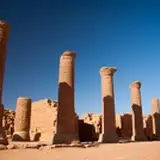
Ancient temple near Wuqro, Ethiopia, Stone sphinx from Addi gramaten, Eritrea.
A brief background to the history of the ancient northern Horn of Africa.
The first millennium BC in the highlands of modern Eritrea and Tigray witnessed the growth of social complexity and the emergence of agropastoral economies. On the highland landscapes, from the Aksum area of Tigray to the Asmara Plateau of Eritrea, hundreds of settlements have been found which range from dispersed homesteads and hamlets to nucleated villages and towns built of stone; their inhabitants herded domesticated cattle, goats and sheep, and cultivated cereals and other crops
In a few of these settlements, there were specialized ceremonial or ritual centers containing distinctive and elaborate monumental architecture, complex tombs, dedicatory inscriptions, and ceremonial objects. Archaeologists working in the northern Horn have long referred to these few communities as “Ethio-Sabaean”, however, the discovery of many contemporaneous sites without 'Sabean' elements such as the 'Ona culture' sites has led most to prefer the term Pre-Aksumite.
This essay outlines the key archaeological discoveries and historical analysis of the so-called 'Ethio-Sabean' sites, followed by their local and external influences such as the Ona sites, South Arabia, and Nubia; followed by the later periods of the pre-Aksumite sites when exogenous influences had declined.

Location of the pre-Aksumite sites, and neighboring societies in the Red Sea region and North-Eat Africa
Description of the pre-Aksumite sites.
The first among the pre-Aksumite settlements to be studied was Yeha, in Tigray, whose ancient temple had been converted to a church and had been known to archaeologists since the early 20th century. The site covered an estimated 7.5 ha. It contains the remains of a monumental temple measuring 18x15x13 m, a stone palace known as Grat Be'al Gebri, traces of a house called Grat Abune Afsea, and rock-cut tombs. Overlooking these is the town of Enda Gully which housed an estimated 3,000 people.
The Yeha temple and palace were constructed between the 8th to 6th centuries BC. They were both built on a podium with steps, had walls reinforced with timber beams, and featured high roofs supported by square pillars, and their fronts had six-pillar propylons. The temple itself was likely preceded by an earlier building whose material was reused, and it was dedicated to the deity Almaqah who is identified by an inscription found at Addi Akaweh and Wurqo.
(Yeha and Hawelti pg 147-155, Changing Settlement Patterns pg 69-72)


A reconstruction of the front facade of the Great Temple of Yeha with six pillars and a narrow wooden door

Yeha temple, interior.

Grat Be'al Gebri palace, Yeha with six pillar bases and parts of the stone door posts

Grat Be'al Gebri palace interior.
Second is the site of Hawlti, which measures around 4.5ha contains the remains of two temples built side by side, measuring 11x11 and 10x10m. Along the facade was a small step on which clay figures were placed, and the temple was surrounded by square pillars that belonged to an earlier building.
Figures found at Hawlti include two statues of sitting women with their hands on their knees, wearing a draped dress ornamented with big breast collars; a throne chair with bovine legs decorated with a frieze of ibexes as well as figures of a man and woman; a sphinx depicting a lion with a human head; and clay figures of sitting women, cattle, bovines, plow, and houses.
(Yeha and Hawelti pg 155-157, Remarks on pre-Aksumite pg 4-6)

Other sites include; the settlement at Malazo, which contains the remains of a small temple 8.9x6.7m divided into two rooms with one containing small altars, all surrounded by a boundary wall. Another small temple to the god Almaqah was found at the site of Mäqabər Gaʿəwa near Wuqro, along with its uniquely local libation altar, as well as cultic installations and religious furniture. It dates to the 8th-6th century BC and is architecturally similar to the temple at Yeha.
Remains of buildings have also been found at Enda Cerqos, Adi Berekti, Matara, Fiqya, Kaskase, Enzelal, Seglamen, and Addi Grameten. Other stone sculptures have also found, such as the small statue of a sitting woman at Addi Galamo, a rectangular offering table with sphinxes at Fiqya, the sphinx with a human head at Addi Grameten, a similar sphinx at Dibdib, and a stone bull from Mahabere Dyagove.
(Changing settlement patterns pg 79-81, Pre-Islamic South Arabia pg 143-149 Remarks on the pre-Aksumite pg 6)
Material culture found at the sites includes local pottery with multiple decorative patterns. With the exception of material from the Nubian Nile valley such as the Kushite vessels and cups at Yeha and the Meroitic amulets at Hawlti and Matara, most of this pottery was local in origin and attested at multiple sites. as well as bronze and iron objects including sickles, knives, blades and ornaments such as bronze seals featuring profiles of animals and south Arabian inscriptions.
(Remarks on the pre-Aksumite period pg 7, 14)

temple of Mäqabər Gaʿəwa near Wuqro

Statue of a seated woman found next to the central sanctuary, a Miniature shrine with a female figure and the moon symbol of Almaqah.

The altar with the initial part of the dedication text.
Chronology and History of the pre-Aksumite Sites : the enigmatic kingdom of D'MT.

The pre-Aksumite culture can be divided into three chronological phases, based on cross-dating with material culture from neighboring societies.
The first phase, dated to 1000-800BC, displays a diversity of pottery styles and few imports, but no monumental constructions. It consists of two large settlement clusters; an eastern region beyond the modern town of Adigrat, a western one between Adwa and Aksum, and a northern one around Asmara referred to as the Ona culture. All with different kinds of pottery but with some shared wares.
The inhabitants of these early settlements cultivated cereals and other crops, herded domestic animals, made pottery, and predominantly microlithic flaked stone tools, and may have had access to copper alloys for ornamentation. Indirect contacts with neighboring neolithic societies may have been established at this point, likely with the Gash group and Jebel Mokoram culture of eastern Sudan.
(The first millennium BC in the northern Horn pg 296, Remarks on the pre-Aksumite pg 16)

The second phase, dated to between the 8th century BC to 5/4th century BC is the main phase of the cultural sequence, when settlements developed into towns and most of the stone structures were constructed. The presence of towns, monumental architecture, long-distance trade, and writing, point to the development of a state-level complex society, especially in the western cultural sites.
The names of four kings (written in the ancient south Arabian script without vowels as MLK ie: 'malik' ) are recorded as; WRN HYWT, and three kings of D'MT; RDM, RBH, LMN, with the first three being associated with their queens as co-rulers. The last three bear the title of MKRB, and ruler over DMT and SB. They are associated with the worship of both south Arabian and indigenous gods, named; 'str, Hbs, Dt Hmn, Rb, Smn, Sdan, and Syhn.
(Remarks on the pre-Aksumite pg 17, The first millennium BC in the northern Horn pg 267-268 )
King WR’N, son of RD’M and Queen Shakkatum, is mentioned on an inscription at the Almaqah temple of Meqaber GaΚewa near Wurqo, as its patron, having commissioned its construction on the occasion of his inauguration as master of the temple of Yeha. Indicating Yeha's control extended to this region.
The mention of the king's mother beside the name of his father is very unusual in South Arabian inscriptions and reflects an African concept similar to that of the Napatan-Kushite kings. The inscriptions and their related material indicate that this king reigned between 8th-6th century BC. The dispersed nature of the inscriptions found mentioning both D'MT kings and non-D'MT kings like WRN HYWT indicates that the geographic extent of the kingdom of D'MT likely overlapped with multiple states co-existing at the time.
(The Almaqah temple pg 371, 378, 24-25, The first millennium BC in the northern Horn pg 268-270)
Besides the royals, inscriptions of non-elites are also attested at multiple sites. Only a few of them are in Sabaean language and total no more than 40 words, while the rest show specifically African linguistic forms of 'Old Ethiopic' or 'Proto-Ge'ez' and contain names that are not attested in south Arabia. The former group is older than the latter, whose relative dominance indicates that they were commissioned by local populations.
(The first millennium BC in the Northern Horn pg 265)

The votive inscription of king Wa’ran, dedicating the shrine to Almaqah and referring to Yeha. It reads: "Waʿrān, the king who overthrows (the enemy), son of Rādiʾum and of Šaḫḫatum, the female companion, built for ʾAlmaqah (this new altar) when the temple of ʾAlmaqah in Yiḥaʾ had been transferred (to him), on the authority of ʿAṯtar and ʾAlmaqah and ḏāt Ḥamyim and ḏāt Baʿ (D) dān.” these last four are deities
Local and exogenous influences on the pre-Aksumite civilization: Between the Ona culture, the Sabean kingdom, and the Napatan kingdom of Kush.
There are two main cultural influences discernible in the archaeological material recovered from the pre-Aksumite societies of this period. The predominant influence was the local in origin, and was represented by the multiple forms of pottery styles attested across all sites, that were broadly similar to the pottery traditions of the northern Horn of Africa, with some marginal similarities to the eastern Sudan and the Nile valley.
(Remarks on the pre-Aksumite period pg 21)
This local influence was especially evident in the eastern settlement sites, such as at the regions of Wakarida, Gulo Makeda, and Asmara, which contain no material evidence of south Arabian influence. The Wakarida sites of Armengela and Mangagebit, whose material culture was dated to between the 4th to 2nd century BC, contain ruins of rectilinear stone houses that were likely surrounded by semi-permanent dwellings. Their material culture shows influences of the neighboring 'Ona culture' of Eritrea.
(What was the South Arabian impact pg 4-14, On the nature of South Arabian influence pg 23-31, Pre-Aksumite and Aksumite settlement of N.E Tigrai, pg 164-165)
The ancient 'Ona culture' is one of the best-studied neolithic traditions in the northern Horn, and bears strong similarities with contemporaneous sites in the regions of Tigray and eastern Sudan during the 1st millennium BC. This neolithic tradition is represented by at least 90 archaeological sites extending from the Asmara region of Eritrea to eastern Tigray, thus encompassing the northern and easternmost parts of the pre-Aksumite culture.

The Stone Walls found at the Sembel Site

Stone built walls at the Mai Nutsa site, Excavated household units from Mai Chihot(left) and Sembel(right), and Ancient Ona ceramic vessels from excavations in the greater Asmara area 1999–2003.
The largest Ona sites at Sembel, Sembel Kushet, and Mai Hutsa measure over 9 ha, making them larger than most pre-Aksumite sites including Yeha. They feature ruins of stone buildings occupied between 800-400BC, that were used as residential and ritual centers. Their material culture included lithic tools, zoomorphic figurines, and local pottery. The presence of clay and bronze seals suggests the presence of a form of administration, and the rich tomb at Mai Temenay with vessels, glass beads, and a bronze sword radiocarbon points to an affluent elite.
The absence of fortifications and prestige goods suggests the growth of communities along non-hierarchical patterns, with a commitment to preserving common space and open public ritual space. The site density of the Ona culture was higher than the western pre-Aksumite cultural sites indicating a much larger population.
(Relating the ancient Ona culture pg 329-351, Urban precursors in the Horn pg 850-860, The Archaeology of Ancient Eritrea pg 109-161, The first millennium BC in the highlands pg 262-263)
The second cultural influence comes from the south Arabian regions of the kingdoms of Saba, and to a lesser extent from Qataban, and Hadramaut. These were contemporaneous with the pre-Aksumite period, having flourished between the 10th century BC to the 3th century CE. This South Arabian component is attested in the architectural style of the temples and altars which resemble the 7th-5th century BC temples in the Sabean city of Marib and the Hadramaut city of Hureida, as well as the bronze seals, and the use of the South Arabian script, albeit in multiple local languages.
This material culture is concentrated in the western section of the pre-Aksumite culture especially around the valley of Yeha, with its complex of monumental religious structures grouped on high ground overlooking the fertile, irrigated fields of the valley floor. There is however, no evidence of any foreign ceramic traditions, as all pottery types were local traditions bearing little resemblance to those in South Arabia.
(Changing settlement patterns pg 55-56)

Limestone altar with inscription reading; 'SBHHMW and LHY from the FQM family from the tribe of MRYB have dedicated to LMQH the god for the protection of their life, from Goboshela, Tigray, 5th-4th cent. BC. Addis Ababa Museum. Incense burner, YLBB, dedicated to LMQH, 6th-5th cent. BC, Addis Ababa Museum.

Local pottery recovered from the temple at Wuqro, including incense burners and a red ware bottle.

Local pottery from Yeha
Most archaeologists therefore argue that a small group of individual Sabean craftsmen and religious elites may have taken up residence locally in small groups that didn't leave a significant material footprint. Inscriptions found at Qahaito, Malazo, and Wuqro document the presence of such members of the tribe of Saba, with the one from Wurqo in particular being a mason. [It should be noted here that the Wuqro mason explicitly mentions his tribal affiliation to Yemen, while none of the D'MT kings make such claims]. These small groups were quickly integrated into the local communities which adopted some of their cultural aspects.
(The Development of Ancient States pg 164, The First Millennium BC in the Northern Horn pg 269-270)
According to the archeologist Joseph Michael, who was the first to study the western pre-Aksmite sites in detail during the 1970s, the predominance of local material culture indicates that "Yeha does not appear to have been a South Arabian colonial enclave set apart from the Indigenous population but a fully integrated demographic, cultural, economic, and ritual center".
According to Rodolfo Fattovich, "Indigenous leaders used foreign elements with a different origin (not only South-Arabian) to express their ‘royal’ rank", According to Andrea Manzo, "the occurrence of South Arabian elements in what I think was a coherent and consistent decorum system should be regarded as resulting from the adoption of South Arabian traits by a basically local elite"
(Changing Settlement Patterns pg 56, 66, The Development of Ancient States pg 164, Capra Nubiana in Berbere Sauce pg 300)
There is also evidence of a third cultural influence from the Nile valley that is represented by finds of Nubian-style material culture, and depictions of sphinxes and elite women which have parallels in Napatan-Meroitic art. The South Arabian sphinx is usually winged and explicitly female, while its Pre-Aksumite counterpart is male and related also in its posture to the Egyptian and Nubian traditions. This is further supported by the ubiquity of lions in pre-Aksumite art compared to South Arabia.
The other Nubian parallel is presented by the multiple figures of corpulent women in pre-Aksumite art, which has no immediate similarities in South Arabia. These images likely reflected the prominence of women in pre-Aksumite society whose inclusion in royal iconography and inscriptions was similar to the Napatan rulers of Kush. The Hawlti throne for example, likely housed the female statue, and is structurally similar to a Nubian naos, even though it features South Arabian iconography on its surface, underscoring the complex nature of the tripartite cultural synthesis that occurred in the pre-Aksumite civilization.
(Capra nubiana in Berbere Sauce pg 295-298)
The Sphinx from Adi Gramaten

Statues of seated women found in Addi Galamo and Hewlti, Addis Ababa museum.

The throne dais‘ of Hawelti, Addis Ababa Museum.
The pre-Aksumite societies during the late period: 4th century BC - 1st century CE.

The last phase of the pre-Aksumite period began in the 4th/3rd century BC and lasted until the start of the common era. It features the least amount of south Arabian material in the western sites, it marked the collapse of the Ona culture sites, and the abandonment of most of the Yeha valley and the temple itself in favor of outlying sites like Enda Seglamen, Adi Atero, and Melazo. Populations became more nucleated, occupying larger villages and towns, which in turn acquired new religious shrines and/or elite residences of masonry construction.
The largest of these sites range from the 21-ha site of Adi Atero, to the 4ha site of Melazo. Some feature temples along with associated material and inscriptions eg the dedication inscriptions at Gobochela and Enda Cerqos that were left by a group who referred to themselves as the MRYB, indicating a continued presence of migrant craftsmen. Most of the sites, however, contain no visible South Arabian elements nor imports, despite the increase in aggregated settlements that could facilitate regional trade and exchanges.
(Changing settlement patterns pg 83-87, 97-101, The development of ancient states pg 162)
The terminal period of this era represents the transition to the early Aksumite kingdom but is less clearly understood than the preceding and succeeding periods. Archaeological surveys in the Adua-Yeha region identified a few dozen sites that were dated to the period between 150BC-150CE.

None of these terminal sites contain temples or shrines associated with south Arabian deities, but a number of them contained elite residential complexes eg at Musa Matahen, Aoudi Welka, Mirai Aba Afesa, Daro Atem, and Sefra De Gezmati that resembled the proto-Aksumite palace at Bieta Giyorgis. These sites were small compared to Beita Giyorgis. They also contained no imported material, showing that their occupants had no access to foreign goods, unlike the volumes of Nubian and Egyptian wares that the elites of Beita Giyorgis had access to preceding their unification of the region as the Aksumite empire.
(Changing settlement patterns pg 103-121)

excavation photo of an early Aksumite palace at Beita Giyorgis built in the late 1st millennium BC.
Conclusion:
Until the mid of the last century, it was generally assumed that the northern Horn of Africa was colonized by Arabian tribes who settled in urban enclaves and transplanted their cultural material to the highlands. However, as more substantial excavations were undertaken across the pre-Aksumite and Ona sites, new hypotheses were developed that postulated a cultural synthesis between the predominantly African population and the south Arabian arrivals.
While earlier scholarship on the pre-Aksumite period focused only on the elite (and foreign) elements of the society such as the temples and inscriptions, but disregarded the predominantly local settlement patterns and cultural developments, later research, especially around the Ona cultural sites, has proven that urbanism, stone architecture, and state complexity in the northern Horn of Africa were all autochthonous developments that ultimately facilitated long-distance exchanges and population movements between the pre-Aksumite civilization and neighboring societies in south Arabia and the Nile valley.
The Origin of the pre-Aksumite civilization is therefore rooted in endogenous cultural developments in the northern Horn that were later augmented by the adaptation of foreign cultural elements and the creation of a dynamic and cosmopolitan ancient society that eventually gave rise to the Aksumite empire.

references:
Changing Settlement Patterns in the Aksum-Yeha Region of Ethiopia: 700 BC - AD 850 by Joseph W. Michels
Pre-Islamic South Arabia and its Neighbours: New Developments of Research Edited by Mounir Arbach, Jérémie Schiettecatte
The Development of Ancient States in the Northern Horn of Africa, c. 3000 BC–AD 1000: An Archaeological Outline by Rodolfo Fattovich
The First Millennium BC in the Highlands of Northern Ethiopia and South-Central Eritrea: A Reassessment of Cultural and Political Development by David W. Phillipson
Capra nubiana in Berbere Sauce? Pre-Aksumite Art and Identity Building by Andrea Manzo
Urban Precursors in the Horn: early 1st-millenniumBC communities in Eritrea by P. Schmidt and M. Curtis
The Almaqah temple of Wukro in Tigrai/Ethiopia by Pawel Wolf et. Al
The Almaqah temple of Meqaber GaΚewa near Wuqro (Tigray, Ethiopia) by Pawel Wolf et a.l
Relating the Ancient Ona Culture to the Wider Northern Horn: Discerning Patterns and Problems in the Archaeology of the First Millennium BC by Matthew C. Curtis
What was the South Arabian Impact on the Development of Ethiopian Margins in Antiquity by Anne Benoist et al.
On the nature of South Arabian influences in Ethiopia during the late first millenium BC by Anne Benoist et al.
Remarks on the pre-Aksumite period in Northern Ethiopia by Rodolfo Fattovich
Yeha and Hawelti: cultural contacts between Saba and DMT: New research by the German Archaeological Institute in Ethiopia by Sarah Japp et al.