[COLUMN] Fire Walk With Me Still Burns Bright | by Darren Mooney
Added 2025-01-26 15:00:12 +0000 UTC
Note: This piece contains spoilers for Twin Peaks and Twin Peaks: Fire Walk With Me.
It is something of an understatement to suggest that David Lynch’s Twin Peaks: Fire Walk With Me met with a harsh reception on its initial release back in 1992.
The film was “released without press screenings to protect Lynch from the critics who once doted on him.” That protection was perhaps necessary. “It's not the worst movie ever made,” opined Vincent Canby in The New York Times. “It just seems to be.” Quentin Tarantino famously proclaimed, “[A]fter I saw Twin Peaks: Fire Walk With Me at Cannes, David Lynch has disappeared so far up his own ass that I have no desire to see another David Lynch movie until I hear something different.”
It is possible to understand this rather extreme response in a very particular context. A surrealist auteur, Lynch had dominated pop culture at the start of the decade. He had created Twin Peaks with Mark Frost, a television show that captured the zeitgeist. That same year, he won the Palme d’Or at Cannes for Wild at Heart. He appeared on the cover of Time in October 1990. There was a sense that David Lynch was due a humbling.
At the same time, Lynch was vulnerable. Despite winning the top prize at Cannes, Wild at Heart opened to somewhat sniffy reviews, describing it as “dishonest” and even “forced.” Viewership for the second season of Twin Peaks began to falter, and ABC forced Lynch and Frost to reveal the identity of the person responsible for the death of homecoming queen Laura Palmer (Sheryl Lee). The show completely imploded, dying in a whimper of dead-end plots and sitcom goofs.
To an outside observer, Fire Walk With Me seemed perhaps like one last shot at redemption for Twin Peaks as a franchise, a cinematic follow-up to a dead-before-its-time television show with a cult audience. On paper, Fire Walk With Me feels like a companion piece to something like Joss Whedon’s Serenity, spinning out of the cancelled show Firefly. Lynch would return to the property that he largely abandoned in its second season, and presumably set things right.
With this in mind, it is no surprise that the response to Fire Walk With Me was so hostile. Even more than Twin Peaks: The Return, Fire Walk With Me seems actively antagonistic to the very idea of nostalgia. The film seems like a visceral assault upon the fans who tuned into Twin Peaks for a slice of network-television-friendly Americana, the quirky eccentricities of small town life in Washington State. The coffee was bitter, the cherry pie had gone off.
This is obvious from the film’s opening act, which unfolds far away from the eponymous rural town, focusing on an obvious mirroring of the show as FBI Agent Chet Desmond (Chris Isaak) investigates the murder of Teresa Banks (Pamela Gidley) in the small community of Deer Meadow. This choice is alienating on a number of levels. Not only does it keep viewers at a remove from the comforting world of Twin Peaks, it is also designed to emphasize that distance.
Whereas Twin Peaks is a romantic depiction of small-town living, Deer Meadow is something else. Many of the characters are obvious mirrors to regulars on Twin Peaks. The actively hostile Sheriff Cable (Gary Bullock) contrasts with the friendly Sheriff Harry Truman (Michael Ontkean). In the place of kind-hearted Deputy Andy Brennan (Harry Goaz) is the drug running Deputy Cliff Howard (Rick Aiello). The local diner, Hap’s Diner, is a contrast to the Double R. It doesn’t have any specials.
There is a sense that Lynch is being deliberately withholding and provocative in the choices that he makes. Early on, FBI Deputy Director Gordon Cole (Lynch) provides Desmond and his partner Sam Stanley (Kiefer Sutherland) with a briefing in the form of a dancing lady (Kimberly Ann Cole), which Desmond decodes for Stanley in what feels like Lynch mocking attempts to rationally unpack the symbolism of his own work by reducing his choices to a set of empty symbols.

To be fair, it’s possible to over-exaggerate the extent to which Lynch was deliberately antagonizing and provoking his audience. The decision to focus on Chet Desmond rather than beloved character Dale Cooper (Kyle MacLachlan) was forced. MacLachlan reportedly did not think “the prequel was a hot idea”, and so limited his involvement, forcing Lynch to rework the sequence with a new character. Lynch also shot lots of nostalgic scenes with old Twin Peaks regulars, which would later be edited into The Missing Pieces, a much softer feature-length companion to Fire Walk With Me, indicating he didn’t initially plan to deny fans their favorites.
Still, there is an undeniable harshness to Fire Walk With Me, particularly in contrast to Twin Peaks, even before the film gets to the meat of the story: the last days of prom queen Laura Palmer before she is brutally murdered by her father, Leland (Ray Wise), who it turns out has been sexually abusing her for years. For the better part of two hours, the audience is forced to endure Laura’s downward spiral in horrific and graphic detail. It is one of the most harrowing things that Lynch has ever made. It remains a deeply uncomfortable watch.
Part of this harshness comes from the shift in format. Twin Peaks aired on ABC. While the show could allude to topics like incest and rape, there was only so far that the series could explore the true horror of these themes while remaining on the right side of Broadcast Standards and Practices. In contrast, Fire Walk With Me was a feature film made by a respected auteur working outside the studio system with international financing. Lynch no longer had to pull his punches.
Indeed, Fire Walk With Me repeatedly acknowledges this transition. The film plays its opening credits over static on a television set, which Leland smashes with a hammer as he murders Teresa Banks. At various points in the film, as Lynch transitions between the real world and the surrealist abstract spaces that define Twin Peaks, static fades into and out of view. It is as if some decaying signal is trying to break through, to break into the film itself.
While the world of Twin Peaks is explicitly supernatural, Fire Walk With Me repeatedly emphasizes the artifice of Lynch’s surreal spaces. They are abstractions, often framed as constructed works. Not only through the television static, but pictures. Laura repeatedly tries to escape the torture of her live by retreating into the pictures in her bedroom. She pleads to angels in one such portrait to save her. She imagines herself in a picture of a doorway hanging on her wall. These imagined worlds must be better.
After Leland murders Laura, he ventures out into the forest. The familiar red curtain materializes, and he steps through it, like an actor leaving the stage when his role is complete. There is a sense in Fire Walk With Me that these constructed images – pictures, television shows, the stage – are really just a way of dressing up the very mundane horror of what is happening to Laura. The show’s infamous red room with its subtitled backwards-talking characters is contrasted with a grimy brothel where the music plays so loud the characters’ dialogue has to be subtitled. The quirk and charm of Twin Peaks is a distraction from the real horror at the show’s core: incestuous abuse.
Twin Peaks is ultimately explicit that the demonic force Bob (Frank Silva) that possesses Leland is a real and malevolent supernatural entity. Indeed, Bob’s old partner Mike (Al Strobel) haunts the movie. However, Fire Walks With Me suggests that Bob might also just be a story that Laura (and even Leland) made up to escape the horror of what was happening. Laura imagines Bob creeping into her room from outside, rather than Leland letting himself in through her bedroom door.
In this sense, Fire Walk With Me feels like the quintessential Lynch movie. Lynch described his next movie, Lost Highway, as a “psychogenic fugue” wherein “the mind tricks itself to escape some horror”, but that description applies to most of his work, particular after Fire Walk With Me. Characters experience a break with reality to process what they have done or what happened to them in Fire Walk With Me, Lost Highway, Mulholland Drive, Inland Empire and even The Return.
Throughout his work, Lynch has returned time and again to the role of art and performance in articulating things that are hard to put into words. Many of his films have a very vaudeville or theatrical aesthetic, a space where performance and reality overlap: the Lady in the Radiator (Laurel Near) in Eraserhead, Ben’s (Dean Stockwell) serenade in Blue Velvet, the theatre in Elephant Man, Club Silencio in Mulholland Drive, the entirety of Inland Empire, the Roadhouse in The Return.

Fire Walk With Me seems to recontextualize the entirety of Twin Peaks as such a space. It reframes Twin Peaks as a story about a young woman who was the victim of sustained sexual abuse by her father, told through the framework of American network television that could not clearly and explicitly articulate the horror of that violence. It’s bold and provocative. It’s no wonder that fans of Twin Peaks bristled at Fire Walk With Me.
However, there is something more pointed happening within Fire Walk With Me which may also have contributed to that visceral and angry reception. Lynch never really talked about his work in these terms, but, as his career progressed, there was a palpable sense of the director engaging with his prior filmography and even interrogating some of his own decisions. Inland Empire is a very abstract movie, but it often seems to be about the kinds of stories that Lynch chooses to tell.
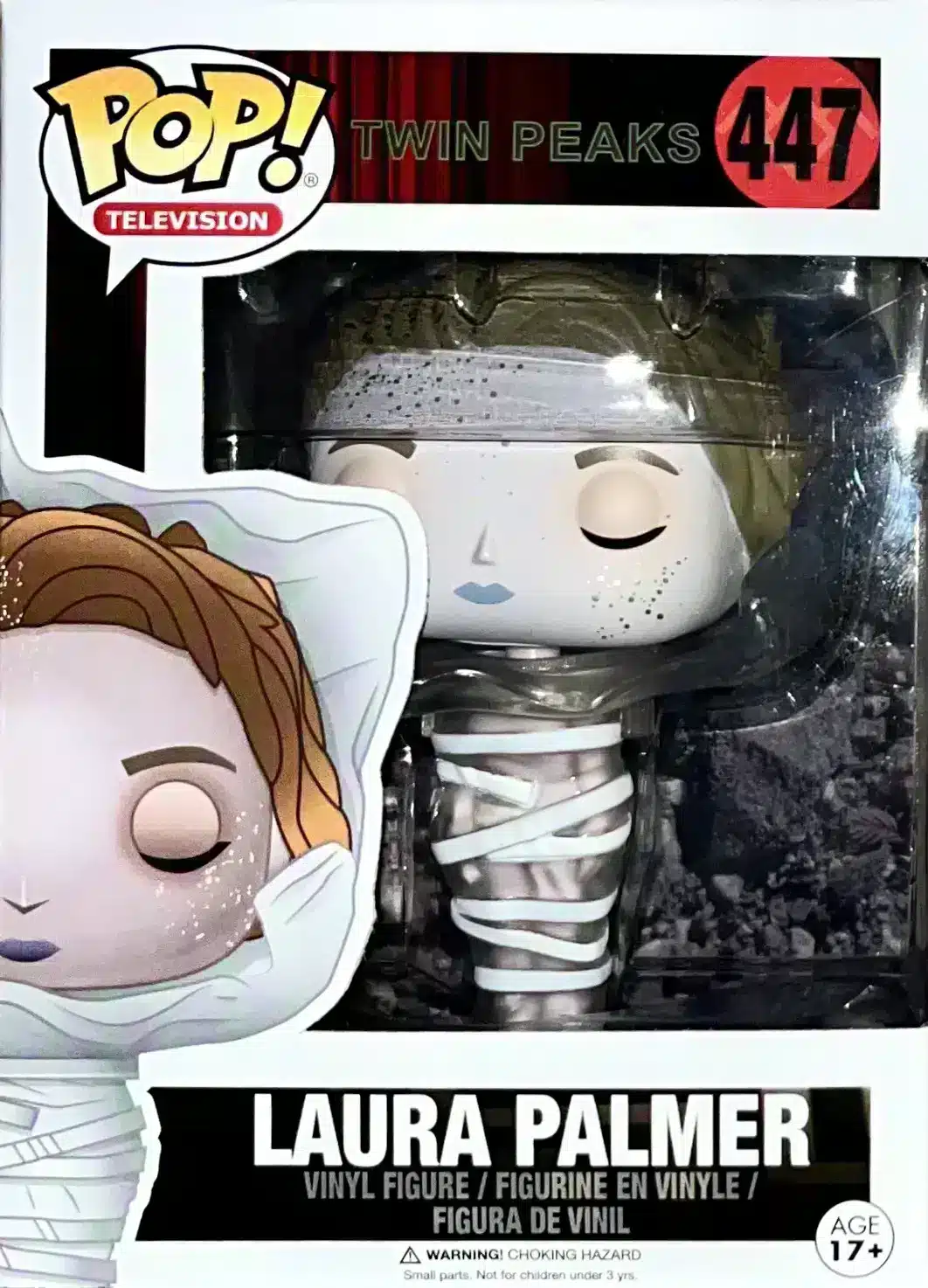
Twin Peaks began with the discovery of Laura Palmer, “dead… wrapped in plastic.” Laura was the archetypal “pretty dead girl”, a fixture of literature and pop culture. As Edgar Allen Poe noted, “the death […] of a beautiful woman is unquestionably the most poetical topic in the world.” It is certainly one of the most consistent and reliable. It is a marketable image, a saleable commodity. Surely enough, there is even a Funko Pop of Laura Palmer, dead and wrapped in plastic.
Television overflows with pretty dead girls. Prestige dramas spread the death of one pretty dead girl over eight to ten episodes. Episodic procedurals churn through dozens in a given season. Women denied any agency, reduced to limp forms and plot motivators, eternal sleeping beauties. Indeed, observers would point out that many of the women in these stories don’t even have to literally die to be reduced to inanimate plots to motivate (most often) male protagonists.
“I remember feeling disconcerted by the way Kim Novak’s character seems stranded between ghost and flesh, whereas Jimmy Stewart’s seems the ‘real,’ incarnate,” recalls Maggie Nelson of watching Alfred Hitchock’s Vertigo. “I wanted to ask my professor afterward whether women were somehow always already dead, or, conversely, had somehow not yet begun to exist, but I could not find a way to formulate this question without sounding, or without feeling, more or less insane.”
Vertigo was a major influence on Lynch, who arguably doubled down on Hitchcock by daring to ask “what if there was a blonde woman but also there was a brunette woman?” From the start of Twin Peaks, Lynch had been in conversation with the trope of the pretty dead girl, bringing actor Sheryl Lee back to the show to play Laura’s cousin Maddie, who was also murdered by Leland. Fire Walk With Me follows that idea to its conclusion. It gives Lee a starring role and foregrounds Laura.
Twin Peaks is built around the death of Laura Palmer, treating her murder as a plot device. Lynch famously vowed to “never solve the mystery” of Laura’s death, which would have denied the character any closure, even postmortem. As such, it is a bold voice to give Laura focus in Fire Walk With Me, to turn her from object to subject, from prop to person. The pretty dead girl is allowed to live. Indeed, in the film’s final moments, Lynch even allows her a moment of grace.
There is some implication of both the audience and the creator here. The mysterious supernatural entities in Fire Walk With Me are largely spectators, feeding on the “garmonbozia” created by Leland’s abuse of Laura, which the subtitles helpfully translate as “(pain and sorrow).” There are repeated shows of mouths and throats, a grizzle expression of the idea of consumption. Why do audiences eat up these stories of pain and trauma? Why are audiences so hungry for the suffering of these young women?
It's a question that recurs throughout Lynch’s filmography, most obviously in Jeffrey’s (Kyle MacLachlan) - and implicitly Lynch’s - voyeurism in Blue Velvet and in the story that seems to trap Nikki (Laura Dern) in Inland Empire. However, it’s never phrased quite as aggressively as in Fire Walk With Me. More than three decades after it was originally released, Fire Walk With Me still burns bright and hot.
Comments
I'm due to watch it again, lost count of the number of times now 🥰
RubySpook
2025-01-28 22:42:58 +0000 UTCThank you!
Darren Mooney
2025-01-28 22:42:05 +0000 UTCIt has really stayed with me, in a very visceral way.
Darren Mooney
2025-01-28 22:41:54 +0000 UTCThere's no horror film out there which as much love for its world and characters as FWWM and that's why I've always felt Lynch was so much better than his peers. Where others would veer into misery porn (cough Von Trier), Lynch portrays horrific things with sincerity and empathy. Great write up!
hairyson94
2025-01-27 11:28:35 +0000 UTCI'm still amazed at the response the film received when it first came out... to the AuDHD 15yo I was at the time, it actually made sense that it had a completely different tone even though metaphors and imagery were more difficult for me lol and I for one loved seeing Mr Lynch unleashed 🖤🖤🍾
RubySpook
2025-01-27 01:13:19 +0000 UTCOh yeah, as the piece points out, figures from the other place do intersect with the characters in "Fire Walk With Me", most memorably Mike. They do exit. But I think that the supernatural world of "Fire Walk With Me" does feel more remote than it did in the original "Twin Peaks" or "The Return", and much more mediated - separate by media imagery; television static and paintings on top of the stage curtains from the show and so on.
Darren Mooney
2025-01-26 23:50:18 +0000 UTCThank you!
Darren Mooney
2025-01-26 23:47:53 +0000 UTCYep. That said, I wonder how "Fire Walk With me" would have watched for somebody who hadn't watched "Twin Peaks." I wonder if that might have been where Tarantino was coming from - Lynch making a monument to his own show that might have been difficult to understand for an outsider. (And I think Tarantino is on record being sniffy about pre-prestige era contemporary television, at least historically.)
Darren Mooney
2025-01-26 23:47:45 +0000 UTCNot sure where Tarantino is coming from because Fire Walk With Me is probably one of Lynch's less abstract movies (minus the FBI scenes). It's very unambiguous what this movie is about. It's also somewhat lessened by being a Twin Peaks movie as at certain points needs to pivot sharply to stay in the continuity (e.g. having to show Bobby kill some rando and dispose of the body). I'd also argue that the Return is more a continuation of Fire Walk With Me than the original series.
Michael McCarthy
2025-01-26 23:00:31 +0000 UTCThanks again, Darren. 🥲☮️
Bryan Cybershaman(X) Logie
2025-01-26 22:29:21 +0000 UTCI wonder what critics and fans of Twin Peaks thought of the reveal of Leland at the time of the show's initial broadcast, as well as the direction it went in after Lynch's departure. Also, just as a note, I wouldn't imagine Fire Walk With Me would take the stance that Bob wasn't real or was a figment of Laura's damaged psyche. Lynch's works are usually very spiritual in nature and an evil spirit compelling others to commit unspeakable acts upon good people isn't really outside of his wheelhouse. Leland was similarly horrified by what he did when Bob left his body just before his death in Season 2 and a lot of The Return's tone was (according to Lynch himself) about an undercurrent of darkness throughout society and the fight between good and evil always taking place. Which is why criminality and violence is so close to the surface of normal society in the Return as well as the commonality of brutal acts of violence in the show, like the car accident with the child and that one civilian using a machine pistol to shoot up a van with the two assassins after a minor car accident
Ryallen
2025-01-26 17:22:08 +0000 UTC