![[Asuna Bunny wip 2] Halo making Process](https://img5.xaiju.com/storage/8/zy/ay/d38796-019e8e83-ea0a-7322-b335-1639d550761e.jpg)
This time, I would like to summarize making Halo. To be honest, I think it would be better to make a more accurate Halo by simply 3D modeling it and using a 3D printer with clear resin, so I think it would be better for those who can do that.
However, I currently do not have a 3D printer, so I maked it in analog.

The freehanded design has some distortions, but even a certain degree of accuracy is not a problem.
I don't know how to make these parts with even higher precision, so I made them in a way that I don't care what it takes as long as I can make them. The following is a textual description of the process.
1. Using a circle cutter, cut out the pla plate as a hollowed-out circle of the appropriate size.
2. Paste Sculpey, shape it, peel it off, and bake it in a toaster (to make a prototype).
3.Mold making with Oyumaru
4.Pour UV resin for crafts into the Oyumaru mold.
5.Cure with UV light and remove from the Oyumaru mold.
6.Polish and shape
I guess it's not that easy...
I hope you will read it as a memorandum.
The pla plate is cut out using a circle cutter from a 100-yen store. Since you are not going to bake these directly, you can use the same size as you want to make them. It may be easier to use white than clear.

Make a cut to the width of the size you want to make. The more even the width, the less time you will have to spend polishing and shaping.
If you are using Shadow hobby's circle cutter, you can use the special acrylic jig to make a circle of even width. But I didn't use it, so it took me a long time...
By the way, please note that similar Shadow hobby circle cutters do not come with a jig.

Hollow this out.

Once this is done, placed sculpey on each rings.

Super appropriate is fine.

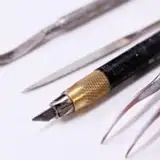
Once one round is completed, shape it and scrape off the unwanted parts with a knife.

Once the shape and thickness are set, remove the plastic plate.

Since it can be duplicated and then polished, a rough shape like this is OK.

Once this is done, bake in a toaster!

Sculpey is difficult to adjust the time because it becomes overcooked and charred just by leaving it for 5 minutes.

This is then evened out by sanding.

Polishing inside and out.

I think this is enough. This is the end of prototype making using Sculpey. It is troublesome to use Epo Putty, but Sculpey is good for this kind of work.

Press the prototype into an oyumaru warmed in a toaster to make a mold.

Oyumaru softened by heat will take time to cool down, so once the prototype is buried, it is quickly cooled by soaking it in water.

After molding, pour UV resin into the paint dish. Warm the resin with an embossing heater to break up any air bubbles.
If you pour UV resin as it is, air bubbles will easily enter the Oyumaru, and if you heat it with an embossing heater, the Oyumaru will soften and lose its shape.
So it is quicker to squash the air bubbles beforehand.

After pouring into the mold, cure with a pen-type UV light.

Most pen-type UV lights seem to use LEDs with a power of about 9W, so they cure quickly after just a little irradiation. However, if irradiated too much, the light will turn yellow, so you will need to get used to it.

Harvested parts. Unnecessary parts are removed and polished.


Polish until it reaches this level.

It is difficult to get a three-dimensional effect by simply cutting a pla plate into a circular shape, but UV clear resin can be used to give a certain degree of three-dimensionality.

This is what it looks like when you polish all of them. If I can do this much freehand, I think I did a good job...maybe
The smallest ring has a concave side, but I want to work with as much precision as possible, so we use a square file.

First, write the guide in a cross.

Use a reuter to shave a little off the guide portion.

Then, the shape is carefully shaved with a corner file.


After about two places have been shaved, it becomes softly and distorted, making it difficult to shave, so it is a good idea to place a metal ruler on the back surface to prevent it from moving.

When all four sides are shaved, this is the result.

At any rate, the halo itself was maked.

After this, I will use UV resin to make the support columns in the same way, but now that I think about it, I should have used Sculpey to make the prototype for the columns as well.
First, position the rings with masking tape so that they are evenly spaced.

Make a stick of appropriate length with UV resin.

Try this against the ring secured with masking tape and lightly position it.

With this stick, the width is too long. So, cut it in half vertically, and then make a groove with a square slit to grip the ring.
So you can make three of these parts.

I want to use them as supports, so I will glue them one by one with UV resin.

Don't worry about the shape as long as only the orientation and position of the supports are aligned, because the shape will be adjusted later.

This is about the size of a small piece of resin. All that is left to do is to polish it, cut off unnecessary parts, and add more UV resin to the missing parts.

It is okay if it is trimmed down to this level. If you make it thinner than this, it will be distorted and the rings will easily fall off.

Then drill a hole in the back of the head and install the Halo.
If it is enough to compromise by checking it from various angles, it is considered complete.


That's all.
It looks easy, but it was a time-consuming process. This is the kind of work that I feel is really hard to do with analog prototypes...
That's enough about detailing and polishing.
The next step is the painting process.
If you have any questions about painting, please write them in the comments section of this article and I will reflect them in the next update!
Ashley Lau
2022-05-30 16:15:08 +0000 UTCSUKIMA SANGYO
2022-05-30 02:29:53 +0000 UTCSUKIMA SANGYO
2022-05-30 02:23:33 +0000 UTCSUKIMA SANGYO
2022-05-30 02:19:21 +0000 UTCCeylonix
2022-05-30 01:04:17 +0000 UTCAshley Lau
2022-05-29 15:17:46 +0000 UTCPDubs
2022-05-29 09:23:09 +0000 UTC