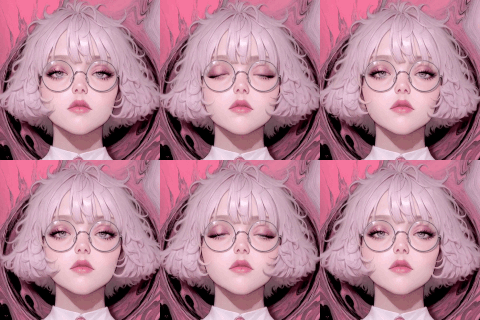
Midjourney is a hot topic, so I'll jump on board.
First off.
I have never used it.
(I thought about using Midjourney, but decided not to because of the hassle of the procedure. )
I don't have any expertise in AI, and the information I know about AI is probably the same as that of the general public.
Therefore, the following is my own theory.
I hope you will think that I think so on my own.
(In addition, I am just writing what I think, so the sentences are unconnected...)
I hope you will read this with these assumptions in mind.
First, I think the main topic of conversation is whether AI will take the jobs of creators in the future.
No matter how much AI production improves
I don't think this is a serious issue.
How will its market participation and diffusion affect the market?
I think it is more accurate to ask economic experts and companies about this than to ask artists, science fiction writers, and technologists.
Let's consider other impacts from the characteristics of AI.
Assume that the production of AI is completed.
If individuals can easily create it for free.
As an illustration, individuals will be able to get exactly what they want for free.
This would have a considerable impact.
However, there is little likelihood that it will be identical to something originally produced by an existing artist.
This lack of potential for sameness is due to more complex factors, such as, for example, the scenario in a comic book.
Let us leave aside which is more interesting or more complete.
It is quite possible that current events or influences from the writer's personal life can strongly influence the scenario.
Therefore, it is impossible to give the AI the same information that the writer is getting.
(Subjectivity of information cannot be input by others).
Therefore, we can conclude that there is no perfect identity.
The reason I am being somewhat subtle about it is more or less
because the artists themselves are producing in an AI-like manner.
If it is commercial, even more so.
First, let me explain how I think of AI production.
(The following is too long, so please skim it as you see fit...)
As far as a quick glance at the information.
AI does not currently recognize humans.
It could be described as overdone impressionism.
It is only color, shape, and reconstruction from the information that accompanies them.
The human being has a skeleton, muscles that cover it, and skin on top of that.
We have been adapting culturally influenced clothing to the times...not a perception.
The reason why it is now at a level that is worth seeing (I didn't notice the AI at first) is that the accumulation of image information for learning has become overwhelming.
The overwhelming accumulation of image information to be learned, the ability to recognize information about a part from an image enough to mask the above problems, and the
The ability to recognize parts of information from an image that can mask the above problems, and
In other words, the ability to separate the components of the entire screen (separating the character from the background in an illustration, separating the human body from the clothing in a character, etc.)
And then, the ability to combine this separated information with names, attributes, and information on how people perceive the image (cute, sparkling, etc.).
(I don't know how it was made, so...) These things are now possible by using the Internet. (I think the net is more effective than databases because of the vast amount of information it contains. I think it is both.)
In addition to the accumulation and analysis of this information
I believe that there is considerable progress in the reconstruction of information by information.
In this regard, DeepL translations are quite colloquial translations, intentional translations, and
It is not only the accuracy of the meaning and linguistic structure that is being translated, but also the directionality of the translation.
It is not only about the accuracy of meaning and linguistic structure, but also about reproducing the everyday groove of the language.
It is more human-like and accurate to incorporate such non-verbal reproduction into AI.
I think there is a trend that it is more human-like and accurate to incorporate such non-verbal reproduction into AI.
Of course, I don't know the fads of engineers, so I can only speculate based on news reports and the like.
I myself believe that this trend will lead to more accuracy.
By the way, as far as Midjourney's use case is concerned
I think you will find similarities between Midjourney and machine translation.
The inaccuracy of translation of colloquial words (including abbreviations and slang), and
The accuracy of logical sentences (papers are very accurate).
The difficulty of reproducing the non-verbal nature of the above can be seen in Midjourney.
I guess you could say that poetic conversation is hard to reproduce accuracy.
However, I think there are many differences in the results because of the different purposes of AI.
Midjourney seems to be more accurate in a list of sentences, but a translation AI may either translate the sentence directly or try to make it colloquial and make the meaning unclear.
or it tries to make it colloquial, and the result will be unintelligible.
Also, sentences with unclear meanings by AI are generally not evaluated, but in the case of paintings, they are evaluated as unexpected.
This is how I perceive AI for now.
I think the difference between AI and humans is most obvious in the recognition of object information.
It is said that if you draw three dots and enclose them with zeros, humans can recognize a face.
This is not the case with AI recognition.
For the current AI to do that, it needs to connect the image "three dots and a zero" with the information
It is necessary to recognize that not all "three dots and a zero" is a human face. It is not a matter of whether or not it can be done as a result.
A human recognizes three dots as a central element of facial composition above its details, but
the difference is that to an AI, the three points are only one component of the image.
What difference does this difference make?
This simple recognition by the human makes possible symbolic expressions such as cartoons.
On the other hand, AI cannot create symbolic expressions because it sees the components of an image as flat. (Current expressions as reconstructions of already existing symbolic expressions)
In fact, the images in Midjourney do not depict faces, or
The fact that we can see parts of the image that have achieved fusion with other elements
These problems can be seen to persist.
For example, if we look at the details of other Midjourney robots
We can see that they are machine-like reconstructions of image-like machine-like objects, rather than constructs of machine parts. This suggests that the concept of machine in AI exists only as a synthesis of these image-like elements.
Midranger has not succeeded in reconstructing a face or human body, but
As an AI, I think it is an amazing feat.
I think this is another way to squash the problems.
These problems have not been overcome, though.
This is a major problem with the evaluation points of the face and human body.
I expect that faces will not be completely deconstructed, but will be classified as faces and represented in the form of composites or modifications rather than restorations.
Or, the faces are by means of not being depicted at all.
Or the human program is not only reconstructing the above information.
Maybe they are programmed separately about the face and the human body. ...................... What a thought!
From the way I feel when I am painting.
If I pursue the beauty of the human body, I deviate from the human body and become cubist.
I feel that if I don't set the limit of the human body, I will go in a direction that deviates from the human body.
I did mention that this is a difference between humans and
Humans tend to be less cognizant of non-humans.
The problem of the detail of the robot I used as an example above
I have often derived this problem from my own drawings (sweat).
Without knowledge and experience, such as having seen it often, it would be difficult to recognize the details of a robot.
I think it is easy for human beings to understand the object, although they don't fuse it with the background.
We easily disregard physical phenomena and other scientific components. The visual image precedes the understanding of their existence.
(For example, a person who knows a lion does not know the anatomy or biology of the lion. That is not to say that they cannot recognize a lion, but if they draw a picture of it, they will not be able to reproduce it because they have no knowledge of it. (This phenomenon happens to me a lot.)
While there are differences, there are also similar elements that are
I am in the position of not distinguishing between AI, or machines, and humans (and animals).
Now, let's return to the subject of AI-like production by the artists themselves....
The AI-like element of human beings is based on the accumulation and analysis of information
The act of reconstructing them... is the same as our act of learning.
I would think that this act of output from what has been learned would be analogous to AI.
This also means that identical learning produces identical (tendentious) output.
I mentioned earlier that commerciality increases similarity.
Commerciality is often deployed using (commercial) models.
(I am not saying that what sells is highly commercial, but rather that what is produced in an attempt to sell is the act of building and producing a model.)
This model is naturally based on the best-selling products, so the amount of information is overwhelming (due to the flood of products).
Inevitably, it is easier to incorporate into AI training, and since the model exists
We believe that the analysis will also be more accurate. When we think of a royal development, or a
or death flags, it shows that the model exists.
Output based on these learnings is likely to catch up with AI
In some cases, they may even be overtaken.
Since the mechanical technical aspects have already been overtaken (which is natural since it is a reconstruction of what is already there), it is even more so if it is highly complete = faithful to the model.
On the other hand, I doubt that many people are creating just for that reason.
Because individuality does exist in AIs (whether it's a learning bias or a programmatic one).
I've heard some say that individuality is no longer the difference between humans...
However, as I mentioned earlier, the emergence of AI has only increased the number of creators, and I don't think it has anything to do with the individuality of each creator.
Even if AI is able to draw the same picture as me
The picture I will draw tomorrow
If there is a perfect copy of me
Just as there is no possibility that a perfect copy of me would paint the same picture as I do.
(since it is all dependent on my mood at the time)
I, AI, and the copy will all paint different pictures.
So I think that individuality is only a matter of the picture, not the individual work.
However, I think it is better to attribute this issue to copyright issues.
(not about individuality or personality, but about practical use), so I'll leave it out.
Also, in the formation of individuality
I think the diversity of output (including failures and lack of skills) has a lot to do with the formation of individuality.
I still don't feel that people can be replaced. The tendency of output is not that many creators have the skill to draw everything perfectly (they don't, do they?)
but because there are aspects of the direction of expression that are determined according to what they can draw.
I am not saying that all creators are like that, but I think a lot of them are.
In the event that it is actually replaced, social and economic factors will be the more decisive factor.
Companies may say they only hire AI because they don't want to pay for it.
We often see things like Midjourney's genius idea.
If anything, this is a problem for the evaluator, not the AI's ability.
The wacky ideas are not due to imagination, but simple combinations that lose their meaning (the AI is not picking them for aesthetics, it's picking them for the right reasons).
And it is more correct to assume that the person who chooses them and posts them online has good taste.
The combination itself can be done by anyone, even in a roundabout way.
I myself sometimes think of stories in that way.
(I often do a compilation of yuri...)
On the other hand, the combination of elements that have lost the meaning of AI may be one of the conditions for genius.
It may be one of the conditions of genius. Destruction of generality.
Genius is AI-like. (Not in a derogatory sense).
In order for a combination to appear complete as a work of art, the images must be integrated to some degree (both visually and technically).
I think Midjourney is well integrated by visual imagery (oil painting style, cartoon style, 80's style, etc.).
I often make mistakes, and this is perhaps the most difficult part of production.
I think the AI will eventually settle into an ancillary role, such as putting out a story, letting it build the basics, and then revising it later on its own.
This is not so much a prediction, though, as it depends largely on company trends.
This is my personal opinion, including my own personality.
I personally would like to seek AI's help in areas that I consider a pain in the ass and
I would like to ask for AI's help with ideas.
If I can decide what ideas are useful and what are not, even if it's bullshit, it's useful enough.
I can decide if they are useful or not. You can roll the dice if you want.
All you need is a condition that you don't have.
It does not matter whether the other person understands the meaning or not.
You can add the necessary meaning later on your own, and it doesn't matter if you can't add it.
If you can't add the necessary meaning, it means that the idea is not attractive to you, and you will lose it.
I would expect much more specific and detailed ideas (including patterns and touches) than dice.
I usually think about it without any context....
I am a little frustrated that I am not able to make use of them in my creations.
When I'm thinking about science fiction stories, I think it's useful.
On the other hand, I am too concerned about it and can't write anything... (sweat)
Well, it's okay, because thinking about it is like a hobby for me.
I have mentioned the difference between AI and humans, but I do not consider this to be an essential difference between the two.
How do humans perceive it? The difference is that we have not yet fully analyzed how humans perceive the world, and this has not been reflected in the design of the AI.
I believe that technical differences with humans, such as speed of output, are essential differences. If AI is to rise to prominence, this will be the decisive factor.
However, as long as expression is evaluated by humans and the correct answer is the same as human expression, there is little possibility that the content of expression will be (or be made) better than human expression. It is enough to cite the example that Van Gogh sold only one piece before his death to show that it is not only a matter of the painter.