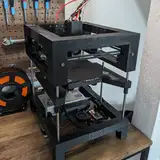
Always use proper Filament!!!
Added 2025-01-21 18:02:01 +0000 UTCAbout a week ago, I calibrated my T250 to a level where I felt confident fine-tuning a quality profile for it. I began my initial prints and noticed a fuzzy orange skin effect along the outer perimeter of all the prints:

My initial hypothesis was that the issue was related to VFA. I knew that low inductance motors tend to exhibit stronger VFA, and since the hysteresis settings I’m currently using are quite aggressive, I experimented with finding sweet spots that would reduce the vibration of my motors. Additionally, I printed a VFA test pattern at speeds ranging from 200 mm/s to 800 mm/s to determine if certain speeds resulted in fewer VFAs. The results clearly show that the optimal range for my outer perimeters is between 320 mm/s and 400 mm/s, which I have identified as the sweet spot.

I went on an in-depth investigation to determine the root cause of that error, examining every component:
1. Motor Alignment: First, I double-checked that all motors were properly aligned—ensuring there were no bent shafts or misaligned pulleys.
2. Linear Bearings and Rods: Next, I suspected that a faulty linear bearing or rod might be causing vibrations. To test this, I pushed my printer to its limits, which seemed plausible. I replaced the rods and the LM8UU linear bearings on both axes, but the fuzzy orange skin issue persisted.
3. Z-Axis Enhancements: Although I wasn't convinced the problem was related to the Z-axis, I installed Oldham couplers on the Z-axis as an additional precaution. Unfortunately, there was still no improvement.
4. Toolhead Modification: Frustrated, I removed the entire toolhead and installed my prototype Bowden toolhead, suspecting potential flaws in my extruder design. However, even with the Bowden setup, the fuzzy skin remained.
After four frustrating days of troubleshooting, Volgger gave me a tip that I initially thought was pretty dumb. But desperate for a solution, I decided to give his advice a shot—and it worked. I just switched the filament.
Here’s a comparison:


Both hulls were printed at 360 mm/s with an acceleration of 70,000 mm/s², and the results were like night and day! Interestingly, the white hull was printed using high-speed PLA that I received as a gift from a reputable brand—a 1 kg spool costs €35. In contrast, the filament on the right is my go-to AE filament, priced at €8 per spool (or €5–€6 when on sale).
Lesson learned: Avoid using high-quality filament for tuning!
Comments
So true. And sometimes the symptoms overlap - I recently had an issue where it looked like under extrusion and/or zed offset issues - but it turned out to be flow. And the only way I found that out is the same way - someone on a forum forced me to re-look at flow despite tuning it twice. I also thought it was silly, but he was right - flow was too high. Perfect prints after knocking it down quite a bit.
Daniel San Pedro
2025-01-23 14:14:43 +0000 UTCNow this really peaks my interest. Ive also had similar issues where I adjusted every variable except the filament and found it was simply the filament. I never questioned it because it was a quality brand. This is the biggest frustration in 3D printing, there are so many variables, especially when trying to tune to perfection, that you can get lost.
SimplyElectronics
2025-01-21 18:38:25 +0000 UTC